
Shiso in a pot: what the sources say
| Question | Answer | Source |
|---|---|---|
| Life cycle | Annual | NC State Extension, RHS |
| Light | Full sun to partial shade | NC State Extension, RHS |
| Soil | Fertile, moist but well drained | RHS |
| Height | Up to 3 ft tall and 1.5 ft wide (NC State); 0.1-0.5 m (RHS, var. crispa) | NC State Extension, RHS |
| Harvest cut | Annual herbs: 50-75 percent can be removed | University of Illinois Extension |
| Flowering trigger | Long nights (short-day plant) | Frontiers in Plant Science, 2023 |
| Spread | Self-seeds prolifically; pinch flowers | NC State Extension |
Shiso grows well in a pot if you start it from seed, give it sun or part shade, pinch it while it is young and cut the flower spikes before they set seed. It is an annual, so the pot starts over every year unless you let it drop seed. That seed is the main thing to manage.
Shiso (also called perilla) is a member of the mint family. NC State Extension describes it as an annual native to the Himalayas and Southeast Asia, and the RHS agrees. If you are weighing seed against a nursery plant, the seed or plants decision guide covers the trade-offs. For shiso the RHS lists propagation by seed, and that is the route most growers take.
Pick the right shiso
Two types are sold under the name. NC State Extension separates the plain species from var. crispa, the type called shiso, with more deeply toothed leaves and a different flavor. Green and purple forms exist in both. The label on the packet should say perilla or shiso and name the colour, so check it before you buy, because the leaves differ in look and flavor.
Sowing and starting
Follow the depth and timing on the packet for your variety. Three points are worth settling first.
Set young plants outside only after the last frost. The RHS says nights should generally stay above 7 °C before you plant out tender plants, and the frost date guide for balconies shows how to find your own date.
Bright light helps seedlings, but not blazing sun on a young tray. A 2022 trial at Fluminense Federal University, published in Revista de Agricultura, grew purple and green shiso under 70 percent shade and in full sun. Germination stabilized 15 days after sowing, the Fluminense Federal University authors report, and in the shaded treatment there were 84 germinations of the purple variety and 34 of the green. In full sun germination was much lower, and the seedlings did not stay viable long enough to measure. That is a trial on seed trays, not a rule for a balcony, but it suggests keeping a new sowing bright and out of hot midday glare until the seedlings have leaves.
Thin to the strongest seedlings once they have a few true leaves. NC State Extension says a plant can reach 3 feet tall and 1.5 feet wide in open ground, while the RHS gives 0.1 to 0.5 metres for var. crispa. The two figures differ widely, so give each plant room and start with one or two per pot.
Light, water and feeding
The RHS recommends fertile, moist but well-drained soil in sun or partial shade. NC State Extension says full sun to partial shade, and calls the plant very resistant to heat and drought. A balcony with morning sun and shade from the hottest afternoon hours suits it. Check the herb sunlight chart if you are placing it next to other herbs.
For water, use the test Iowa State Extension gives for any container: water when the mix is dry at a depth of 1 to 2 inches. Pots dry fast in wind and heat, so a pot on a sunny railing needs checking more often than one against a wall. The herb watering chart shows which pot in a mixed group to test first.
Pinching for a bushy plant
A shiso left alone grows tall. Pinch the growing tips when the plant has a few sets of leaves, cutting just above a pair of leaves so the plant branches from below the cut. Penn State Extension’s basil routine is a good model: pinch above the second set of leaves once the seedling has six leaves, then repeat on any branch with six to eight leaves. Shiso is a different plant from basil, so treat that as a pattern to follow rather than a shiso-specific rule. The guide to pruning basil, mint, parsley and chives shows where to cut.
Shiso is an annual, and the University of Illinois Extension says annual herbs can be cut back 50-75 percent and still recover. So you can harvest hard while the plant is growing. Harvesting the tips is also pinching, which is why a regularly picked plant stays compact. The harvesting guide covers the technique across herbs.
The RHS says no pruning is required for curly perilla. That describes it as an ornamental bedding plant; for a kitchen herb, pinching is what keeps the leaves coming.
Why it flowers, and when
Shiso is a short-day plant. A 2023 paper in Frontiers in Plant Science says flowering occurs only when day length does not exceed a critical day length, that perilla becomes photosensitive at the fourth leaf pair stage, and that long nights tend to induce flowering. The same paper notes that Korean farms usually illuminate their greenhouses to delay flowering so they can harvest leaves into the fall.
For a pot, the practical point is timing. Flower spikes arrive as nights lengthen, late in the season, and the plant puts less into new leaves. Pick generously through summer, and pinch the first flower spikes as they show.
Self-seeding, and keeping it in the pot
NC State Extension says shiso’s seeds are wind-dispersed, that left alone it will self-seed prolifically, and that pinching off the flowers before they go to seed helps slow the spread. It classes the species as invasive in North Carolina, and says it is listed as invasive in Virginia, West Virginia, Tennessee and Kentucky. NC State also notes that the plant can be toxic to cattle, which matters if you live next to grazing land.
A pot does not stop wind-borne seed from leaving it. If you live in or near those states, cut spikes before the seed ripens. If you want volunteers next spring, leave one spike on one plant and pull the extra seedlings. If you do not, cut every spike.
What to do with the leaves
Pick young leaves as you need them. The harvest calendar gives timing for other herbs, and sowing a second pot partway through the season, as in the succession planting guide, gives you fresh young plants when the first one flowers.
Sources
- NC State Extension Gardener Plant Toolbox: Perilla frutescens (beefsteak plant)
- RHS: Perilla frutescens var. crispa (curly perilla)
- Marques et al. (2022), Different lighting conditions affect the germination and seedling development of two varieties of shiso, Revista de Agricultura
- Frontiers in Plant Science (2023): Genome-edited HEADING DATE 3a knockout enhances leaf production in Perilla frutescens
- University of Illinois Extension: Harvesting herbs
- Penn State Extension: Basil, a summer favorite
- Iowa State University Extension: How to care for plants growing in containers
- RHS: When to plant out tender plants to avoid late frosts
Herbs in pots
Start herbs from seed, prune them for regrowth and keep a mixed collection watered.
Common questions
How do you grow shiso in a pot?
Start it from seed, set it in a pot of fertile, moist but well-drained mix in sun or part shade (RHS), and pinch the growing tips early so it branches. Keep the top inch or two of mix from drying out and pinch off flower spikes when they appear.
Does shiso come back every year?
No. NC State Extension and the RHS both describe it as an annual. It replaces itself only through seed, which is why spent flower spikes matter.
How do I stop shiso self-seeding?
NC State Extension says pinching off the flowers before they go to seed helps slow the spread of its wind-dispersed seeds. In a pot, cut spikes as soon as they form, or remove the whole pot before the seed ripens.
When does shiso flower?
It is a short-day plant, so flowering is triggered as nights get longer. A 2023 paper in Frontiers in Plant Science says perilla becomes photosensitive at the fourth leaf pair stage and that long nights tend to induce flowering. In practice that means flower spikes in late summer and autumn.
Related guides
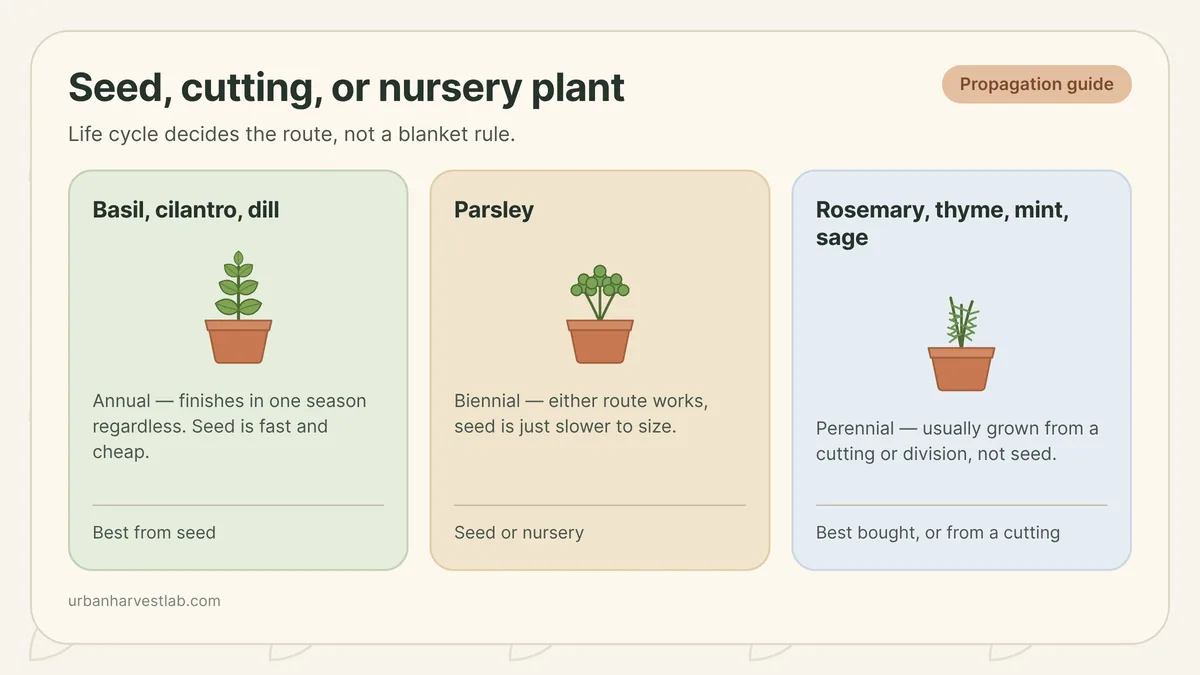
Herbs from seed or buying plants: how to decide
Some herbs finish a whole life cycle from seed in a matter of weeks; others are slow, woody, or simply propagated a different way. The life cycle of the herb, not a blanket rule, is what actually decides which route makes sense.
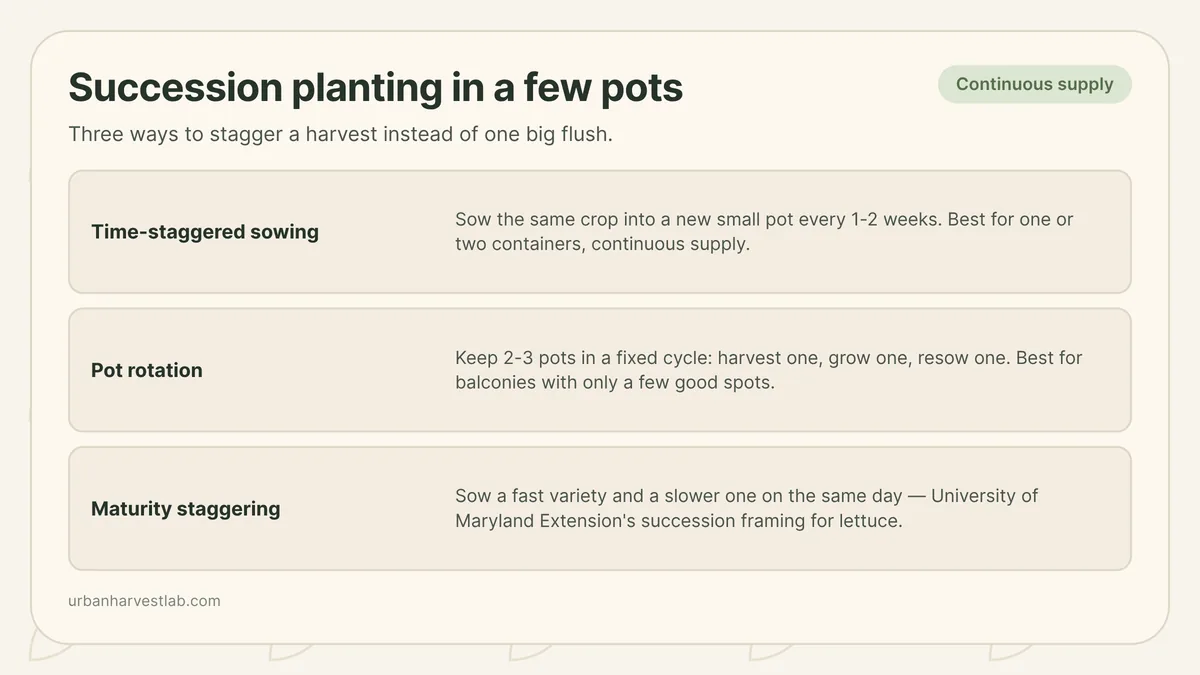
Succession planting in containers: how to stagger a harvest from a few pots
Succession planting in containers is a sowing rhythm: a few pots restarted on a schedule keep producing, where one large planting ripens together and then quits together.
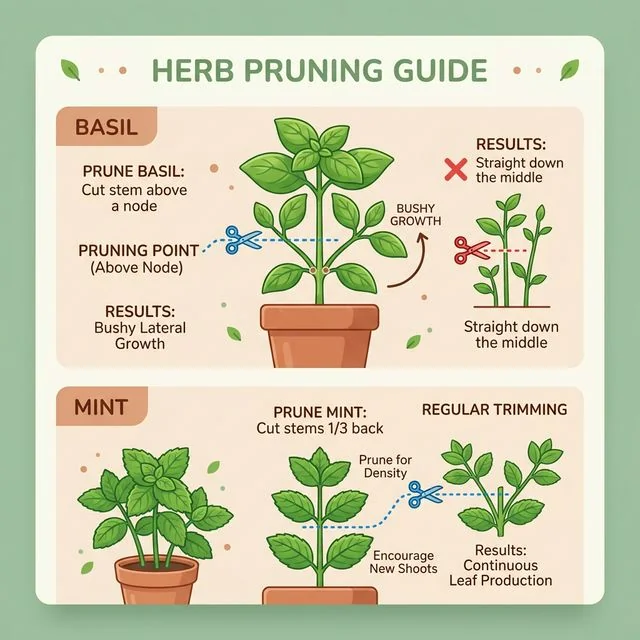
How to prune basil, mint, parsley, and chives without stunting growth
Basil and mint should be cut above a node, parsley should be harvested from the outer stems, and chives should be cut like a small patch of grass.