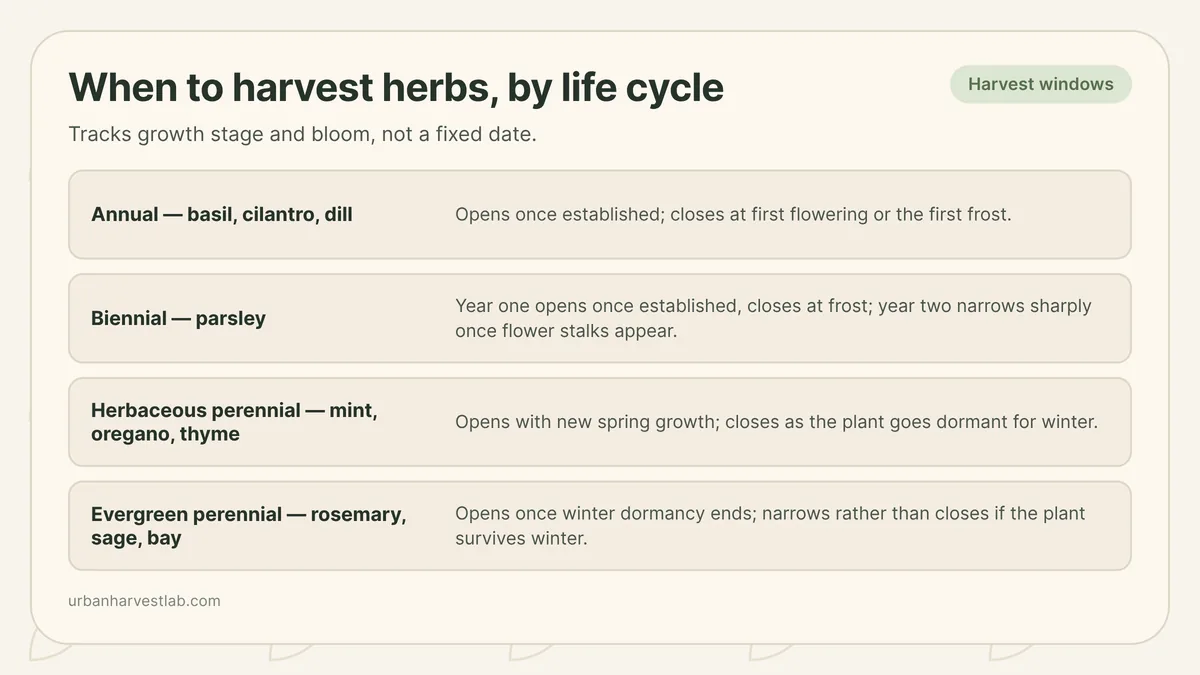
Herb harvest windows by life cycle
| Life cycle | Herbs | Window opens | Window closes |
|---|---|---|---|
| Annual | Basil, cilantro, dill, borage, marjoram | Once the plant is established, with foliage to spare | At first flowering or the first frost, whichever comes first |
| Biennial | Parsley (fennel is either biennial or perennial) | Year one, once established; year two, early in the season | Year one at frost; year two narrows sharply once flower stalks appear |
| Herbaceous perennial | Chives, mint, oregano, thyme, catnip | With new spring growth | As the plant goes dormant for winter |
| Evergreen or tender perennial | Rosemary, sage, bay, lemongrass | Once winter dormancy ends and new growth resumes | Narrows rather than closes, if the plant survives winter |
Herb harvest timing tracks the plant’s life cycle, not a date on the kitchen calendar: an annual like basil gets harvested hard until frost kills it, a biennial like parsley gets two years with a shrinking window in the second, and a perennial like rosemary or thyme opens a fresh window every year it survives winter. Across all three groups, flavor and oil concentration peak right before the plant flowers, and mornings beat afternoons for cutting. Where exactly on the stem to cut, and how a plant regrows afterward, is a separate question, covered in how to harvest basil, mint, parsley, and chives so they keep growing — this is about when that cut should happen.
Why the window opens and closes at all
Clemson Cooperative Extension and the University of Georgia Extension both give the same underlying reason a harvest calendar exists in the first place: essential-oil concentration in herbs peaks “just prior to blooming.” Once a plant flowers, it is redirecting energy into seed production rather than leaf growth, and flavor drops accordingly. That single fact is what closes the window for every herb below, whether the closing event is a frost, a season change, or the plant simply blooming on its own schedule.
Penn State Extension makes the basil version of this explicit: the plant’s flavor “will be adversely affected” if it is allowed to flower, which is why pinching off flower buds the moment they appear is worth doing even outside a formal harvest — it buys the plant, and the cook, more weeks of good leaf.
The best time of day, whatever the season
Independent of life cycle, three extension sources converge on the same daily window. University of Illinois Extension recommends harvesting “early in the day after plants dry off and before it gets hot.” The National Center for Home Food Preservation gives nearly identical advice: harvest “in the early morning after the dew has evaporated.” Iowa State University Extension times it the same way — “when dew is off the plants.” Early morning, once the leaves have dried but before the day heats up, is the window all three describe; a damp evening or a scorching midday are the two times that come up nowhere in this guidance.
Annual herbs: harvest hard until frost
Clemson’s own classification groups basil, cilantro, dill, borage, and marjoram as annuals — plants that complete an entire life cycle in a single season regardless of how well they are cared for. There is no multi-year plan to protect; the goal is to take as much usable growth as possible before the plant flowers or the season ends, whichever happens first.
That changes how hard an annual can be cut compared with a woody perennial, and the two extension sources that measured it agree closely. University of Illinois Extension found that annual herbs like basil “can be cut back 50-75 percent and still recover, but with perennial herbs, remove about one-third of the growth at any one time.” Iowa State University Extension gives the same split in absolute terms: a perennial tolerates removing “no more than about one-third of the top growth at a time,” while an annual can be cut “back to within 4 to 6 inches of the ground.” For a mature basil plant in active growth, that second figure amounts to most of its visible foliage in one pass.
Practically, that means an annual’s harvest window is wide open through summer: take a large cutting, let the plant regrow, and repeat until it either bolts to flower or a frost ends the season outright. Losing track of your local frost timing is the easiest way to lose a late-season harvest to a surprise cold night — a working frost date, rather than a guess from the calendar, is covered in first and last frost dates for a balcony.
Biennial herbs: two years, and the second one is shorter
Parsley is Clemson’s one biennial example; fennel is grown as either biennial or perennial depending on the type planted. A biennial’s calendar has a structure an annual and a perennial both lack: it needs two full growing seasons to complete its life cycle, and the two years behave differently at harvest time.
In its first year, parsley behaves much like an annual for harvest purposes — established growth can be picked through the whole season, with the plant surviving into a second year rather than dying at season’s end. In its second year, the plant’s priority shifts toward flowering and seed, and once flower stalks appear the same rule applies as anywhere else: quality drops once the plant blooms. That makes a biennial’s second-year window shorter than its first, closing earlier in the season rather than running until frost the way a first-year plant, or a true annual, does.
Herbaceous perennials: the window reopens every spring
Clemson groups chives, mint, oregano, thyme, and catnip as herbaceous perennials — plants whose top growth dies back in winter while the roots survive to send up new growth the following spring. For this group, the harvest window is tied to that above-ground cycle rather than to flowering alone: it opens once new spring growth appears, runs through the active growing season, and closes as the plant goes dormant heading into winter.
The same one-third figure from Illinois Extension and Iowa State University Extension applies here on every cutting during the active season, rather than the harder cut an annual tolerates. Taking a third of the top growth at a time keeps a herbaceous perennial productive year after year without the plant needing to rebuild from nothing each spring.
Evergreen and tender perennials: a window that narrows, not one that closes
Rosemary and sage are Clemson’s perennial evergreen shrubs, with bay hardy to “around 0°F”; lemongrass is a tender perennial, hardy only in “USDA Zones 9-10.” Left outdoors somewhere their roots survive winter, these plants can keep foliage year-round, and the harvest window stays open in some form through winter rather than closing the way an annual’s does.
A potted specimen brought indoors for winter is a different case. University of Illinois Extension’s overwintering guidance for sage, rosemary, and bay describes a genuinely dormant stretch: a cool, bright spot in the 40-60°F range, watering “when the top inch of soil becomes dry,” and no fertilizer at all, because the plant is “not actively growing.” Harvest during that stretch is necessarily light — there is little new growth to spare — and the window widens again only once day temperatures are “over 60°F” and frost risk has passed, when the plant goes back outside and resumes active growth. The full sequence for bringing a potted rosemary or thyme through that stretch, including what to cut back before it goes dormant, is in how to overwinter rosemary and thyme in pots.
The RHS describes an outdoor alternative for a container left in place all winter: a spot “where they cannot be frozen, saturated by rain or allowed to become too dry,” such as “the rain shadow of walls, in a coldframe or even in an open fronted shed,” with the pot wrapped “in bubble polythene” only if a hard freeze is forecast — protected from freezing, saturation, and drying out, as an alternative to bringing the plant indoors rather than a better or worse one.
Matching a new herb to its window
For an herb newly planted this season, match it to its life cycle first — a seed packet or plant tag usually states annual, biennial, or perennial directly — then use that group’s opening and closing markers rather than a fixed month. A basil plant started in April and one started in June do not share a calendar date for their last good harvest, but they do share the same closing signal: flowering, or frost, whichever arrives first.
Once established, a broader season plan for the rest of a balcony’s crops, not just herbs, is covered in the balcony vegetable garden calendar, and general watering and feeding through that season is in potted herb care.
What to do with a harvest once it is timed right
Getting the timing right only matters if the herb survives past the cutting board. University of Georgia Extension puts frozen herbs at about three to six months before quality drops, which is the ceiling a well-timed harvest is actually buying against a herb that would otherwise wilt within a day of being cut. Fresh basil, cilantro, and other tender leaves wilt fast once cut; drying and freezing extend a well-timed harvest well past the day it was picked, and the methods and figures for each are in how to dry herbs at home and how to freeze herbs. If a perennial like rosemary or thyme looks leggy after a hard seasonal cutback, spring is also the easiest time to take cuttings and start a replacement plant, covered in how to regrow herbs from cuttings.
Common calendar mistakes
- Harvesting after flowering has already started, then wondering why the flavor is off.
- Applying one cutback percentage to every herb, instead of the sharper split between annuals and perennials.
- Treating an average frost date as fixed for a specific balcony rather than checking a local source.
- Expecting a dormant, indoor-overwintered perennial to keep producing at its summer pace.
- Ignoring that a biennial’s second year runs on a shorter clock than its first.
Sources
- Clemson Cooperative Extension HGIC: Herbs
- University of Georgia Extension Bulletin 1170: Herbs in Southern Gardens
- Penn State Extension: Basil, a Summer Favorite
- University of Illinois Extension: Harvesting (Herbs)
- Iowa State University Extension: Growing, Harvesting, and Drying Herbs
- University of Illinois Extension: Overwintering Tender Plants
- RHS: Growing Herbs in Containers
- National Center for Home Food Preservation: Drying Herbs
Harvest technique and preservation next
Once the timing is set, these cover exactly how to cut without stunting the plant, and what to do with what you pick.
Common questions
When is the best time of day to harvest herbs?
Early morning, once dew has evaporated but before the day heats up, is the window extension sources agree on. Illinois Extension recommends harvesting after plants dry off and before it gets hot, and the National Center for Home Food Preservation gives the same advice: early morning, once the dew is gone.
When should I stop harvesting basil each year?
Basil is an annual, so its window closes for good once flowering starts or the first frost kills the plant, whichever comes first. Penn State Extension notes that basil's flavor is adversely affected once the plant is allowed to flower, so pinching off buds as soon as they appear keeps the window open longer.
Can I harvest rosemary or thyme in winter?
It depends on whether the plant is dormant. A potted rosemary or thyme brought indoors for winter enters a resting stretch where Illinois Extension recommends only light harvesting and no fertilizer, since the plant is not actively growing. One kept outdoors in a sheltered spot, or grown somewhere mild enough to stay evergreen, can still offer a light harvest through winter.
Does harvest timing change for a biennial herb like parsley?
Yes. Parsley gets two growing years instead of one, and the second year's window is shorter than the first. Clemson Cooperative Extension classes parsley as a biennial, and once it sends up flower stalks in its second year, quality drops the same way it does for any herb allowed to bloom.
Related guides
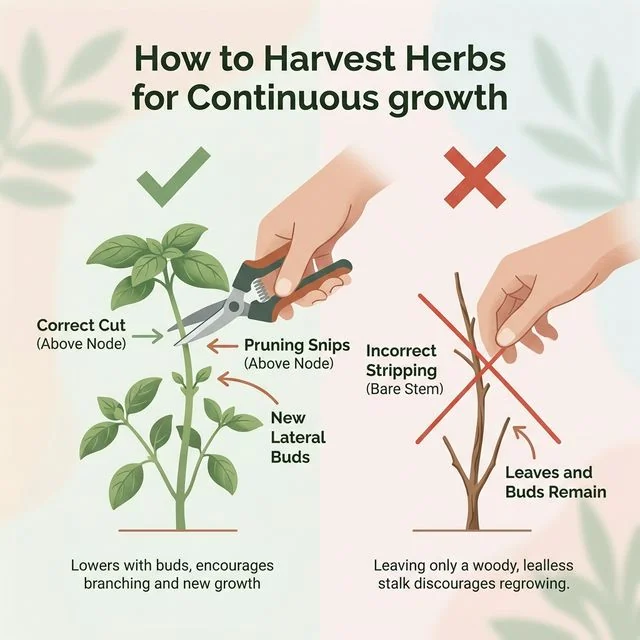
How to harvest basil, mint, parsley, and chives so they keep growing
The fastest way to destroy an indoor herb plant is to harvest it incorrectly. If you just pull random leaves off the stem, the plant will eventually go bald and die. Here is the exact botanical method to harvest your herbs so they yield endlessly.
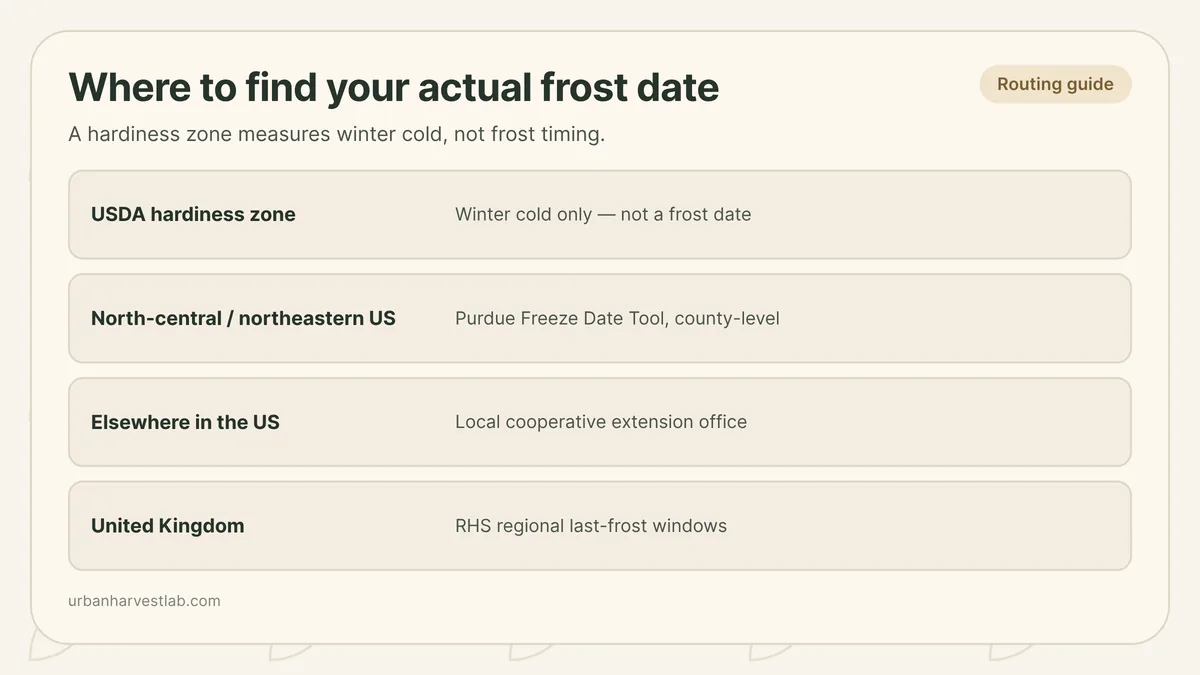
First and last frost dates for a balcony: start with your zone
Your hardiness zone tells you how cold winter gets, not when frost starts or ends. Look up the zone's temperature band, then use the tools built to answer the date question directly.
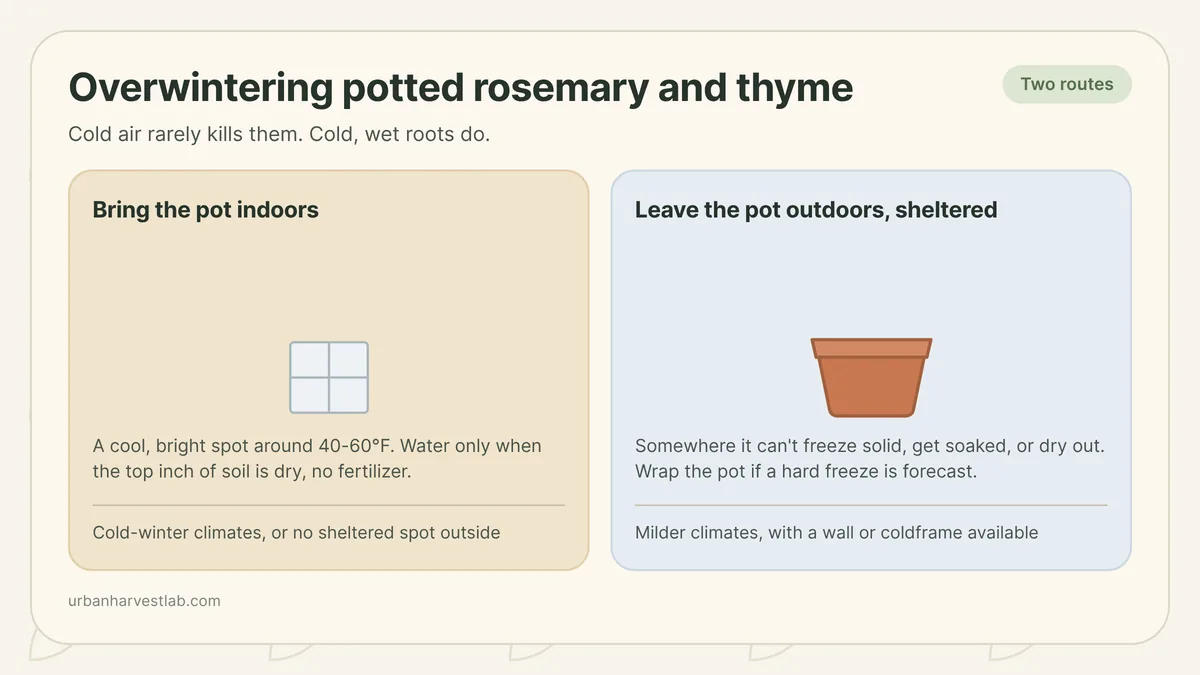
How to overwinter rosemary and thyme in pots
Winter kills more potted rosemary and thyme through mistimed watering and cold-wet roots than through cold air alone. Here is what to do indoors and out.