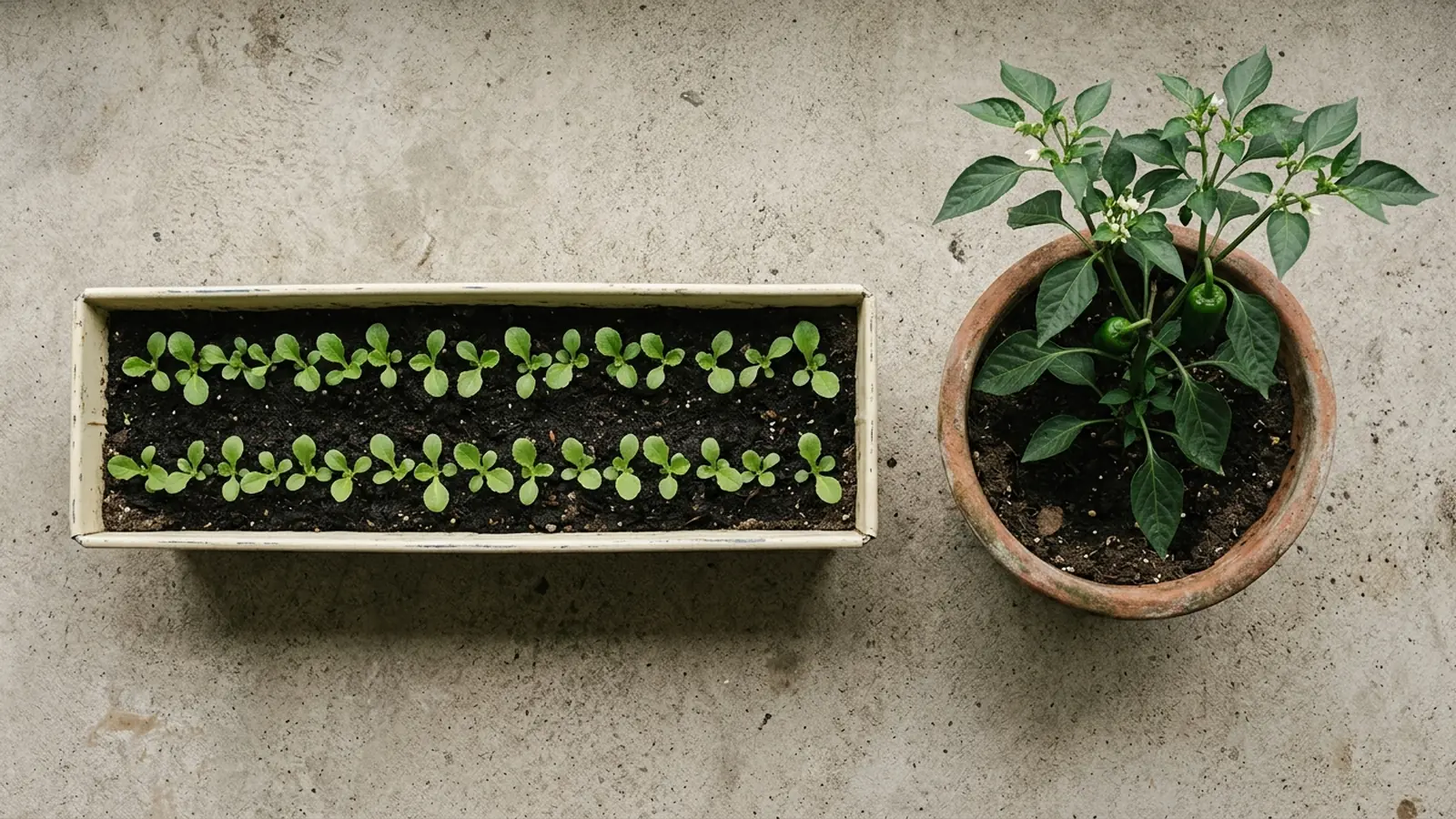
You are standing over an empty window box with a tray of lettuce seedlings, and the question is simply how many go in. Most container advice answers the reverse of it: here is one plant, here is the pot it needs. That is a useful question, and the pot size calculator answers it. It is not this one.
Two limits decide how many plants fit, and the answer is whichever is smaller: the room their leaves need, and the root volume each one needs. Either can bind first. A wide shallow tray runs out of volume long before it runs out of surface. A deep narrow pot runs out of surface first. Work out both, take the lower number, and you have a ceiling you can trust.
The two limits, and why you need both
Canopy spacing is the one people reach for. It is the figure in every seed packet: thin to so many inches apart. It answers a real question, which is how much light and air each plant gets once it has grown, and it is measured across the surface.
Root volume is the one people skip. A plant in the ground sends roots wherever it likes. A plant in a container has a fixed budget, and when that budget is split too many ways every plant in the box is short of water and nutrients at once. Colorado State University Extension publishes this budget directly, in gallons per plant, alongside a minimum depth.
Use only spacing and you will plant four peppers into a trough that has the surface for four and the volume for one. Use only volume and you will plant lettuce so tightly that the leaves shade each other into limp rosettes. The number that matters is the smaller of the two.
There is a third voice, and it outranks both. For some crops Colorado State does not give you a figure to work from, it gives you the answer: peppers and eggplant take one plant per container. When an extension service speaks that plainly about containers, that is not a data point to be averaged against your own arithmetic.
What the sources actually publish
Two documents carry almost everything below, and both matter because both are about containers rather than garden rows. That distinction is easy to lose and it changes the numbers.
Colorado State University Extension’s container vegetable guide gives minimum depth, gallons per plant and per-crop spacing. University of Maryland Extension’s salad table guide gives spacing for shallow planted boxes — a salad table is a container, so its figures are container figures by construction.
| Crop | Minimum depth | Volume per plant | Spacing |
|---|---|---|---|
| Tomato | 12 in | 2-5 gal, by variety | Not published; crowding cuts yields |
| Pepper | 8 in | 2-5 gal | One per container, or 14-18 in in a row |
| Eggplant | 8 in | 4-5 gal | One per container |
| Cucumber | 8 in | 3 gal and up | Not published |
| Summer squash | 8 in | 5 gal | 36 by 36 in |
| Broccoli, cabbage, cauliflower | 10 in | 5 gal | 18 by 18 in |
| Carrot | 12 in | Not published | Thin to 2-3 in |
| Beet, kale, collard for greens | 8 in | Not published | Thin to 3 in |
| Chard | 8 in | Not published | 6 in and up |
| Lettuce grown to heads | 6 in | Not published | Thin to 9 in |
| Salad greens, baby leaf | 6 in | Not published | 1-2 in, rows 4 in |
| Basil | 6 in | Not published | 4-6 in |
| Beans | 8 in | Not published | 3-4 in |
Blank cells are blank on purpose. Where a source does not publish a figure, the calculator below works from the one it does have rather than filling the gap.
The method, without the calculator
The widget does arithmetic you can do on paper in under a minute, and the method is worth knowing because it travels to crops the tool does not carry.
For a rectangular box, count rows and count along them. Divide the length by the row spacing and round down. Divide the width by the in-row spacing and round down. Multiply. A 30-inch by 17-inch salad table at Maryland’s 4-inch rows and 2-inch spacing gives seven rows of eight, which is 56 plants — and 56 baby salad plants in a salad table is exactly what that guide describes.
For a round pot, do not divide the area. Picture a ring of plants set half a spacing in from the rim, and ask how many fit around it. Add one in the middle only if the middle is a full spacing clear of the ring. For most balcony pots this comes out at a handful, and a handful is the truth.
Area division is where this goes wrong, and it goes wrong in the direction that matters. A 12-inch pot has about 113 square inches. At 12-inch spacing the sum says 0.78 plants. The rim is most of a small circle, so treating it as open field overstates what fits at larger sizes and returns nonsense at smaller ones.
For volume, multiply length by width by depth for a box, or take the radius squared by pi by depth for a pot, then convert: 231 cubic inches to the US gallon. Divide by the gallons per plant. Round down.
Then take the smaller of your two numbers.
Work it out
—
- Limited by
- —
- Fits by spacing
- —
- Fits by root volume
- —
- Container holds
- —
A count is a ceiling, not a target
The number the tool gives you is the most plants that fit, which is not the same as the best number to plant. Colorado State makes the trade explicit for tomatoes: crowding cuts yields and increases disease potential. Plants at their minimum spacing dry the container faster, shade each other sooner and hold humidity in the canopy longer.
So treat the ceiling as information, not instruction. If you are growing salad to cut at baby leaf, plant near the maximum — you are harvesting before the plants ever compete. If you are growing anything to full size in a container you will water daily in midsummer, drop one or two below the ceiling and you will spend less of August rescuing it.
Depth is the limit the count cannot express. A window box that suits basil at 6 inches is a poor home for carrots, which want 12. The tool flags a shortfall rather than silently reducing the number, because a shallow container and a crowded one fail differently and need different fixes.
Where these figures stop
The crops above are the crops those two extension documents name, and the tool does not extrapolate past them. Stretching a lettuce spacing onto a crop nobody measured would give you a confident number with nothing behind it.
Two more boundaries worth stating. The ring model for round pots is deliberately conservative — at large diameters a true hexagonal packing fits slightly more, and erring low is the safer direction for a planting guide. And on harvest style, the container sources are more restrained than most garden writing: Maryland gives one spacing for salad plants however you cut them, and Colorado State calls chard a cut-and-grow-again crop without loosening its 6 inches. The difference that is genuinely published is between baby leaf and a formed head, and the table reflects that and nothing more.
For the other half of the job — how much mix to buy once you know the container — the potting mix batch calculator works from the same dimensions. For depth by crop, container depth for tomatoes, peppers and herbs goes further than the minimums here. And if you are working the other direction from a single plant, the pot size calculator is the tool that answers it, with lettuce and tomatoes covered crop by crop.
Sources
- CMG GardenNotes #724: Vegetable Gardening in Containers — Colorado State University Extension
- Plant, Fertilize, Water a Salad Table or Salad Box — University of Maryland Extension
- Growing Vegetables in Containers and Salad Tables — University of Maryland Extension
Once you know the number, size the container
These cover the pot itself -- depth by crop, how much mix to buy, and the pot-size question in reverse.
Common questions
Can I just divide the pot area by the spacing?
Not at the sizes most balcony containers come in. A 12-inch round pot holds about 113 square inches, and 12-inch spacing asks for 144 square inches per plant, so the division returns 0.78 -- a number with no meaning when one plant clearly fits. Area division ignores the rim, and in a small circle the rim is most of the container. Counting rows, or counting a ring of plants set in from the edge, tracks reality much better.
Why does the calculator sometimes ignore the size of my container?
Because for some crops a source overrides the arithmetic. Colorado State University Extension states that peppers and eggplant take one plant per container, and gives summer squash a 36 by 36 inch footprint. When an extension service speaks that directly about containers, that figure carries more weight than a number worked out from dimensions, so the tool returns one plant however large the pot is.
What happens if my container is shallower than the minimum depth?
The tool reports the shortfall separately instead of quietly reducing the count, because a shallow container is a different problem from a crowded one. A shallow box with the right number of plants will still dry out fast and restrict roots. Either choose a crop whose minimum depth you meet, or use a deeper container.
Does cut-and-come-again harvesting let me plant more densely?
The container sources are more cautious about this than most garden writing. University of Maryland Extension gives one spacing for salad plants regardless of how you harvest them, and Colorado State describes chard as an excellent cut-and-grow-again crop without changing its 6-inch spacing. The genuine difference is between baby leaf and a formed head: Maryland puts salad plants at 1 to 2 inches, while Colorado State thins lettuce grown to heads at 9 inches.
Related guides
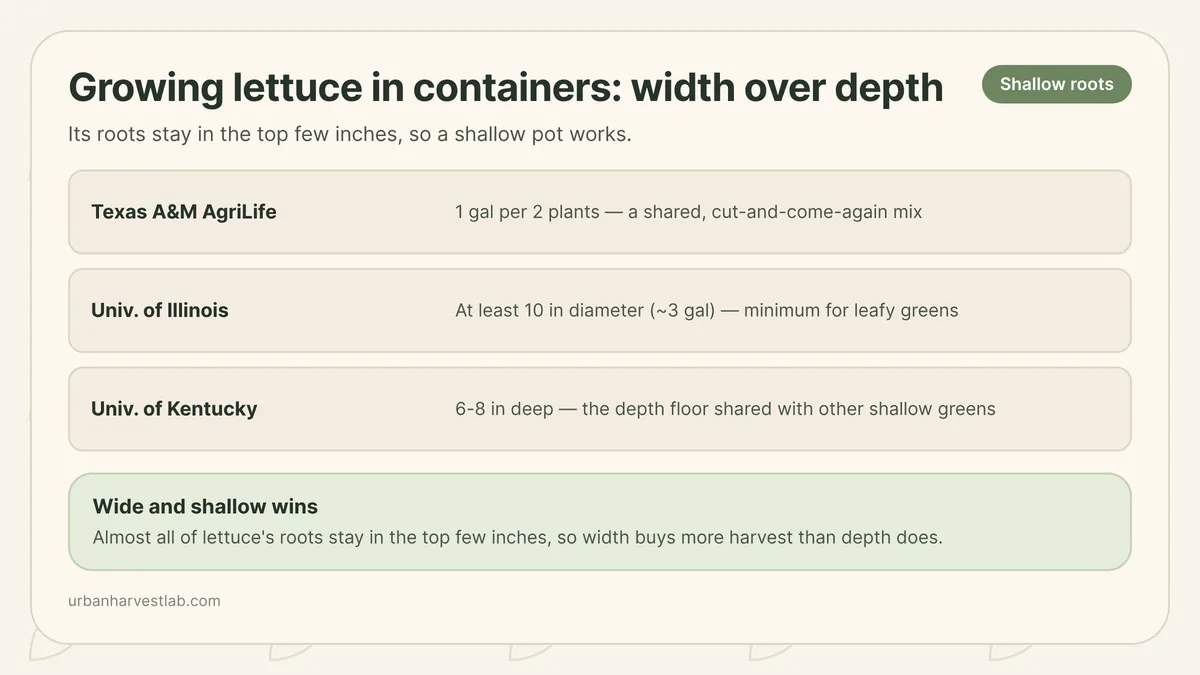
Growing lettuce in containers: pot size and spacing for soil
Lettuce keeps its roots in the top few inches of soil, which changes the whole container math. Here is how wide, how deep, and how far apart to space it.
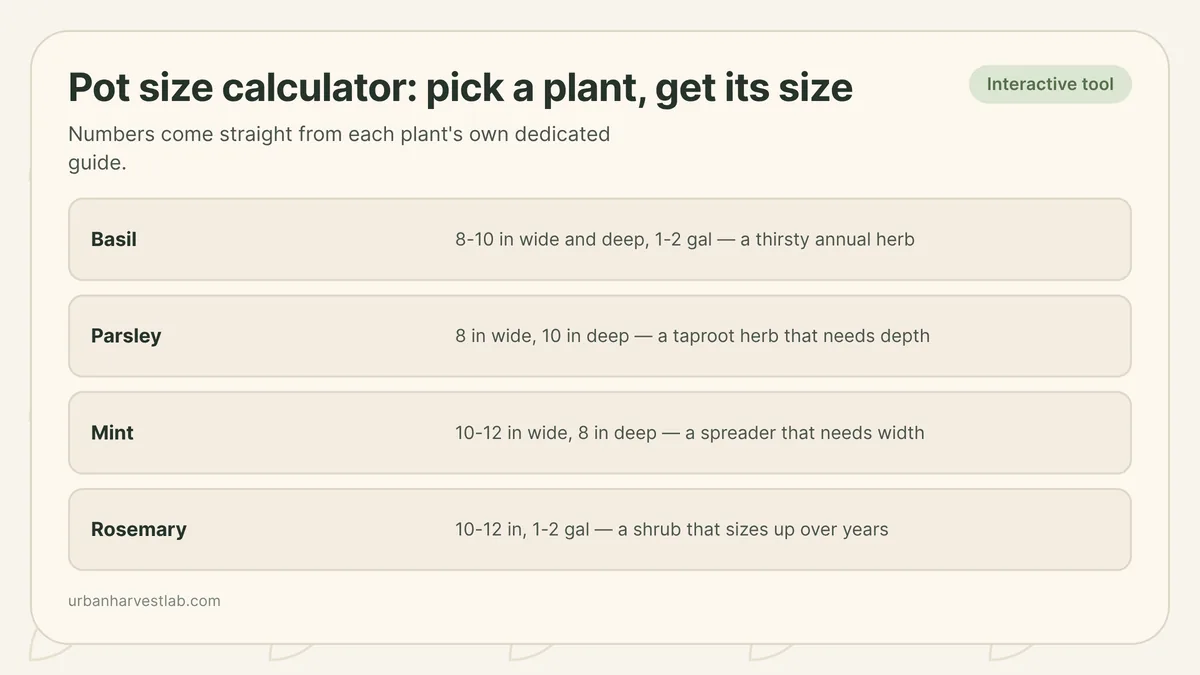
Pot size calculator: find the right container by plant and stage
A plant-and-stage picker that pulls its numbers straight from each herb's own dedicated pot-size guide, not a separate estimate.
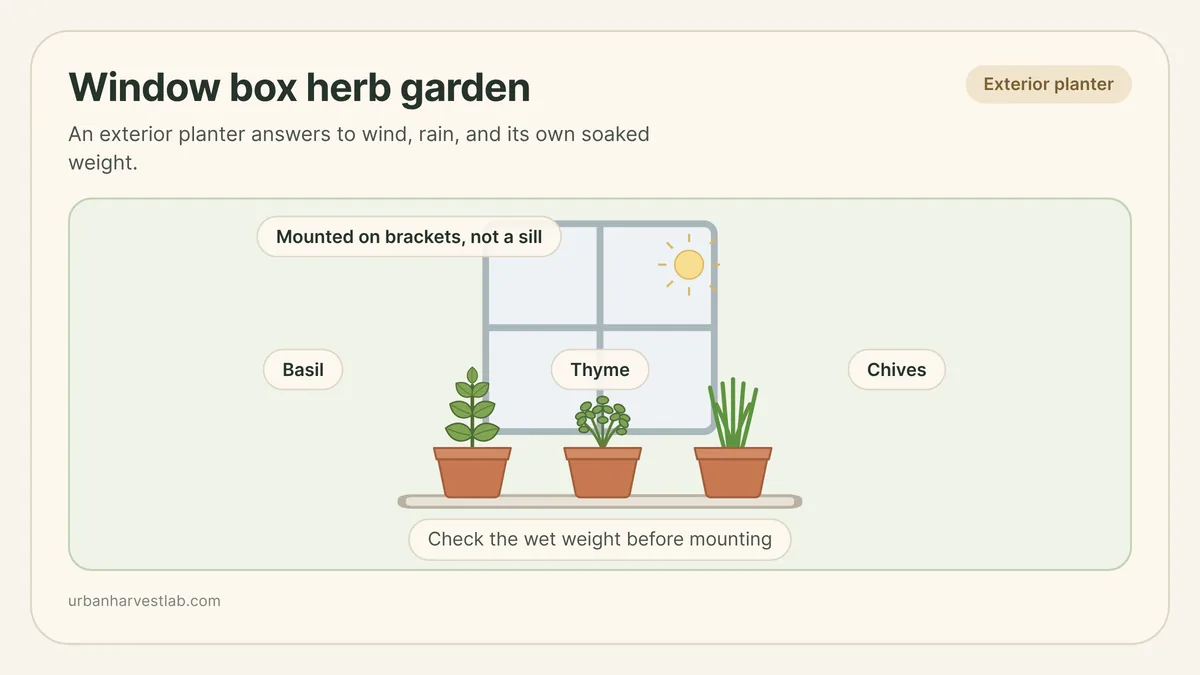
Window box herb garden: depth, mounting, and a workable mix
An exterior window box answers to gravity and weather in a way an indoor sill does not. Here is how to size, mount, and plant one without turning it into a hazard.