Watering windows for container plants
| Time | Best for | Main risk | How to use it |
|---|---|---|---|
| Early morning (5 to 9 am) | Any method, including a hose or can that splashes leaves | Few; mix may still be cold in early spring | Default slot; water until it runs from the drainage holes; on hairy-leaved plants, aim at the soil |
| Midday | A pot that is dry and wilting | More water lost to evaporation | Water the soil, not the leaves; skip routine midday watering |
| Late afternoon | Second watering for small pots in a heat spell | Leaves still damp at dusk | Aim at the soil and finish well before dark |
| Evening or night | Drip lines and soaker hoses; a pot that would otherwise stay dry | Wet foliage for 9 or more hours helps fungi infect leaves | Soil only, stop early enough that the surface dries before dark |
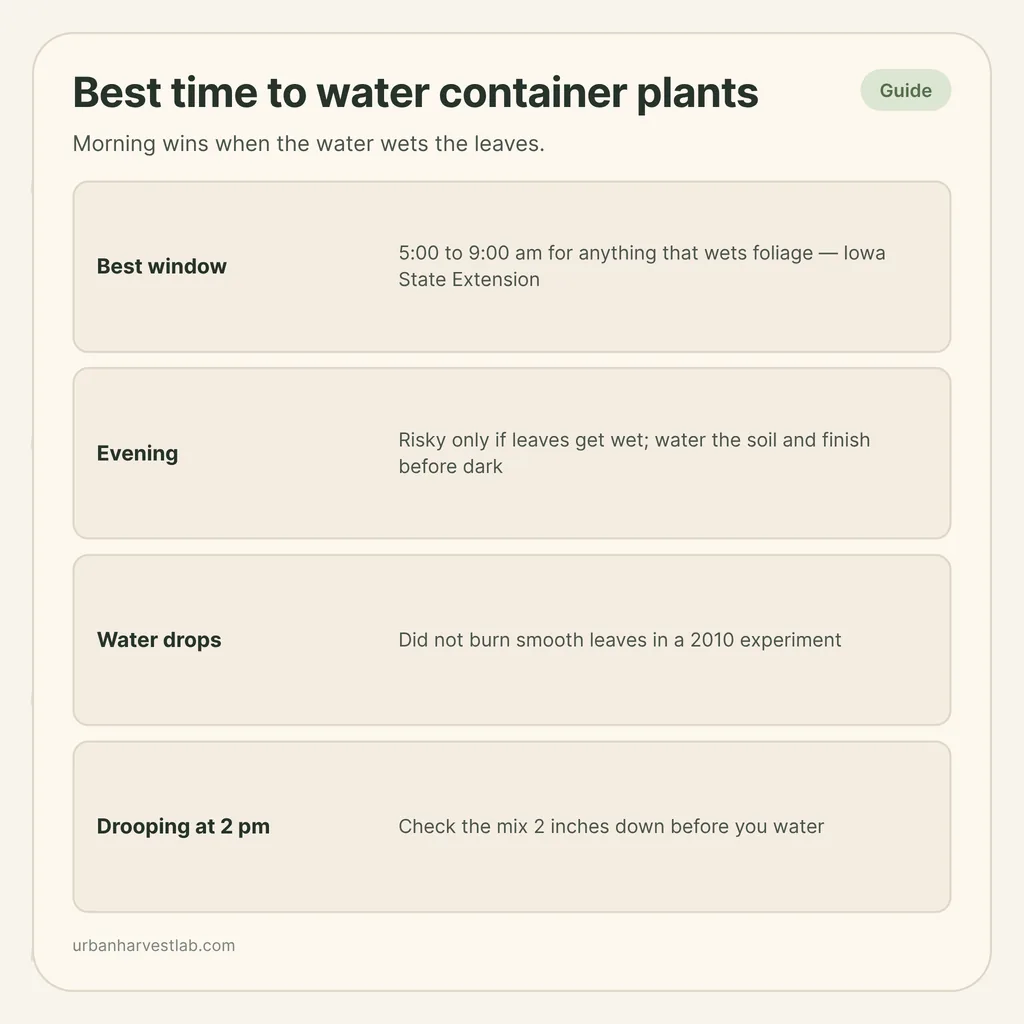
Water container plants in the morning, ideally between 5:00 and 9:00 am. Leaves dry fast, the water soaks in before the heat takes it, and the plant starts the hottest hours with a full pot. Evening is the slot to avoid, but only if the water lands on the leaves. How often to water is a different question, covered in how often to water container vegetables.
Why morning wins
Iowa State University Extension recommends early morning, 5:00 to 9:00 am, for a sprinkler, a hose or any device that wets the foliage. Two reasons stand behind it. The foliage dries quickly once watering is done, which helps guard against fungal disease. And a morning application soaks deeply into the soil with little lost to evaporation.
Containers add a third reason. A pot has no reserve of deep soil moisture to fall back on, so a plant that goes into a hot afternoon with a full root zone has more to draw on. Iowa State’s advice for hot spells is that most containers need water at least once a day, and some need it in the morning and the afternoon.
What goes wrong at night
The problem is not the water itself. It is how long a leaf stays wet. The University of Georgia Extension notes that watering in the late afternoon or evening can leave leaves wet for an extended period through the cool nighttime hours, while early morning watering is unlikely to add moisture to the leaves for long because they dry as the sun rises.
Mississippi State University Extension puts a number on why that matters. Many fungi need a film of free moisture for at least 9 hours to germinate and penetrate a leaf, and some need slightly less or more. A leaf soaked in the evening can stay wet for much of a night. Mississippi State also points out that dew counts as moisture, and that dew is usually present from about midnight to 8:00 in the morning. Watering as the dew is starting to dry, or before it forms in the evening, stretches the wet period further.
The watering slot is one of the few disease controls you can change at no cost. Wet leaves are the main risk for diseases such as basil downy mildew. Powdery mildew is the exception: it does not need wet leaves, so dry foliage alone will not stop it; see powdery mildew on container herbs.
When evening watering is fine
Iowa State describes mornings and evenings as excellent times to water with a drip line or soaker hose, because those methods do not wet the foliage. The same logic applies to a watering can or wand used well. The University of Georgia suggests a water breaker or wand to direct water at the soil rather than the leaves, and Mississippi State advises watering at the base of plants when you water by hand.
University of Kentucky Extension adds the practical point: watering in the evening is better than no water at all, provided the water goes to the base of the plant and away from the foliage. If your only free time is after work, use that. Pour at the soil line, and stop early enough that the surface dries before dark, as Mississippi State advises.
A drip setup takes the choice away. If you are putting one on a balcony, the sizing is in balcony drip irrigation.
The myth that water drops burn leaves
The advice to skip midday watering usually comes with a reason: drops on leaves act as tiny magnifying glasses and scorch them. Egri and colleagues tested this at Eötvös University in Budapest and published it in New Phytologist in 2010. Their paper opens by calling it a widespread belief that plants must not be watered in the midday sunshine, and then reports what happened.
- Sunlit water drops, from rounded to flat, on hairless leaves of ginkgo and Norway maple did not cause burn damage.
- Sunlit glass spheres placed on the same maple leaves did cause serious burn.
- Rounded drops held in place by wax hairs on the floating fern Salvinia natans did cause sunburn. The authors point to extremely high light intensity in the focal regions and to the loss of water cooling because the drop does not touch the leaf tissue.
So the exception is real but narrow: leaves whose water-repellent hairs hold a drop up off the surface, as on the floating fern Salvinia. The study tested a few species, and the paper does not say how a hairy herb or a fuzzy tomato leaf would behave. Their calculations also put the strongest focusing at a low sun, about 23 degrees above the horizon, which is early morning or late afternoon, not midday. On hairy-leaved plants, water at the soil line, as Mississippi State and the University of Georgia advise, which keeps drops off the leaves whatever the hour. For everything else, the reason to avoid midday is efficiency, not scorch.
What to do about midday wilting
Plants droop at 2 pm, and the instinct is to water. Check first: NC State Extension says wilting between 12 and 4 pm that clears by early evening is likely a normal, temporary heat response, and that well-watered plants often droop in the heat of the day as a protective reaction. The University of Georgia adds that plants wilted in the afternoon often perk back up at night and look fine by morning.
A finger settles it. NC State’s quick test is to push a finger into the soil to the second knuckle: if it feels damp, the wilting is probably temporary; if it is dry, especially more than two inches down, it is time to water. Watering a pot that is already damp risks poor oxygen around the roots, which NC State links to root rot.
Containers dry faster than beds, so a dry, wilted pot at midday is a real case for watering right then. Go to the soil, not the leaves, and give it enough to run out of the drainage holes. Hot-spell routines for herbs are in watering herbs in summer heat, and the wider response to extreme heat is in protecting container plants in a heatwave.
A routine that fits a balcony
- Morning check. Press a finger into the mix and lift small pots to feel their weight. Water the ones that are dry, aiming at the soil.
- Hot days. Look again in late afternoon. If a small pot is dry, water at the base and finish early.
- Hanging baskets and small pots. These dry first and may need the second watering. Basket specifics are in edible hanging baskets.
- Evening. Keep it for soil-level watering or a drip line. Skip the overhead spray.
Sources
- Iowa State University Extension, When is the best time to water the garden?
- Iowa State University Extension, Managing the garden in extreme heat
- Mississippi State University Extension, The Plant Doctor: Watering and Plant Disease
- University of Georgia Extension, Leaf spot on greens linked to moisture
- University of Georgia Extension, Wilted leaves aren’t always a sign that the plant needs water
- University of Kentucky Extension (Daviess County), Watering, Annette Meyer Heisdorffer, June 28, 2025
- NC State Extension, What wilting really means: heat stress vs. water needs
- Egri et al. 2010, Optics of sunlit water drops on leaves: conditions under which sunburn is possible, New Phytologist
Keep working on your watering routine
These cover how often to water, the summer heat routine and powdery mildew, which humid, crowded pots invite even when the leaves stay dry.
Common questions
What is the best time of day to water plants in pots?
Early morning. Iowa State University Extension gives 5:00 to 9:00 am as the best window when the water touches the foliage, because the leaves dry quickly and the water soaks in with little lost to evaporation. The plant then goes into the hottest hours with a full pot.
Is it bad to water plants at night?
Overhead watering at night is the worst slot for disease. Iowa State and the University of Georgia both note that foliage stays wet through the cool night, and Mississippi State says many fungi need a film of moisture for at least 9 hours to infect a leaf. Watering the soil only, with a wand or drip line, removes most of that risk.
Will watering plants in the midday sun burn the leaves?
On smooth leaves, no. In a 2010 New Phytologist study, sunlit water drops on maple and ginkgo leaves did not cause burn damage. Drops held above the leaf by hairs, as on the floating fern Salvinia, did. Midday is still a less efficient time because more water evaporates, so use it for a pot that is dry and wilting, not for routine watering.
Should I water a wilting plant in the afternoon?
Check the potting mix first. NC State Extension says wilting between 12 and 4 pm that recovers by early evening is likely a normal, temporary heat response. If the mix is dry more than 2 inches down, water it, even in the afternoon, and aim the water at the soil.
Related guides

Edible hanging baskets: what to grow and how to water them
A hanging basket frees floor space but dries out faster than most containers. These are the edibles that cope, the ones that do not, and a watering routine that keeps the basket alive.
How often to water container vegetables: volume and crop stage set the interval
A pepper in a 2-gallon pot in May and the same pepper in the same pot in August are two different watering problems. Once you can see why, the question stops being how often and becomes how much mix you gave the plant, and what it is carrying right now.

How to protect container plants during a heatwave
Watering more is only one piece of getting containers through a heatwave. This is the wider plan: cutting the heat load, grouping and staging pots, and reviving one that has already dried out.