Days to first tomatillo harvest, by extension source
| Source | Counted from | Days |
|---|---|---|
| Utah State Extension | Transplanting | 60 to 75 |
| South Dakota State Extension | Transplanting | 65 to 100 |
| Oregon State Extension | Transplanting | 75 or more |
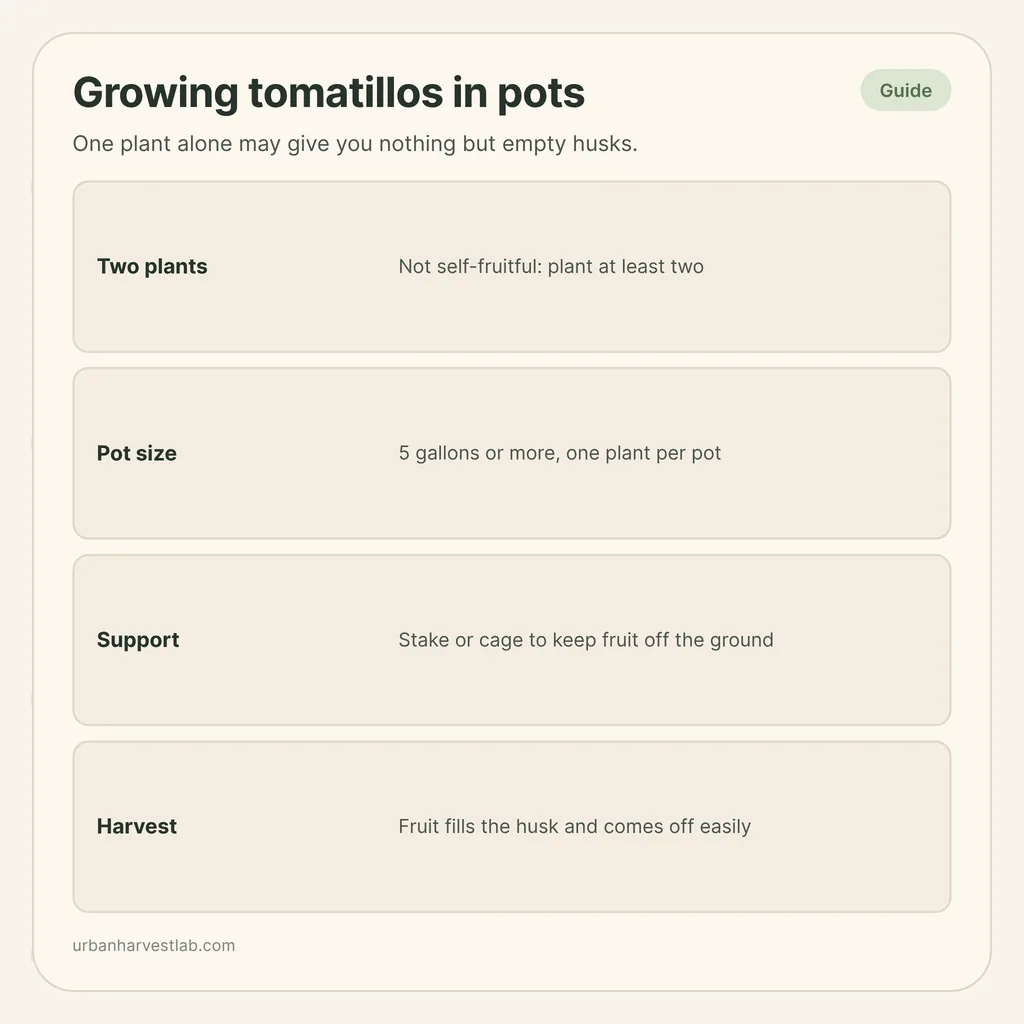
Grow at least two tomatillo plants, each in its own pot of 5 gallons or more, give each a cage or stake, and pick when the fruit fills the husk and comes off the plant easily. One plant on its own will flower and may give you nothing but empty husks.
Tomatillos are close relatives of tomatoes, with a similar appetite for sun and warmth. They suit a sunny balcony from the full-sun vegetables list, and Utah State Extension notes that they do very well in containers. The difference that catches people out is pollination.
Why one plant is not enough
A tomato flower pollinates itself. A tomatillo flower generally does not. Utah State Extension says tomatillos are not self-fruitful and advises planting at least two, of the same or different varieties. South Dakota State Extension goes further: the plants require cross-pollination by insects, so plant at least two, and two different varieties is ideal. Oregon State Extension is less absolute, saying you might need two or more types for good pollination and fruit set.
The hand-pollination routine for tomatoes and peppers is built for flowers that pollinate themselves. A tomatillo needs pollen from a second plant, and Utah State Extension says bees and other insects are needed to carry it.
On a balcony, that points to a few practical choices:
- Buy two plants, or sow two seedlings, and keep them close together.
- Two different varieties is the stronger plan, going by South Dakota State.
- Put flowers that insects visit nearby, so there is a reason for them to land on your balcony.
Pot size and mix
Oregon State Extension says tomatillos can grow well in pots of 5 gallons or larger. The plants are multi-branched and bushy, 2 to 4 feet tall and just as wide by Oregon State’s account, and 3 to 4 feet by Utah State’s. Plan on one plant per pot rather than two squeezed into one. For the volume question in general, the tomato pot size guide lays out how much extension figures for a full-size plant vary, and the same reasoning about watering frequency applies here.
Use a free-draining potting mix. Oregon State says tomatillos do not like soggy, poorly drained soil, and Utah State says the same. Tomatillos may be a bit more drought tolerant than tomatoes, but they still want even moisture: Oregon State puts their need at 1.5 inches of water per week in the ground, and South Dakota State says not to let more than the top inch of soil dry out. In a pot, check by finger rather than by calendar.
Go easy on the feed. South Dakota State warns that too much nitrogen grows more leaves than flowers, and Utah State says over-fertilizing delays fruit set.
Light and temperature
South Dakota State Extension says tomatillos need 8 hours of sun per day. It also says temperatures above 90 °F or below 55 °F can cause flowers to drop without producing fruit. In a heat spell, a pot against a sun-baked wall is the first one to check.
Do not set plants out early. South Dakota State says to wait until all danger of frost has passed and the soil has warmed, and to harden off transplants first. Use your frost dates and the hardening-off plan for that step. If you start from seed indoors, South Dakota State Extension puts sowing 4 to 5 weeks before transplanting, a week or two later than tomatoes.
Support
Tomatillos sprawl. Oregon State Extension says they can manage without support but that it is best to stake or cage them, to improve air circulation and keep fruit off the ground. Utah State says tomato cages work, and that because tomatillos weigh less than tomato plants they are supported much more easily. Oregon State adds that the training system can be somewhat less substantial than for tomatoes.
Utah State also says you can pinch off growing tips to limit spread if space is tight. That is useful on a balcony, where a plant 3 to 4 feet wide crowds its neighbour.
In a pot, the cage or stake has to be anchored in the mix and the pot has to be stable. If you rent and cannot fix anything to the railing, see trellising without drilling.
Harvest: when a tomatillo is ready
Timing differs by source and by variety, so use it as a rough window and watch the plant.
Each plant is indeterminate. South Dakota State says it produces fruit continuously through the season, and recommends picking weekly or as needed. Utah State puts the yield at 2 to 3 pounds per plant in the ground, so a pair of potted plants will not fill a salsa batch every week.
The signs to pick on:
- The fruit fills the husk. Utah State says ripe fruit is firm and fills the papery husk.
- The husk dries. South Dakota State describes it turning from green to tan and beginning to split open.
- It comes off easily. Oregon State says fully ripe fruit falls easily off the plant when picked.
- Colour, for green varieties. South Dakota State says to pick before the fruit turns yellow or purple, when it goes soft and loses its tang. Oregon State says that as green types turn yellow-green they lose some acidity.
Fruit sometimes drops early. Utah State says to gather it and keep it in the husk until it is fully ripe. South Dakota State’s warning covers the whole Physalis group, tomatillos included: eat only ripe fruit, because unripe fruit and other plant parts are poisonous and should not be eaten.
The husk is not edible; remove it before eating or cooking, as Oregon State says. The fruit underneath is sticky. South Dakota State says to wash and dry it before use, especially any that touched the ground. Store them husked-on in a paper bag in the fridge: 1 to 2 weeks according to South Dakota State, up to 3 weeks according to Utah State. An airtight bag makes them spoil much faster. For crops generally, see when container vegetables are ripe.
Pests to look for
South Dakota State says most insect damage falls on the leaves, because the husk protects the fruit. It names the three-lined potato beetle as the one to watch on tomatillos, and with only a few plants its advice is to hand-pick adults, larvae and egg clusters. Flea beetles, cutworms and tomato hornworms also feed on the plants. Do not grow tomatillos in the same pots or mix where tomatoes, peppers or eggplants grew the year before; South Dakota State gives that rotation advice for nightshades.
Sources
Growing fruiting vegetables on a balcony
Pot size, pollination and support for the crops that share tomatillo's needs.
Common questions
Can you grow just one tomatillo plant in a pot?
You can, but expect husks with no fruit. Utah State Extension says tomatillos are not self-fruitful and recommends at least two plants, same or different varieties. South Dakota State Extension says insects must cross-pollinate them and that two different varieties is ideal.
How big a pot does a tomatillo need?
Oregon State Extension says tomatillos grow well in 5-gallon or larger pots. The plants reach 2 to 4 feet tall and just as wide, and Utah State Extension puts them at 3 to 4 feet, so give each plant its own pot rather than sharing one.
Why are my tomatillo husks empty?
Utah State Extension links empty husks to a lack of pollination, since tomatillos are not self-fertile and need multiple plants. It also says extreme temperatures and dry conditions can affect flower fertilization. South Dakota State Extension says flowers can drop above 90 degrees F or below 55 degrees F.
How do I know a tomatillo is ripe?
South Dakota State Extension says it is ready when the fruit completely fills the husk and comes off easily, and the husk dries to tan and starts to split. Green varieties should be picked before they turn yellow or purple. The husk is not edible, and Oregon State Extension says to remove it before eating.
Related guides
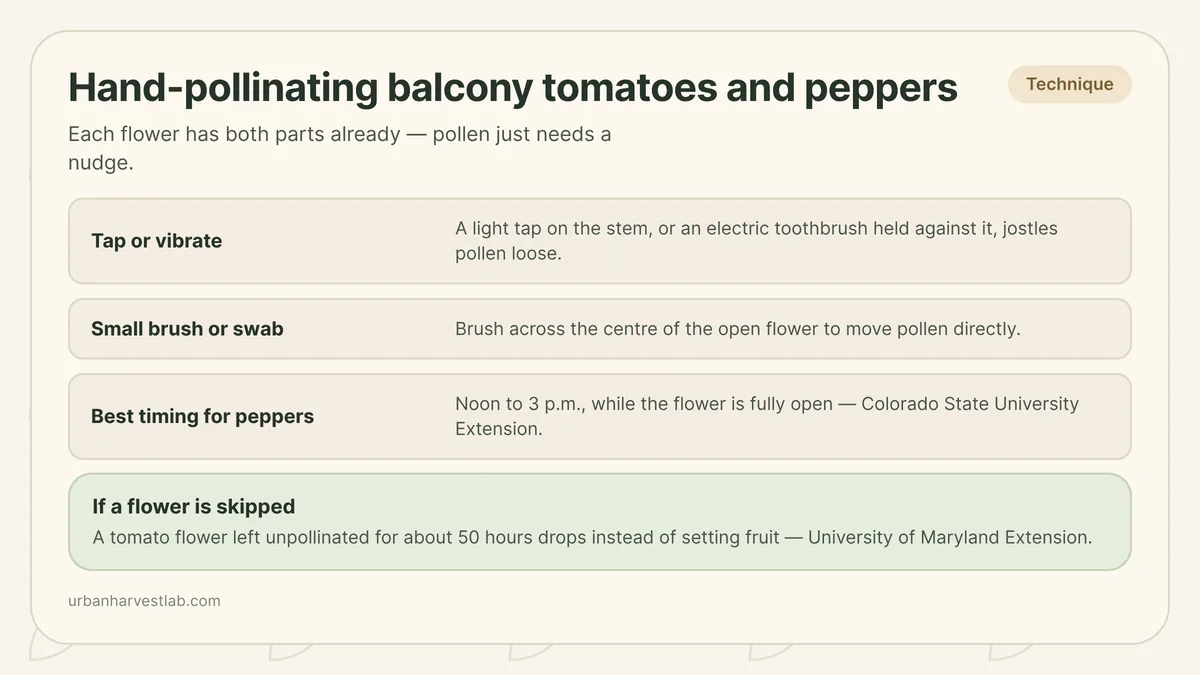
How to hand-pollinate tomatoes and peppers on a balcony
A tomato or pepper flower already carries both male and female parts, but nothing on a balcony reliably moves the pollen between them. This is the tap, brush, or vibrate technique that stands in for a bee.
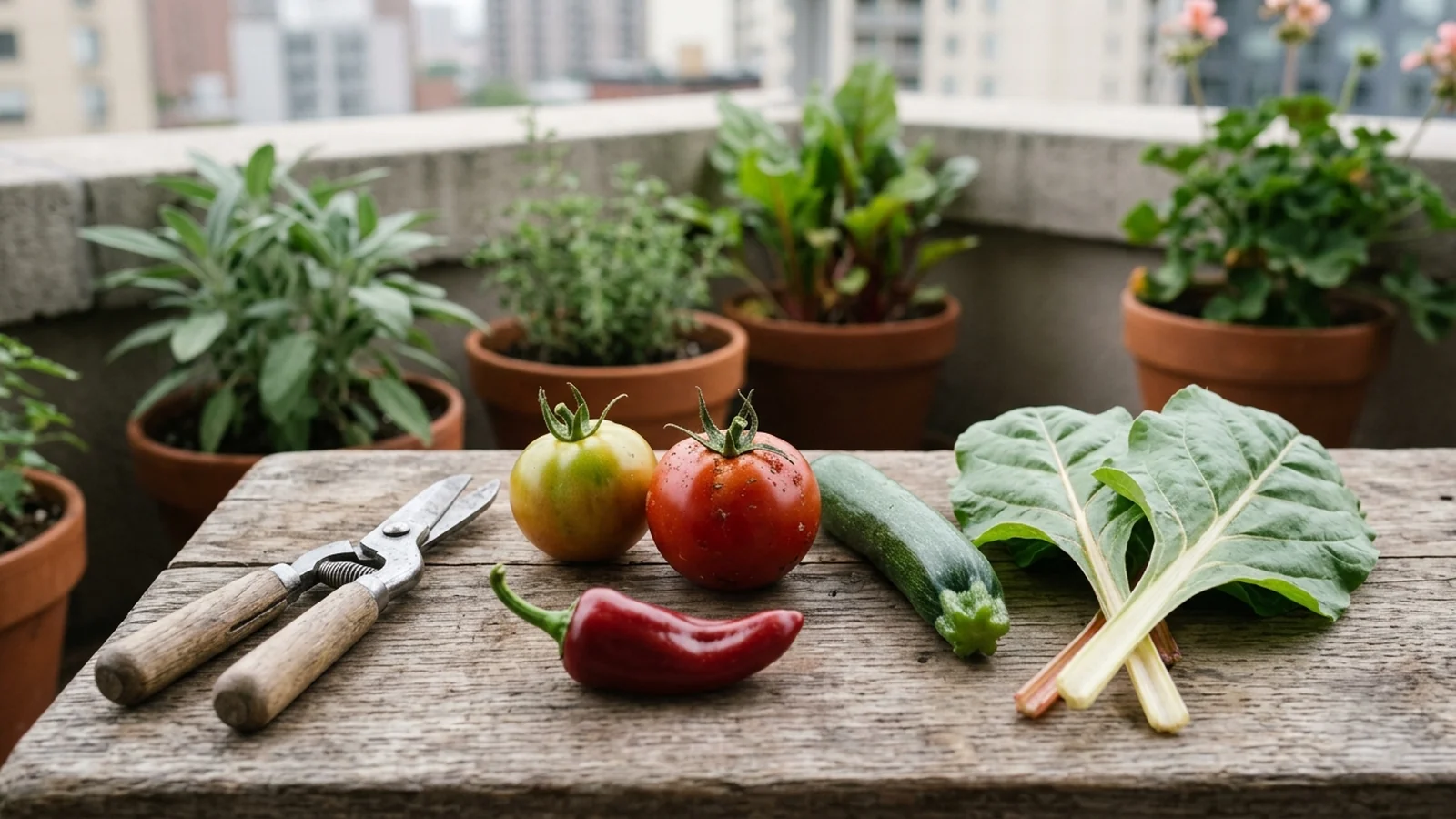
When container vegetables are ripe, crop by crop
A tomato tells you it's ready with color and give. A zucchini tells you with size and how easily it lets go. The signal is different for every crop, and waiting costs more when the plant only has a pot's worth of reserve behind it.
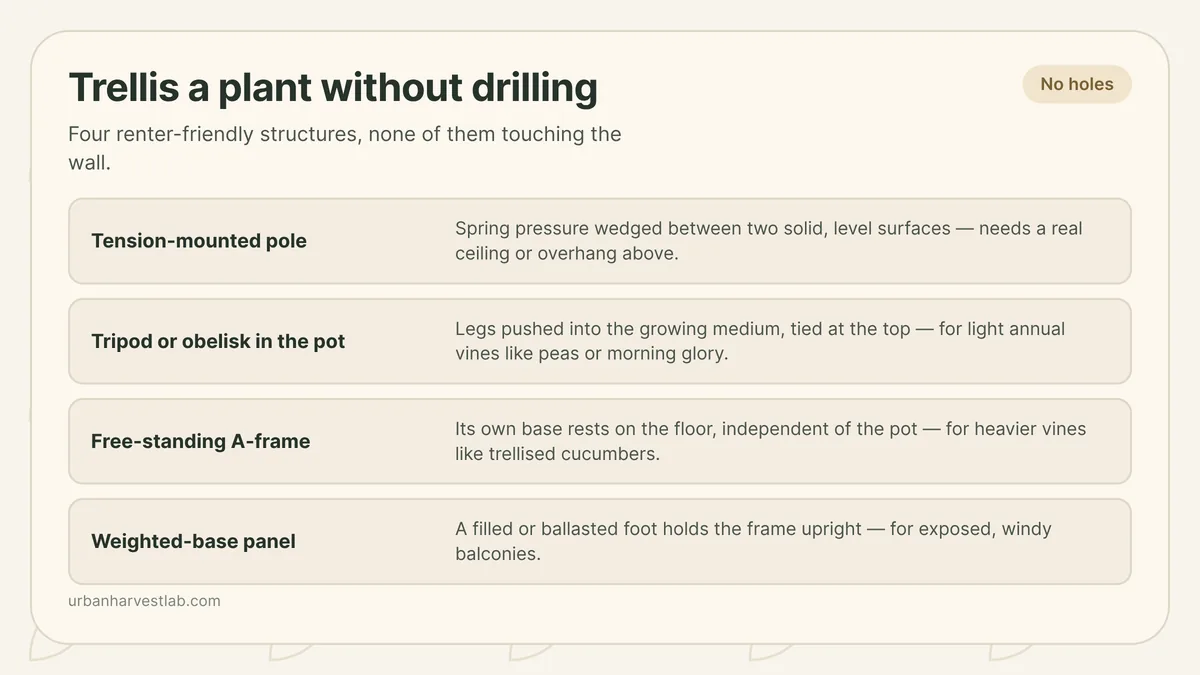
How to trellis a plant without drilling a single hole
A container has no ground to sink a post into, so a renter-friendly trellis has to get its stability from somewhere else. Four approaches do that without touching a wall, railing, or ceiling.