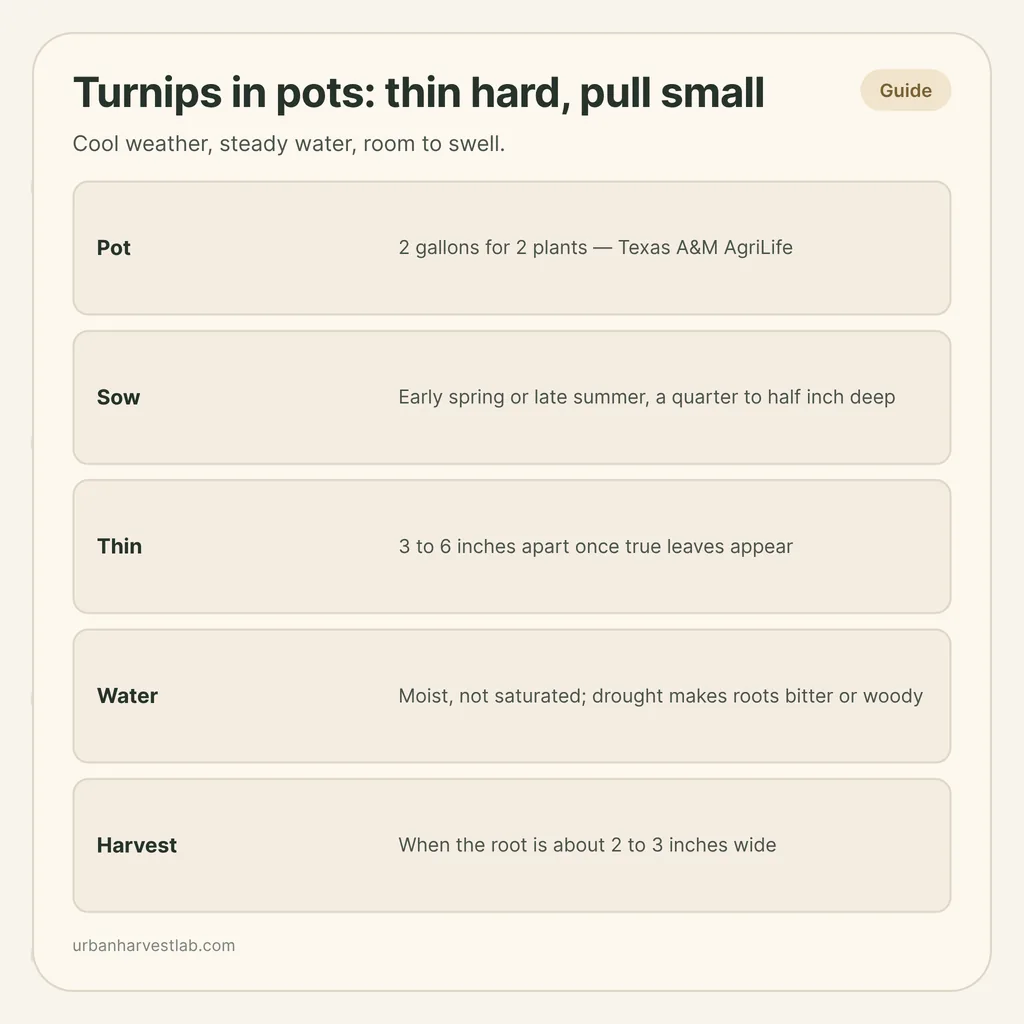
Turnips grow well in pots if you give them cool weather, steady water and room to swell. Texas A&M AgriLife Extension lists a 2-gallon container for 2 plants. Sow in early spring or late summer, thin hard, and pull the roots when they are 2 to 3 inches across.
Each plant gives you two crops. The root is crisp, white and spicy; the leaves cook like any brassica green. Clemson Extension describes turnip flesh as crisp and white with a spicy, mustard-like flavor. If you want a faster root, see radishes; for another root-and-greens crop, see beets.
Pick a pot and a mix
Texas A&M’s container table gives turnips 2 gallons and 2 plants, any cultivar. That is a modest pot. The same publication notes that leafy crops tolerate more shade than root crops such as radishes, beets, turnips and onions, so give the pot the brightest spot you have.
Turnip seed is tiny. Clemson says to plant it only a quarter to half an inch deep, and warns that hard, crusty soil inhibits emergence and gives a poor stand. A loose potting mix that you keep damp, not soaked, avoids the crust. Clemson recommends frequent, light watering until seedlings are up. UMN says to expect emergence after about ten days.
If you grew cabbage-family crops in the same pot or soil recently, UMN says to plant where none of the group (cabbage, broccoli, kale, mustard, turnip and others) has grown for the past four years. In a pot, that means fresh mix, or a different pot.
When to sow
Turnips are a cool-season crop, though Clemson notes they tolerate some heat. Both extension services describe two windows:
| Source | Spring sowing | Fall sowing |
|---|---|---|
| Clemson (South Carolina) | Late winter to early spring; Coastal Plain Feb. 1 to Apr. 1, Piedmont Mar. 15 to Apr. 30 | Late summer; Coastal Plain Aug. 1 to Sep. 30, Piedmont Aug. 1 to Sep. 15 |
| UMN (Minnesota) | From April 15 | From August 1 |
Those dates belong to those climates. Count from your own last and first frost with the balcony frost date guide, or use the fall planting calculator. A fall sowing finishes in cooling weather, which suits the crop. UMN says turnip quality can be poor when they grow in hot weather or if they grow too large, and Clemson says pithiness and a strong flavor can develop if they sit through hot weather.
Sowing a short row every couple of weeks keeps roots coming at a pickable size; the succession planting guide covers how to stagger.
Thin early
Crowded turnips make leaves and little else. Clemson gives 2 to 3 inches between plants in the row. UMN says to thin to 3 to 6 inches once true leaves have emerged, depending on the size of root you want. The wider the gap, the bigger the root.
In a 2-gallon pot with 2 plants, that means thinning well past what most people are willing to pull. Do it anyway. UMN says the thinnings are good as greens, so nothing is wasted. See thinning seedlings for the technique.
Water and feed
Turnips form roots near the surface and do not have an extensive root system for taking up water, UMN says. It gives one inch of water per week as a baseline in the ground and warns that drought stress can make them bitter or woody. Pots dry faster than soil, so check them often in warm weather. Soak the pot thoroughly rather than sprinkling.
Clemson says watering is critical in two stages, the seedling stage and the root development stage, and to avoid letting leaves wilt between waterings, while keeping the soil moist but not saturated.
On feeding, go light. Clemson warns that over-fertilization with nitrogen may reduce root formation, and UMN says turnips need no more fertilizer than the initial pre-plant application. Fresh manure is out: UMN says its readily available nitrogen can cause branching of the roots.
Root and greens
| Variety (Clemson list) | Grown for |
|---|---|
| Purple Top White Globe | Root and greens |
| Shogoin | Root and greens |
| White Lady, Royal Crown | Root |
| Hakurei | Root (white, small) |
| Alamo, Topper | Greens only, no swollen root |
If you want both from one pot, choose a root-and-greens type. If you only want leaves, Alamo and Topper are bred for it and will not give you a root.
Leaves can be cut from a very early stage, Clemson says, but continual harvest of the leaves will adversely affect root development. Use the thinnings, go easy on the leaves while the root fills, and cut the tops off at harvest. UMN says to cut greens from the roots when you pull the turnips, wash them and store them separately.
Harvest small
UMN says to harvest when the root is about 2 to 3 inches wide. Turnip shoulders usually stick out above the soil, so you can see the size without digging. Clemson puts it at the size of a tennis ball or larger, 2.5 to 2.75 inches in diameter. UMN adds that bigger roots are more likely to be bitter, strong-flavored, woody or fibrous.
Store roots and tops separately in the refrigerator. UMN gives a week or two and says turnips lose moisture rapidly, so they do not keep long term. In a pot this is not a problem; pick small batches as you need them.
Pests
UMN lists two main insect problems. Flea beetles chew small holes in leaves and seedlings are most vulnerable. Root maggots feed on the developing roots. For flea beetles, UMN’s insect page suggests row covers or other screening while seedlings are growing. If you want cover for a pot, browse row cover fabric on Amazon. The flea beetle page covers identifying and handling them in more detail.
Sources
More quick root crops
Radishes, beets and thinning guides for pots.
Common questions
How big a pot do turnips need?
Texas A&M AgriLife Extension lists a 2-gallon container for 2 turnip plants, any cultivar. UMN Extension wants 3 to 6 inches between plants in the ground, so in a pot plan on fewer plants than the spacing suggests and thin early.
When should I sow turnips in pots?
Early spring or late summer. Clemson Extension says late winter or early spring for a spring crop and late summer for a fall crop in South Carolina; UMN Extension starts April 15 and again August 1 in Minnesota. Use your own frost dates to shift those.
When do I harvest container turnips?
UMN Extension says about 2 to 3 inches wide; Clemson says tennis-ball size, 2.5 to 2.75 inches across. Larger roots become bitter, woody or fibrous (UMN).
Can I eat the greens and the root from the same plant?
Yes, but not by stripping the plant. Clemson Extension says continual harvest of the leaves will adversely affect root development. Use the thinnings and the tops when you pull the root.
Related guides

How to grow radishes in pots: depth, spacing and why you get only leaves
Radishes are one of the fastest crops you can grow in a pot, and the one that most often goes wrong in the same way: big leaves, no root. Here is what to change.

How to grow beets in containers: sow, thin, and harvest roots and greens
A beet seed is really a cluster of seeds, so a pot sown once comes up crowded. Thinning on time, and watering evenly, is what turns that crowd into round roots.
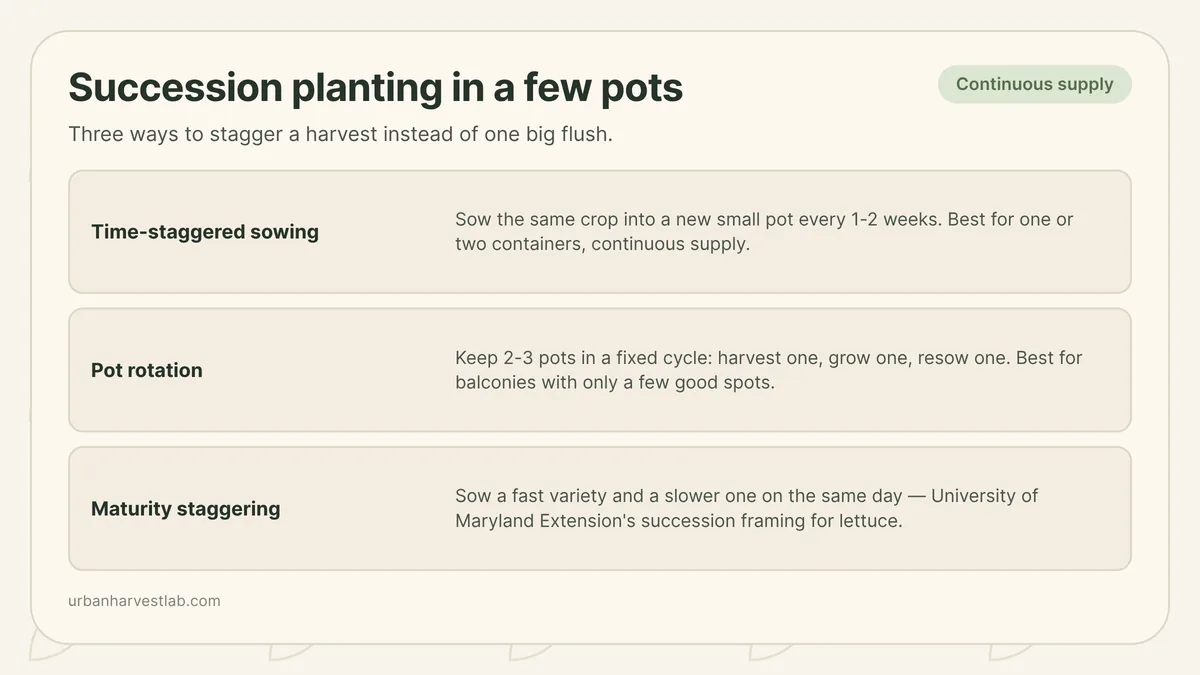
Succession planting in containers: how to stagger a harvest from a few pots
Succession planting in containers is a sowing rhythm: a few pots restarted on a schedule keep producing, where one large planting ripens together and then quits together.