
Pocket planter or a shelf of pots?
| Question | Pocket planter | Shelf of individual pots |
|---|---|---|
| Floor space used | Almost none: it hangs on a wall or railing | A strip of floor or a rack |
| Root room per plant | Small; sets the limit on what you can grow | As large as the pot you choose |
| Watering | Fast drying; rows dry unevenly; check daily in warm weather | Pot by pot; larger pots need watering less often |
| Best crops | Salad greens, small herbs, trailing flowers | Anything, including tomatoes and perennial herbs |
| Moving one struggling plant | Awkward: it is fixed in its pocket | Lift out and relocate |
| Weight on the wall or railing | Concentrated at the fixings once watered | Spread over the floor or shelf supports |
Vertical pocket planters are worth buying if you want salad greens or small herbs on a sunny wall and can check them daily. They are a poor choice for large plants, shaded walls or a schedule that leaves the planter unwatered for days. The trade is simple: you gain planting area on a wall, and you give up root room and watering margin.
If you are still deciding how to fit herbs into a small space, the small-space herb gardening hub lays out the wider options. What follows is the decision for pockets specifically.
What you gain
Floor space. A balcony with room for two pots can still carry a wall of planting pockets on a railing or fence. For a renter with a few square feet of floor, that is the whole appeal.
Easy picking. University of California Master Gardener guidance names salad greens as a good fit for vertical gardens because the edible part grows above ground and can be harvested without disturbing what supports the plant. Cut-and-come-again leaves in a pocket at chest height are about as convenient as growing gets.
A tidy look. A wall of green hides a bare fence or a blank balcony panel.
What it costs you
Little soil per plant
Each pocket holds a small volume of mix. University of Illinois Extension is plain about the consequence: larger pots need less frequent watering than smaller pots, and plants that want moist soil need a larger root ball to guard against drying out. A pocket is the small-pot end of that rule. Iowa State Extension puts watering frequency anywhere from once or twice a day for a small container in hot, windy weather to once or twice a week for a large container in cool weather, and a pocket sits at the small-container end, which is why daily checks in warm weather are the working rule. Illinois also notes that fluctuating soil temperatures are a problem with small pots, and a bigger one in sun than in shade.
The same small volume holds few nutrients. UC Master Gardeners point out that container-grown plants need feeding more often to replace what washes away, and that salad greens in particular need regular feeding to stay lush and leafy. Iowa State Extension’s container guidance is to fertilise every 1 to 3 weeks through the summer, using a 1:2:1 N-P-K product. A pocket wall sits at the frequent end of any container schedule.
Uneven watering
This is the defect to plan around. Water runs downhill. UC Master Gardeners describe plastic wall pockets built so that water from upper pockets drains into lower ones, which is convenient to pour but means the top row gets the least. The top is also the most exposed to sun and wind. University of Illinois Extension notes that anything hanging in the air needs watering more often, because wind and reflected heat dry plants faster.
The result is a gradient: dry and stressed at the top, wetter at the bottom, with a risk of saturated mix where a pocket has no way to drain. Illinois calls a drainage hole at the bottom of a container critical, and says wet soil favours root rot because it leaves little room for air around roots.
Material changes the speed but not the pattern. Illinois lists porous materials as losing water faster than non-porous ones, and says a container can be lined with plastic to resist water loss. An American Society for Horticultural Science greenhouse study found that unwrapped fabric containers lost water more rapidly than black plastic ones and than fabric wrapped in plastic. Felt pockets therefore forgive overwatering and punish neglect. Plastic pockets are the reverse.
Hard to rescue one plant
A pocket is fixed. If the basil in pocket six is struggling, you cannot lift it into the shade and nurse it, as you could with a pot. The best herb planters for small spaces guide makes the same point about shelves of single pots: one failing plant can be moved without disturbing the rest.
Weight at the fixings
A watered pocket is heavier than it looks, and the load hangs from a few points. University of Illinois Extension advises consulting a building architect about weight limits when placing heavy containers on balcony or rooftop gardens, and advises securing hanging items well. The balcony weight limit guide shows how to work out what a wet container weighs. If you rent, the renter’s checklist covers fixings you can undo, and a freestanding frame is easier on a landlord than a wall mount. For a leaning or climbing setup that stays off the wall, see trellising without drilling.
What actually grows well in pockets
Match the plant to the pocket, not the other way round.
- Good fits: salad greens, which tolerate shallow roots and are picked leaf by leaf; small herbs such as chives and thyme; trailing flowers.
- Worth trying with care: basil in the sunniest, best-watered row.
- Poor fits: tomatoes, peppers and courgettes, which need deep root room and steady moisture; mint, which fills a small pocket with roots and dries quickly; large woody herbs.
Light decides more than the pocket does. Clemson’s extension guidance says almost all herbs grow best in an area that is sunny for at least six hours each day. Count the sun your wall actually gets before you buy, using the balcony sunlight method. Penn State Extension names lemon balm, chives and cilantro as tolerating lower light, at 2 to 6 hours. A north-facing or shaded wall suits those three at best; most other herbs need more sun than it gives, whatever the planter.
For hanging containers that are not a wall, the hanging baskets guide compares the same drying trade-off.
Watering a pocket wall so it survives
- Test, do not guess. Iowa State Extension says to water a container when the mix is dry at a depth of 1 to 2 inches. Push a finger into the top row and the bottom row separately.
- Water the top row slowly. Let it soak in before the next pass, so water reaches the middle rows rather than only running down the surface.
- Rescue a dried-out pocket. Iowa State recommends standing a fully dried-out container in a tub of water for 20 to 30 minutes. With a fixed pocket wall, lift the whole planter off its hooks and lay it in a tub or bath, or water it slowly in several rounds.
- Consider drip. UC Master Gardeners suggest running drip irrigation to tall or unusually shaped structures. The balcony drip irrigation guide covers sizing emitters and a reservoir, and it removes the daily-check problem.
- Shade the wall in a heatwave. Dark fabric and sun on a vertical surface heat the mix; Illinois warns that heat from dark containers in intense summer sun can damage roots.
When to choose pockets, and when not to
Choose pockets if the wall gets six hours of sun, you can check them every day in warm weather or can fit drip, and you want greens and small herbs rather than a harvest of fruit.
Choose a shelf of pots if you travel, if your only free wall is shaded, if you want tomatoes or perennial herbs, or if you rent and cannot trust the fixing. The same plants in pots have more soil, dry more slowly and move when they need to.
Sources
- UC Master Gardeners of Napa County, Vertical Gardening (UC ANR)
- University of Illinois Extension, Container Size
- University of Illinois Extension, Container Material Choices
- University of Illinois Extension, Container Drainage Options
- American Society for Horticultural Science, Evaporative and Transpirational Loss from Three Nursery Container Types (2013 abstract)
- Iowa State University Extension, How to Care for Plants Growing in Containers
- Clemson Cooperative Extension, Herbs
- Penn State Extension, Growing Herbs Indoors
Small-space growing, compared
Related guides for choosing containers, supports and watering for a balcony or wall.
Common questions
Are vertical pocket planters worth it?
They are worth it for compact, shallow-rooted crops such as salad greens and small herbs, on a wall that gets about six hours of sun, when you can check the pockets daily, since Iowa State Extension puts watering for small containers in hot, windy weather at once or twice a day. They are a poor fit for large or deep-rooted plants, for walls in shade, and for anyone who travels often, because the small volume of mix dries out quickly.
Why do the top pockets dry out and the bottom ones stay wet?
Gravity moves water down the wall. University of California Master Gardener guidance describes plastic wall pockets designed so that water from upper pockets drains into lower ones, which is why the lower rows tend to stay wetter. Wind and sun on the exposed top rows speed up drying there. Water the top row slowly and check each row with a finger rather than watering the whole wall on a schedule.
What grows best in a vertical pocket planter?
Salad greens and small herbs. University of California extension notes that salad greens suit vertical gardens because the edible part grows above ground and is easy to harvest without disturbing the planter. Clemson Cooperative Extension says almost all herbs grow best in an area that is sunny for at least six hours each day, so pick herbs that match the light on your wall.
Are felt pocket planters better than plastic ones?
Neither wins outright. Felt and other fabric let water escape through the wall: an American Society for Horticultural Science greenhouse test found that unwrapped fabric containers lost water faster than plastic ones. That helps if you tend to overwater and hurts if you forget. Plastic pockets hold water longer but need drainage so the mix does not sit saturated.
Related guides

Edible hanging baskets: what to grow and how to water them
A hanging basket frees floor space but dries out faster than most containers. These are the edibles that cope, the ones that do not, and a watering routine that keeps the basket alive.
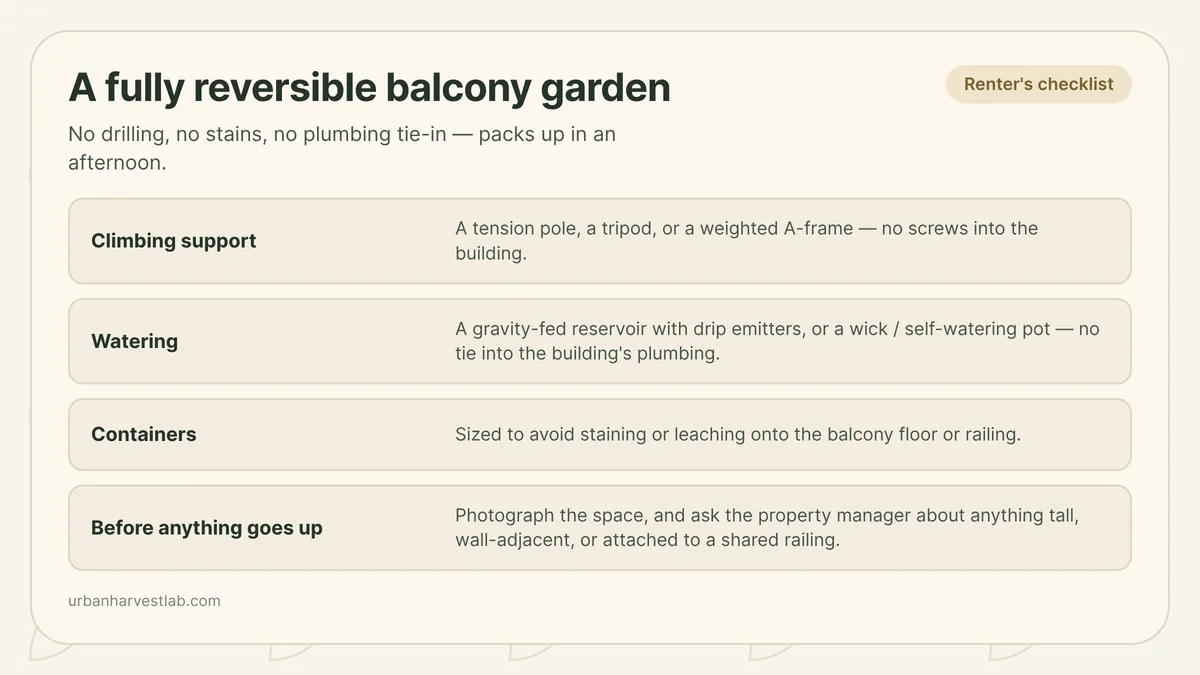
A renter's checklist for a fully reversible balcony garden
A rental garden holds up under a lease when nothing in it is drilled, stained, or plumbed in permanently -- the container, support, and watering choices that keep it that way, in one before-you-start checklist.
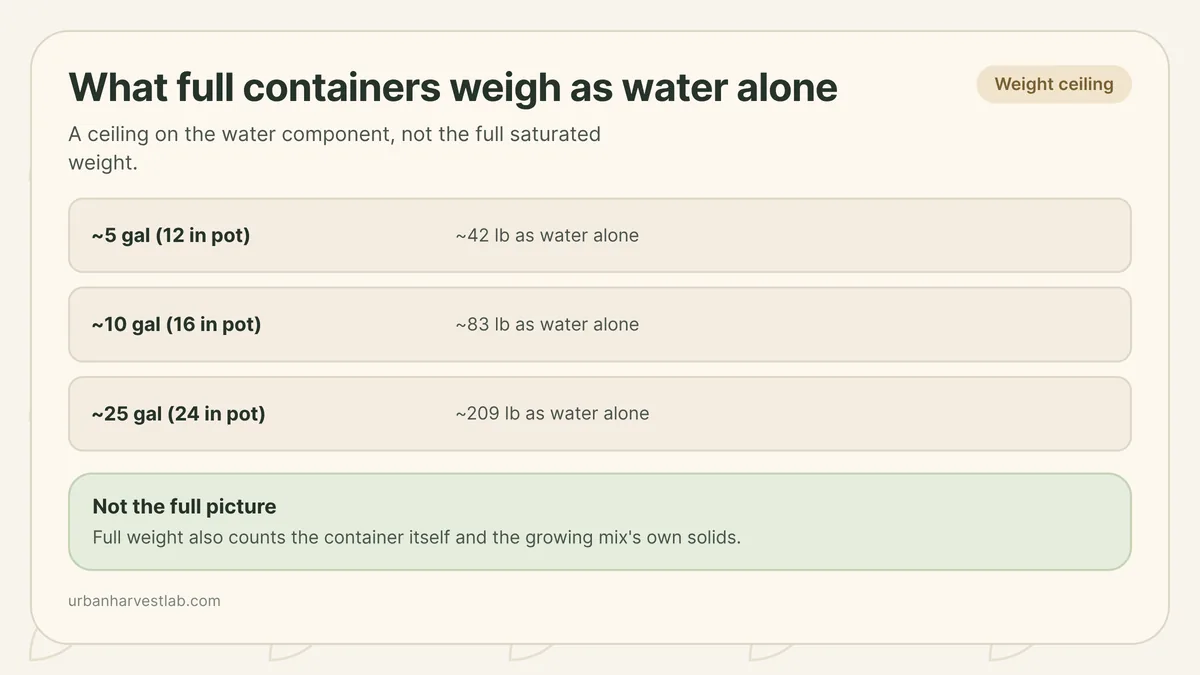
Balcony weight limit: calculate what your container garden really weighs
A balcony's real weight allowance comes from its own structural documentation, not a one-size figure online. What you can calculate yourself is exactly how much your containers weigh once every one of them is soaked through.