Troubleshoot the system before you change the inputs.
Symptoms
- Pale, bleached or faded patches on the top leaves, directly under the fixture.
- Brown, crisp edges or tips on the leaves closest to the light, while leaves lower on the plant look fine.
- Leaves that curl or dry out under the lamp, with mix that dries faster than the rest of the tray.
Possible causes
- Too much light at the leaf: the fixture is too close, turned up too high, or the plant was moved under strong light without time to adjust.
- Heat at the canopy, especially on an enclosed top tier, adding to the light stress.
- Look-alikes: dry mix, fertiliser salts building up, which can scorch margins with the light innocent.
Quick fixes
- Raise the fixture or dim it, then re-check the leaves after several days of new growth.
- Check the mix and the air temperature at leaf height before blaming the lamp.
- If the mix is salty or over-fertilised, flush it with plain water and hold the feed.
Bleached, pale or crisp leaves right under a grow light usually mean the light is too intense for that plant at that distance, sometimes with heat or dry mix making it worse. The fix is to move the light up or turn it down, then watch the new leaves. Before you do, take a moment to confirm it is the light, because three other problems wear the same face.
Read the pattern on the plant
University of Maryland Extension describes the damage plainly: “Damage appears as pale, bleached or faded areas. These areas eventually become brown and brittle.” That sequence is the signature. It starts pale, then dries out.
Where it sits tells you more than what it looks like. Light is strongest at the top of the canopy and directly under the fixture, and University of Maryland Extension notes that light intensity “decreases rapidly with increasing distance” from the source. So burn is worst on the highest leaves and the ones in the centre of the beam, and it fades as you look down and out toward the edges.
If the oldest, lowest leaves are the ones going yellow or brown, or the damage is spread evenly over the whole plant, the light is not the likely cause. Start with watering instead, using overwatered vs underwatered.
Rule out the look-alikes
Three things scorch leaves without the lamp being to blame, and one of them often travels with light burn.
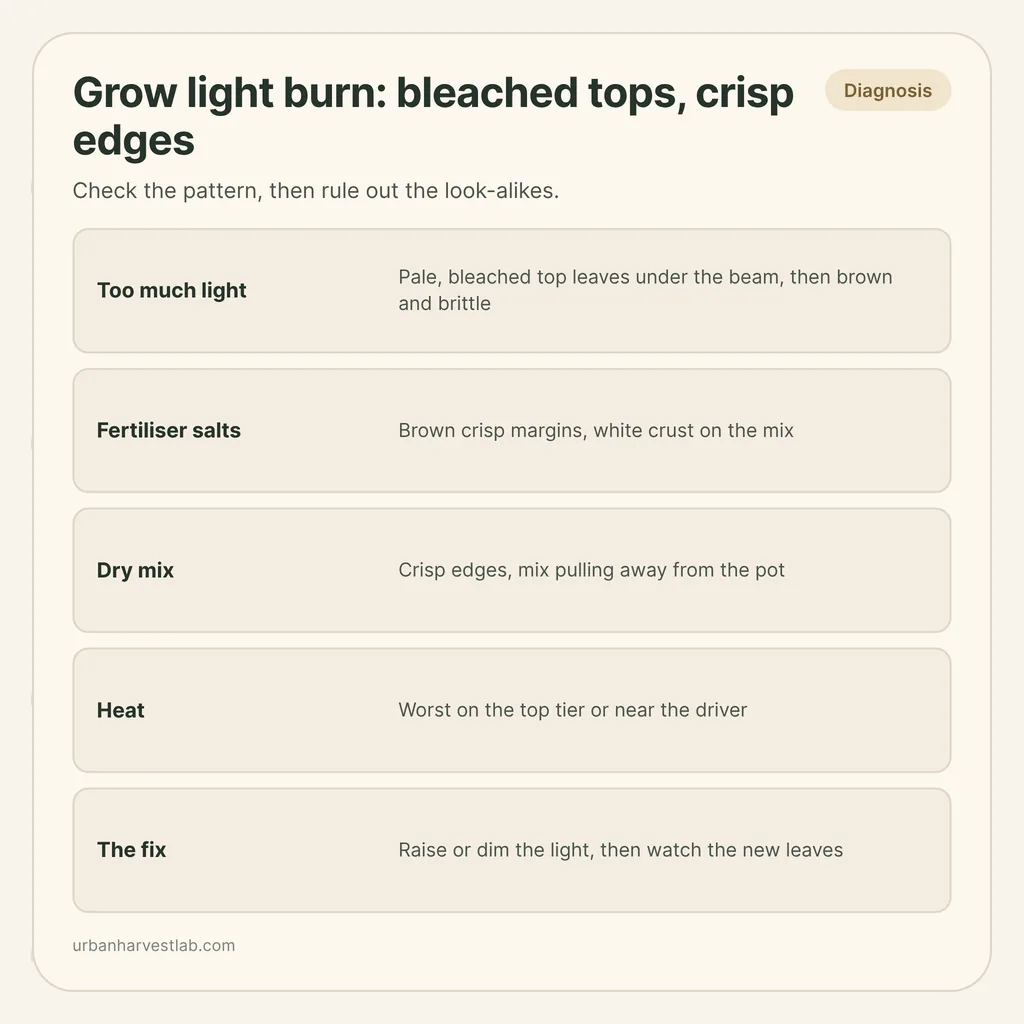
| What you see | Likelier cause | Quick check |
|---|---|---|
| Pale or bleached top leaves, worst under the beam | Too much light | Does it fade lower down and toward the tray edges? |
| Brown crisp margins, white crust on the mix or pot rim | Fertiliser salts | Look for crust; see salt build-up in herb pots |
| Crisp edges, mix pulling away from the pot | Dry mix | Lift the pot; push a finger into the mix |
| Damage worst on the top tier or near the driver | Heat | Feel the air at leaf height; see heat management |
University of Maryland Extension lists “over-fertilization, high soluble salts, lack of water” as causes of scorch that “can occur along leaf margins or between veins”, and separately lists “Excessive light or sunburn” for bleached or whitened leaves. Its fix for salts is to “leach excessive fertilizer from potting mix by flushing with water or repot with fresh potting media.”
Dry mix matters twice. It scorches leaves by itself, and the same extension page says the symptoms of strong light “are more severe when strong sun is combined with dry soil conditions.” A lamp that dries the mix faster than you water it can turn a mild problem into a visible one.
Light, heat or both
University of Maryland Extension puts it as “strong sun and heat” breaking down chlorophyll, so the two are not separate suspects. An LED puts out far less radiant heat at the leaf than older lamps, which is the reason people hang them close, but a close fixture over an enclosed top tier can still warm that leaf and the air around it. The heat management guide covers where the warmth collects on a shelf and how to let it escape.
A rough test: if the damage follows the beam on an open, cool shelf, think intensity. If it follows the warm spot, the top tier, the area next to the driver or a closed cabinet, think heat first and intensity second.
What to change, in order
- Raise the fixture or dim it. Burn is a problem of intensity at the leaf, so this is the direct fix. The grow light distance guide explains how to set height from the fixture’s output rather than from a rule of thumb, and PPFD and DLI for indoor herbs shows how to measure what actually reaches the canopy.
- Fix the mix. Water if it is dry. If you see salt crust, flush as above.
- Bring hours back into range. University of Maryland Extension advises against more than 16 hours of light a day, because plants need a dark period. If you are near that line, see how many hours herbs need.
- Introduce changes gradually. The same extension service says to “acclimate plants slowly to higher light intensities” and, for plants moved into sun, to start at 2 hours a day and build up. A plant that has been under a weak lamp can burn when you suddenly raise the output or move it closer.
Change one thing, then wait. Damaged tissue does not come back, so the test of the fix is the next leaves that open.
More light is not always more growth
It is tempting to push the lamp harder once plants are growing well. Frontiers in Plant Science, in a basil study, notes that “a light saturation response occurs when plant growth gets limited by other factors, e.g., CO2, temperature or nutrients.” Once the plant cannot use more photons, extra intensity buys damage rather than growth. The daily target for each herb sits in DLI targets for herbs and leafy greens, and the usual mistakes that push a shelf past it are in grow light schedule mistakes.
Sources
- University of Maryland Extension: Excess Light on Indoor Plants
- University of Maryland Extension: Lighting for Indoor Plants
- University of Maryland Extension: Diagnose Indoor Plant Problems
- Frontiers in Plant Science (2020): Response of Basil Growth and Morphology to Light Intensity and Spectrum in a Vertical Farm
Fix the light, not just the leaf
Once you know it is the light, these set the distance, the daily dose and the heat.
Common questions
How do I know if my grow light is burning my plants?
Look at where the damage is. Light burn is worst on the leaves nearest the fixture and eases lower down the plant, and it starts as pale, bleached or faded patches that later go brown and brittle (University of Maryland Extension). Damage spread evenly over the whole plant, or worst on the oldest leaves, points elsewhere.
Will bleached leaves turn green again?
Treat the damaged tissue as permanent. Fix the cause and judge the result by the new leaves, which should come in a normal green. Trimming badly damaged leaves is a cosmetic choice, not a cure.
Can an LED burn leaves if it feels cool?
It can. A cool-running LED is mainly a reason you can hang it closer, and intensity at the leaf is what counts. University of Maryland Extension describes strong light and heat together breaking down chlorophyll, and says the damage is worse when the mix is dry. Check both the distance and the temperature at the leaf.
Should I shorten the light hours or raise the light?
Raise or dim the fixture first, because burn is about intensity at the leaf. University of Maryland Extension advises no more than 16 hours of light a day, so hours matter at the limit, but cutting hours on a light that is simply too close lowers the daily dose without removing the strong exposure.
Related guides

Grow light heat management: what actually matters on a shelf
A warm top shelf is not just a comfort problem. It changes the light your herbs want and wears the fixture down faster, and the fix is usually smaller than a fan.

Grow light mistakes that stress herbs more than they help
Most grow light problems trace back to a handful of repeatable mistakes, not a mysterious plant failure — and most of them show up as a visible sign you can check today.
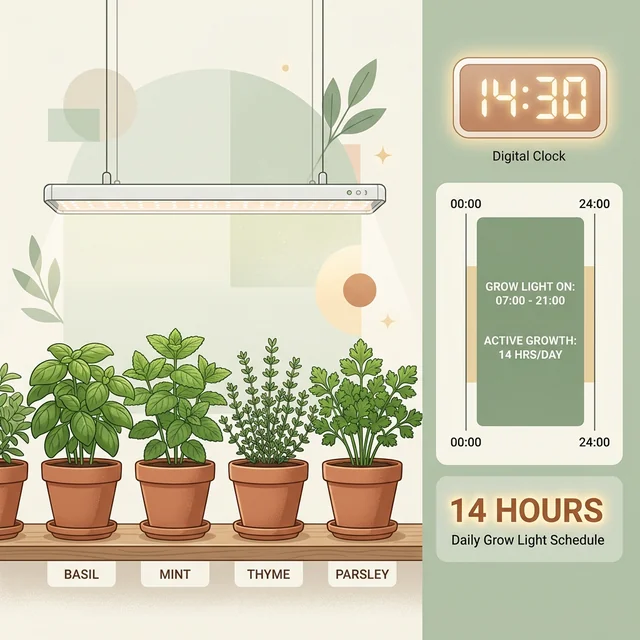
How many hours should grow lights run for herbs? 12-16
Most herb grow lights should run about 12 to 16 hours per day, but intensity, distance, and a stable dark period matter as much as the timer itself.