
How the four tiers typically differ on the same rack
| Tier | Typical heat | Typical height budget | What that favors |
|---|---|---|---|
| Top | Warmest — collects heat rising from every tier below plus its own fixture | Often the most headroom, if nothing is stacked above the unit | Herbs whose light requirement falls as temperature rises, so a fixed fixture output covers more of it |
| Upper-middle | Warmer than the bottom, cooler than the top | Set by the shelf spacing above it | A middle ground; check both heat and clearance before assigning a crop |
| Lower-middle | Cooler than the top two tiers | Whatever the shelf spacing gives it — measure rather than assume | Fast, compact crops that finish before they threaten the shelf above |
| Bottom | Coolest — least accumulated heat from tiers above, since there are none | Often generous if the unit sits on the floor with no shelf underneath | Herbs whose requirement is lowest when cool, so a modest fixture is enough, and anything needing a longer runway before harvest |
A four-tier shelving unit with a light under each shelf is not four separate grow-light setups stacked on top of one another. The mechanics of lighting one shelf on its own are covered on how to grow herbs indoors under a grow light; what follows is what changes once you stack four.
Treat the rack as one system with four interacting zones, not four copies of the same shelf. Heat moves upward through it, the shelf above each tier fixes a maximum plant height for that tier, the middle of each shelf is worth more light than the ends, and the wiring for four fixtures needs a plan before it needs a fourth extension cord. Handle those four things in order and the rack behaves the way you expect it to.
Why a tier is not an independent shelf
It is tempting to plan a four-tier rack as the same decision made four times: pick a light, pick a crop, repeat. That approach breaks down almost immediately because the tiers are physically connected in ways that plain shelves are not.
Heat is the clearest example. Warm air rises off a fixture and off the plants and growing medium under it, and on an enclosed or semi-enclosed rack it has nowhere obvious to go except up into the tier above. A fixture running on the second shelf from the bottom is not just warming its own tier — it is contributing to the temperature the tier above it experiences too. Grow light heat management covers where that heat actually concentrates and what to do about it in detail; the point that matters here is that heat accumulates through the stack, so the top tier inherits warmth from everything below it rather than starting from the same baseline as the bottom.
Cables and drivers stack up the same way plants do. A single shelf light needs one cord and one plug. Four fixtures need four cords, and typically four drivers, all routed down or around a unit that also holds pots of wet growing medium. What is a minor tidiness question on one shelf becomes a real safety question across four.
Timing compounds too. One shelf on one timer is simple. Four shelves can run on one timer if every tier is happy with an identical photoperiod, or on separate timers if they are not — and that decision has to be made once, for the whole rack, rather than shelf by shelf as an afterthought.
And then there is the ceiling effect: the shelf sitting above a tier is a physical limit on how tall anything on that tier can get before it runs into the light fixture or the shelf itself.
Height per tier is the constraint everything else bends around
Before choosing a single fixture or a single crop, measure the vertical clearance on each tier — the gap between the top of the growing medium and the underside of the shelf (or fixture) above it. That number, more than any spec sheet, decides what can live on that tier.
A tier with four or five inches of clearance above the pot rim is a tier for something that stays short and finishes fast: microgreens, a tight tray of cut-and-come-again greens, or herbs kept in a compact, frequently harvested state. A tier with a foot or more of clearance can carry something that actually grows upward over weeks, like a basil plant left to bulk up rather than be cut back constantly.
This is why “which herb goes where” is a measurement question before it is a preference question. A rack built from evenly spaced shelving often has identical clearance on every tier, which simplifies things, but plenty of units do not: a taller gap at the bottom for larger pots, tighter gaps above for trays. Whatever the spacing turns out to be, assign crops to the space that exists rather than picking a favourite herb and discovering three weeks in that it has reached the fixture.
A plant that outgrows its clearance does not simply stop — it either gets scorched or stressed by proximity to a fixture it was not given room to clear, or it has to be cut back hard and early, throwing off whatever growth cycle you were expecting. Neither outcome is a fixture problem; it is a mismatch between the crop’s mature height and the box it was planted into.
Zoning by light need, not by tidiness
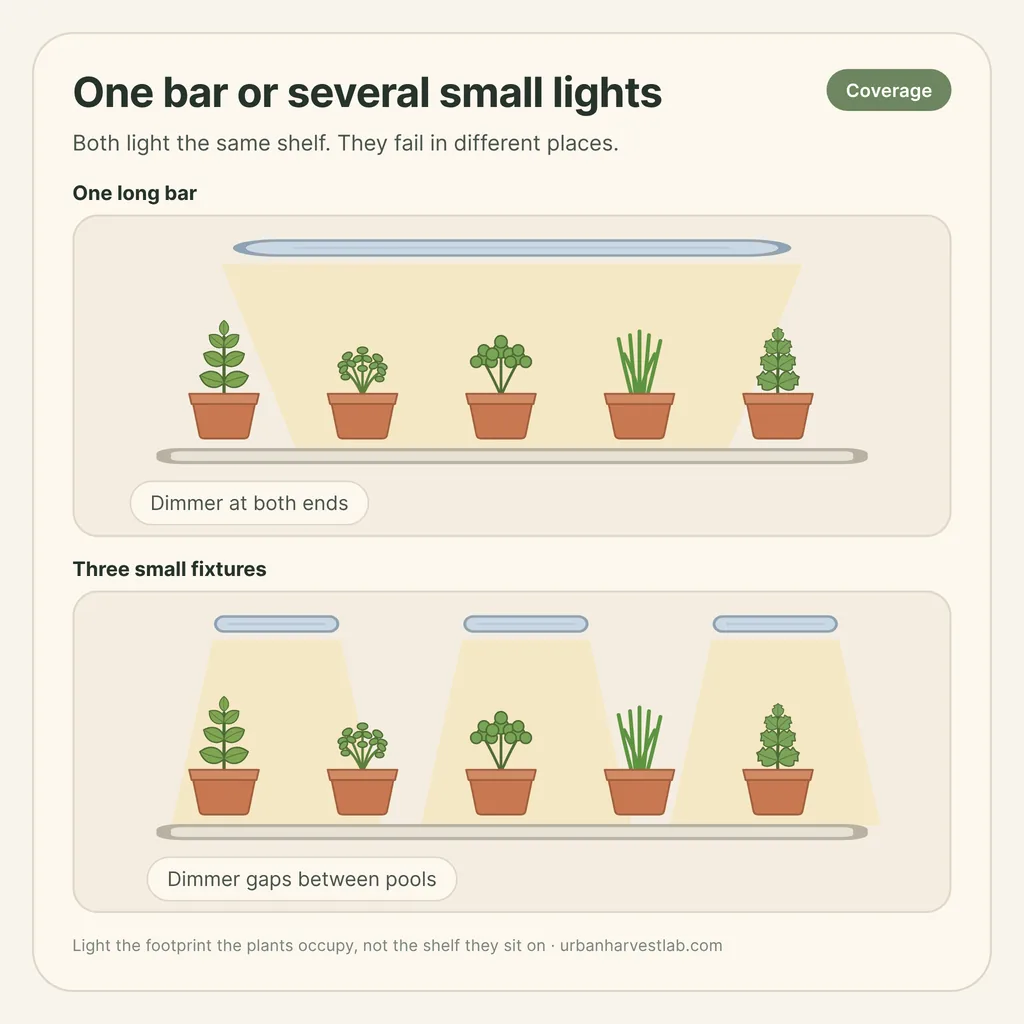
Once height has sorted out which tier a crop can physically occupy, the next decision is where on that tier to put it. It is natural to arrange pots evenly across a shelf for a neat appearance, but light does not fall evenly across a fixture’s spread. It is strongest in the middle of the coverage area and weaker toward the ends of a shelf and the edges of whatever pattern the fixture throws — a fact that matters most on any shelf wider than a single fixture’s sweet spot.
The practical consequence is straightforward: the crop that wants the most light on a given tier belongs in the middle of that tier, not wherever it happens to fit visually. A herb that tolerates lower light, or one you have already decided is a lower priority on a heat- or height-constrained tier, is the better candidate for the ends. Working out how many fixtures a given shelf actually needs, and where their coverage genuinely overlaps or thins out, is covered on one grow light or several — that page is the place to work out fixture count; this one is about what to do with the spread once you have it.
It is also worth checking this zoning after the fact rather than only planning it in advance. A pot at the edge of a shelf that is visibly lagging its neighbours in the middle, on the same tier and the same schedule, is often telling you it sits in a dimmer part of the spread — worth moving before assuming the plant itself is the problem.
The heat gradient as a planting decision, not just a comfort issue
The top tier of a rack runs warmest, for the reason already covered: it collects heat rising off every tier beneath it in addition to its own fixture’s output. The bottom tier runs coolest, because there is nothing below it contributing heat upward. That gradient exists whether or not you plan for it — the only choice is whether to use it or ignore it.
That gradient is what turns a rack into a set of different growing positions rather than four copies of one. Modelling by Walters, Tarr and Lopez found that different culinary herbs’ optimum daily light integral moves in opposite directions as mean daily temperature rises, so which tier a pot sits on changes how much of that crop’s requirement a fixed fixture and schedule actually cover — DLI targets for herbs and leafy greens has which herb moves which way and the figures behind it. Nothing is disqualified from either end of the rack; what the gradient costs you is the assumption that a shelf position is neutral.
That also means a single blanket photoperiod or intensity target applied to the whole rack is a simplification, not a rule. It is a completely reasonable one for a home setup — running every tier the same way is far easier than customising four — but it is worth knowing what that simplification costs: on a mixed rack, the top and bottom tiers are not experiencing an identical growing environment even when the light schedule is. PPFD and DLI for indoor herbs covers how to actually measure what a given tier is receiving, which is the only way to know whether a tier’s real conditions match what the label on the fixture implies.
Cables, drivers, and one switch
The unglamorous part of a multi-tier rack is also where most home setups actually go wrong. Four fixtures typically means four drivers and four cords, all sharing space with pots of wet growing medium, and a rack that started tidy tends to accumulate loose cable and stacked power strips faster than expected.
On a four-tier rack, plan where each tier’s driver will hang before the unit is planted and moving it becomes awkward. ENERGY STAR requires an indoor luminaire to still deliver 70% of its initial output after 25,000 hours — the L70 rating — and that projection assumes the fixture runs in the thermal conditions it was tested under, which the top of a four-tier stack is the least likely place on the rack to provide. How long LED grow lights actually last covers what the rating does and does not promise. Grow light heat management covers why a driver needs open air in the first place.
Four fixtures means four cords crossing three tiers of wet growing medium, so decide the routing once, for the whole unit, rather than per shelf. Grow light safety covers drip loops, strip load ratings and daisy-chaining in full.
On timers: one timer running the whole rack is simpler and works fine as long as every tier is meant to run the same photoperiod. Once a tier needs a different schedule from the rest — a taller crop with a longer runway wanting more hours than a fast tier below it, say — a single timer can no longer serve both, and that is the point to split the rack across two or more timers rather than compromise on one schedule that suits no tier particularly well. Choosing a grow light timer covers the timer choice itself in more depth.
What four fixtures add to the electricity bill
Four fixtures do not just multiply the draw — they multiply the draw by however many hours each one runs, and those hours do not have to match across tiers. Photoperiod is the multiplier actually under a grower’s control: a tier of fast, compact microgreens that finishes in days does not need as long a day as a tier of basil bulking up over weeks, and giving it one anyway is paying for light nobody on that tier is using. The same schedule decision doubles back on the heat picture from earlier — a tier running a longer day is also the tier accumulating the most heat, on top of whatever it inherits from the tiers below. What a grow light costs to run covers the actual calculation, using each tier’s measured draw and its own hours rather than a single rack-wide guess.
Common mistakes on a four-tier rack
Planning each tier as an isolated shelf, then being surprised that the top tier runs hotter or that a plant on tier three has grown into the shelf above it, is the most common one. Both are consequences of treating the rack as four separate decisions instead of one connected system.
Ignoring the height budget until a plant hits the shelf above it is close behind. Measuring clearance before planting takes a minute; cutting back an overgrown plant mid-cycle, or discovering a fixture has been scorching new growth for a week, costs considerably more.
Arranging pots for visual symmetry rather than checking where the light actually falls strongest on each tier wastes the rack’s best real estate on whatever crop happened to end up in the middle by accident rather than by design.
And running four fixtures off whatever cords and strips were on hand, without a plan for where each driver sits or how the load is distributed, is the mistake most likely to turn into an actual hazard rather than just an inefficiency. A four-tier rack has four times the wiring of a single shelf; it deserves four times the attention to how that wiring is arranged.
Sources
Turn the system into a working rack
Once the whole-unit picture is set, these cover the pieces that make one tier work well on its own.
Common questions
Does every tier on a grow light shelf need the same fixture?
No. Each tier has its own height budget, its own position in the rack's heat gradient, and potentially its own crop, so the fixture that suits a tight bottom tier of microgreens is not necessarily the one that suits a taller top tier of basil. Treat the choice per tier rather than buying four of the same thing by default.
Which tier should get the tallest herbs?
Whichever tier has the most vertical clearance to the shelf above it, since that gap is the hard limit on how tall a plant can grow before it reaches the light. Measure the clearance on each tier first, then assign crops to fit the space rather than picking crops and hoping they fit.
Is the top tier of a herb rack too hot to use?
Usually not too hot to use, but it does run warmest, because heat from the tiers below rises and collects there along with heat from its own fixture. That makes it worth treating differently rather than avoiding outright. A warmer tier does not simply help or hurt: it shifts how much daily light a crop actually wants, and it shifts it up for some herbs and down for others, so the top tier is a different growing position rather than a worse one.
Can I run all four tiers off one timer?
You can if every tier runs the same photoperiod, and for many home racks that is the simplest and most reliable setup. Once tiers need different schedules — a taller crop wanting longer days than a fast-growing one below it, for instance — a single timer stops being able to serve both, and that is the point to consider splitting the circuit.
Related guides
One grow light or several: how to decide
There is no fixed ratio of lights to shelf feet. The count follows from your plants' footprint and their light target, and it changes depending on whether they sit in a row or a cluster.

DLI targets for herbs and leafy greens: what to aim for
A single DLI number does not fit every herb. Here is the general target for leafy greens, and what published research on basil, sage, and mint actually measured.

Grow light heat management: what actually matters on a shelf
A warm top shelf is not just a comfort problem. It changes the light your herbs want and wears the fixture down faster, and the fix is usually smaller than a fan.