Oklahoma State University Extension: optimum EC and pH for crops people try to combine
| Crop | EC (mS/cm) | pH |
|---|---|---|
| Basil | 1.0 to 1.6 | 5.5 to 6.0 |
| Sage | 1.0 to 1.6 | 5.5 to 6.5 |
| Peppers | 0.8 to 1.8 | 5.5 to 6.0 |
| Lettuce | 1.2 to 1.8 | 6.0 to 7.0 |
| Pak choi | 1.5 to 2.0 | 7 |
| Cucumber | 1.7 to 2.0 | 5.0 to 5.5 |
| Parsley | 1.8 to 2.2 | 6.0 to 6.5 |
| Spinach | 1.8 to 2.3 | 6.0 to 7.0 |
| Tomato | 2.0 to 4.0 | 6.0 to 6.5 |
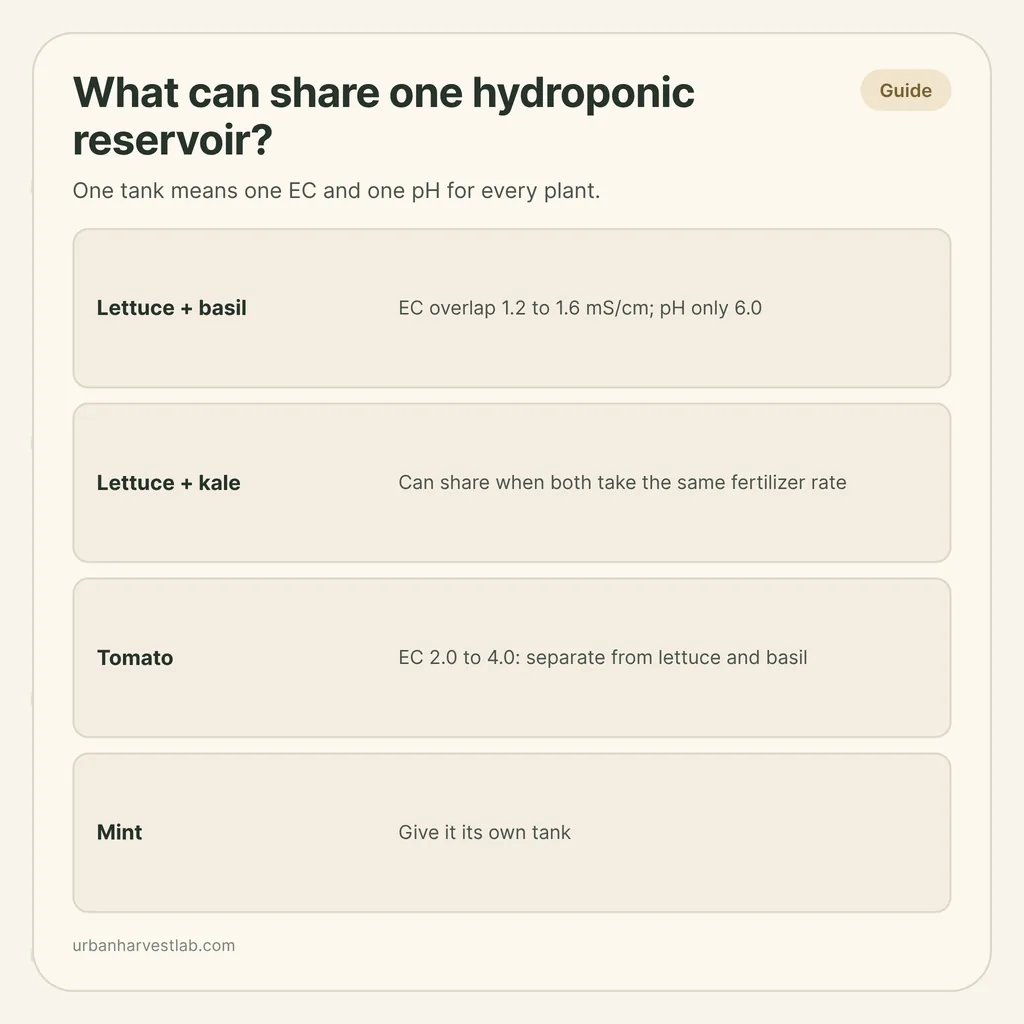
Crops can share a hydroponic reservoir only where their published EC and pH ranges overlap, and the overlap has to be wide enough to sit inside rather than on its edge. Lettuce and kale can share when both take the same fertilizer rate, and lettuce and basil can share but are narrow on pH. Tomato fails against lettuce and basil on EC; against spinach and parsley it clears only on paper and fails on feeding stage and crop cycle. Mint belongs in a tank of its own.
The reason is simple. A reservoir feeds every plant connected to it from one solution, so there is one EC reading and one pH reading to set. You cannot give the lettuce its number and the tomato its number. You pick one, and one of them lives with it.
Read the overlap, not just the range
Start with the EC chart by crop or the table above, then compare two crops at a time. Oklahoma State University Extension labels its figures the optimum range for each crop, in mS/cm. What matters for sharing is the stretch both crops accept.
- Lettuce and basil. Lettuce is 1.2 to 1.8, basil 1.0 to 1.6. By our arithmetic on Oklahoma State’s ranges, the EC overlap is 1.2 to 1.6. Oklahoma State publishes the ranges, not the overlaps. On pH, basil is 5.5 to 6.0 and lettuce 6.0 to 7.0, so the only pH both tables allow is 6.0 itself. That is workable, but narrow.
- Basil and sage. Both list 1.0 to 1.6 mS/cm, and sage’s pH range of 5.5 to 6.5 contains basil’s. These two match on paper.
- Lettuce and spinach. Lettuce tops out at 1.8 and spinach starts at 1.8. That is a single point, not a range, so one of them would sit at the extreme edge of what Oklahoma State calls optimum.
- Basil and parsley. Basil stops at 1.6 and parsley starts at 1.8. They share no EC at all, a split the guide to hydroponic herbs also flags.
Published ranges for the same crop do not agree with each other, which widens or narrows the overlap depending on whose number you trust. For lettuce, Oklahoma State gives 1.2 to 1.8 mS/cm, University of Florida IFAS Extension gives 1.4 to 1.8 as the ideal, and Virginia Cooperative Extension says many leafy greens perform well at 1.2 to 2.0. Cornell’s lettuce handbook states its target as 1150 to 1250 µS/cm above the source water, and tells growers to subtract the base EC of the source water from the sensor reading. If your tap water already reads 0.4 mS/cm, the meter number you aim for is higher than the crop’s number. Check your own source water before you judge an overlap.
Which combinations work
Leafy greens together. University of Minnesota Extension’s rule is the cleanest one in print: keep plants with different fertilizer requirements in different containers, but if lettuce and kale each take one teaspoon of fertilizer per gallon, they can grow together in the same container. Virginia Cooperative Extension reports that most plants grown in deep water culture perform well at pH 5.5 to 6.2, and that DWC systems mostly grow leafy greens and culinary herbs. That is the safest family to mix, and the crop pages for kale and spinach give each one’s own range.
Lettuce with soft herbs. Lettuce and basil can share if you hold EC in the overlap, near 1.4 to 1.6 mS/cm, and the pH around 6.0. At 1.4 you also satisfy the University of Florida’s lettuce range. Oklahoma State lists peppers at 0.8 to 1.8 mS/cm and pH 5.5 to 6.0, so on paper they overlap with basil too, but peppers are a fruiting crop with light and season needs that leaf crops do not share (see below).
Herbs with each other. Basil and sage match. Parsley is the outlier at 1.8 to 2.2. Pick herbs that sit in the same band, and grow the odd one out in its own jar.
When you are unsure, put the crops you want to mix in a spreadsheet with their ranges from one source, find the overlap, and drop the crop that leaves you with a sliver. A small meter is the tool that tells you whether you are actually holding the overlap: if you do not have one, browse EC and pH meters on Amazon or read the guide to pH and EC meters first.
When to split a crop out
Three tests separate a crop from the rest. Fail one and it needs its own reservoir.
- No EC overlap. Tomato at 2.0 to 4.0 mS/cm starts above the top of lettuce (1.8), basil (1.6), sage (1.6) and peppers (1.8). Minnesota’s extension page names tomatoes and lettuce as the example of two crops that belong in separate containers.
- A feeding programme that changes with growth stage. University of Florida’s tomato programme says small amounts of nutrients are needed early, and demand rises as the crop grows, especially after several clusters of fruit have set. The same publication warns that too much nitrogen early in the season makes plants too vegetative, which it calls bullish growth. A tomato’s solution moves through stages, and a lettuce planted beside it cannot follow.
- A different crop cycle. Minnesota says a set-it-and-forget-it approach should only be used for short-lived crops such as lettuce, harvested in 6 to 7 weeks. For tomatoes, which need an entire growing season, or an herb you will keep harvesting, it advises changing the water, and suggests switching the solution entirely once or twice for a longer-season crop. A reservoir shared by a lettuce crop of 6 to 7 weeks and a season-long tomato gets drained for one on the other’s schedule. The page on when to change nutrient solution covers topping up against a full reset.
There is a trap in the numbers. Oklahoma State’s table, read mechanically, does overlap tomato with parsley and with spinach at EC 2.0 to 2.2 and 2.0 to 2.3, because those two begin at the bottom of tomato’s range. A table cannot see the stage programme or the cycle length, so a paper overlap is a necessary condition for sharing, not a sufficient one.
Season and light split them as well. Minnesota calls herbs and leafy greens great choices for winter indoor production, and strawberries, tomatoes, cucumbers and peppers great choices for summer. It adds that growing heat-loving plants indoors needs added heat and light that would be cost-prohibitive for most gardeners. If the lettuce lives on a windowsill in January and the tomato lives on a balcony in July, they were not going to share a tank. The indoor tomato page covers what a tomato needs.
Cucumber also stands apart on pH. Oklahoma State gives it 5.0 to 5.5, below the pH range of tomato (6.0 to 6.5) and lettuce (6.0 to 7.0). University of Florida adds that cucumbers need more nitrogen early in the season than tomatoes do, because they grow faster.
Mint gets its own tank
Mint is not in Oklahoma State’s 27-crop table, so it has no listed range to overlap with anything. Its separation does not rest on a number anyway: the habit that makes it a poor tank-mate is described in hydroponic mint: why it needs its own reservoir. Grow it in a separate bucket or jar and keep the shared reservoir for crops whose ranges match.
Setting up the split
If you want tomato, lettuce and mint on the same shelf, run three small reservoirs rather than one large one. A small DWC bucket per crop group keeps each solution at its own EC, and a fertilizer sized to each crop is easier to mix when you are not averaging between them. The guide to mixing hydroponic nutrients shows how to dilute for each tank.
Sources
- Oklahoma State University Extension HLA-6722: Electrical Conductivity and pH Guide for Hydroponics
- University of Minnesota Extension: Small-scale hydroponics
- UF/IFAS Extension HS1422: Growing Lettuce in Small Hydroponic Systems
- UF/IFAS Extension CV216: Nutrient Solution Formulation for Hydroponic Tomatoes in Florida
- Virginia Cooperative Extension SPES-464: Hydroponic Production of Edible Crops, Deep Water Culture Systems
- Cornell University CEA Program: Hydroponic Lettuce Handbook
Planning what goes in each reservoir
Crop-by-crop EC ranges, the herb that needs its own tank, and which herbs grow best together.
Common questions
Can you grow lettuce and tomatoes in the same hydroponic system?
Not in one reservoir. University of Minnesota Extension says tomatoes and lettuce should be kept in separate containers because they have different nutrient requirements. Oklahoma State's table agrees on the numbers: lettuce is 1.2 to 1.8 mS/cm and tomato is 2.0 to 4.0, so no single EC suits both.
What plants can share a hydroponic reservoir?
Plants whose published EC and pH ranges overlap. By our arithmetic on Oklahoma State's ranges, lettuce and basil overlap at EC 1.2 to 1.6 mS/cm (with a narrow pH overlap at 6.0), and basil and sage have identical EC ranges of 1.0 to 1.6. University of Minnesota Extension gives lettuce and kale as a pair that can share when both take the same fertilizer rate.
Can mint share a reservoir with other herbs?
Oklahoma State's 27-crop table does not list mint, so it has no listed range to overlap with. Give mint its own tank. The page on hydroponic mint explains the root habit behind that advice.
What EC do you set when two crops have different ranges?
Pick a value inside the overlap of both ranges, such as 1.2 to 1.6 mS/cm for lettuce with basil, by our arithmetic on Oklahoma State's ranges. If the ranges only touch at one end, or do not meet at all, the pair does not suit one reservoir and should be split.
Related guides
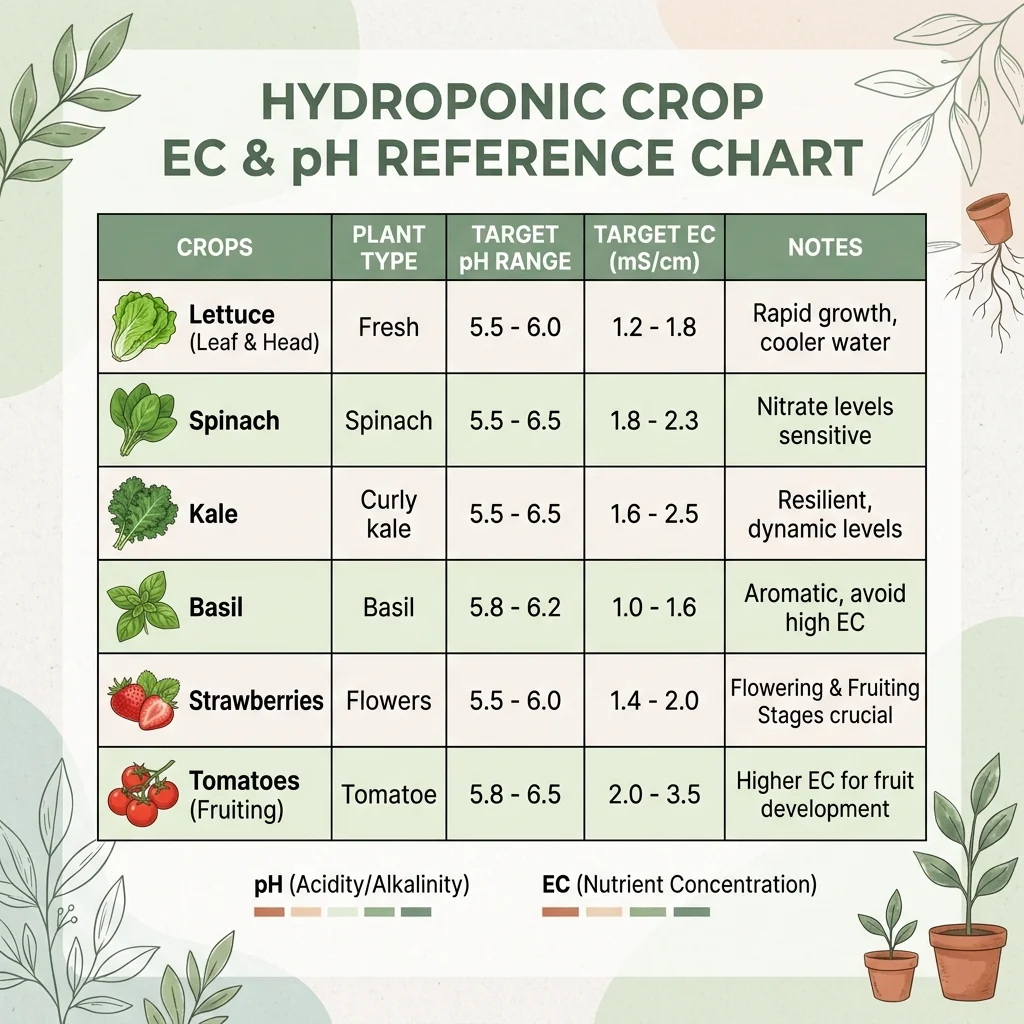
Hydroponic EC chart by crop (not just lettuce)
One reference chart for the EC and pH targets of common hydroponic crops, from leafy greens and herbs to fruiting plants, plus how to use the numbers safely.
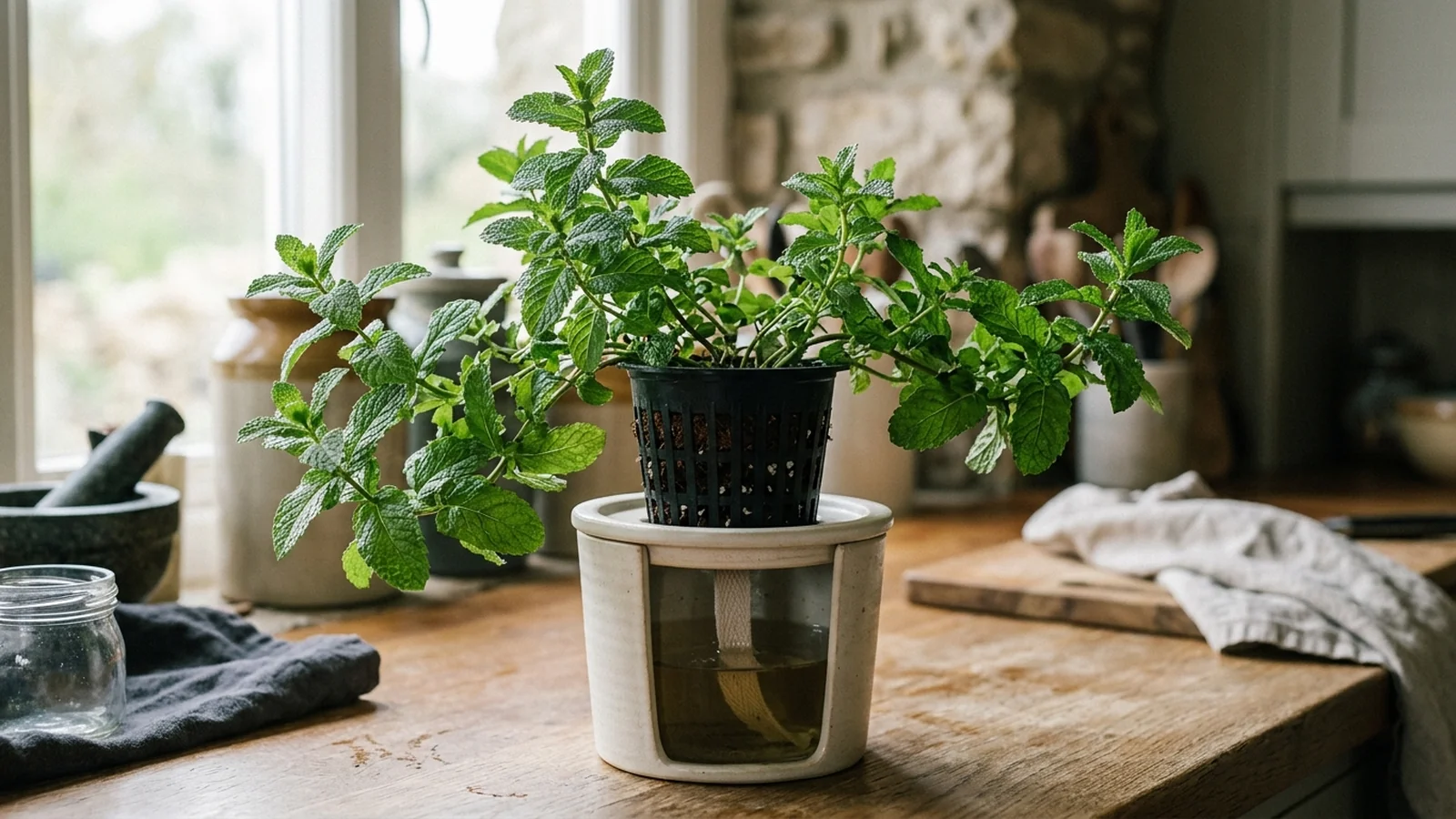
Hydroponic mint: why it needs its own reservoir
Mint's spreading roots make it one of the easiest hydroponic herbs and one of the worst reservoir-mates. Give it a system of its own and harvest it hard, and it rewards you all season.
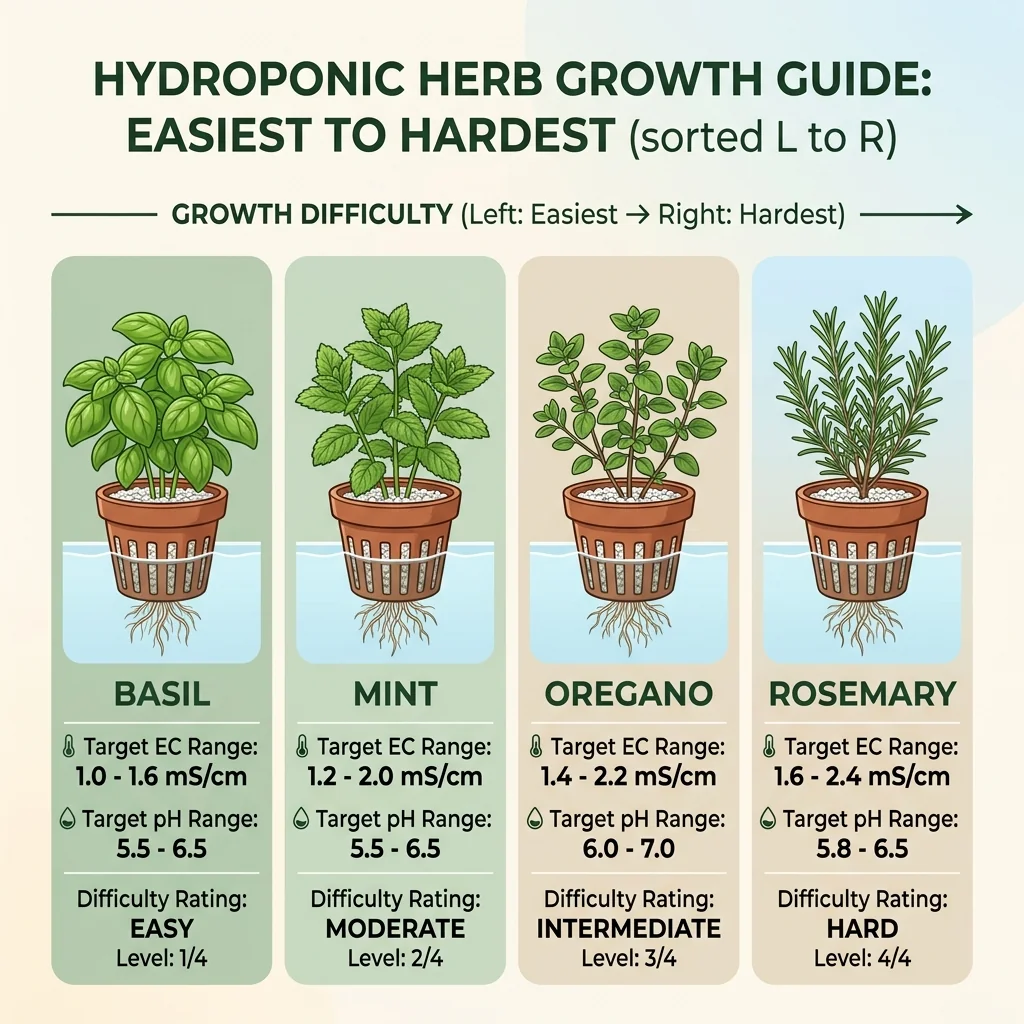
Hydroponic herbs: which grow best and how
Most soft, leafy herbs thrive in hydroponics, while woody Mediterranean herbs are trickier. Here is a ranked guide to which herbs grow best and how to set them up.