
Amaranth microgreens are a warm-season crop grown from a very small seed: sow it thinly by weight, start the tray warm, and cut at the cotyledon stage, between 10 and 18 days after sowing in three published trials, one from Penn State and USDA, depending on cultivar and conditions. The colour is the reason to grow it. Red and magenta cultivars give a tray that looks unlike the green brassicas, and the leaves are small enough to use as a garnish.
If this is your first tray of anything, start with the general method in the beginner microgreens guide and a forgiving crop from the best microgreens for beginners. Amaranth follows the same steps. What changes is the seed size, the temperature it wants and the timing.
The seed is the first difference
University of Florida IFAS describes vegetable amaranth seed as brown-black and tiny, approximately 0.04 inches across. A Penn State and USDA Agricultural Research Service trial put numbers on it: 1,000 Garnet red amaranth seeds weighed 0.779 g, against 58.3 g for 1,000 black oil sunflower seeds. A pinch of amaranth holds a very large number of seeds.
Two practical consequences follow.
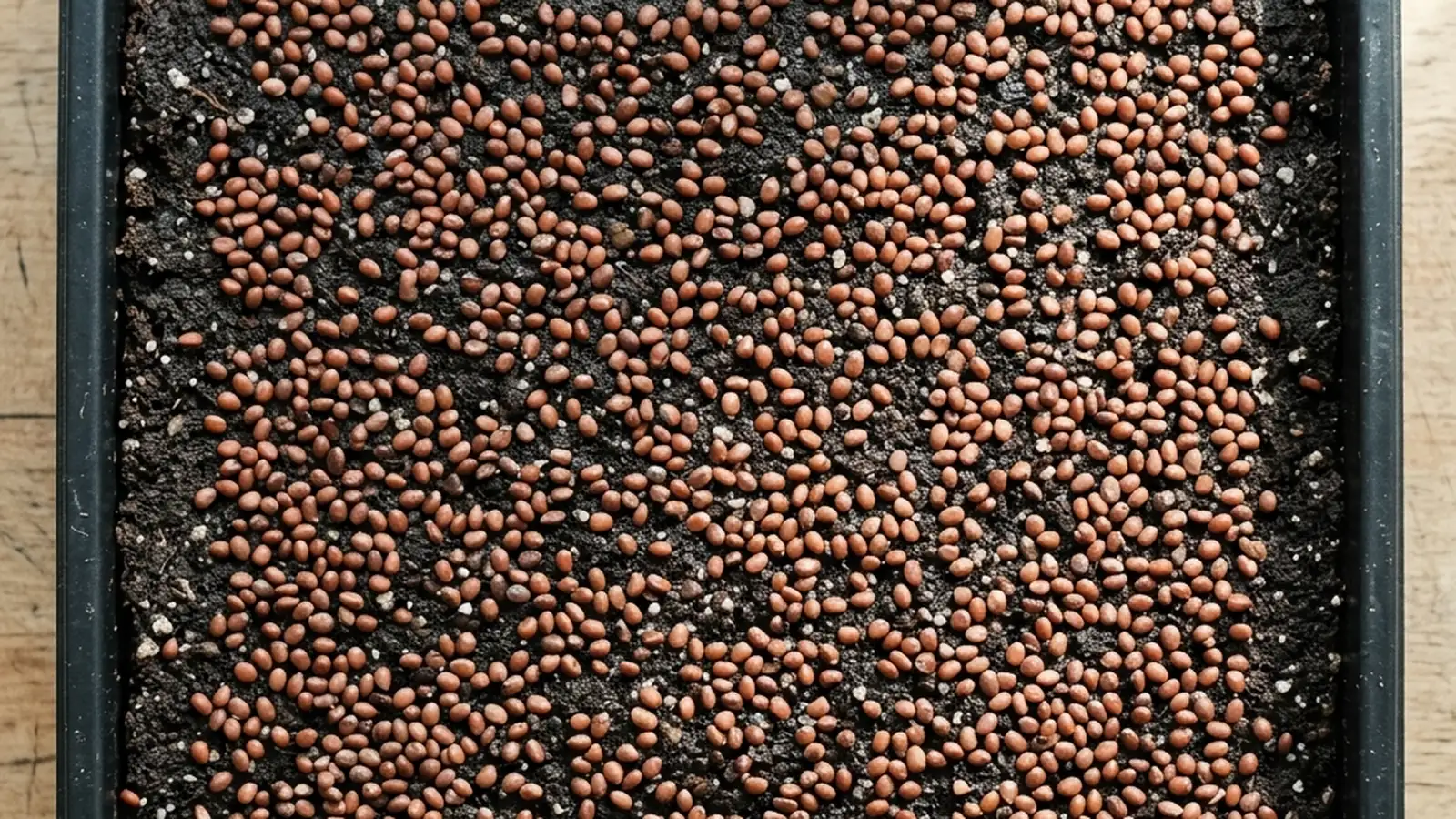
Sow by weight, not by eye. The trial sowed Garnet red amaranth at 7.5 seeds per square centimetre, about 48 per square inch, converted, and sunflower at 1.0 per square centimetre. Illinois Extension and Penn State Extension both quote 10 to 12 seeds per square inch for small seed in general, a rule of thumb that was not built around a seed this light, so check it against weight. A separate Horticulturae study recommended 80 g of seed per square metre on coconut fibre. Scaled by area, that is about 10 g on a 10 x 20 inch flat and about 12 g on a 12 x 20 inch tray, which lands inside Penn State Extension’s general 10 to 15 g for the larger tray. Both studies were soilless (a fibre mat in one, coconut fibre in the other), so treat the weights as a starting point and adjust after your first tray. The seed density chart shows how to rescale any gram figure to your tray’s area.
Thin beats thick. Penn State Extension and the RHS both list overcrowded seedbeds among the conditions that favour damping-off, and Penn State’s own photographed example is an overcrowded arugula bed. A dust-fine seed makes it easy to drop far too much in one shake, so spread it in two passes across the surface instead of one. Mississippi State Extension’s variety list gives 1 teaspoon of Red Garnet seed per tray, with no tray size stated, and adds that amaranth “needs to be grown very dry”, which fits the damping-off advice here.
There is no reason to soak it. The general presoak rule from the UC Master Gardener Program of Sonoma County is written for large seed, and Utah State University Extension lists a soak only for pea and sunflower. Amaranth does not appear in Utah State’s table. The seed soaking guide covers which crops do benefit.
Start it warm
Amaranth is a heat-loving plant, and the germination data reflect it. University of Florida IFAS reports that germination is rapid when soil temperature is higher than 68 F and that the germination rate may significantly slow down or fail below 50 F, with an optimum of 70 to 75 F. That guide covers field-grown vegetable amaranth, not trays, but the seed is the same genus and the temperature response is the one to plan for.
Penn State Extension gives 60 to 75 F for germination and 60 to 70 F for room air across microgreens in general. The bottom of that band sits below Florida’s 68 F threshold for fast germination. A kitchen that suits radish may therefore slow an amaranth tray without anything being wrong with the seed. Illinois Extension puts the ideal germination temperature at around 75 F and suggests a heat mat or a sunny spot at room temperature under a plastic lid. The USDA and Penn State trial grew its trays in a greenhouse averaging 25.4 C (about 78 F).
Do not push past the range either. The RHS names high humidity and poor air circulation as damping-off conditions, and a warm tray is a wet tray, so keep the air moving once the cover is off. Damping-off in microgreens lists the signs.
Covered time and the stretch
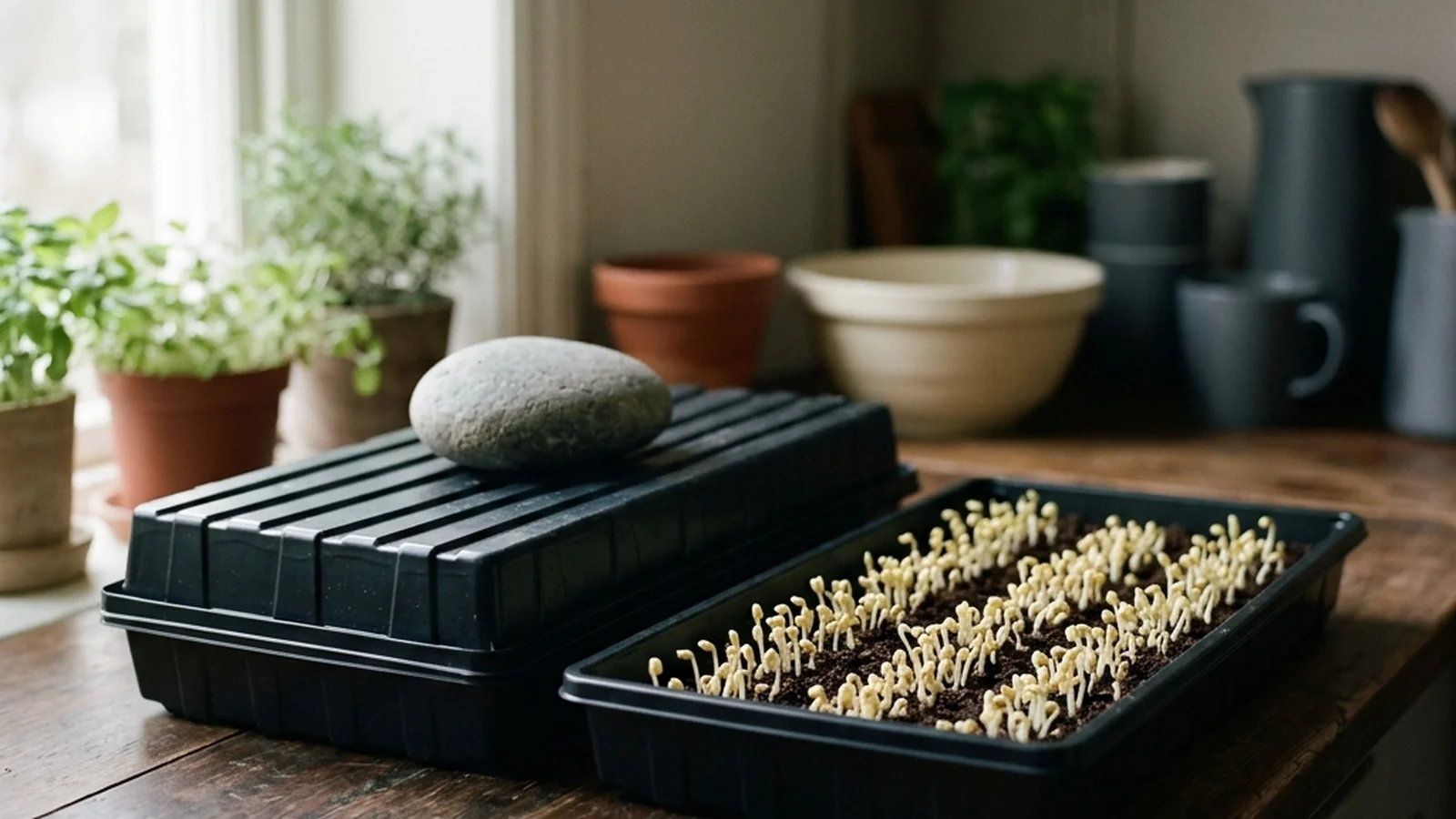
Utah State University Extension’s covered-time table does not list amaranth, and Penn State Extension says only that amaranth runs longer than the 7 to 8 day brassicas without giving a figure; Mississippi State Extension’s listing is the extension timing figure, 16 to 25 days. UC ANR’s general two-stage method uses 2 to 3 days under a weighted cover, then 1 to 2 more days inverted. Treat that as a starting point and lift a corner each day: the cue is the seedlings lifting the cover, not the day count. Microgreens blackout time by crop shows the figures other crops use and why they differ.
If seedlings flop once the cover comes off, microgreens falling over sorts out whether it is stretch, disease or water.
When to cut: three studies and an extension list
| Study | Cultivar | Harvest |
|---|---|---|
| Horticulturae (2025) | Asteca | 8 days of cultivation, 10 days from sowing |
| Pakistan Journal of Biological Sciences (2026) | Red amaranth and a small red-centred type | Compared 7, 10 and 14 days; 14 days gave the best balance of growth and phytochemicals |
| Penn State and USDA, Frontiers in Plant Science (2023) | Garnet red | 18 days |
| Mississippi State Extension (P2884) | Red Garnet | Slowest group, 16 to 25 days |
None of these is wrong. The cultivars differ, and so do the temperature, the light, the nutrient solution and the definition of ready. Penn State and USDA harvested at the commercial stage, which they describe as fully expanded, coloured and turgid cotyledons with the initial growth of true leaves. That is a cue you can see on a windowsill tray in a way that day 14 is not. The Pakistan study also found that plant height, dry weight, chlorophyll and phenolic content all rose with age between days 7 and 14, so a few extra days buy a heavier cut with more chlorophyll and phenolics, in that trial.
Cut about 1/4 to 1/2 inch above the soil line with clean scissors, the range Illinois Extension and Purdue Extension give. Penn State Extension says most microgreens do not regrow after a cut at the base, and no source here describes amaranth as an exception. The timeline planner turns a sowing date into a harvest window.
Expect a light, small crop
In the USDA and Penn State comparison, Garnet red amaranth yielded 897 g per square metre, below the trial mean of about 1,176 g, and its shoots weighed just 16.7 mg each, the lightest in the trial. The authors attribute low yields in amaranth, beet, scallion and lemon balm to smaller shoots or lower germination rates. That was on a fibre mat in a greenhouse, so it is a comparison between crops, not a promise for your tray. Penn State Extension’s measured yield table covers seventeen varieties and does not include amaranth. Mississippi State Extension expects 2 to 3 ounces from its Red Garnet entry, though it states no tray size, so treat it as a rough marker rather than a target. A light tray is normal, and the yield by tray size page shows what other crops return.
A note on nitrate and nutrients
The same USDA and Penn State study measured nitrate in seventeen species. Garnet red amaranth landed in the very high group, with scallion and others. The authors point out that for such species it could be possible to exceed the acceptable daily intake of 3.7 mg nitrate per kg of body weight if you ate a lot of them. That is a reason to use amaranth as a garnish by the pinch, not a reason to avoid it.
The Horticulturae study found that a half-strength nutrient solution was enough, and better than plain water, for amaranth on coconut fibre. That is a trial in fibre with no soil. For a tray in potting mix, Purdue Extension says the seed carries the nutrients needed up to the first true leaves, so no feeding is needed.
Sources
- University of Florida IFAS Extension: Production Guide of Vegetable Amaranth for Florida (HS1407): seed size and germination temperature.
- Di Gioia et al. (2023), Frontiers in Plant Science: Yield performance, mineral profile, and nitrate content in a selection of seventeen microgreen species: seed weight, density, days to harvest, yield and nitrate.
- Hongthongkham and Rattanasuk (2026), Pakistan Journal of Biological Sciences: Influence of Cultivar and Harvest Stage on Growth and Phytochemical Composition of Amaranth Microgreens
- Horticulturae (2025): Amaranth Microgreen Cultivation: Seeding Density, Substrate Type, Electrical Conductivity, and Application Interval of Nutrient Solutions
- Mississippi State Extension: Microgreen Varieties for the Mississippi Gardener (P2884): timing group, seeding rate, expected yield.
- Penn State Extension: Growing Microgreens: germination range and seeding rate.
- Penn State Extension: The ABCs of Microgreens
- Penn State Extension: Safeguard Your Seedlings from Damping-Off
- RHS: Damping off
- Illinois Extension: Growing Microgreens (PDF)
- Purdue Extension: Grow Microgreens at Home
- Utah State University Extension: Grow Your Own Microgreens
- UC Master Gardener Program of Sonoma County: Growing Microgreens
- UC ANR Coastal Gardener: Your Indoor Winter Garden
Get the basics of any tray right first
Amaranth follows the general microgreens method. These pages cover the parts that do not change from crop to crop.
Common questions
How long do amaranth microgreens take to grow?
Studies disagree because cultivar and conditions differ. A Horticulturae trial of Asteca amaranth ran 10 days from sowing, a Pakistan Journal of Biological Sciences trial compared 7, 10 and 14 days and favoured 14, and a Penn State and USDA greenhouse comparison harvested Garnet red amaranth at 18 days. Penn State Extension says only that amaranth runs longer than the 7 to 8 day brassicas, and Mississippi State Extension puts Red Garnet amaranth in its slowest 16 to 25 day group, which agrees with Penn State and USDA's 18 days. Cut when the cotyledons are fully open and coloured and the first true leaves are just starting.
How much amaranth seed do I sow per tray?
A Horticulturae study recommended 80 g per square metre on coconut fibre. Scaled by area, that is about 10 g on a 10 x 20 inch flat or about 12 g on a 12 x 20 inch tray, which sits inside Penn State Extension's general 10 to 15 g for a 12 x 20 inch tray. Mississippi State Extension lists 1 teaspoon of Red Garnet seed but gives no tray size. Weigh it rather than measuring by volume, and sow thinly because overseeding raises damping-off risk.
Why is my amaranth tray slow or patchy?
Cold is the first suspect. University of Florida IFAS reports that amaranth germinates rapidly above 68 F soil and may slow down or fail below 50 F. Penn State Extension's general germination range for microgreens is 60 to 75 F, so a room at the cool end of that range suits radish better than amaranth. Illinois Extension suggests a heat mat or a sunny spot near 75 F.
Are amaranth microgreens safe to eat?
They are a normal edible crop, but a USDA and Penn State comparison found very high nitrate in Garnet red amaranth microgreens, and the authors note that species with very high nitrate could push intake past the acceptable daily intake if eaten in large amounts. Use them as a colourful garnish rather than a daily bowl of greens, and follow the usual harvest and storage hygiene.
Related guides
Microgreens seed density: how to work out grams per tray
Seed density is the one variable that decides whether a tray comes up as an even carpet or a patchy, mould-prone mat. Here is how to calculate it from your own seed.
Microgreens blackout time by crop: what varies and why
Blackout time varies by crop — Utah State's table runs from 1-2 days for arugula to 7-14 for cilantro. Here is how that compares to the documented blackout methods, and how to judge readiness by the tray instead of the calendar.

Microgreens falling over: leggy stretch, disease, or water damage
A collapsed tray is not always damping-off. The stem at the medium line tells you whether the fix is more light, gentler watering, or the compost bin.