
Soak and cover protocols that include buckwheat
| Source | Soak | Covered stage |
|---|---|---|
| University of Florida Extension (Gardening Solutions) | 12 hours, then rinse and drain twice daily for 2 days | 4-5 days or until germination (general rule, all seeds) |
| Idaho State University | 6-8 hours (large seeds: peas, buckwheat, sunflower) | 3 days with a weight on the cover tray, then bright light out of direct sun for 24 hours |
Buckwheat microgreens are a large-seeded crop: soak the seed (University of Florida Extension says 12 hours, Idaho State University 6 to 8), keep the tray covered and weighted for about three days, then cut them young and eat them soon. They behave like sunflower and pea shoots rather than like a fast brassica, so the sunflower grow log is the closest day-by-day picture of what the tray does. One plant compound makes buckwheat worth reading about before you grow it in quantity.
Soaking: two protocols, one rule of thumb
Extension sources that name buckwheat do not agree on the soak. The University of Florida’s Gardening Solutions page lists buckwheat at 12 hours, followed by rinsing and draining the seed twice a day for two days. Idaho State University groups buckwheat with peas and sunflower as large seed and soaks all three for 6 to 8 hours, using at least three times as much water as seed by volume. The UC Master Gardener Program of Sonoma County gives a general presoak of 6 to 12 hours for large seed, and both protocols sit inside that range.
Utah State University Extension’s per-crop table does not include buckwheat. Either protocol is a defensible starting point. Choose one, write down what you did, and adjust on the next tray. The seed soaking guide covers the general logic for which seed needs it.
Sowing density
Idaho State University treats buckwheat as a large seed, and for large seed Penn State Extension and Illinois Extension both publish 6 to 8 seeds per square inch. On a 10 x 20 in. tray (200 square inches) that is roughly 1,200 to 1,600 seeds; on a 12 x 20 in. tray (240 square inches) it is 1,440 to 1,920. Counting seed this way avoids the problem of grams, since seed weight differs a lot between crops. The seed density chart shows how to rescale for your own tray. Penn State and Illinois do not name buckwheat in that density rule, so treat it as the rule for large seed in general.
Cover, light and watering
Idaho State University sets a weighted cover tray over the seeded tray for 3 days, lifting the lid daily to look, and takes the cover off when the seedlings start to lift their heads. It then keeps the tray in bright light, out of direct sun, for another 24 hours before moving it to a sunny window. University of Florida Extension gives a more general 4 to 5 days covered, or until the seeds germinate, for all of its crops. A University of Florida county-extension slide deck lists buckwheat among the crops suited to the inverted-tray method, where the seedlings lift the cover tray an inch or two. The same deck lists buckwheat among the seeds that do best in a growing medium rather than on a hydroponic pad. Cover time per crop is compared in the blackout period guide. Idaho State’s 3 days is a large-seed figure rather than one measured for buckwheat alone.
Idaho State University says larger seeds may be top watered but recommends building the habit of bottom watering for every tray. The bottom-watering guide shows the method.
Harvest: cut young
Penn State Extension and the UC Master Gardener Program of Sonoma County put most microgreens at 2 to 4 inches with true leaves just emerging. The University of Florida slide deck lists buckwheat among the “shoots” cut at 3 to 5 inches, with sunflower. Purdue Extension adds a flavour reason to keep the tray on schedule: microgreens become bitter the longer they grow, and it singles out sunflower as the worst case. Purdue does not say the same of buckwheat, so the useful reading is general: do not let a tray run long. Purdue cuts about 1/4 inch above the soil line and Illinois Extension 1/4 to 1/2 inch.
University of Florida Extension notes that buckwheat does not keep as well once harvested. Purdue gives about a week for microgreens in general, stored unwashed in the refrigerator and washed just before eating, so a buckwheat tray is best cut when you intend to use it. Illinois Extension takes a different view on washing at harvest to remove seed coats; the harvest and storage guide lays out both sides. For white fuzz on the seed or roots, see mold versus root hairs.
The hull
Buckwheat seed is sold with its hull on or removed, and the two behave differently. A 2021 paper on germinated buckwheat notes that sprouts for eating need the dehulled groat, but that buckwheat seeds are easily damaged during dehulling, so dehulled seed is fragile. For microgreens that means checking what your seed packet actually contains. Neither University of Florida nor Idaho State compares hulled and unhulled seed in a microgreens tray, so test a small tray before committing a full one.
Fagopyrin: what is known and its limits
Buckwheat contains fagopyrins. A 2013 study of common and tartary buckwheat sprouts in the journal Acta Pharmaceutica states that the herb contains fagopyrins, which cause sensitivity to light after ingestion, and found fagopyrin and flavonoids located almost exclusively in the cotyledons, the part you eat in a microgreen. By comparison with the toxicity of hypericin, the authors estimated that intake of buckwheat sprouts should be less than 40 g per day.
That figure is an estimate made by analogy with another compound, not a clinical threshold, and it was made for sprouts rather than a tray cut at the microgreen stage. It does not show that a handful on a salad is a problem. The Acta Pharmaceutica 40 g figure is per day of sprouts, so it matters most to someone eating buckwheat in quantity every day rather than as an occasional garnish. If you are unsure, treat buckwheat as a garnish or an occasional ingredient. For what microgreens as a group do and do not show for health, see the nutrition evidence page. New to growing any microgreen? Start with the beginner method.
Sources
- University of Florida IFAS Gardening Solutions: Microgreens
- University of Florida Duval County Extension: Growing Microgreens Can Be For Everyone (slide deck, hosted by Wisconsin Extension)
- Idaho State University: Growing Microgreens instructions, large seeds
- Kreft, Janeš and Kreft (2013), The content of fagopyrin and polyphenols in common and tartary buckwheat sprouts, Acta Pharmaceutica
- Germinated buckwheat: effects of dehulling on phenolics profile and antioxidant activity (PMC)
- Purdue Extension: Grow microgreens at home
- Penn State Extension: Growing Microgreens
- Illinois Extension: Growing Microgreens
- UC Master Gardener Program of Sonoma County: Growing Microgreens
- Utah State University Extension: Grow Your Own Microgreens
Handle a large-seeded crop
Buckwheat follows the same large-seed routine as sunflower and pea, so the soak, density and harvest guides apply.
Common questions
Do buckwheat microgreens need soaking?
Extension sources that include buckwheat soak it. University of Florida Extension gives 12 hours, then rinsing and draining twice a day for two days, while Idaho State University soaks its large seeds, buckwheat included, for 6 to 8 hours. Neither figure is a universal rule.
How long do buckwheat microgreens take to grow?
None of the extension sources that name buckwheat give a buckwheat-specific day count. Penn State, Illinois and Purdue Extension all put microgreens at 7 to 21 days overall, and Idaho State University covers a large-seed tray for 3 days before the seedlings go into light. Cut when the tray reaches the height you want and before it turns bitter.
Are buckwheat microgreens safe to eat?
Buckwheat plants contain fagopyrins, which a 2013 study in Acta Pharmaceutica says cause sensitivity to light after ingestion, and the compounds were found almost exclusively in the cotyledons of sprouts. The authors estimated an intake under 40 g of sprouts a day by comparison with hypericin. That is an estimate, not a clinical threshold, so a garnish-sized portion is the reasonable use.
How long do buckwheat microgreens keep after cutting?
University of Florida Extension notes that buckwheat does not keep as well once harvested, and Purdue Extension gives about a week for microgreens in general when stored unwashed in the refrigerator. Plan on eating buckwheat early in that window.
Related guides

Are microgreens healthy: what the nutrition evidence actually shows
The number gets repeated everywhere, usually stripped of the two words that make it accurate: one nutrient, one crop. Here is what the underlying study actually found, and what that does and does not tell you about eating microgreens.

Soaking microgreen seeds: which crops need it, and for how long
Soaking is not a step every crop needs. Two extension sources cover it — one general rule and one per-crop protocol — and they agree with each other.
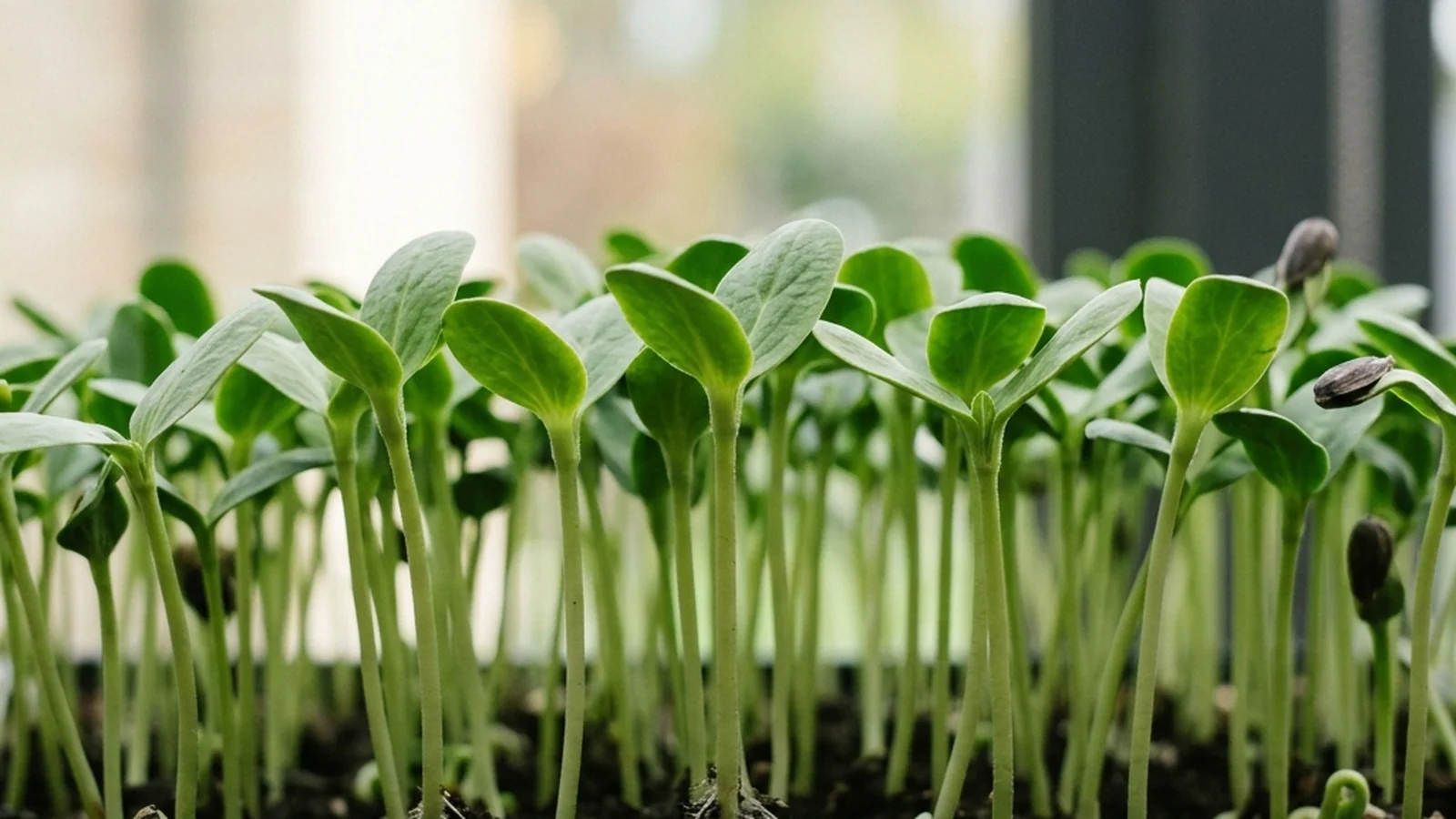
Sunflower microgreens grow log: a day-by-day timeline
Sunflower microgreens follow the same basic method as other crops, but the seed changes the process — a real presoak, a heavier blackout weight, and hulls that often do not let go of the cotyledons on their own.