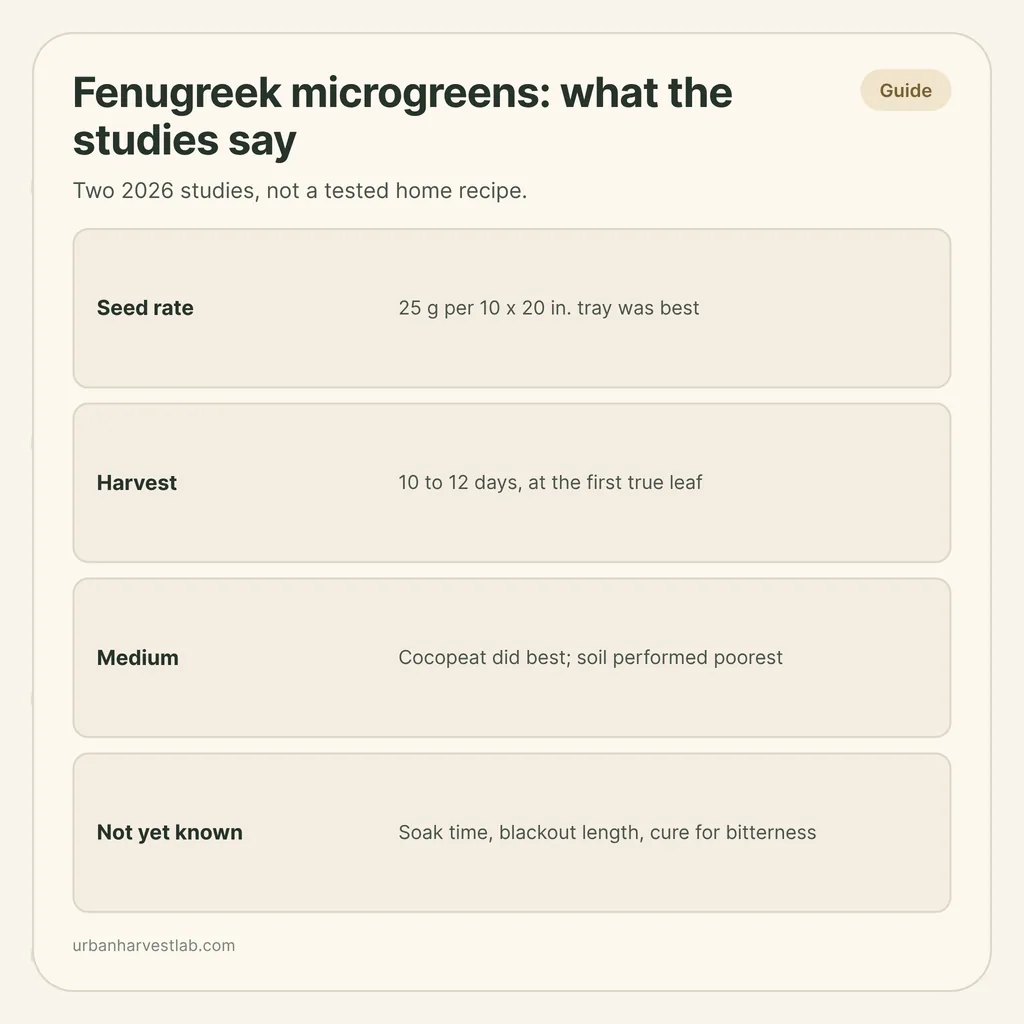
Fenugreek microgreens have almost no extension-service guidance, but two peer-reviewed studies published in 2026 give usable numbers: about 25 g of seed per 10 x 20 in. tray, a harvest at 10 to 12 days when cut at the first true leaf, and a soilless medium over garden soil.
Fenugreek (Trigonella foenum-graecum) is a legume in the Fabaceae family. The Kashmir study says “limited information is available” on how growing medium and seed density affect them. Treat the figures below as a starting point from controlled trials, not a tested home recipe. The general tray method is in the beginner microgreens guide.
The two studies, side by side
| Kashmir study (Mushtaq et al.) | Bihar study (Punasia et al.) | |
|---|---|---|
| Institution | Sher-e-Kashmir University of Agricultural Sciences and Technology | Dr Rajendra Prasad Central Agricultural University |
| Seed rate | 20, 25 or 30 g per 10 x 20 in. tray; 25 g best | 271 g per square metre |
| Harvest stage | First true leaf | Two expanded cotyledon leaves |
| Time reported | 10 to 12 days after sowing | 15.43-day growing period; 4.95 days to germinate |
| Germination | 85.65% in cocopeat | 90.22% |
| Conditions | 24 degrees C, 12 h light, 10,000 lux | Watered every two days, no fertiliser |
Sher-e-Kashmir University and Dr Rajendra Prasad Central Agricultural University do not agree on timing, and the reason is visible in the table: they cut at different stages and used different seed. The Kashmir team harvested at “first true leaf stage i.e. 10-12 days after sowing”, while the Bihar team measured a growing period of 15.43 days for fenugreek among 16 crops that ranged from 8 days for amaranth and radish to 19.45 days for parsley. Plan on a harvest window rather than a single day, and check the tray rather than the calendar. The timeline planner shows how to lay several crops on one shelf.
How much seed
Sher-e-Kashmir University’s trial sowed three densities, 20, 25 and 30 g per 10 x 20 in. tray, broadcast evenly over the medium. It found 25 g optimal, producing the highest fresh weight per shoot (100.4 mg) and the tallest seedlings (6.3 cm on average). Raising the rate to 30 g did not raise yield, which the authors attribute to competition between plants. Its conclusion is that cocopeat with 25 g per tray “may be optimal”.
The Bihar study took a different route. It scaled a recommended high-density rate down to its small experimental tray, ending at 271 g per square metre for fenugreek. A 10 x 20 in. tray covers about 0.129 square metres, so that is roughly 35 g, a conversion, not a number stated in the paper. It sits above the Kashmir optimum, and since the Kashmir trial found 30 g already crowded, 25 g is the safer place to begin. How to rescale a gram figure to your own tray is covered in the seed density chart.
Crowding matters beyond yield. Dense, humid trays are where damping-off starts; damping-off in microgreens explains how to tell it from harmless root hairs.
Which growing medium
The Kashmir team compared five media: garden soil, blotting paper, cocopeat, sawdust and soil mixed 1:1 with vermicompost. Cocopeat gave the highest germination (85.65%), the highest fresh yield and the earliest first true leaf: 10 days on average across the three densities, and 9 days at 25 g, in the Sher-e-Kashmir trial. Sawdust came second, and soil performed poorest. In their data, soil and soil with vermicompost took 12 to 14 days to reach the first true leaf, against 9 to 10 in cocopeat.
Shoot nitrate, a quality measure, was highest in soil with vermicompost (684.55 mg per kg fresh weight) and at the highest seed density, and lowest on blotting paper at 25 g. The authors link this to the nitrogen available in rich media. The practical reading is modest: a plain, fine, water-holding medium did better than a rich one, in one trial at one site.
The same paper sterilised its seed with 1% sodium hypochlorite for a minute and states that this was done for experimental purposes only and “is not generally recommended” for routine microgreen production. Do not copy it as a home step. Seed and tray hygiene are covered in microgreens food safety.
Soak, blackout and bitterness: not in the studies
Three things a grower would want are not in either paper or in the Utah State table:
- A soak time. Neither study reports soaking the seed. Utah State University Extension lists a presoak for pea (6 hours) and sunflower (12 hours) and none for the other crops in its table, but fenugreek is not in that table. Which seed benefit from a soak, and for how long, is covered in soaking microgreen seeds; a figure for fenugreek specifically remains unverified.
- A blackout length. Neither study states how long the trays were kept covered. For how blackout timing varies, see blackout time by crop.
- A cause or cure for bitterness. The Bihar study scored fenugreek microgreens on a 9-point hedonic scale: aroma 9.5, texture 8.1, taste 6.8 and overall acceptability 7.9. Taste was the lowest of those four, but the study did not measure bitterness or test any way of changing it. Harvest timing is the one lever the sources let you test yourself; Purdue Extension says microgreens get more bitter the longer they grow, a statement about microgreens in general, not a fenugreek result.
Phenols, chlorophyll and antioxidant assays
In the Bihar study, fenugreek had the highest total phenol content of the 16 microgreens tested, 6.59 mg gallic acid equivalents per gram, and the highest total chlorophyll, 58.77 mg per 100 g fresh weight. Its antioxidant activity measured by the DPPH assay was the strongest of the group at 98.52 micrograms per mL, where a lower value means stronger activity. These are laboratory measurements on the plant tissue. The authors list fenugreek among the crops “most promising for nutraceutical and functional food applications requiring elevated antioxidant bioactivity”, which is a statement about the assays, not a human health outcome. What microgreens research does and does not show is covered in are microgreens healthy.
Harvest and storage
Neither paper gives a cutting height or storage for fenugreek. Cut, wash and refrigerate it as for any microgreen, following how to harvest and store microgreens safely. For the cut, the general rule applies: at the base, once true leaves appear.
Sources
- Mushtaq et al., Effect of growing media and seed density on growth, yield and quality of fenugreek microgreens, Indian Journal of Agricultural Sciences 96(6), 2026 (Sher-e-Kashmir University of Agricultural Sciences and Technology): seed density, media, harvest stage, nitrate.
- Punasia, Singh and Agnihotri, Assessment of sixteen different herbs for their suitability as antioxidant rich microgreens, Indian Journal of Agricultural Sciences 96(5), 2026 (Dr Rajendra Prasad Central Agricultural University): growing period, germination, sensory scores, phenols.
- Purdue Extension: Grow Microgreens at Home: the general point that bitterness rises with growing time.
- Utah State University Extension: Grow Your Own Microgreens: which crops it lists a presoak for.
Shared microgreens routines
The soaking, density, blackout and harvest pages cover everything fenugreek does not need its own rule for.
Common questions
How much fenugreek seed do I sow per tray for microgreens?
A study from Sher-e-Kashmir University of Agricultural Sciences and Technology tested 20, 25 and 30 g per 10 x 20 in. tray and found 25 g gave the best growth. A study from Dr Rajendra Prasad Central Agricultural University used 271 g per square metre, which works out at roughly 35 g on a 10 x 20 in. tray (a conversion at about 0.129 square metres per tray, not a figure from the paper). The studies used different seed lots, so start near 25 g and adjust by eye.
How long do fenugreek microgreens take to grow?
The Kashmir study harvested at the first true leaf stage, 10 to 12 days after sowing, at 24 degrees C. The Bihar study harvested at the cotyledon stage and recorded a growing period of 15.43 days for fenugreek. Both are peer-reviewed measurements under controlled conditions, so a home tray can run earlier or later.
Do fenugreek microgreens need soaking?
Neither 2026 study reports soaking the seed, and Utah State University Extension's per-crop table, which gives a presoak only for pea (6 hours) and sunflower (12 hours), does not list fenugreek. Treat any specific soak time for fenugreek as unverified.
Are fenugreek microgreens bitter?
The Bihar study scored fenugreek microgreens on a 9-point hedonic scale and gave taste 6.8 and aroma 9.5, but it did not measure bitterness itself. Neither study tested what causes bitterness in fenugreek microgreens or how to reduce it.
Related guides
Microgreens food safety: sanitizing trays, seed, and water
Sprout recalls do not automatically make microgreens risky. The harvest method is what separates them, and one hydroponic setup can erase that gap.

Are microgreens healthy: what the nutrition evidence actually shows
The number gets repeated everywhere, usually stripped of the two words that make it accurate: one nutrient, one crop. Here is what the underlying study actually found, and what that does and does not tell you about eating microgreens.

Microgreens growing timeline: sow, blackout and harvest dates by crop
A tray's calendar depends on the crop in it. Enter a sow date and a variety below and get the blackout, light and harvest dates worked out for you, plus the numbers behind them.