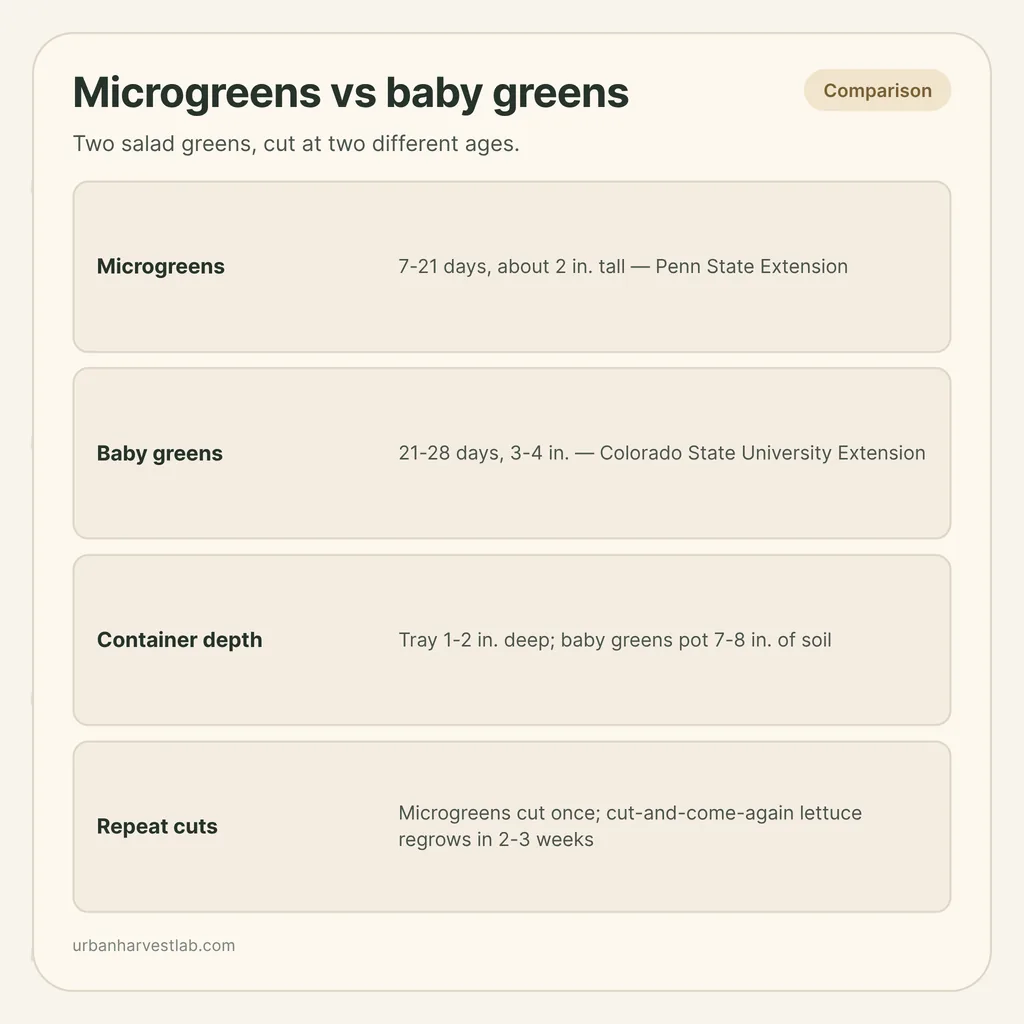
Microgreens and baby greens, side by side
| Factor | Microgreens | Baby greens |
|---|---|---|
| Days to harvest | 7-21 days (Penn State Extension) | 21-28 days (Colorado State University Extension) |
| Size at cut | About 2 in. (Colorado State); 2-4 in. (Purdue) | 3-4 in. (Colorado State) |
| Growth stage | Seed leaves open, first true leaves emerging | Young plant with true leaves, cut small |
| Container depth | 1-2 in. tray (Illinois Extension) | 7-8 in. of soil for greens (Oregon State Extension) |
| Repeat cuts | Cut once from the tray | Cut-and-come-again: second cut 2-3 weeks later (University of Maryland Extension) |
Microgreens and baby greens are salad plants cut at two different ages: Penn State Extension gives 7 to 21 days for microgreens, and Colorado State University Extension gives 21 to 28 days for baby leafy greens. Pick microgreens for speed and a shallow tray on a shelf. Pick baby greens for a salad base from a pot that you can cut more than once. Neither is the more nutritious on every count, and the studies that compare them say so.
The difference is the age at cutting
Penn State Extension says microgreens can be harvested from 7 to 21 days after germination, once the seed leaves (cotyledons) have fully developed and the first true leaves have emerged, by cutting the seedlings at the base just above the growing medium. Purdue Extension puts the height at 2 to 4 inches for most crops. These are the cut-and-eat tray crops covered in how to grow microgreens at home.
A baby green is a plant that has gone on to make real leaves and is cut while those leaves are still small. A Colorado State University Extension fact sheet lays out the ladder: microgreens at 7 to 21 days and about 2 inches, baby leafy greens at 21 to 28 days and 3 to 4 inches, and mature leafy greens at 45 to 60 days. Baby leaf is not a sprout either; sprouts are a separate, higher-risk product.
Timing in research trials runs longer than the extension ranges, and the gap between the stages widens. In a trial of three wild leafy species grown hydroponically, Lenzi and colleagues (Foods, 2019) cut microgreens 14 to 16 days after sowing and baby leaves 35 to 43 days after sowing. In a 2023 study of five vegetable crops, Mallor and colleagues cut microgreens at 25 to 30 days and baby plants at 50 to 60 days. Species, light and temperature move these numbers, so treat the extension ranges as the home target.
Yield: what a pot gives you against a tray
Per square metre of hydroponic bench, baby leaf won in one study. Lenzi and colleagues (Foods, 2019) report that, on average across three wild species, the baby leaf stage gave 2.11 kg fresh weight per square metre against 0.99 kg for microgreens. It was not universal: salad burnet (Sanguisorba minor) yielded more as microgreens than as baby greens. Hydroponic benches are not a windowsill tray, so read it as a direction that varies by crop rather than a number to plan around.
Baby greens have one advantage microgreens do not share in the same way: repeat cuts. The University of Maryland Extension describes cut-and-come-again lettuce as plants cut just above ground level with scissors at 6 to 10 inches tall, which regrow if watered and fertilized and are ready for a second cut 2 to 3 weeks later. That is a larger plant than a baby leaf, so treat it as the upper end of the method. Whether a microgreens tray gives a second cut is its own question, answered in do microgreens regrow. For grams per tray by crop, see microgreens yield per tray.
Taste and texture
Microgreens are meant to be cut early for a reason beyond speed. Purdue Extension notes that microgreens generally become bitter the longer they grow, and says this is especially true for sunflowers. A tray left a week too long drifts toward a tougher, more bitter green.
Baby leaf is cut as whole, small true leaves, which is why Colorado State’s fact sheet lists it as a separate product from microgreens, with its own size (3 to 4 inches) and its own timeline. Grow it if what you want is a salad base rather than a garnish.
Nutrients: what each study measured
The figure most people quote comes from USDA. The Agricultural Research Service tested 25 microgreens and reported that, in general, they contained about five times the vitamins and carotenoids of their mature plant counterparts. The ARS write-up also lists the vitamin C range, 20 to 147 mg per 100 g of fresh weight depending on the species, and warns that growing, harvesting and handling conditions may have a considerable effect. The comparison in that work is with mature plants. It does not say microgreens beat baby leaf. The wider picture, including how the more dramatic “40 times” figure was narrowed, is in what the microgreens nutrition evidence shows.
Two studies that did put the stages side by side give a mixed answer:
- Five crops at three stages. Mallor and colleagues (Foods, 2023) measured chard, spinach, lettuce, borage and chicory as microgreens, babies and mature plants. For vitamin C, spinach and chard were highest at the baby stage, while borage, chicory and lettuce were mostly highest as microgreens. For carotenoids, baby plants generally came lower than microgreens, and lettuce babies were lowest. The authors also found mature plants lower than both young stages for fatty acids, carotenoids, tocopherols, vitamin C, polyphenols and antioxidant activity.
- Three wild species. Lenzi and colleagues compared microgreens and baby leaves of salad burnet, Sinapis arvensis and dandelion grown in a nutrient solution. They found the pattern depended on the species. Nitrate was significantly higher in baby greens than in microgreens overall, but the interaction with species mattered: dandelion microgreens were much lower than dandelion baby greens, while salad burnet and Sinapis arvensis were similar at the two stages.
So a claim that microgreens are healthier than baby greens holds for some crop and nutrient pairs and fails for others. Spinach for vitamin C is a case where the baby stage led in that study. These are lab measurements of composition, not health outcomes for a person who eats them.
Tray or pot: the space you need
A microgreens crop fits a shallow tray. Illinois Extension calls a container 1 to 2 inches deep ideal for microgreens if you want to save on soil, and sizes its seeding rates for a standard 10 by 20 inch flat. If you are choosing one, you can browse 10x20 microgreen trays on Amazon and check the depth against that 1 to 2 inch figure.
Baby greens want a pot. Oregon State Extension says containers are ideal for lettuce and other greens, and that greens have shallow roots but need 7 to 8 inches of fertile soil. Oregon State also treats baby greens as young seedlings thinned from a bed: cut at ground level, leaving the rest room to grow. The width and spacing arithmetic for a lettuce pot is in lettuce container size, and the cool-season mix to put in it is in growing salad greens in containers this fall. University of Maryland Extension adds that baby leaf lettuce can be grown entirely in indirect light in summer.
Per-tray running costs for microgreens, seed, substrate and light, are worked through in microgreens cost per tray.
Which one to grow
- Choose microgreens if you want something on the plate in the 7 to 21 days Penn State Extension gives, have only a shelf or a windowsill, and are happy to start a fresh tray for each harvest.
- Choose baby greens if you want a salad base, have room for a pot 7 to 8 inches deep or more, and would like to cut the same planting more than once.
- Grow both if you have the space: a tray cut within Penn State’s 7 to 21 days covers the wait while a pot of baby greens grows to Colorado State’s 21 to 28 days.
Sources
- Penn State Extension: The ABCs of Microgreens
- Colorado State University Extension: Sprouts, Microgreens and Leafy Greens fact sheet
- Purdue Extension: Grow Microgreens at Home
- University of Illinois Extension: Growing Microgreens
- Oregon State University Extension: Growing Lettuce & Other Greens
- University of Maryland Extension: Growing Lettuce in a Home Garden
- USDA Agricultural Research Service: Specialty Greens Pack a Nutritional Punch
- Mallor et al. (2023), Foods: Nutraceutical Potential of Leafy Vegetables Landraces at Microgreen, Baby, and Adult Stages of Development
- Lenzi et al. (2019), Foods: Antioxidant and Mineral Composition of Three Wild Leafy Species, a Comparison Between Microgreens and Baby Greens
Go deeper on each side
The nutrition evidence, the fall salad container guide, and the cost of a tray.
Common questions
What is the difference between microgreens and baby greens?
The harvest stage. Penn State Extension describes microgreens as cut 7 to 21 days after germination, when the seed leaves have fully developed and the first true leaves have emerged. A Colorado State University Extension fact sheet lists baby leafy greens at 21 to 28 days and 3 to 4 inches, cut as smaller immature leaves, against about 2 inches for microgreens.
Are microgreens more nutritious than baby greens?
It depends on the crop and the nutrient. USDA's Agricultural Research Service reported about five times the vitamins and carotenoids in microgreens compared with mature plants, not with baby leaf. A 2023 study that did compare the two stages found baby spinach and baby chard higher in vitamin C, and microgreen lettuce, chicory and borage higher.
How long do baby greens take compared with microgreens?
Penn State Extension gives 7 to 21 days for microgreens, and Colorado State University Extension gives 21 to 28 days for baby leafy greens. In two research trials the gap was wider: 14 to 16 days against 35 to 43 days for three wild species, and 25 to 30 days against 50 to 60 days for five vegetable crops.
Can I grow baby greens in a microgreens tray?
Not as a substitute for a pot. Illinois Extension recommends a tray 1 to 2 inches deep for microgreens, while Oregon State Extension says greens have shallow roots but still need 7 to 8 inches of soil. Seedlings thinned from a leaf-lettuce pot can be eaten as baby greens, but a microgreens tray is built for a single cut.
Related guides

Are microgreens healthy: what the nutrition evidence actually shows
The number gets repeated everywhere, usually stripped of the two words that make it accurate: one nutrient, one crop. Here is what the underlying study actually found, and what that does and does not tell you about eating microgreens.
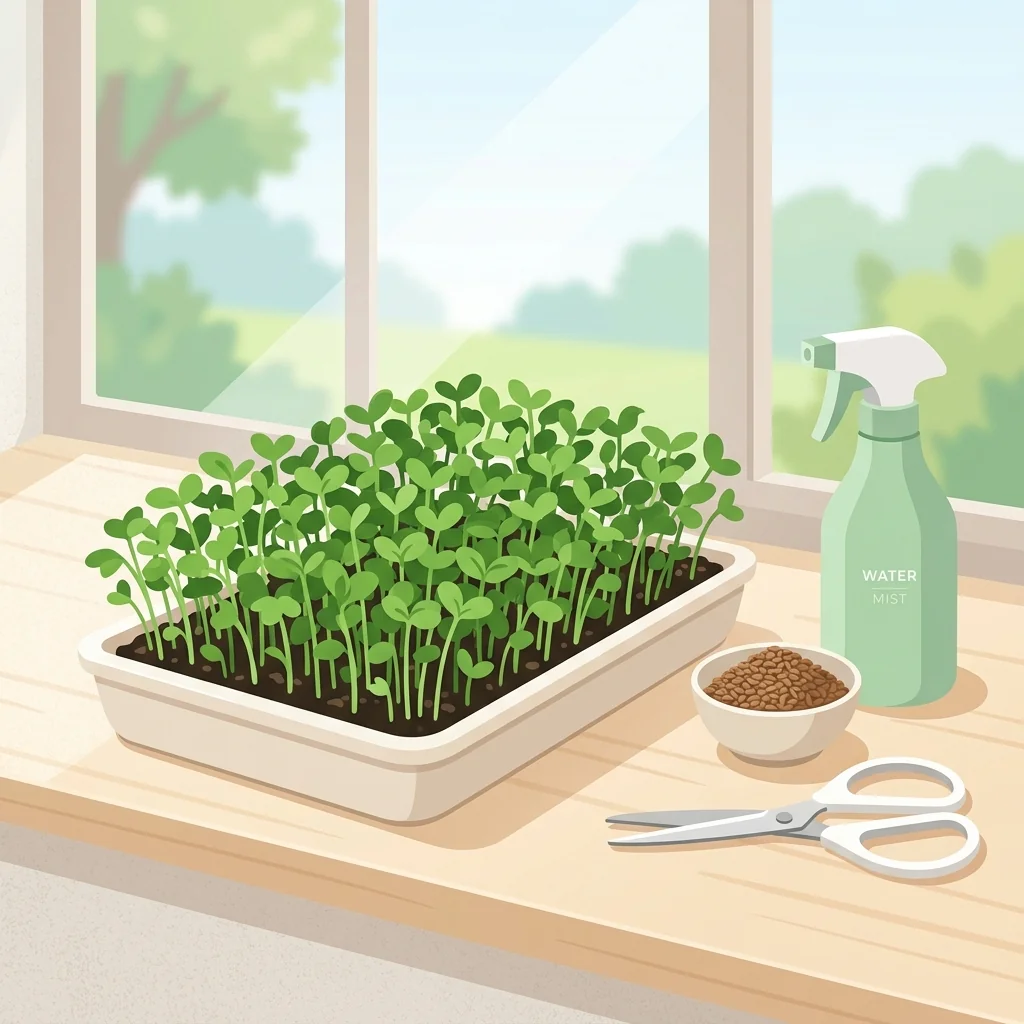
How to grow microgreens at home: a beginner's guide
Microgreens are the fastest crop you can grow indoors. This beginner guide walks through sowing, watering, light, and harvesting your first tray in about ten days.
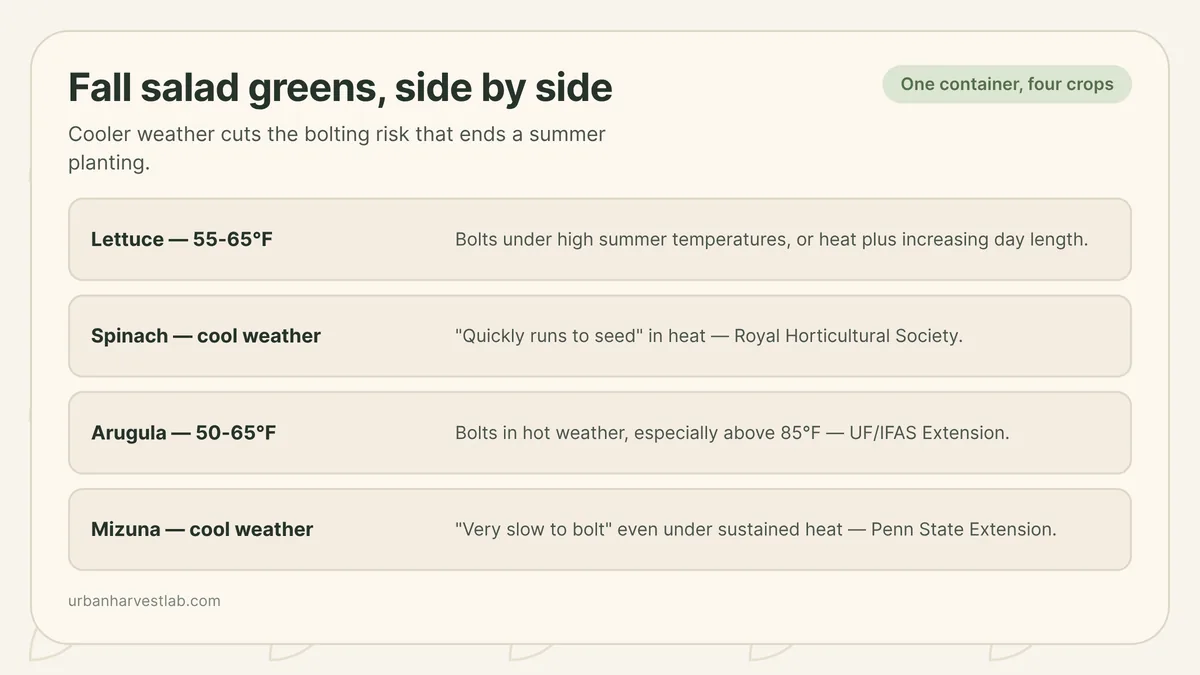
Growing salad greens in containers this fall
Lettuce, spinach, arugula, and mizuna all share the same summer problem and the same fall fix. Here is how to grow them together once the heat breaks.