Troubleshoot the system before you change the inputs.
Symptoms
- A dark, sunken, leathery patch on the bottom of the fruit.
- Round sunken spots with darkened centres on ripe fruit.
- Dark leathery patches around the stem, or firm brown blotches on the shoulders.
- Many small raised brown flecks over the skin.
Possible causes
- Blossom end rot, a watering and calcium-uptake disorder.
- Anthracnose, a fungus that shows on ripe fruit.
- Early blight or late blight, which also mark the leaves.
- Bacterial spot or bacterial speck.
Quick fixes
- Check the position of the spot first, then check the leaves.
- Pick off affected fruit and bin it; do not compost diseased plant material.
- Water the soil steadily, not the foliage.
- Pick fruit before it is fully ripe if anthracnose is the cause.
Black spots on tomato fruit: five causes compared
| Cause | Where on the fruit | What it looks like | Leaves |
|---|---|---|---|
| Blossom end rot | Bottom, opposite the stem | Dark, leathery, sunken patch | Healthy |
| Anthracnose | Anywhere, mostly ripe or overripe fruit | Circular, sunken, darkening spots; can become soft rot | Older leaves may show small dark spots with a yellow halo |
| Early blight | Around the stem | Dark, leathery, sunken; rings may show | Brown spots with rings |
| Late blight | Often the upper part of the fruit | Firm, corrugated, brown to olive-black patches | Oily black patches; white fuzz underneath |
| Bacterial spot or speck | Scattered over the skin | Small raised brown spots, corky when larger | Small dark spots with yellow halos |
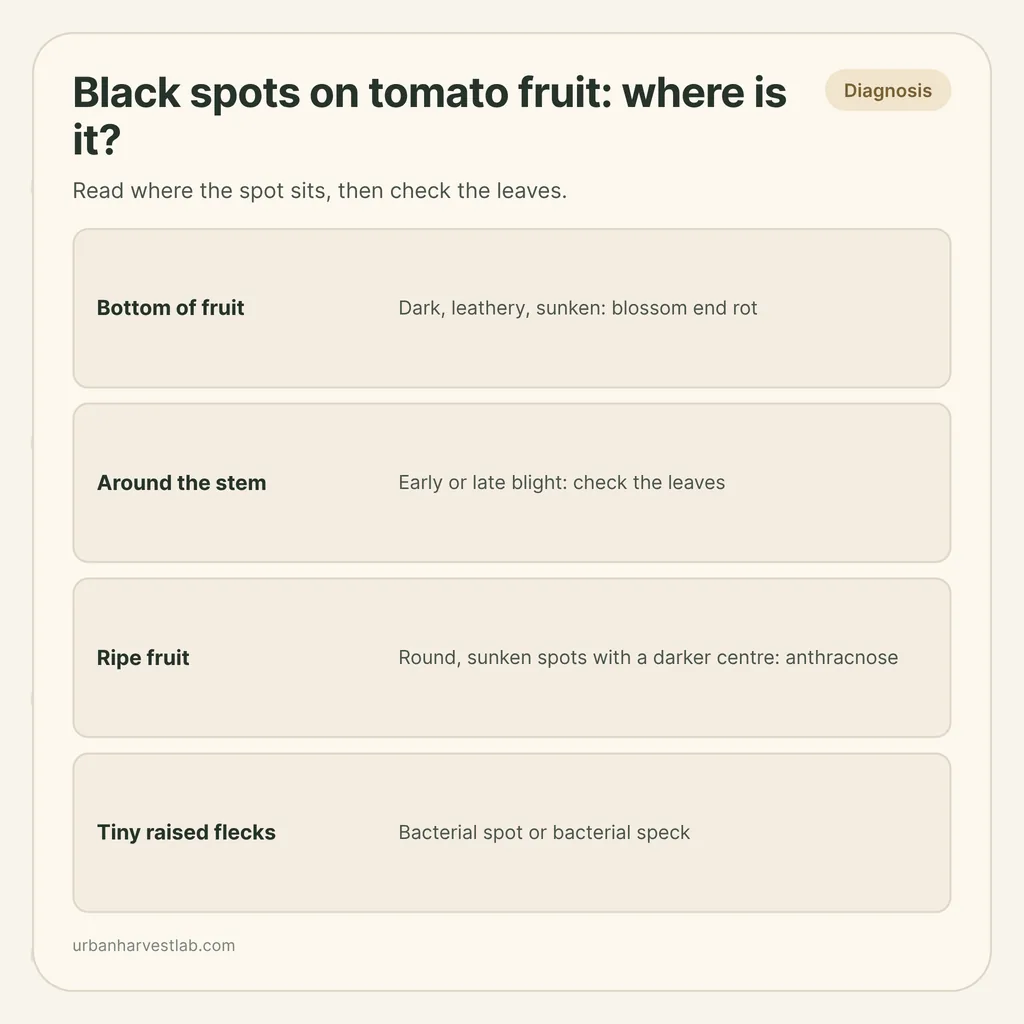
Look at where the spot sits. A black, leathery patch on the bottom of the fruit is blossom end rot. Dark patches around the stem point to early or late blight, round sunken spots on ripe fruit point to anthracnose, and tiny raised flecks point to bacterial disease. Then check the leaves, because they settle most of the doubt.
The bottom of the fruit
If the spot is on the end opposite the stem and the leaves look healthy, you are almost certainly looking at blossom end rot. University of Maryland Extension describes dark, leathery, sunken areas on the blossom end, most common on enlarging fruit, and links them to inconsistent or shallow watering and to heavy nitrogen feeding. It is a disorder rather than an infection, so it does not spread from fruit to fruit. Potted plants are exposed to it more than most, because a pot swings between soaked and dry quickly. The full fix is in blossom end rot on tomatoes in pots.
Illinois Extension says to remove affected fruit and discard it. Fruit that is scarred and puckered at the bottom, rather than blackened, is a different thing: see catfacing.
Around the stem
Dark, leathery, sunken patches at the stem end could be early blight or late blight. Penn State Extension describes early blight fruit as dark with leathery, sunken spots, usually where the stem attaches. University of Maryland Extension notes a bull’s-eye pattern may show. Late blight is the more dangerous of the two. Washington State University describes its brown blotches as firm and corrugated or wrinkled, and Wisconsin describes them as sunken but still firm, golden to chocolate brown, with fairly distinct rings.
The fruit alone is a poor guide, so go to the leaves:
- Brown spots with concentric rings, mostly on lower leaves, mean early blight. Brown spots on tomato leaves separates it from septoria and bacterial spot.
- Oily-looking black patches that spread within days, or white fuzz on the underside of a leaf, mean late blight. Pull the plant and bag it: late blight on tomatoes covers the order of steps and why a balcony plant still matters to everyone else’s tomatoes.
University of Wisconsin Extension says that fruit with late blight lesions should not be eaten or preserved. Its advice for fruit with no lesions is to use it quickly, since it may still develop them.
Anywhere on ripe fruit
Round, sunken spots with a darker centre, on fruit that is ripe or past ripe, are the classic look of anthracnose. Washington State University says the fruit can be infected while green but shows symptoms only once it ripens. Spots start water-soaked, grow to about half an inch, and often show rings around a tan centre. In damp weather, salmon-coloured spore masses can form on the lesion. University of Maryland Extension lists the result as a soft rot, and notes the fungi overwinter in seeds, soil and plant residue.
Two habits cut the risk:
- Pick before the fruit is fully ripe. University of Maryland Extension gives this directly for anthracnose. If picked fruit or fruit on the plant stalls, green tomatoes not ripening covers why.
- Clear the debris. Washington State University says to remove plant debris, avoid overhead irrigation, rotate crops on a three- to four-year cycle and discard diseased material rather than composting it. In a single pot, that translates to fresh mix and a cleaned pot before the next tomato goes in.
Tiny raised flecks
Dozens of small, raised brown spots across the skin suggest bacteria. Penn State Extension separates the two: bacterial spot lesions are larger and can look corky, while bacterial speck lesions are only slightly raised and about 1/16 inch across. University of Maryland Extension notes that the bacteria overwinter on crop residue and are seed-borne, and Penn State describes black leaf spots that often have a yellow halo. Clear the old plant and its debris out at the end of the season.
A pale sunken patch that is not a disease
Fruit exposed to full sun after the leaves above it were lost can develop pale, sunken or blistered areas, which University of Maryland Extension calls sunscald. These stay pale (white, yellow or tan), and the patch sits on the sun-facing side; Iowa State Extension notes that secondary organisms can move in and rot it. See white patches on tomatoes.
Should you spray?
Whether a product may be used on tomatoes is set by its label. If you decide to use one for a leaf disease, choosing a pest treatment for plants you are going to eat explains what the label controls. For blossom end rot, the commonest black spot, no spray helps: Illinois Extension says foliar calcium does little, and the fix is steady watering.
Sources
- University of Maryland Extension: Key to common problems of tomatoes
- Washington State University Hortsense: Tomato anthracnose
- Washington State University Hortsense: Tomato late blight
- Penn State Extension: Scouting and identifying tomato diseases
- University of Wisconsin Extension: Late blight
- University of Illinois Extension: Blossom end rot
- Iowa State University Extension: Why does side of tomato in sun develop white or yellow areas?
More on tomato problems
Neighbouring tomato fruit and leaf problems.
Common questions
Why do my tomatoes have black spots on the bottom?
A dark, leathery, sunken patch on the blossom end, the side opposite the stem, is blossom end rot. University of Maryland Extension links it to inconsistent or shallow watering. It is a disorder, not an infection, so the leaves stay healthy.
Can I eat a tomato with a black spot?
It depends on the cause. For late blight, University of Wisconsin Extension says fruit with lesions should not be eaten or preserved. For blossom end rot, Illinois Extension advises removing and discarding the fruit. A spot that is soft and rotting is a lost fruit in any case.
What are black sunken spots on ripe tomatoes?
Round, sunken, darkening spots on ripe or overripe fruit are typical of anthracnose, a fungal disease. Washington State University describes spots that reach about half an inch across and may show rings around a tan centre.
Do black spots on tomatoes mean the whole plant is sick?
Not always. Blossom end rot comes from water stress and does not spread. Early blight, anthracnose and bacterial spot can also mark leaves and need sanitation. Late blight is the serious one: University of Wisconsin Extension says that in cool, wet conditions it can kill a plant in as little as 7 days.
Related guides
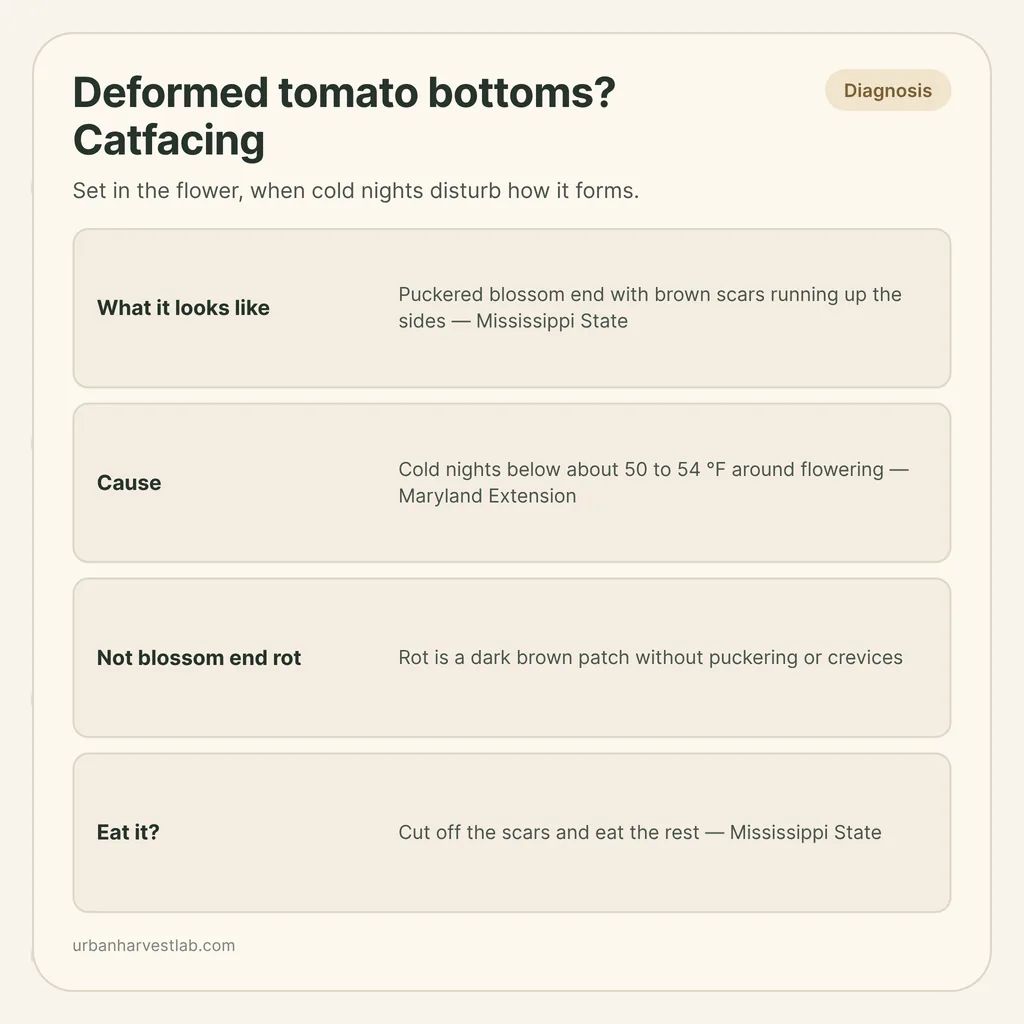
Deformed tomatoes with scarred bottoms? That is catfacing
Puckered, scarred, lumpy tomatoes on the first trusses are usually catfacing, a flower-stage problem tied to cold nights. Here is how to confirm it and what to change.

Tomato plant wilting even though you water it: heat, roots, or disease
Midday droop that clears by evening is usually heat. Wilt that stays after watering points to rotting roots or a vascular disease, and a cut stem tells you which.

Why are my tomatoes cracking? Radial vs concentric splits
Cracked tomatoes are almost always a water-swing problem. Learn which split you have, whether the fruit is safe to eat, and how to stop it in pots.