Troubleshoot the system before you change the inputs.
Symptoms
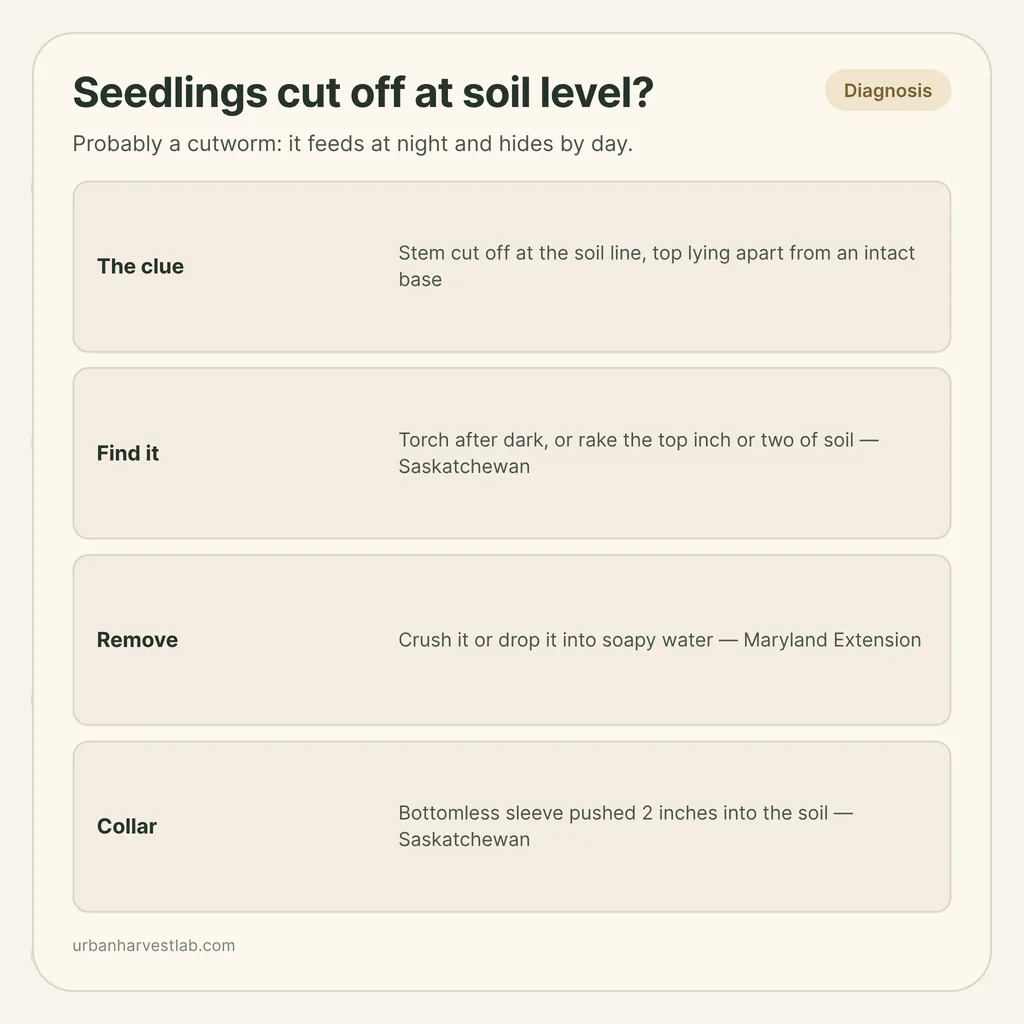
- Seedlings or fresh transplants are snipped off at or just below the soil line, with the top lying beside an intact base, or the whole plant has vanished by morning.
- Nothing is visible on the plants during the day.
- A stem that was only partly chewed leaves a wilted plant.
Possible causes
- Cutworms, plump caterpillars that hide in the soil by day and feed at night.
- Other night chewers such as earwigs, slugs, snails or root maggots, which can also fell seedlings.
- Damping-off, if the stem is pinched, dark and water-soaked but still attached.
Quick fixes
- Search after dark with a torch, or rake the top inch or two of soil around the cut plant, and remove any caterpillar you find.
- Push a collar of cardboard, foil or plastic into the soil around every remaining seedling.
- Replace lost seedlings with larger transplants or pre-sprouted seed once the collars are in place.
Cut seedlings: cutworm, damping-off or another chewer
| Clue | Cutworm | Damping-off | Slugs and other chewers |
|---|---|---|---|
| Stem at the soil line | Cut through or chewed, top lying loose | Pinched, dark and water-soaked but still attached | Leaves and stems ragged, often with holes |
| Whole plant gone overnight | Yes, can be dragged into the soil | No, the plant stays and collapses | Sometimes, if small enough |
| Culprit seen | Curled grey-brown caterpillar in the top soil | No creature, just wet cold mix | Slime trail for slugs and snails |
| First move | Dig for it, then fit collars | Dry the mix, discard the plant | Check after dark and match the damage |
Seedlings snipped off at the soil line overnight, with nothing in sight, are most likely the work of cutworms. These are caterpillars that hide in the soil by day and feed at night. Dig for one tonight, pull out any you find, and fit a collar around every seedling that is left.
How to tell a cutworm from everything else
The classic picture comes from University of Maryland Extension: seedlings or even transplants cut off at the soil line, or gone entirely by morning, sometimes dragged underground into the cutworm’s burrow. The University of Saskatchewan describes the same morning discovery: stems cut off at the soil line and no suspect in sight.
Cutworms are the larvae of night-flying moths. The University of New Hampshire describes the kind that matters for seedlings, the surface cutworms, as chewing plants just above or just below the soil level, typically eating just enough of the stem to make the plant topple over. UC IPM, in its guide to foliage-feeding caterpillars, says cutworm larvae hide in the soil during the day and emerge to feed at night. That is why the damage seems to come from nowhere.
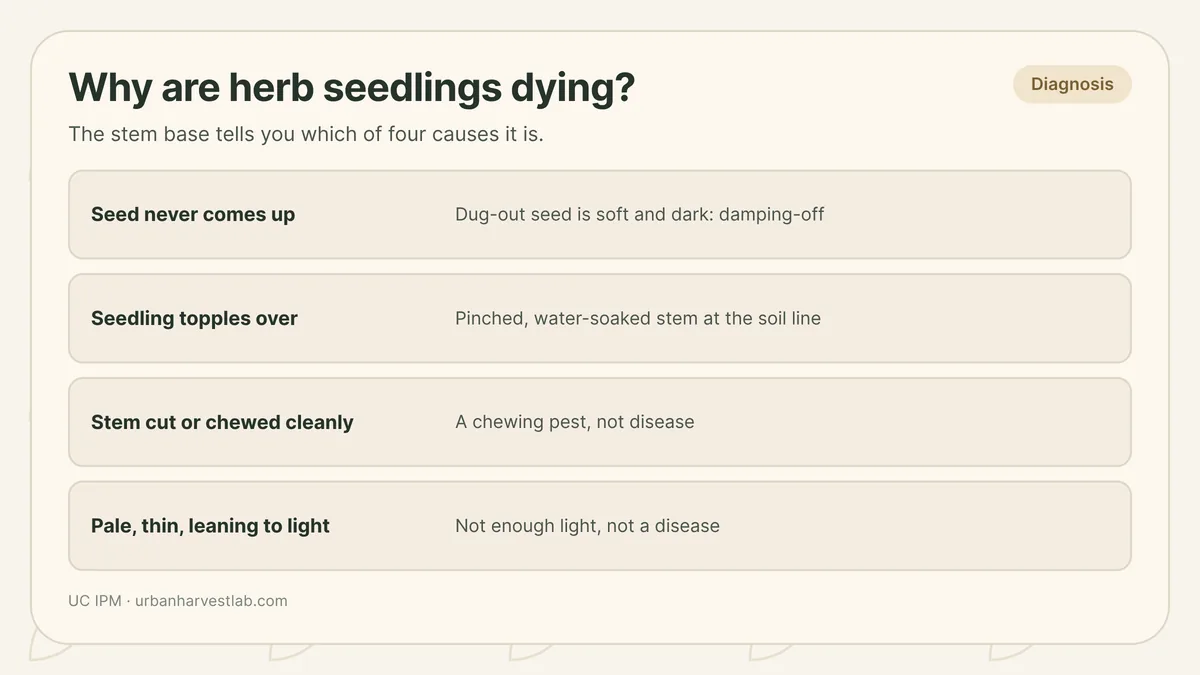
The cut itself is your best clue. A stem with the top lying separate from an intact base is a chewing pest. A stem that is still attached but pinched, dark and water-soaked at the soil line is damping-off, a fungal disease. UC IPM’s damping-off note says to rule out cutworms, earwigs, flea beetles, snails, slugs and root maggots first, which is the order to work in. The full disease picture is in why herb seedlings die.
If the cut was not complete, the plant may simply look wilted, according to the University of Saskatchewan. Do not mistake that for thirst. Look at the stem base before you reach for the watering can, and check transplant shock in seedlings only if the stem is intact.
Find the caterpillar
Searching is the only real confirmation. The University of Saskatchewan gives two methods: use a flashlight to find them on plants at night, and in the daytime lightly rake the top inch or two of soil around plants. UNH Extension adds that you should search the base of the plant and the top layer of soil with a torch after dark.
What you are looking for is a plump, soft caterpillar. University of Maryland Extension describes them as stout with rough skin, almost 2 inches long when full grown, and notes that the black cutworm is uniformly gray-brown to nearly black with a somewhat greasy sheen. The University of Saskatchewan says they range from brown or grey to green and curl into a tight C when disturbed. A curled-up caterpillar in the top inch of soil beside a freshly cut seedling is your answer.
In a pot or tray, check the whole container, not only the cut plant’s spot. Maryland notes that larger larvae feed at night and seek shelter in the soil by day, and the University of Saskatchewan says they hide in the soil under plants during the day.
Deal with the ones you find
Handpicking works at container scale. University of Maryland Extension suggests crushing larvae or dropping them into a container of soapy water, and UNH Extension gives the same method.
Pre-sprouting seeds, and planting larger transplants, helps afterwards. Maryland says larger transplants better withstand damage and pre-sprouting seeds is helpful.
Both Maryland and the University of Saskatchewan name Bacillus thuringiensis: Maryland says it will kill young larvae, and Saskatchewan reserves the kurstaki type for severe infestations, applied to stems and leaves. For anything you will eat, read the label of any product first. UNH Extension is plain about it: be sure the label lists both cutworms and the crop you intend to treat. Saskatchewan also warns against using insecticides to kill cutworms because they will also kill beneficial insects, and names ground beetles, parasitoid wasps and flies, ants and rove beetles among the natural predators. The wider rules for edibles are in choosing a pest treatment for plants you eat.
Collars: the fix that stops the next one
A collar is a bottomless sleeve around the stem. Cardboard, foil or plastic all count. The University of Saskatchewan lists foil, toilet roll tubes, milk cartons, tin cans and plastic containers with both ends removed, and says to insert them 5 cm (2 inches) into the soil. UNH Extension says the collar should extend at least an inch down into the soil and two inches above it. University of Maryland Extension suggests a 3 inch collar pushed into the soil.
Put the collar on at planting or pricking out, not after the first loss. Push it in so there is no gap at the bottom, because a cutworm that tunnels under the edge reaches the stem. In a small pot a short slice of toilet roll tube does the job.
Two more barriers appear in Maryland’s guidance. Floating row cover prevents egg-laying and excludes larvae. Coarse materials such as crushed oyster shell, sand or diatomaceous earth placed around plant stems discourage cutworms. Maryland adds that the first generation of mature larvae does the most damage.
Stop the next round
Moths lay eggs in weeds and debris. UNH Extension says removing weeds and mowing the grass close to the ground aids prevention, and the University of Saskatchewan says to remove plant debris after harvest because moths lay eggs on plant litter in late summer. It also notes that cutworms are common in newly cultivated gardens that were formerly lawn or pasture, which matters if you are filling raised beds from turf-topped soil.
If the damage is more ragged than a clean cut, check slugs and snails in containers, pill bugs or earwigs. If cutworm-like caterpillars are working up a tomato plant rather than at the base, see caterpillars eating tomato leaves. Tiny shot-holes in eggplant or brassica leaves are a different insect, covered in flea beetles on container vegetables.
Sources
Seedlings that fail for other reasons
If the stem was not cut cleanly, these guides cover the other usual suspects.
Common questions
What cuts seedlings off at soil level?
Usually cutworms, the caterpillars of night-flying moths. The University of New Hampshire describes surface cutworms chewing plants just above or just below the soil level, often eating just enough of the stem to make the plant topple over. Earwigs, flea beetles, slugs, snails and root maggots can also fell seedlings, so check for the caterpillar before you act.
How do I find a cutworm?
Look at night or dig by day. The University of Saskatchewan advises using a flashlight to find them on plants after dark, and lightly raking the top inch or two of soil around the plants in the daytime. A found cutworm is a plump, legless caterpillar that curls into a tight C when disturbed.
How do I protect seedlings from cutworms?
Put a collar around each stem. University of Maryland Extension suggests a 3 inch cardboard, foil or plastic collar pushed into the soil. UNH Extension says it should reach at least an inch into the soil and two inches above it. Toilet roll tubes and cut-up drink bottles both work as collars.
Will the seedling recover if it was only partly cut?
Sometimes. The University of Saskatchewan notes that when the cut is not complete, the plant may appear wilted. A plant that is still rooted and has an intact stem can survive if you protect it now, but one cut clean through will not regrow from the stump, so resow or replant.
Related guides

Pill bugs in plant pots: when they hurt seedlings and how to cut their numbers
Grey, armoured, roll-into-a-ball creatures in your potting mix are usually decomposers. Here is when they threaten seedlings, how to confirm it after dark, and what actually reduces them.

Earwigs in potted plants: harmless, helpful, or pest?
Earwigs in a pot are usually sheltering, and they eat aphids. They only earn a trap when you can show they are chewing seedlings, lettuce, or soft fruit.
Why are my herb seedlings dying?
A tray of herb seedlings can fail three or four different ways, and they do not all look the same up close. The stem base and the seed itself tell you which one you have.