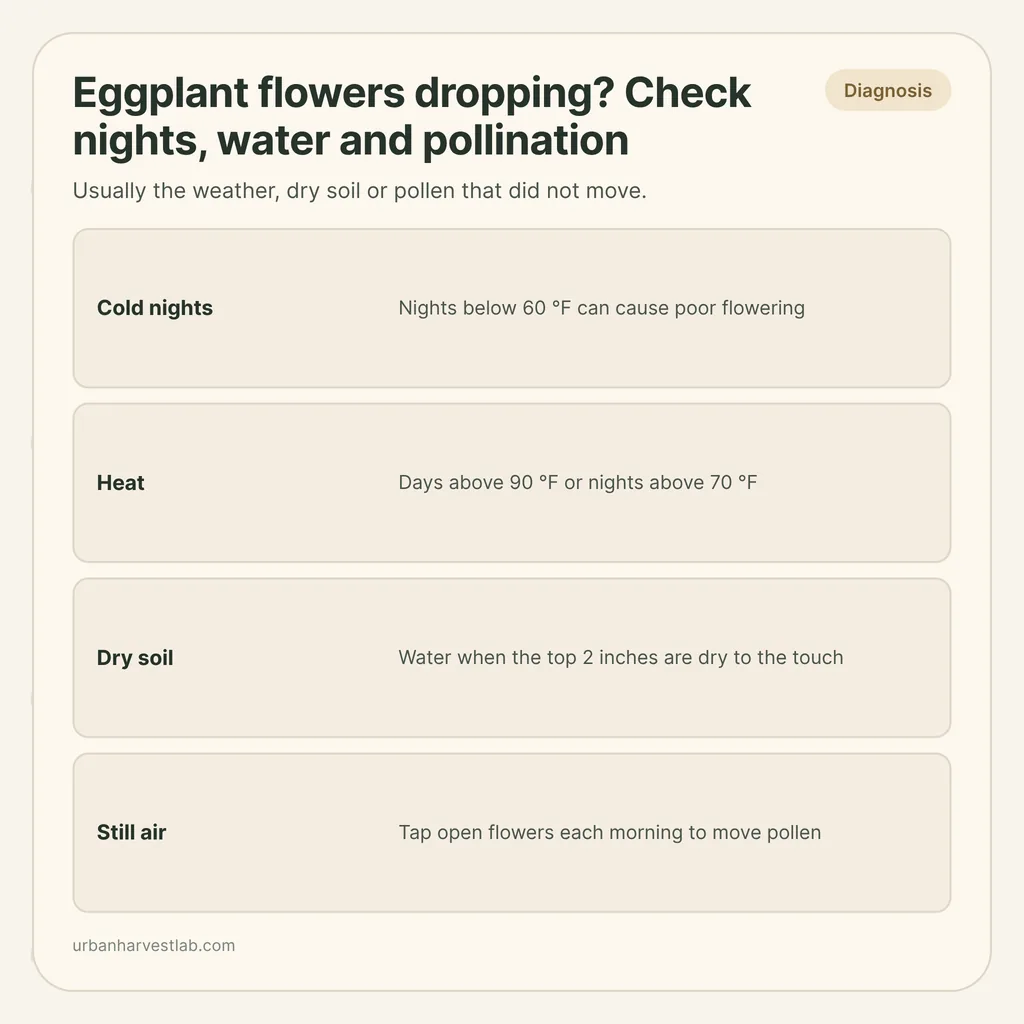
Troubleshoot the system before you change the inputs.
Symptoms
- Flowers open, then shrivel and fall with the small stalk still attached, and no little fruit forms behind them.
- The plant itself looks healthy and keeps making new leaves and buds.
- The drop began after a cold spell, a heatwave, a dry week or a run of still, sheltered days.
Possible causes
- Nights below 60 °F or above 70 °F, or days above 90 °F, which University of Minnesota Extension links to poor flowering.
- Soil that dries out in the pot, especially while the plant is flowering and setting fruit.
- Pollen that does not move from anther to pistil on a still balcony with few insects.
- Short-styled flowers, which set little or no fruit even when conditions are good.
- Too much nitrogen, too little sun, or ripe fruit left hanging.
Quick fixes
- Move the pot against a warm wall or bring it in on cold nights; shade it in the hottest part of the afternoon in a heatwave.
- Water before the mix dries out and keep the moisture even through flowering and fruiting.
- Tap open flowers gently each morning, or touch them with a soft brush.
- Switch to a feed that is not nitrogen-heavy and give the plant at least six hours of direct sun.
- Pick fruit when it is mature so the plant keeps flowering.
Eggplant flowers that wither and fall without leaving a baby fruit behind are usually reacting to the weather, to dry soil, or to pollen that did not move, not to a disease. Start with the nights: University of Minnesota Extension links night temperatures below 60 °F or above 70 °F, and days above 90 °F, to poor flowering. The full growing routine is in the eggplant container guide; what follows is only the flower-drop diagnosis.
Start with the weather
Eggplant is a warm-weather crop that wants warmth by day and by night. The three extension services set the cold floor at different points.
University of Minnesota Extension says temperatures above 90 °F, and night temperatures below 60 °F or above 70 °F, can cause poor flowering. University of Maryland Extension sets the cold floor lower: eggplant does not set fruit well until minimum night temperatures exceed 55 °F. Texas A&M AgriLife puts the hot side at flowering and fruit set needing to occur before nights reach 72 to 75 °F in combination with days above about 92 °F, and notes that some varieties of tomato, pepper and eggplant will set some fruit above that, “but excessive blossom drop will occur.”
Read together, University of Minnesota Extension’s window is nights of 60 to 70 °F and days under 90 °F, and Maryland’s floor is 55 °F at night. Compare your own recent highs and lows with those numbers before looking for any other cause.
Cold nights
A cool spring or a cold week in early summer can start the drop. University of Minnesota Extension warns that eggplants set out before nights are consistently above 50 °F will suffer from the chill and may not recover and bear fruit, and University of Maryland Extension says cold stops plant and root growth and cuts yield. For a short dip, bringing the pot in on cold nights is the simple answer; the steps for a real cold snap are in the emergency cold snap guide.
Heat
Hot spells cause the opposite drop. Dark pots add to the heat around the roots: North Carolina A&T says dark-coloured plastic containers hold excess heat, increasing soil temperature and possibly damaging roots in summer. Shade the pot in the hottest part of the afternoon and keep the mix evenly moist. The heatwave guide for container plants covers the methods.
Texas A&M AgriLife notes that normally there is only a 2 to 3 week period of favourable conditions for optimum fruit set in these crops, which is why heat late in the season causes so much drop. University of Minnesota Extension adds that as you continue to harvest, the plant will continue to produce flowers and set more fruit.
Dry soil
If the weather has been mild and the flowers still fall, look at the pot. A UC Cooperative Extension Master Gardener write-up from El Dorado County, citing the UC Davis Vegetable Research and Information Center, names insufficient water and lack of pollination as the likely culprits for eggplant blossom drop. Clemson Extension says the critical period for soil moisture is during fruit set and fruit development, which is exactly when a container plant is hardest to keep even.
A pot dries far faster than a bed, and a pot that swings from bone dry to soaked stresses the plant at the moment it is flowering. North Carolina A&T advises checking container eggplant daily and watering when the top 2 inches of soil are dry to the touch. For how the interval shifts with pot size and weather, see how often to water container vegetables. Peppers share many of these triggers but carry their own temperature limits; their version of this problem is in pepper plant not producing.
Pollen that does not move
If the pot sits on a still balcony with few insects and the flowers fall without any fruit bud behind them, pollen may not be moving. The El Dorado County write-up says a light breeze or flying insects shift the pollen, and that in a summer with little of either the author hand-pollinated. Tap the open flowers in the morning. The method and timing are in the eggplant container guide.
Flowers that cannot set fruit
Eggplant plants carry two types of flower. A study in PLoS One describes long-styled flowers, with anthers attached midway along the floral tube, and short-styled flowers, with anthers at the top of the tube. In that study the short-styled flowers had a small and highly reduced pistil and were often functionally staminate, which limits production. Pollen from the long-styled flowers did not germinate on the short-styled stigma, and no pollen tubes entered the short style.
The practical reading: a plant can drop a share of its flowers with nothing wrong. Check open flowers on the plant, not fallen ones: in the study’s short-styled flowers the pistil is reduced and the stigma sits at or below the ring of anthers, while in a long-styled flower it sticks out past them. Tapping will not rescue those flowers, and neither will extra water. What you want to see is that other flowers on the same plant are swelling at the base into little fruit. If some are, the plant is doing its job. If none are for several weeks, go back to the weather and the water.
Feeding, light and fruit load
Three smaller causes add to the drop on a plant that is already marginal:
- Too much nitrogen. Penn State Extension says too much nitrogen will increase leafy growth, not blooms. A plant with deep green leaves and few buds is the pattern. The container vegetable fertilizer schedule has the feeding routine for container crops.
- Too little sun. University of Maryland Extension lists excessive shade among the causes of poor blossom and fruit set in vegetables, and calls for at least 6 hours a day of direct light for eggplant, preferably 8 to 10.
- Fruit left to over-mature. University of Maryland Extension says leaving mature fruit on the plant will reduce overall productivity, and University of Minnesota Extension says that as you continue to harvest, the plant will continue to produce flowers and set more fruit.
Checking an eggplant that keeps dropping flowers
- Look at the lowest night temperature and the highest day temperature over the past one to two weeks. If they fall outside the ranges above, shelter or shade the pot and wait for the weather to settle.
- Check the pot. If the mix is dry a couple of inches down every day, water earlier or more often, and keep the moisture even.
- Tap open flowers each morning for a week.
- Check what you are feeding and how much sun the pot gets.
- Pick any mature fruit.
- If a few flowers drop but others are setting fruit, leave the plant alone.
Sources
- University of Minnesota Extension, “Growing eggplant”
- University of Maryland Extension, “Poor Blossom and Fruit Set of Vegetables”
- University of Maryland Extension, “Growing Eggplant in a Home Garden”
- Texas A&M AgriLife, Texas Vegetable Growers Handbook, Chapter IV: Cultural Practices
- UC Cooperative Extension Master Gardeners of El Dorado County, “Tips for Hand Pollinating Eggplant”
- Clemson Cooperative Extension HGIC, “Eggplant”
- Penn State Extension, “Eggplant in the Garden and the Kitchen”
- North Carolina A&T, “Growing Fruiting Vegetables in Containers: Tomato, Pepper and Eggplant”
- PLoS One 2017, “Comparative proteomic analysis of eggplant heterostylous pistil development”
Keep a container eggplant setting fruit
Pot size, watering rhythm and heat protection are what a balcony eggplant needs most once it starts to flower.
Common questions
What temperature makes eggplant flowers fall off?
University of Minnesota Extension lists day temperatures above 90 °F and night temperatures below 60 °F or above 70 °F as causes of poor flowering. University of Maryland Extension puts the cold floor lower: eggplant does not set fruit well until minimum night temperatures exceed 55 °F. Texas A&M AgriLife says flowering and fruit set need to happen before nights reach 72 to 75 °F combined with days above about 92 °F, or blossom drop becomes excessive.
Will the plant make fruit again after the flowers drop?
Usually, once nights and days are back inside the University of Minnesota and University of Maryland ranges. University of Minnesota Extension notes that as you continue to harvest, the plant will continue to produce flowers and set more fruit. Flowers that already fell are gone, but new ones follow.
Why do eggplant flowers fall off even when the plant looks healthy?
A UC Cooperative Extension Master Gardener write-up from El Dorado County, citing the UC Davis Vegetable Research and Information Center, names insufficient water and lack of pollination as the likely culprits. A third possibility is the flower itself: short-styled eggplant flowers have a small, reduced pistil and set fruit far less often, so they drop even on a healthy plant.
Is it a problem if only some of the flowers drop?
Not by itself. A plant sheds flowers that cannot set, and eggplant produces two kinds of flower: long-styled and short-styled. A published study of eggplant flowers found that the short-styled kind set fruit less often because pollen failed to germinate on their stigma. If other flowers on the same plant are setting fruit, a few dropped ones are no cause for alarm.
Related guides

Tomato flowers falling off: heat, cold nights, and stress
Flowers that yellow and fall without setting fruit are usually reacting to temperature or stress, not disease. Work out which, then change the one thing that applies.

Pepper plant not producing: why flowers drop and no fruit forms
Flowers that open and fall without setting fruit point to temperature, nitrogen, water, shade or wind. Work through them in order and match each to what you see.
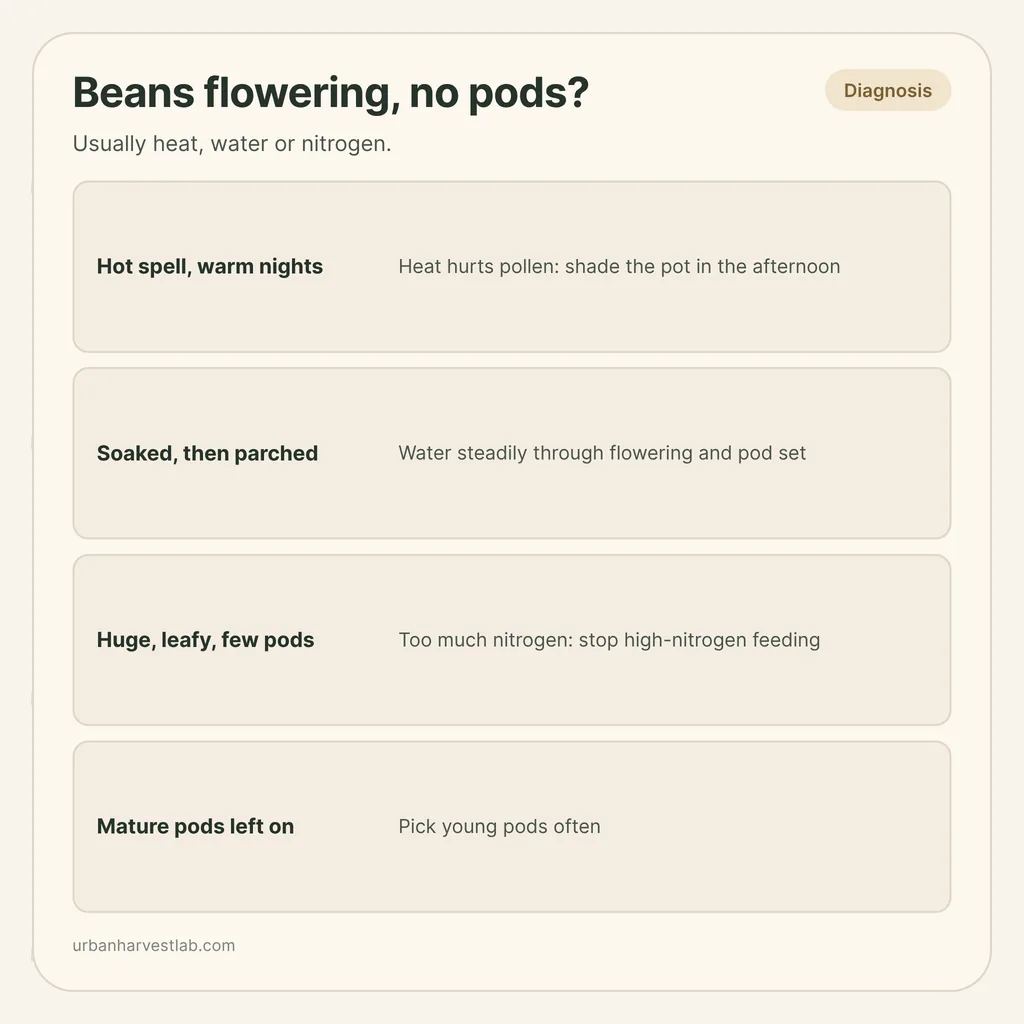
Bean plants flowering but no pods: heat, water, nitrogen or old pods
A bean plant covered in flowers and bare of pods is rarely sick. Heat, uneven watering, a nitrogen-rich mix or pods left to ripen are the usual reasons, and each has its own fix.