Troubleshoot the system before you change the inputs.
Symptoms
- Leaves droop and the plant looks limp, with the mix dry a finger-joint down.
- Leaves droop although the mix is wet and the pot feels heavy.
- The plant wilts fast, the stem looks dark or purple at the soil line, and leaves fall.
- The plant droops in the day and stands up again at night, week after week.
Possible causes
- Dry mix: the roots cannot keep up with the leaves, and a drink fixes it.
- Saturated mix: roots short of oxygen or rotted by Phytophthora stop delivering water.
- A wilt disease such as Verticillium, Rhizoctonia or southern blight that blocks or rots the stem and roots.
- Salt build-up, wind or root-knot nematodes damaging the root system.
Quick fixes
- Push a finger into the mix to the first joint and lift the pot before you water.
- If the mix is dry, water thoroughly, empty the saucer and look again within a day.
- If the mix is wet, stop watering, check the drainage hole and slip the plant out to look at the roots.
- If the stem base is dark or crusted, or the roots are brown and soft, treat it as a soil disease: discard the plant and its mix.
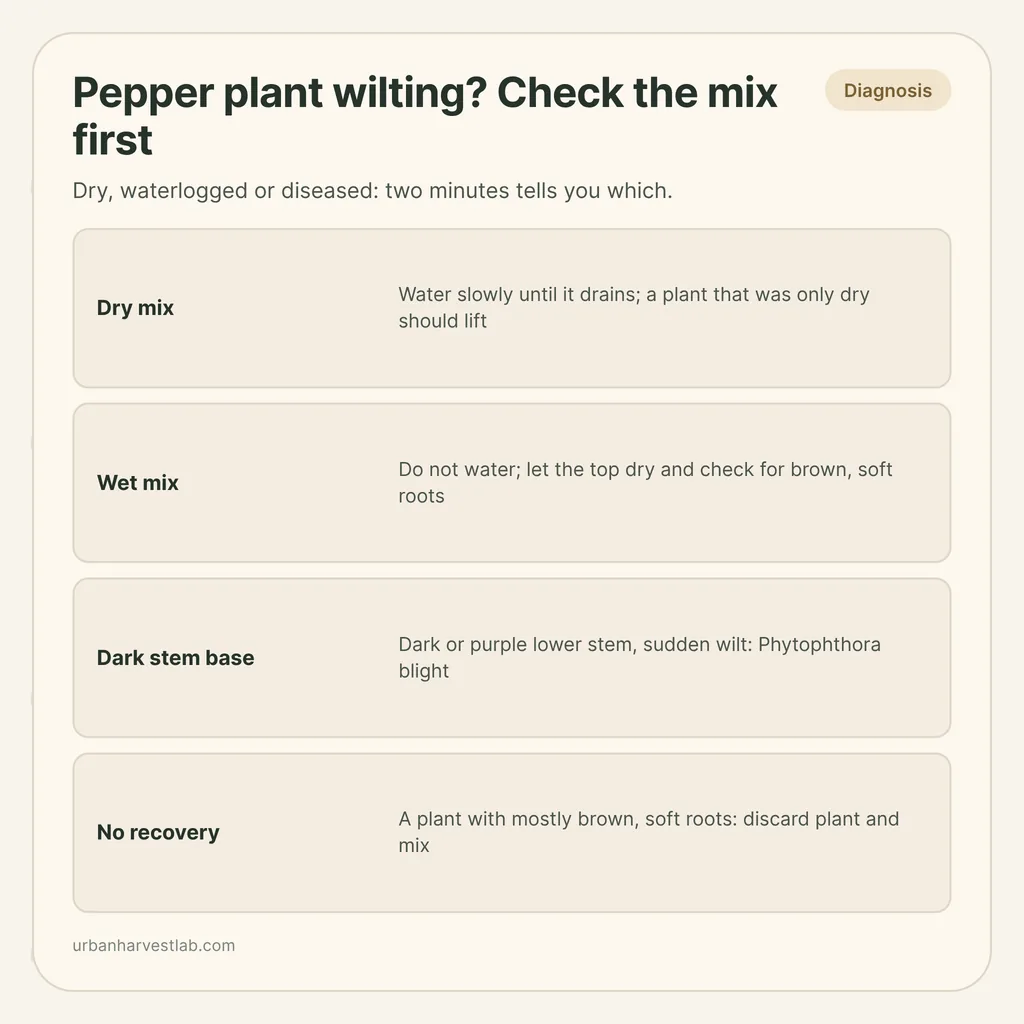
A wilting pepper is dry, waterlogged or diseased, and you can tell which in two minutes: check the mix, then the stem base, then see whether the plant lifts after water. Dry mix and a plant that lifts means thirst. Wet mix and a plant that does not lift points to roots that have stopped working. A dark stem base or a crust at the soil line points to disease.
Tomatoes share some of these causes, and why tomatoes wilt in pots covers that crop. Peppers have their own set of wilt diseases, covered below.
Start with the mix, not the leaves
Wilting is a poor guide to thirst. Clemson Extension says that although wilting is often an indication of the need to water, it is not always so: any injury to the root system, including root rot, reduces a plant’s ability to take up water, and watering may make the problem worse. It also says the symptoms of over-watering and underwatering are similar. So the leaves cannot settle it. The pot can.
- Push a finger into the mix up to the first joint. Clemson Extension says that if it is dry at your fingertip, the plant needs water.
- Lift the pot. Clemson Extension notes a definite loss in weight as potting mix dries, so a pot that feels light is dry and one that feels heavy is not.
- Look at the saucer. Clemson Extension’s advice is not to let the pot sit in the water that runs out, and to empty the saucer.
Clemson also warns that watering meters vary widely in accuracy, which is why a finger and the weight of the pot are the better checks for a pepper.
If the mix is dry
Water slowly and thoroughly until it runs out of the drainage hole, then empty the saucer. A plant that was only dry should start to lift. If the pepper stays limp after a good drink, stop treating it as thirst. UC IPM draws the same line for Phytophthora: unlike plants suffering from water stress, they do not recover when irrigated.
Container peppers that dry out every afternoon are a separate problem from a sick plant. Plants wilting in afternoon heat explains when to water and when to wait, and how to water container vegetables covers the routine.
If the mix is wet
This is the case that catches people, because the reflex is to water. Do the opposite. Let the top of the mix dry, make sure the drainage hole is open, and look at the roots by sliding the plant out of the pot. Brown, soft or sloughing roots mean rot. If the roots are mostly intact, look at the stem base next.
Phytophthora is the disease to know. New Mexico State University says Phytophthora root rot, which it also calls chile wilt, is caused by Phytophthora capsici and becomes a problem when soils are excessively wet, whether from over-irrigation, heavy rain or both. NMSU also says the first symptom is severe wilting, and that within a few days infected plants collapse from root and stem infections and die. Roots pulled from diseased plants are discoloured and dead, with bark that sheds easily.
How fast can this start? UC IPM says Phytophthora diseases can develop in as little as 4 to 8 hours of soil saturation. A blocked drainage hole or a pot left standing in a full saucer through a rainy night is enough exposure to take seriously.
NMSU also says shade that causes high humidity and slow drying favours the pathogen. A crowded balcony corner where the pots stay damp fits that description.
The bad news is that treatment is poor. NMSU says that chemicals have not proven very effective and that once a plant is infected, a registered fungicide will not cure it; it also says no cultivars are highly tolerant. UC IPM says a plant with a substantial Phytophthora infection rarely recovers. For a potted pepper that means: if the roots are mostly brown and soft, discard the plant and the mix, and do not reuse that mix for peppers or tomatoes. NMSU says the pathogen survives in crop debris and soil as oospores that can persist for years, and that 3- to 4-year rotations out of peppers and tomatoes reduce it in the field. If the roots are still mostly intact, the wet mix may simply have stressed the plant. How to save a plant with root rot walks through repotting and what is worth saving.
If the stem base looks wrong
The soil line tells you more than the leaves do. Compare what you see with the table below.
| What you see at the base | Likely cause | What the sources say |
|---|---|---|
| Dark or purple lower stem, sudden wilt | Phytophthora blight | Purdue Extension says the first sign is often the wilt and death of a plant, and that infected lower stems may be dark or even purple. |
| Reddish-brown lesion at the soil line | Rhizoctonia root rot | NMSU calls the lesion diagnostic, and says infected plants may recover at night unless high temperatures persist. |
| Small white to brown sclerotia at the base | Southern blight | Purdue Extension says peppers may wilt and decline, and that these fungal resting structures may be seen at the base of affected plants. |
| Yellow lower leaves first, no rot of the roots or crown | Verticillium wilt | NMSU says the fungus stays in the stem’s vascular tissue and there are no adequate control measures once it appears. |
NMSU is frank about the limits: Phytophthora, Verticillium and Rhizoctonia can cause similar symptoms and be confused, and it says a laboratory test is needed to determine the specific causal agent. At home, you will not always get a certain answer. You can get a good enough one: a plant that is wilting, with a damaged stem base or brown roots, in mix that has no obvious dry spell, is a plant to remove.
Verticillium raises one more trap. NMSU says infected plants may recover at night for a few days before permanent wilting and death occur. Droop that comes and goes is not proof that the weather is the whole story, especially when the lower leaves are yellowing first. Check the yellowing pattern against pepper leaves turning yellow.
Other causes of a limp pepper
- Salt build-up. NMSU says peppers are relatively sensitive to salt, and that mature plants with salt injury show burned root tips, marginal leaf necrosis, wilt and defoliation.
- Wind. NMSU says that on older plants, desiccated foliage may wilt beyond recovery. A pepper on an exposed balcony can lose water from its leaves faster than the roots supply it.
- Root-knot nematodes. NMSU says they cause damage on peppers worldwide and are particularly troublesome in warm, sandy soils. Root-knot nematodes in pots covers how to recognise them.
- Virus. Tomato spotted wilt virus is carried by thrips. NMSU lists mosaic, ring spots, deformation and dying shoot tips as the leaf symptoms, which looks different from a plant that simply droops. For curled or distorted leaves, see pepper leaves curling. NMSU’s control advice is to remove infected plants.
What to do next time
- Check the mix with your finger before watering, every time the plant looks tired.
- Keep the drainage hole open and empty the saucer.
- Let the top of the mix dry between waterings, and avoid damp, shaded corners where the mix stays wet.
- When a plant is lost to a soil disease, start the next one in fresh mix, not in the old.
Sources
- Chile Pepper Diseases, Circular 549 - New Mexico State University
- Chile Pepper Disorders Caused by Environmental Stress, Guide H-249 - New Mexico State University
- Pepper diseases - Purdue University Extension
- Phytophthora Root and Crown Rot in the Garden, Pest Notes 74133 - UC IPM
- Indoor Plants - Watering - Clemson Cooperative Extension HGIC
Sort out a wilting pepper
Compare the tomato version, check the leaves and rescue the roots.
Common questions
Why is my pepper plant wilting when the soil is wet?
Roots that sit in saturated mix cannot take up water properly, and Clemson Extension says watering them further may make the problem worse. New Mexico State University links Phytophthora root rot to excessively wet soil, and UC IPM says it can develop in as little as 4 to 8 hours of saturation.
Will a wilted pepper plant recover?
It depends on the cause. A plant that was simply dry should lift after a drink. UC IPM says plants with Phytophthora root rot do not recover when irrigated, and that a plant with a substantial infection rarely recovers.
How do I tell Phytophthora from other wilts on peppers?
Look at the base. Purdue Extension says Phytophthora blight can leave the lower stem dark or even purple, while small white to brown sclerotia at the base point to southern blight. NMSU adds that Verticillium causes no rot of the roots or crown, and that a laboratory test is needed to be sure.
Why does my pepper wilt in the day and recover at night?
Heat stress is a common explanation, but NMSU notes that plants infected with Verticillium or Rhizoctonia can also recover at night for a time. If the pattern repeats with moist mix, check the stem base and roots rather than assuming it is only the weather.
Related guides
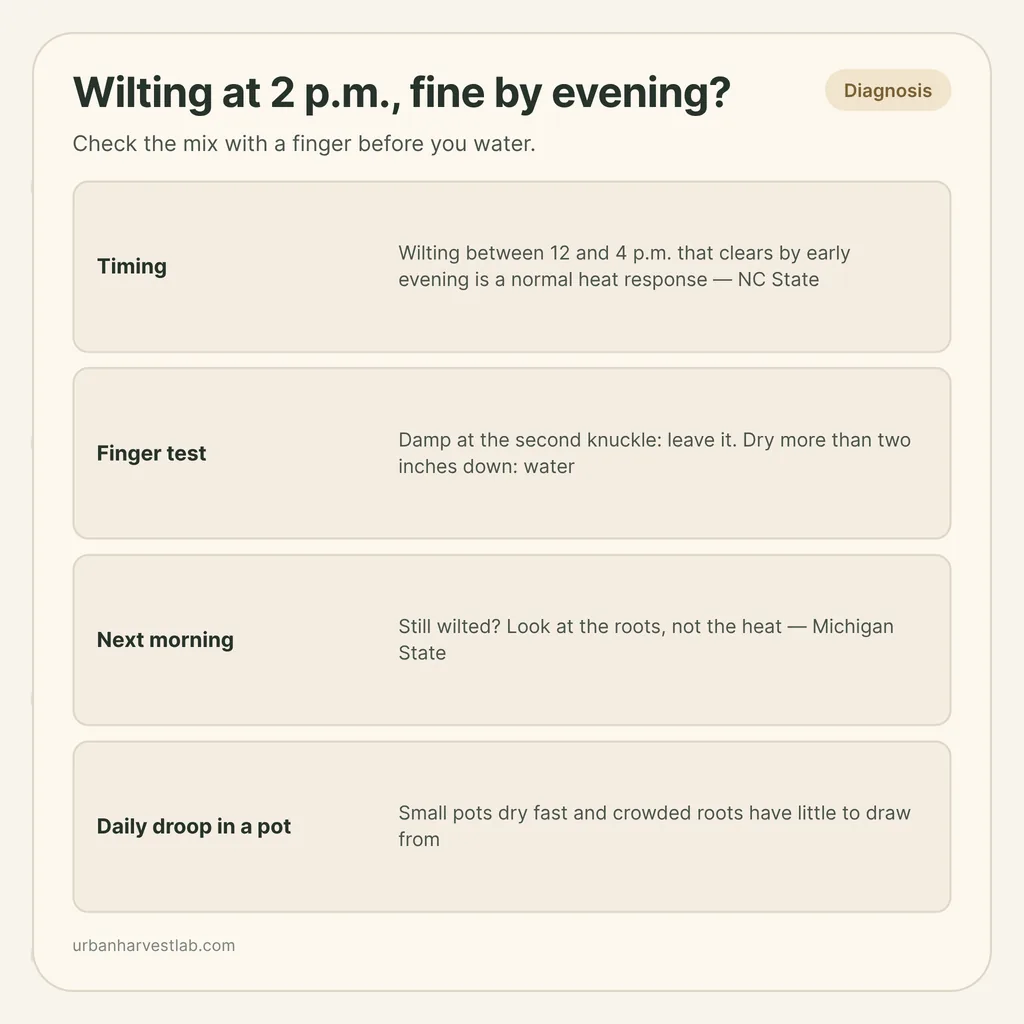
Plants wilting in afternoon heat but fine by evening: when to water and when to wait
A droop at 2 p.m. that is gone by dusk is often a heat response, not thirst. Here is how to check, when it points to the pot or the roots, and when watering is the right call.

Tomato plant wilting even though you water it: heat, roots, or disease
Midday droop that clears by evening is usually heat. Wilt that stays after watering points to rotting roots or a vascular disease, and a cut stem tells you which.
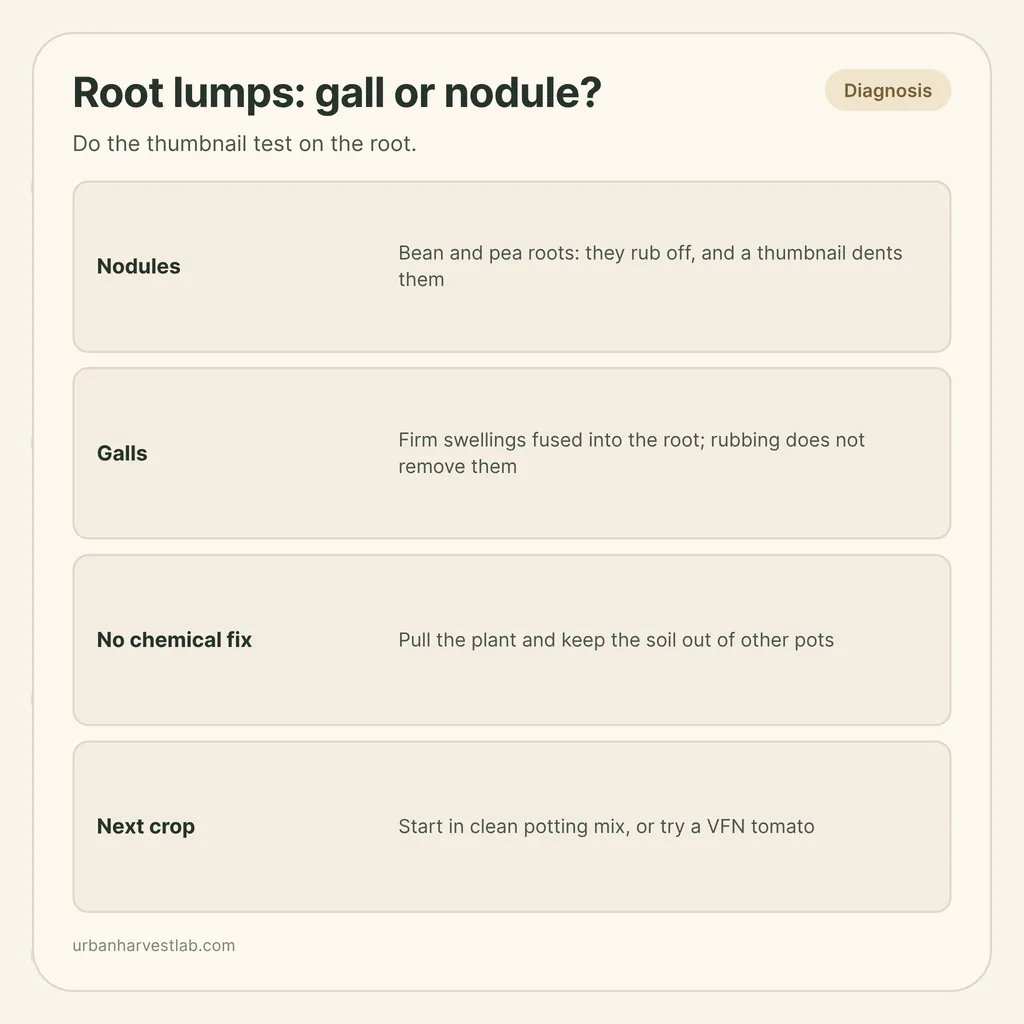
Galls on plant roots: root-knot nematodes or harmless nodules?
Lumps on a pulled-up root ball can be nematode galls or the nodules legumes are supposed to grow. A thumbnail and a rub test tell you which, and the answer decides what happens to the pot.