Troubleshoot the system before you change the inputs.
Symptoms
- White, powdery wax or fluff on the outer root ball, between the roots and the pot wall.
- Small, oval, whitish insects that crawl slowly when exposed.
- White powdery wax on the soil surface near the stem, or white cottony masses at the drainage holes.
- Stunted growth, pale or yellowing leaves, or wilting, with ants sometimes active near the stem base.
Possible causes
- Root mealybugs, often brought in on a new plant, which UC IPM says commonly happens.
- Harmless fungal growth in the mix, which is fungus feeding or living in the soil rather than an insect.
- Perlite in the potting mix, which looks like white flecks but is hard and does not move.
- A different root problem such as rot or a root-bound plant that happens to show the same stunting and wilting.
Quick fixes
- Move the pot away from other plants and take the plant out to look at the outer root ball.
- Look for movement and powdery wax before deciding; fluff with no insects is probably not mealybugs.
- If insects are present, decide between discarding the plant and long-term rechecking, and clean the pot and saucer either way.
- Check the roots of every plant that stood next to it.
White material found on roots or in the mix
| Clue | Root mealybugs | Fungus (no insects) | Perlite | Springtails |
|---|---|---|---|---|
| Texture | Powdery wax or fluff that smears | White fluff or threads with no insects under the material | Hard, lightweight, rounded white bits | Tiny specks, not wax |
| Moves? | Slowly, oval insects | No | No | Jump when disturbed |
| Where | Outer root ball against the pot wall, drainage holes | Anywhere in the mix | Spread evenly through the mix | Damp surface and the mix |
| Harm to the plant | Yes, they suck sap from roots | Not a plant pest (see white mold on soil) | None | Mainly a nuisance |
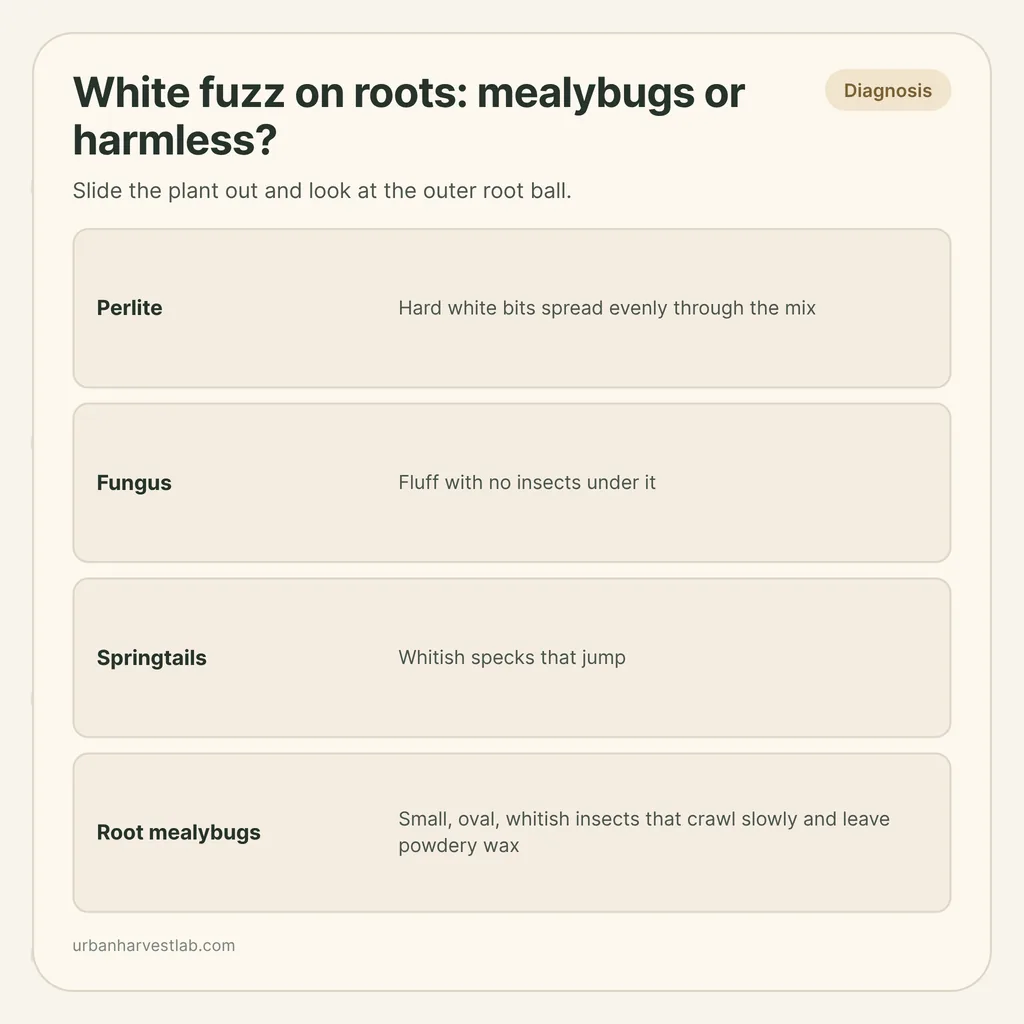
White fuzz on roots is only root mealybugs if you can also find small, oval, whitish insects that crawl slowly and leave powdery wax behind. Fluff with no insects is usually harmless fungus, and hard white bits spread evenly through the mix are perlite. The check takes a minute: slide the plant out of the pot and look at the outer edge of the root ball.
Four white things that look alike
Perlite is the quick one to rule out. Iowa State Extension describes it as a rock-like material that has been “puffed up” like popcorn, added to potting mix to provide long-lasting air-filled pores. It is a component of the mix, so you will find it everywhere in the pot, not clustered on roots. It does not move and it does not smear.
Fungus with no insects is the second harmless option. The fungus living in a pot is usually feeding on organic matter in the mix, the same thing described in white mold on plant soil. Threads alone do not rule out mealybugs: NC State notes some root mealybug species “secrete slender filaments that form a netting over the insect”, so look for insects under the material, as UC IPM advises (“carefully examine the insect beneath the wax”). Mycorrhizal fungi are a reason not to panic about roots generally, not an explanation for what you can see: University of Wisconsin Extension describes them as ubiquitous in soil, harmless to the host (“neither the host plant nor the fungus suffer any ill effects”) and unseen. Visible white fluff with no insects is far more likely the fungus described in white mold on plant soil.
Woolly aphids are a lookalike too. UC IPM’s mealybug pest note lists woolly aphids among the pests that also produce wax and are confused with mealybugs, and advises examining the insect beneath the wax. If you find waxy insects, isolating the plant, inspecting its neighbours and discarding it apply in the same way.
Springtails can be mistaken for root pests because they are whitish and live in damp mix. UC IPM describes them as small jumping creatures that do not bite people or pets, spread disease or damage furnishings. NC State makes the comparison directly: root mealybugs “resemble large, white springtails but move much more slowly.” If the specks jump, see springtails vs fungus gnats.
What root mealybugs look like
NC State Extension gives adult females as roughly 1/16 to 1/8 inch long, slightly flattened and bluish white under a shallow white bloom, and says the powdery white fluff they secrete can give the soil a bluish tint. UC IPM gives a slightly wider range, up to 1/16 to 3/16 inch, with nymphs resembling small adults. UC IPM adds that these insects lack the marginal wax filaments of the foliage-feeding mealybugs. So they look flatter and plainer than the cottony ones on stems, which are covered in mealybugs on indoor herbs.
Where to look matters as much as what to look for. UC IPM says that in pots they concentrate on the outer part of the root ball, between the roots and the pot, though they also occur through the root mass. UC IPM’s advice for new plants is to remove a portion from the container and examine roots for white, powdery wax and slow-moving, oval, whitish insects.
Clues before you unpot
None of these confirm anything on their own, but together they justify taking the plant out:
- Stunted growth, pale or yellowing leaves, wilting. UC IPM lists these as common symptoms and adds that other problems can cause them too, which includes the overwatering and root-bound problems in root-bound herbs.
- White powdery wax on the soil surface near the stem, according to UC IPM.
- Small white cottony masses around the drainage holes, which Wisconsin Extension lists, with the caveat that in many cases infestations can be confirmed only by removing the root ball from the pot.
- Ants on the plant or soil near the base of the stem. UC IPM says ants can indicate ground mealybugs or other sap-feeding pests, and can carry and spread them.
Because roots are out of sight, UC IPM says ground mealybugs are generally not seen until plants are dug up and the roots exposed. Where they come from is usually less mysterious: UC IPM says they commonly arrive with new stock, so the most likely culprit is the last plant you brought home.
If you do find them
Isolate first. UC IPM describes the crawlers as highly mobile and readily walking to nearby plants, and NC State notes root mealybugs sometimes crawl out of drainage holes and infest nearby plants. Move the pot to its own spot, and put it on a surface you can wipe down. UC IPM also advises not letting water from infested areas run to clean ones, since crawlers are easily spread with moving water.
Decide whether the plant is worth saving. Both extension services that cover this are blunt. UC IPM says it is difficult to completely disinfest roots, and that starting with pest-free plants and growing media can be preferable to uncertainty over whether plants can be entirely disinfested. Wisconsin Extension calls discarding the plant and replacing it “often the most practical way of eliminating root mealybugs”. For a supermarket basil or a cheap pot of parsley, that is the sensible call. Bag the plant and its soil and put them in the bin; UC IPM’s advice is to dispose of infested debris in covered containers.
Clean everything the pot touched. UC IPM says tools, pots and benches near an infestation may carry crawlers and suggests disinfectants, hot water or steam for sanitising them. Scrub the pot, saucer and any tools before they go near another plant, or retire the pot if it cannot be cleaned. Then inspect the roots of every plant that sat next to it. Pull one pot at a time and look at the outer root ball.
If you decide to treat a plant you want to keep. Do not use a houseplant systemic insecticide on an herb or vegetable you will eat unless the product label lists that crop. The National Pesticide Information Center puts it plainly: “If your fruit or vegetable is not listed on the label, that means you cannot apply the product to it.” UC IPM’s nursery table, for example, says its granular neonicotinoid product must not be applied to bedding plants intended as food crops. UC IPM notes that sanitation, heat treatment and soil-drench or systemic insecticides are the main management methods for nursery growers, and for ornamental houseplants only, NC State recommends a systemic insecticide labelled for residential use. For anything edible, work from the product label and choosing a pest treatment for edible plants rather than from a houseplant recommendation. Treating roots is also harder than treating leaves: UC IPM says ground mealybugs are even more difficult to control than those that feed aboveground.
Use clean mix and a clean pot for any replacement. Fresh, unused potting mix in a washed pot is what UC IPM suggests, in its words, “new or freshly pasteurized” media for propagation. Repotting a plant you are keeping follows the usual steps in repotting herbs without shock, except that you start from a bare root ball and old mix goes straight in the bin.
How long to keep checking
UC IPM gives a generation time of about 2 to 4 months at common soil temperatures, and adults living 1 to 2 months. UC IPM says eggs usually hatch within a day of being laid, and females can also give live birth to crawlers. A plant that looks clear after one repotting can still carry crawlers, so check the outer root ball again over the following months rather than after a week.
Keeping them out
Buy plants you can inspect, and slide new ones out of the pot before they join the rest. Preventing pests on indoor herbs covers quarantine routines in general. If ants are climbing a pot, see ants in plant pots, since ants can spread these insects between pots. Root rot can produce the same wilting and stunting, so a plant with no insects on its roots still needs a look at root colour and firmness. For that, see root rot in potted plants.
Sources
- UC IPM, Ground (Root) Mealybugs, Floriculture and Ornamental Nurseries
- UC IPM Pest Notes 74174, Mealybugs
- UC IPM Pest Notes 74136, Springtails
- NC State Extension, Root Mealybugs
- University of Wisconsin Extension, Mealybugs
- University of Wisconsin Extension, Mycorrhizae
- Iowa State Extension, Potting media: components and handling
- National Pesticide Information Center, Preharvest Interval
Related pest and repotting guides
Mealybugs above the soil, white growth on the soil surface, and repotting without extra stress.
Common questions
What is the white fuzzy stuff on my plant roots?
Look for insects. If the white material is powdery wax with small oval insects that move slowly, UC IPM describes that as ground mealybugs. If it is hard, lightweight and has no insects under it, it is likely perlite from the mix, and fluff with no insects is probably fungus. Threads alone do not settle it, because NC State notes some root mealybug species spin slender filaments over themselves.
Can root mealybugs be confirmed without repotting?
Not reliably. Wisconsin Extension says many infestations can be confirmed only by removing the root ball from the pot. White cottony masses at the drainage holes and yellow, wilting foliage are clues, but they can have other causes.
Do root mealybugs spread to other plants?
Yes. UC IPM describes the crawlers as highly mobile, readily walking to nearby plants, and NC State notes that they sometimes crawl out of the drainage holes. Move the plant away from the others as soon as you suspect them.
Should I just throw the plant out?
For a cheap or replaceable herb, that is a reasonable choice. UC IPM says it is difficult to completely disinfest roots, and Wisconsin Extension calls discarding the plant often the most practical way of eliminating root mealybugs. For a plant you value, expect repeated checks over months.
Related guides
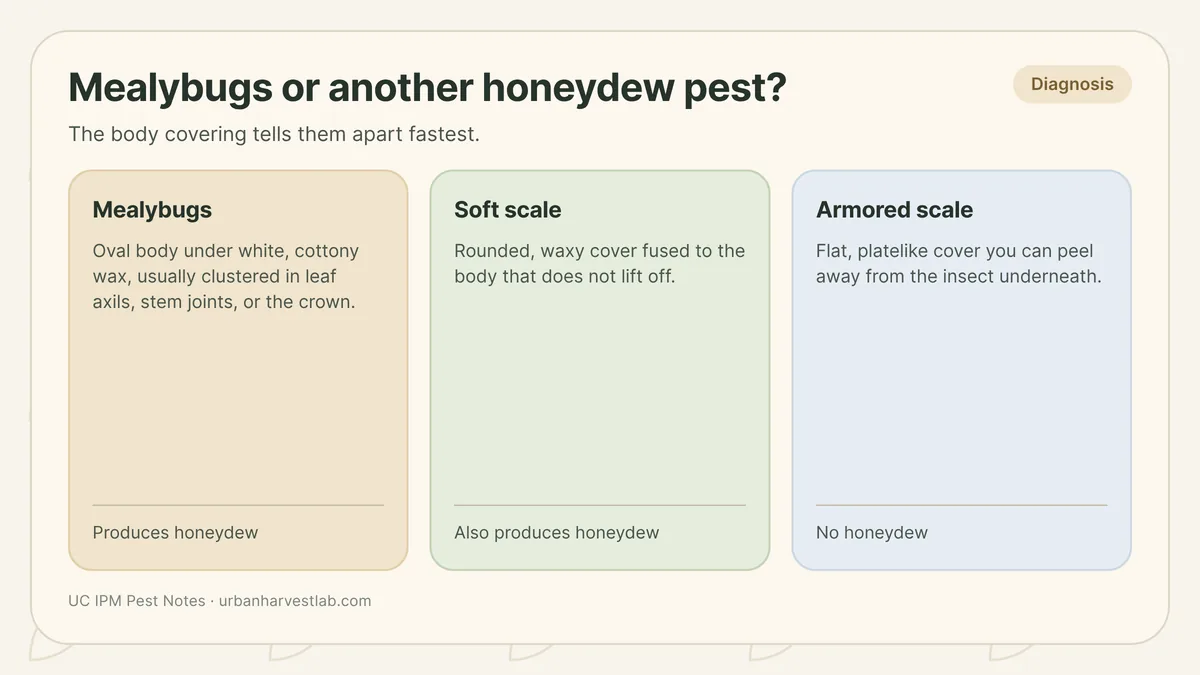
Mealybugs on indoor herbs: identify them and stop the spread
Mealybugs show up as white, cottony masses tucked into leaf axils and stem joints, and they keep coming back until every hiding spot and every generation has been treated.
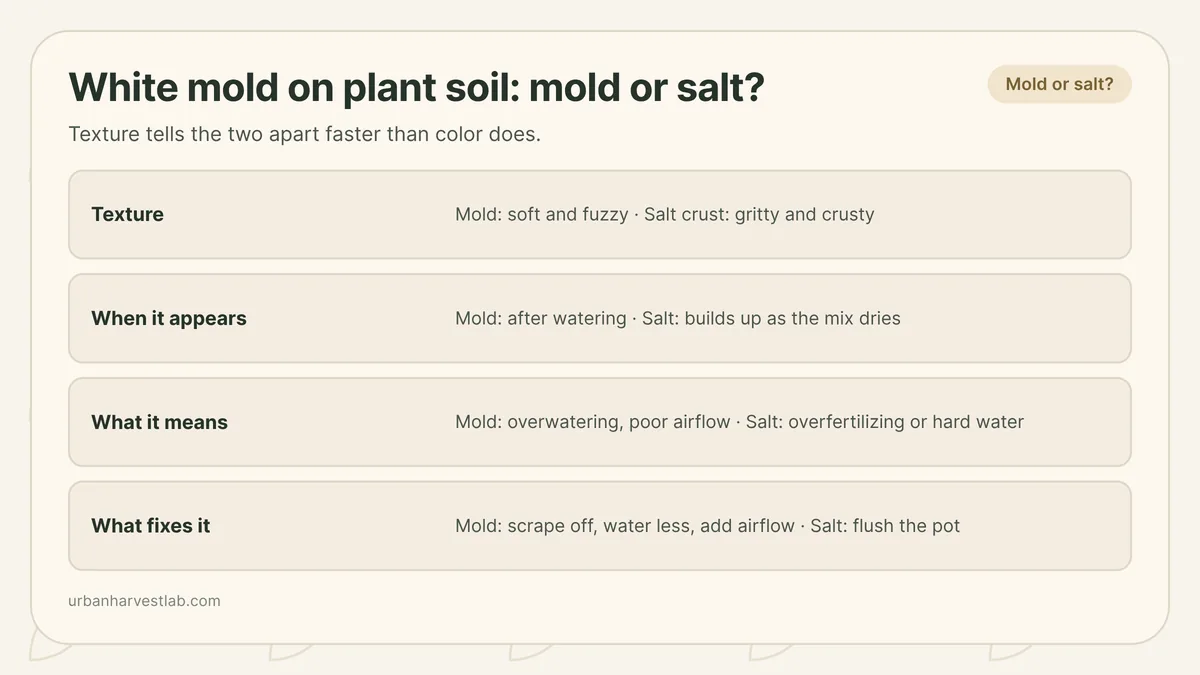
White mold on plant soil: what it means and what to do
A white, fuzzy patch spreading across the soil surface looks alarming, but it is usually a cosmetic fungus feeding on the mix, not the plant.
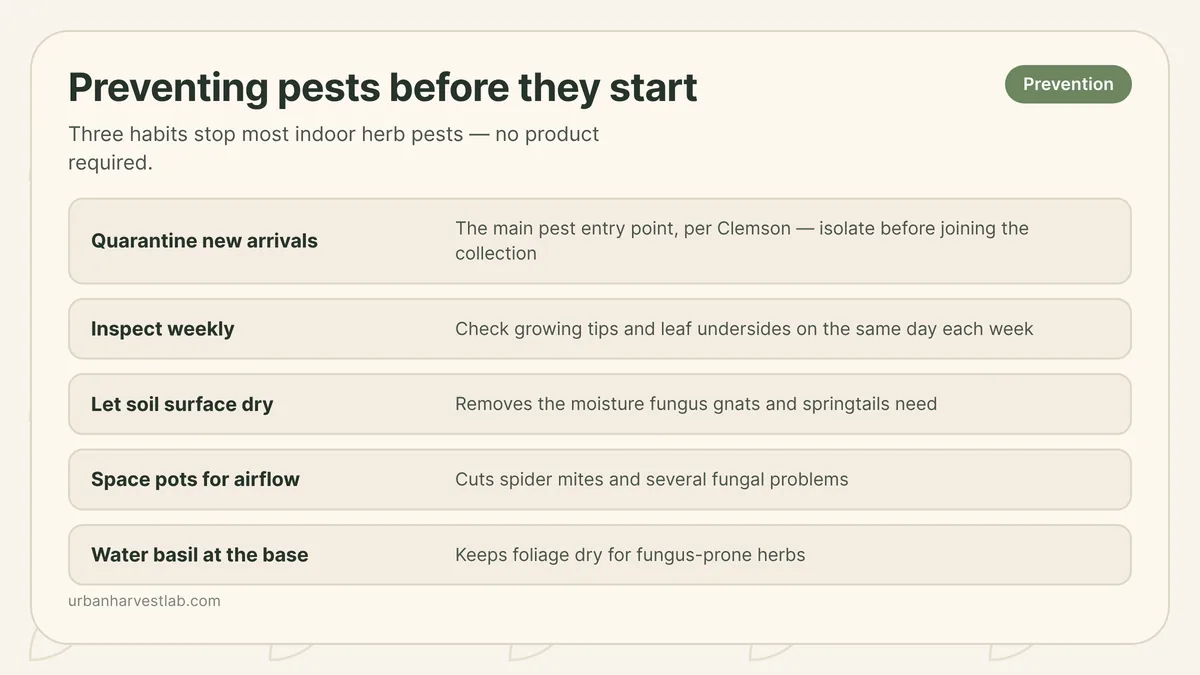
Preventing pests on indoor herbs before they start
Most indoor herb pests arrive on a new plant or one that spent summer outdoors, and most of them are stopped by isolating that plant, checking it on a schedule, and keeping the soil and air from favoring the pest in the first place.