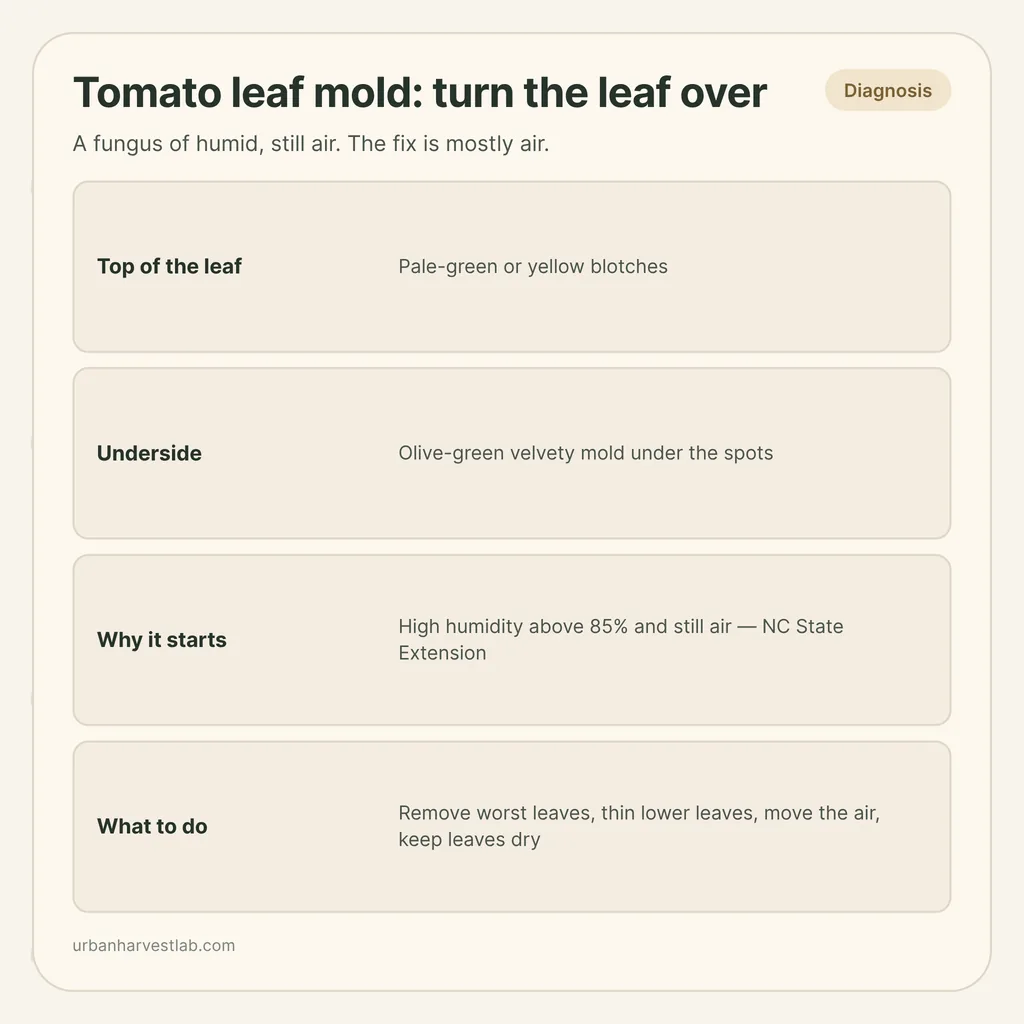
Troubleshoot the system before you change the inputs.
Symptoms
- Pale green to yellow blotches on the top of older tomato leaves, with an olive-green velvety mold on the underside of the same spots.
- Leaves that curl, wither and drop once the spots join up.
- The plant lives in a glazed balcony, a greenhouse or indoors, where the air is humid and does not move.
Possible causes
- Leaf mold, a fungus (Passalora fulva), favoured by humidity above 85% or wet leaves.
- Powdery mildew, if the top of the leaf shows white powder or the underside is powdery rather than olive and velvety.
- Gray mold (Botrytis), if the growth is gray-brown and sits on dead, soft tissue, often a wound.
Quick fixes
- Pick off the worst leaves, bag them, and keep them out of the compost.
- Open the plant up: remove the lowest leaves, space pots apart and run a fan so air moves through the canopy.
- Water the soil early in the day and keep the leaves dry.
- Vent or open the space so humidity drops, especially at night when the air cools.
Leaf mold compared with the diseases it is mistaken for
| Sign | Leaf mold | Powdery mildew | Gray mold | Late blight |
|---|---|---|---|---|
| Top of leaf | Pale green to yellow blotches | Light green to yellow spots, or white powder (Oidium types) | Brown dead areas | See the late blight page |
| Underside | Olive-green velvety mold in the spots | Powdery growth on the underside (one type) | Fuzzy gray-brown growth on dead tissue | See the late blight page |
| Where it spreads | Older leaves first; stems and fruit only in some cases | Leaves | Leaves, petioles, then stem and fruit | See the late blight page |
| Setting | Humid, still air | Humid enclosed structures too | Relatively cool, humid conditions | Cool, wet weather |
If the top of a tomato leaf has a yellow blotch and the underside of that same spot carries an olive-green, velvety mold, it is leaf mold. The cause is a fungus, Passalora fulva (also called Fulvia fulva), and it thrives where the air is humid and still. The fix is mostly about air, not sprays.
This is the tomato disease of closed spaces. For outdoor tomatoes with brown spots, rings or halos, brown spots on tomato leaves is the better page. If you grow on an enclosed balcony, a lean-to or a windowsill with a crowded plant, read on.
Turn the leaf over
NC State Extension describes leaf mold as starting with pale-green or yellowish spots on the upper leaf surface, which later turn yellow. On the underside, an olive-green mold sits under the spots, denser and deeper in colour in the centre. Purdue Extension calls the top lesions bright yellow and blotchy and the underside growth an olive-green fuzz.
Two more details help:
- Older leaves go first. NC State says older leaves are affected, then younger ones. A plant with healthy new growth and spotted bottom leaves fits.
- It gets worse as spots join. NC State says spots can coalesce and kill the foliage when infection is severe, and leaves may curl, wither and drop.
On fruit, the two extension sources differ. Purdue says lesions do not appear on stems or fruit. NC State says leaf mold may spread in some cases to petioles, stems, blossoms and fruit, and that green and mature fruit may develop a black, leathery rot at the stem end.
Purdue also notes the disease is usually not serious, depending on how soon in the season it arrives. A plant hit late, with fruit already set, often carries on.
Telling it from the look-alikes
NC State warns that leaf mold may be confused with Botrytis gray mold, late blight and powdery mildew. The table above separates the first three; the notes below add the rest.
- Powdery mildew. NC State describes one type as light-green to bright yellow spots on top with powdery growth underneath, and another as white, powdery growth on the upper surface. White powder on top is not leaf mold. For mildew on herbs in the same space, see powdery mildew on container herbs, and for the grey-brown fuzz of gray mold on dead tissue, gray mold on herbs.
- Late blight. It is a separate disease with its own page: late blight on tomatoes. If the damage is spreading fast on leaves and stems with no olive fuzz underneath, go there first.
- Plain yellowing. If you turn the leaf over and find nothing, the yellowing is probably something else: tomato leaves turning yellow covers the pattern.
Why a glazed balcony or indoor spot invites it
NC State says high tunnels and greenhouses are protected from heavy rain, but that they are prone to high humidity and tend to be wind free, which encourages problems uncommon in field production, leaf mold among them. A glazed balcony behaves the same way. The fungus, NC State says, needs excess water on the foliage or high humidity above 85%, and can cause disease at any temperature from 40 to 94 °F, with development optimal at 72-75 °F. Purdue gives the same 72-75 °F optimum.
A closed balcony on a still, sunny afternoon, or a crowded indoor plant overnight, can sit in exactly that warm, humid range. Spores spread easily through the air, Purdue says, and NC State adds that rain and wind move them, as do tools and clothing. If you grow in a glazed space, growing on a glazed balcony covers venting the space itself.
What to do
The extension advice for leaf mold is mostly about air and sanitation. Purdue says the options are measures to reduce humidity, increase airflow and improve sanitation.
- Remove the worst leaves. NC State says to remove infected seedlings and diseased tissue. Bag them. Do not compost them: the fungus survives on crop residue.
- Thin the lower plant. NC State recommends removing lower leaves as the plant ages to improve air movement, and wider plant spacing and better ventilation. In pots that means pulling pots apart, not clustering them against a wall.
- Move the air. NC State suggests fans that replace the air several times a day, especially in rainy or cloudy periods.
- Keep leaves dry. NC State says to avoid overhead irrigation and water at the base. It also says to avoid handling wet plants, since that moves spores on hands and tools.
- Cut condensation. NC State advises managing temperatures to reduce condensation. On a glazed balcony, that means venting before the evening drop in temperature rather than closing everything up warm and wet.
- Wash what touched the plant. NC State says trays, tools, stakes, twine and structures should be washed and sanitized between crops.
None of this needs a spray. If you are considering one on a plant you will eat, the label decides what is allowed, as set out in choosing a pest treatment for edible plants.
Resistant varieties help, up to a point
Purdue calls resistant varieties an excellent management strategy, with a warning: some resistant varieties are not listed as such, and variability in the fungus population may overcome the plant’s resistance. NC State puts numbers on it: there are currently 12 races of the fungus, and each resistant variety protects against only one to a few. NC State names Trust, Geronimo and Starbuck as leaf mold resistant varieties for use as part of an integrated programme.
Before the next crop
NC State says the fungus survives for at least a year on crop residue and in the soil. Purdue says it survives season to season in crop residue. At the end of the season:
- Pull every leaf, including those under the pot.
- Wash the pots and any trellis or cage.
- Replace or refresh the potting mix rather than reusing it for another tomato.
For what is safe to keep, see reusing potting mix.
Sources
Related tomato and humidity problems
Other tomato leaf diseases, growing in a glazed space, and the other mildews and molds that like still air.
Common questions
What does tomato leaf mold look like?
Purdue Extension describes bright yellow, blotchy lesions on the top of the leaf and an olive-green fuzz on the underside. NC State adds that older leaves are affected first and that the mold is denser and darker in the centre of each spot.
Why do tomatoes on a glazed balcony or indoors get leaf mold?
NC State Extension says enclosed structures are prone to high humidity and tend to be wind free, which encourages leaf mold, a disease uncommon in field production. The fungus needs high humidity (above 85%) or water sitting on the foliage.
Can I eat tomatoes from a plant with leaf mold?
Purdue says lesions do not appear on stems or fruit, while NC State says it may spread in some cases to petioles, stems, blossoms and fruit, sometimes as a black, leathery rot at the stem end. Neither extension source covers eating the fruit; discard any fruit with a black, leathery rot at the stem end.
Will the leaf mold come back next year?
It can. NC State says the fungus survives at least a year on crop residue and in the soil as spores or sclerotia, and Purdue says it survives season to season in crop residue. Remove every dead leaf, clean the pot and the space, and refresh the mix.
Related guides

Brown spots on tomato leaves: early blight, septoria or bacterial spot
Three common diseases cause brown spots on tomato leaves, and each leaves a different mark. Read the spot, then pick the response that fits.
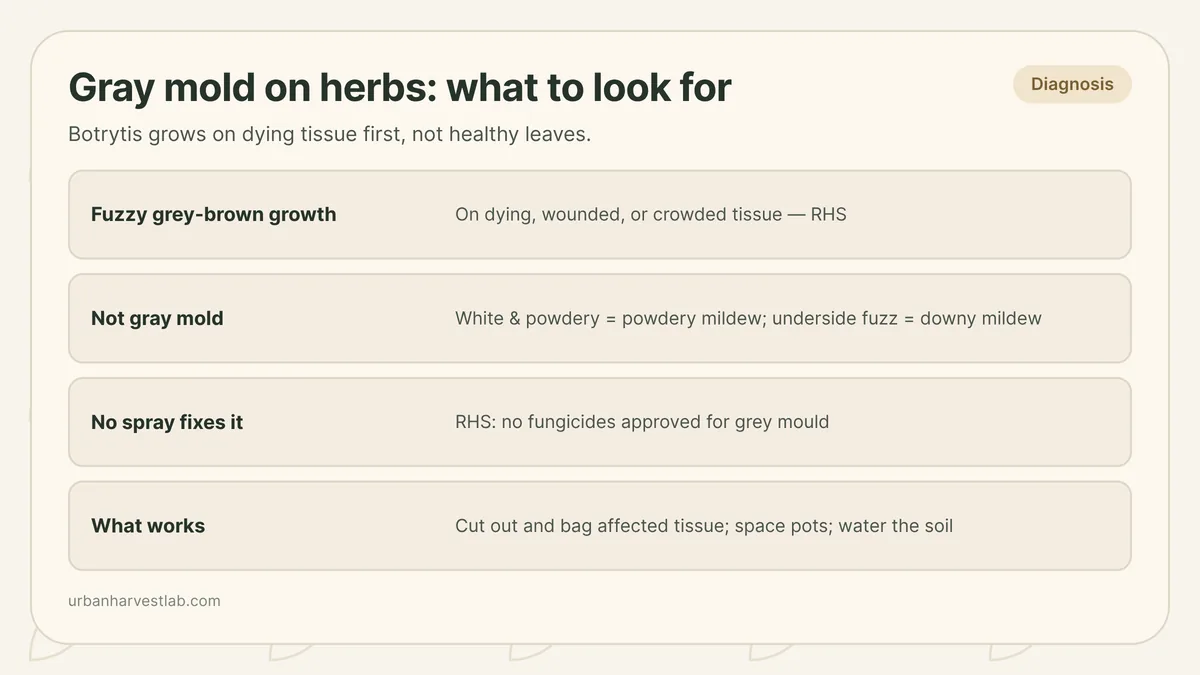
Gray mold on herbs: what botrytis looks like and how to stop it spreading
Gray mold grows on dying or wounded tissue first, not healthy leaves. Remove the source, open up the canopy, and stop watering overhead.
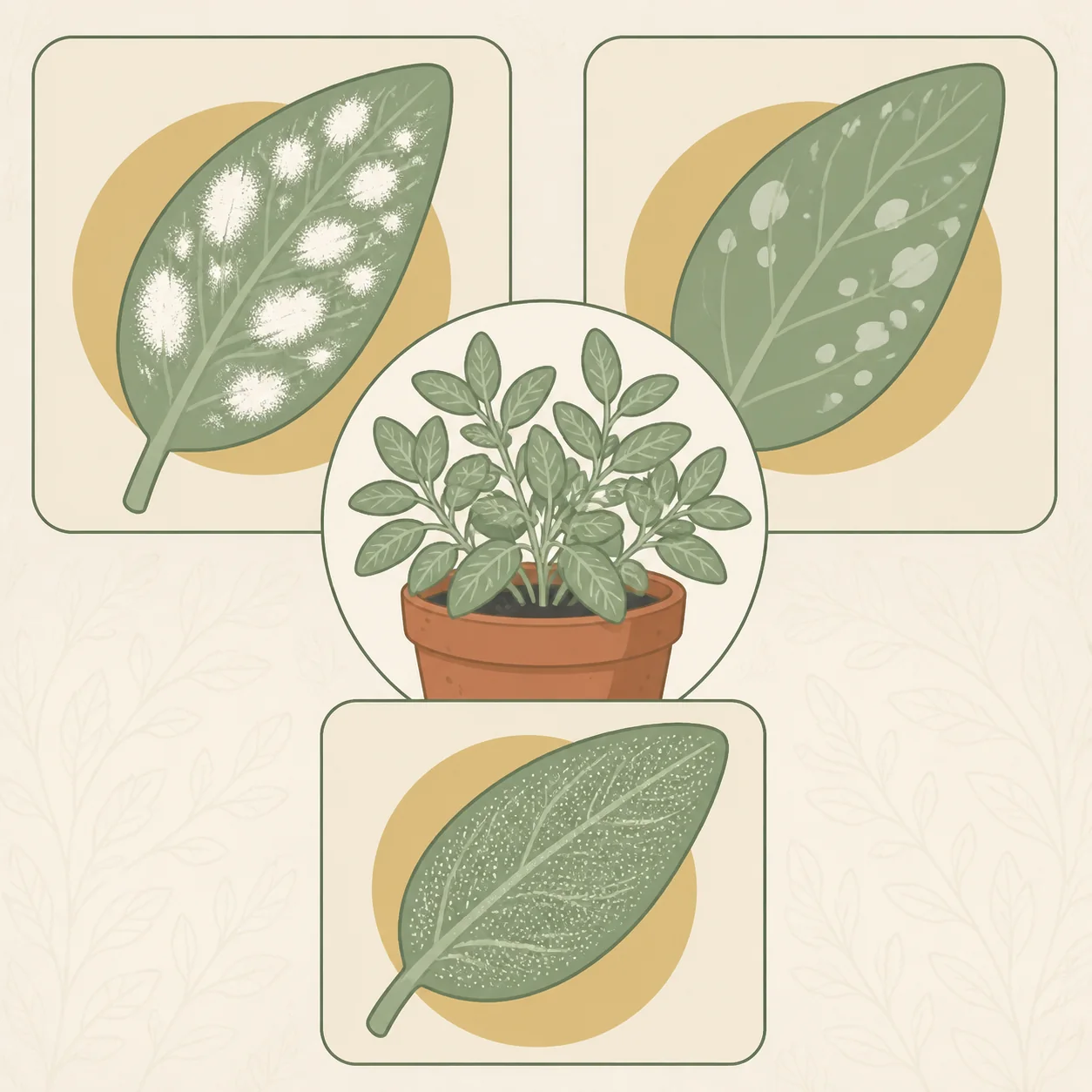
Powdery mildew on container herbs: diagnosis and control
A white mark is not automatically mildew. Confirm whether patches recur and spread on living tissue before changing the entire care routine.