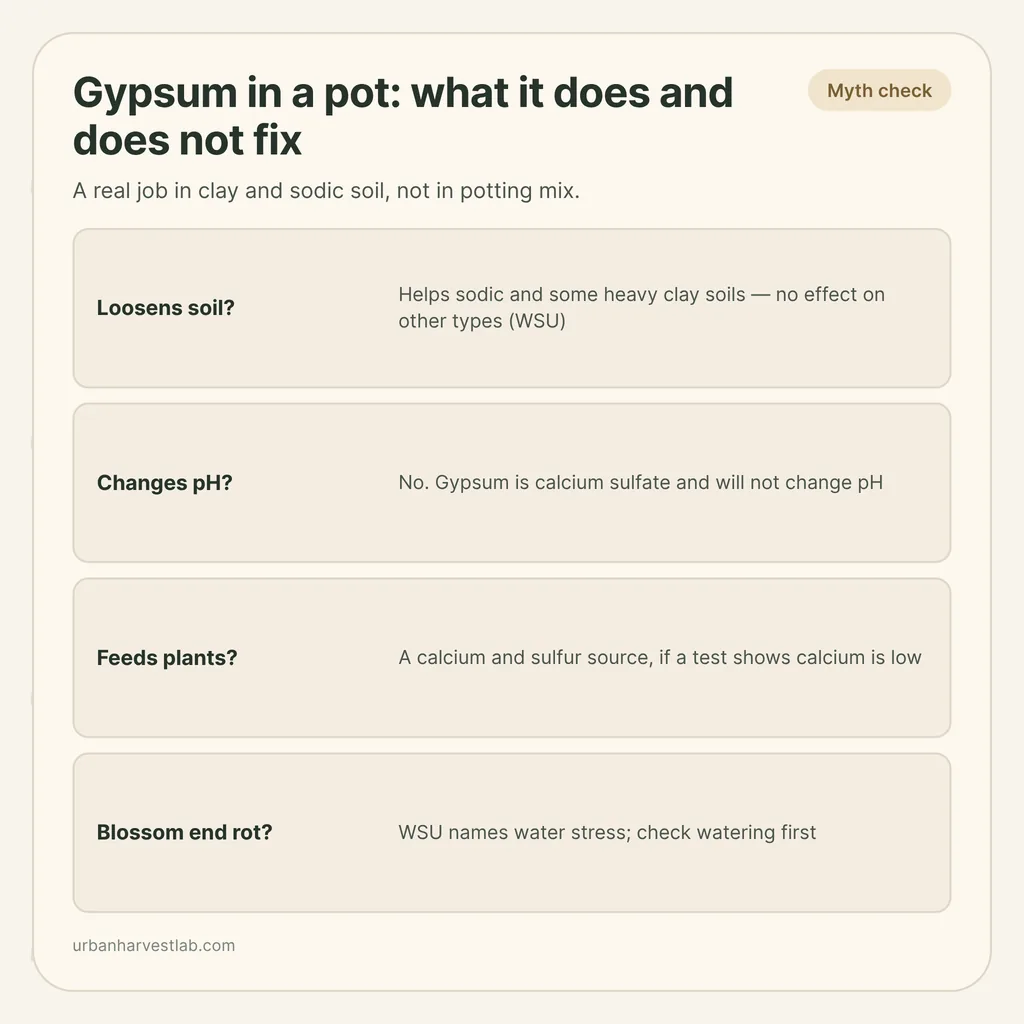
Common gypsum claims and what extension sources say
| Claim | What gardeners hope | What extension sources say |
|---|---|---|
| Loosens tight soil | Opens up a dense pot of mix | Helps sodic and some heavy clay soils through cation exchange; no structural effect on other soil types (WSU) |
| Changes pH | Acidifies or sweetens the mix | Calcium sulfate does not change pH (WSU, Michigan State) |
| Feeds calcium and sulfur | Fills a gap in the mix | A real calcium and sulfur source, useful where a test shows calcium is deficient (WSU) |
| Cures blossom end rot | Stops black fruit bottoms | WSU finds no research linking gypsum to suppression and points to water stress; Maryland suggests it at planting |
Extension sources give no basis for expecting gypsum to loosen a pot of potting mix, and it does not change pH. It is a calcium and sulfur source, and extension sources reserve it for soil where a test shows calcium is low. Its reputation as a soil conditioner comes from clay and sodic field soil, which is not what is in your pot.
Where the loosening claim comes from
Gypsum is calcium sulfate. Washington State University Extension (Chalker-Scott and Guggenheim) says it is beneficial on sodic soils and some heavy clay soils. In sodic soil, sodium makes clay particles disperse; calcium binds to the clay in its place, the sodium leaches away, and the clay clumps into aggregates that drain better.
That chemistry needs clay to work on. WSU’s summary of its own review is blunt: gypsum “has no effect on soil fertility, structure, or pH of any other soil type.” The Washington State University fact sheet suggests a ribbon test to check whether clay content is high enough (over 40%) for gypsum to be useful.
WSU finds gypsum helps only sodic and some heavy clay soils, and notes few studies on gypsum in urban or home settings. Potting mix is neither of those; that step is our inference from WSU’s text, not something WSU tested. So a pot that has gone dense, crusty or stubbornly dry is probably not a gypsum job. Water that runs straight down the sides of the pot is a hydrophobic potting mix problem. A mix that has slumped after a season is better handled by refreshing the old potting soil. If the mix came from the yard, garden soil in pots explains why it behaves so differently.
What gypsum does not do to pH
Gypsum is often sold as a way to adjust pH. It does not. WSU states that the sulfate ion in gypsum “does not form sulfuric acid in the soil and has no effect on soil pH.” Michigan State University Extension says the same from the other direction: some situations call for added calcium without a pH rise, “in which gypsum will be recommended,” and “gypsum is calcium sulfate and will not change pH.”
For a mix that is too acidic or too alkaline, the tool is something else. Container soil pH covers when pH matters and how to move it. Texas A&M AgriLife Extension notes that most soilless media are acid, and that dolomitic lime is generally recommended for raising pH because it also supplies magnesium.
When it does add something useful
Gypsum is a real source of two nutrients. WSU: “Other than being a source of calcium and sulfur, gypsum has no effect on inherent soil fertility.” And where calcium is the shortfall, “adding gypsum can improve plant nutrition.”
The condition matters. WSU’s recommendation is: “Unless calcium is deficient and pH is in the optimal range, do not add gypsum.” If the need is sulfur, WSU points to ammonium sulfate or potassium sulfate instead.
In a pot, calcium is less likely to be missing than gardeners assume. University of Maryland Extension notes that conventional mixes have lime added, and lime is a calcium source. New Mexico State University says a potting soil could be a minor source of trouble if it lacks calcium, but that tap water normally supplies enough unless you water with distilled water. A pour-through test or a lab analysis tells you more than a guess does. WSU asks for pH, basic nutrient levels and sodium when testing.
WSU also warns that misuse can unbalance a soil. It cites field literature on gypsum increasing the leaching of potassium, iron, manganese and magnesium. That work was done in ground soil, so how closely it carries over to a pot is unknown, but it is a reason not to add gypsum as a precaution.
Gypsum and blossom end rot in pots
Here the sources split. WSU states that blossom end rot “is directly influenced by water stress—not by calcium levels,” and that there is “no research indicating any relationship between gypsum addition and blossom end rot suppression.” University of Maryland Extension, by contrast, says: “Mix in 1/4 cup of gypsum (calcium sulfate) with the soil from each planting hole prior to transplanting.” The same page says regular deep watering will alleviate the problem if soil calcium is adequate. The page gives no container rate, so we do not suggest that dose for pots.
Everyone agrees on watering. Michigan State says alternating wet and dry periods decrease calcium uptake and contribute greatly to the disorder. UC IPM says blossom end rot is aggravated by high soil salt content or low soil moisture and advises keeping the root zone from drying out or staying saturated. New Mexico State’s answer to a container grower whose pots were dry by evening was to prevent wilting, in part with a larger container.
A potted tomato dries out fast, so watering consistency is the first place to look. The blossom end rot in container tomatoes page covers diagnosis and fixes. For other calcium sources, see eggshells, and for the magnesium counterpart, Epsom salt. Fruit that already has the lesion does not heal; New Mexico State says there is no solution for that fruit.
A short decision rule
- Dense, dry or crusty mix: treat the mix; gypsum has no extension support here.
- Pot pH off: use the pH page, not gypsum.
- Black fruit bottoms: check watering first.
- Test shows low calcium and pH in range: gypsum is a reasonable calcium and sulfur source, following the rate on the product and the lab’s advice.
Sources
- Washington State University Extension, Gypsum Use in Home Gardens and Landscapes (FS307E)
- Washington State University, Chalker-Scott, The Myth of Gypsum Magic (archived copy)
- Michigan State University Extension, Blossom end rot: Understanding a perennial problem
- University of Maryland Extension, Blossom End Rot on Vegetables
- University of Maryland Extension, Containers and Potting Soil for Indoor Seed Starting
- UC IPM, Blossom end rot
- New Mexico State University, Blossom End Rot in Container Grown Tomatoes
- Texas A&M AgriLife Extension, Growing Media and pH
Calcium, magnesium and pot soil
The other calcium and mineral myths, plus the fixes for a mix that will not behave.
Common questions
Does gypsum loosen potting soil in a pot?
Washington State University Extension describes gypsum as beneficial on sodic soils and some heavy clay soils, where calcium replaces sodium or binds clay particles into aggregates. It reports no effect on structure, fertility or pH in other soil types. Potting mix is neither sodic nor clay soil, so extension sources give no basis for expecting gypsum to loosen it; that last step is our inference, as WSU notes few studies on gypsum in urban or home settings.
Does gypsum change the pH of potting soil?
No. Washington State University Extension says the sulfate in gypsum has no effect on soil pH, and Michigan State University Extension states that gypsum is calcium sulfate and will not change pH. That is why it is used when extra calcium is needed without raising pH.
Will gypsum stop blossom end rot on potted tomatoes?
Extension sources disagree. Washington State University finds no research linking gypsum to blossom end rot suppression and names water stress as the influence, while University of Maryland Extension suggests mixing 1/4 cup of gypsum with the soil from each planting hole before transplanting. the Maryland page does not give a container dose. All of them stress consistent watering.
When is gypsum worth using on container plants?
When a soil test shows calcium is deficient and pH is in the optimal range. Washington State University Extension advises against adding gypsum otherwise, and suggests ammonium sulfate or potassium sulfate if sulfur is what is needed.
Related guides
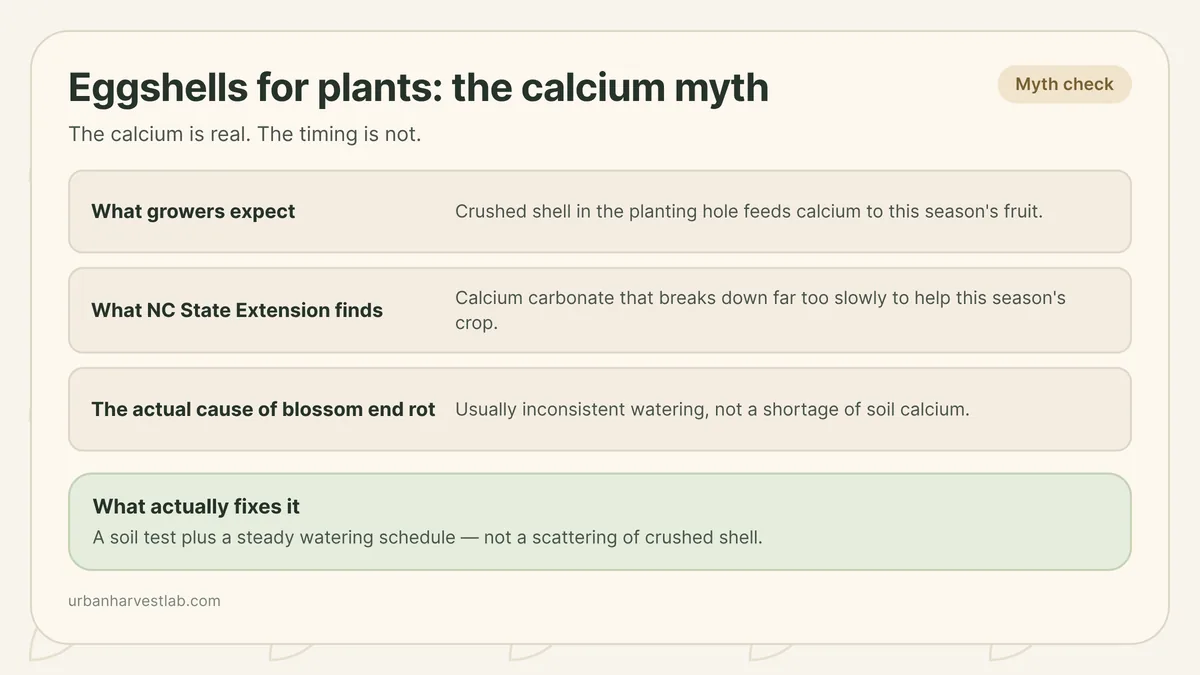
Eggshells for plants: what the calcium myth gets wrong
Crushed eggshells in the potting mix feel like free calcium, but the shell breaks down far slower than a growing tomato needs it to.
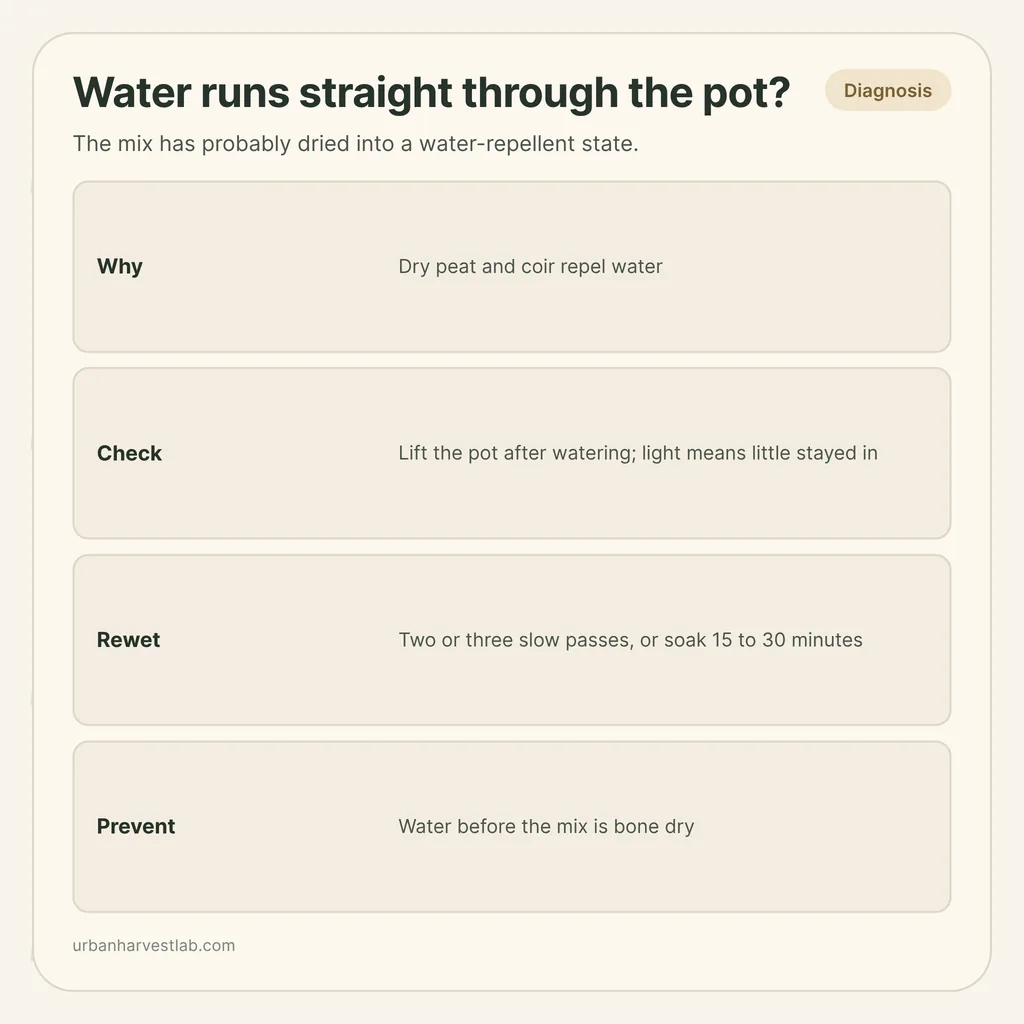
Hydrophobic potting mix: why water runs straight through the pot
When water runs straight through a pot without wetting the mix, the peat or coir has dried into a water-repellent state. A slow, patient soak fixes it, and a few habits keep it from coming back.
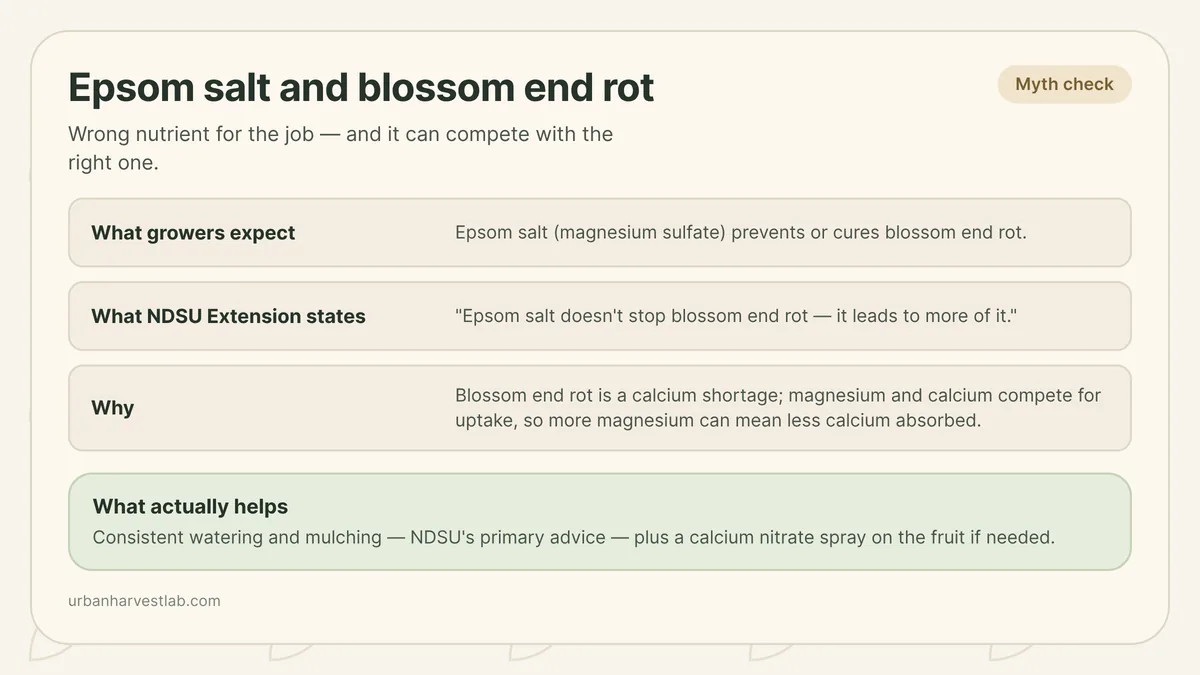
Epsom salt for plants: what the evidence actually shows
Epsom salt is one of the most repeated garden fixes there is, and North Dakota State University Extension says the opposite of what the jar's reputation claims.