Leaf mold compared with hot compost
| Attribute | Leaf mold | Hot compost |
|---|---|---|
| What goes in | Carbon-rich leaves only | Green and brown materials combined |
| What does the work | Fungi, in a cold process | Aerobic, heat-loving bacteria |
| Turning | Fungi can work without being turned | Tossed around periodically |
| Smell | No strong smell, since leaves alone do not produce the odors of food scraps | May smell if not maintained |
| Nutrition | Not much: a conditioner | Improves fertility as well as texture (NC State Extension) |
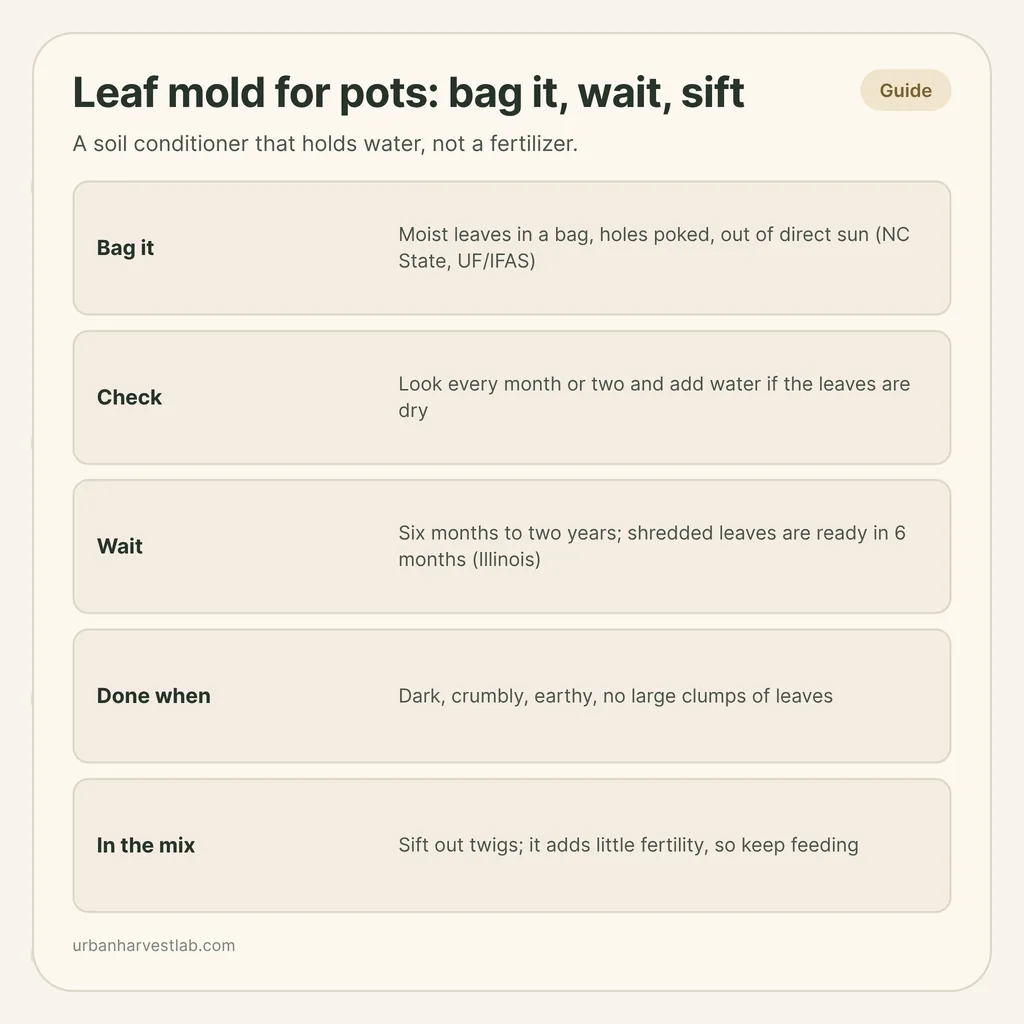
Leaf mold is autumn leaves left to rot into a dark, crumbly material. It improves how a potting mix holds water and keeps its body, but it adds little fertility. Plan on six months to two years from bag to usable, and on feeding your pots separately.
It is a different material from the finished compost covered in how much compost to add to potting mix. UF/IFAS Extension puts the difference this way: “Leaf mold, on the other hand, uses only carbon-rich leaves decayed by fungi.” No kitchen scraps, no grass, no heat.
What leaf mold does and does not do in a pot
NC State Extension calls leaf mold “essentially a soil conditioner” and says it is “fabulous in containers, due to its water retaining abilities.” The same page is blunt about the other side: it does not provide much in the way of nutrition, so you still need compost or other organic fertilizers to build fertility.
For a potted tomato or herb, that means leaf mold is a texture ingredient. It will not replace a feeding schedule. Pair it with a plan from the fertilizer schedule for container vegetables or, for herbs, do potted herbs need fertilizer.
UF/IFAS Extension also lists its limits: it takes longer to make than hot compost, and “it also doesn’t kill weed seeds or suppress plant diseases.” The RHS adds that leaf mold heaps can be colonised by weeds and their seeds.
How leaf mold differs from compost
Leaf mold runs on fungi, not on the heat-loving bacteria of a hot compost pile. UF/IFAS Extension notes that fungi do their work without being turned and that leaf mold has no strong smell, because leaves alone do not produce the odors that food scraps and grass clippings can. That is why it suits a balcony: nothing to turn, nothing to smell.
Choosing and preparing the leaves
All deciduous leaves can be used. The RHS says “the best leafmould is produced from the leaves of oak, beech or hornbeam,” and that thick leaves such as sycamore, walnut, horse chestnut and sweet chestnut need to be shredded first because they break down much more slowly. UF/IFAS Extension says sycamore is slower because of its higher lignin.
Three rules from the sources:
- Shred if you can. Illinois Extension says shredded leaves are ready in 6 months and whole leaves take 9 to 12 months. NC State Extension suggests running a lawn mower over the leaves a couple of times first.
- Avoid roadsides. The RHS warns that leaves collected by main roads may be affected by atmospheric pollution, and street leaves may carry litter, so sort through them.
- Skip leaves from a diseased tree. UF/IFAS Extension says they could carry fungal pathogens such as verticillium wilt into your garden, and names maple, redbud, weigela and magnolia among common hosts.
Pine needles are a special case. The RHS says they produce acidic leaf mold and are worth keeping in a separate pile, for acid-loving plants such as blueberries.
Making leaf mold in a bag on a balcony
The bag method needs no bin and works in a corner of a balcony.
- Fill a large garbage bag with leaves and moisten them. NC State Extension: “Fill the bag with leaves and moisten them.”
- Tie the top and poke holes. The RHS says to pierce holes with a knife or garden fork and tie the top loosely; UF/IFAS Extension says to poke holes in the sides and bottom. The holes give airflow and let excess water out.
- Put the bag out of direct sunlight. UF/IFAS Extension: store bags out of direct sunlight.
- Check the moisture. NC State Extension says to check the bag every month or two and add water if the leaves are dry. UF/IFAS Extension says every few months. Dry leaves stall.
- Wait. The RHS says to stack bags out of sight for up to two years.
If you need bags, you can browse large garbage bags on Amazon. Any sturdy bag you already own works as well.
UF/IFAS Extension says fungi are likely already on the leaves you collect, and that white, thread-like hyphae are a sign decomposition is well underway. For a bigger pile rather than bags, the RHS says to make the heap as large as possible to hasten decay. UF/IFAS Extension puts the minimum at three feet wide and three feet tall.
How long it takes, and how to tell it is done
Timings in the sources overlap but do not agree:
- NC State Extension: six months to a year.
- Illinois Extension: 6 months shredded, 9 to 12 months whole.
- UF/IFAS Extension: six months to two years, depending on leaf type, moisture and ambient temperature.
- RHS: most leaves take about two years.
Go by the material, not the calendar. NC State Extension describes finished leaf mold as dark brown to black, with a pleasant earthy aroma and a crumbly texture. UF/IFAS Extension says it is ready when it looks like compost, dark and crumbly, with no large clumps of leaves.
The RHS draws a line at two years: leaf mold under two years old, or of poor quality, goes on the surface as mulch rather than into potting compost. If you do mulch pots with it, mulch for potted plants covers what helps in a container.
Using leaf mold in a potting mix
Sift it first. UF/IFAS Extension says leaf mold can go into seed-starting mixes or be used on houseplants to improve moisture retention, and that for these uses you should sift out twigs and large pieces.
For proportions, only two named sources state any:
- RHS: good quality, well-rotted leaf mold, more than two years old, can be used as seed-sowing compost, or mixed equally with sharp sand, garden compost and good quality soil for use as potting compost. That is a soil-based recipe, which behaves differently from the soilless bags covered in garden soil in pots.
- A peer-reviewed trial on chrysanthemums (Liu and colleagues, in the journal Sustainability, 2023) tested rice husks and oak leaf mold together in a peat and perlite base. It found that a 20 to 30 percent share of rice husks and leaf mold promoted growth, and that mixes of 10 to 40 percent kept pH, electrical conductivity and nutrient levels suitable. The authors also say replacing peat entirely remains a matter of inquiry. This was one ornamental crop, and the figure covers leaf mold and rice husks together, so it is a reference point, not a rule for tomatoes.
For a vegetable or herb pot, start with a modest share in place of part of the moisture-holding component, and check that water still drains freely. If you are replacing peat or coir, the trade-offs are in peat-free potting mix problems. Leaf mold does not remove the need to feed, and any compost you pair it with should be chosen with care: see choosing compost that is safe for edible containers.
Leaves in a worm bin
If you keep worms, UF/IFAS Extension says adding chopped leaves to a worm bin helps maintain a good carbon-to-nitrogen balance and proper moisture. The setup is in vermicomposting in an apartment.
Sources
Compost and potting mix for containers
Where leaf mold sits next to compost, worm castings and other amendments.
Common questions
How long does leaf mold take to make in a bag?
Sources differ by method and leaf type. NC State Extension says six months to a year, Illinois Extension says six months for shredded leaves and 9 to 12 months for whole ones, and the RHS says most leaves take about two years.
Does leaf mold feed potted plants?
Not much. NC State Extension says it does not provide much in the way of nutrition and that you still need compost or other organic fertilizers for fertility. Treat it as a soil conditioner.
How much leaf mold should go in a potting mix?
The RHS describes well-rotted leaf mold, more than two years old, as a seed-sowing compost or mixed equally with sharp sand, garden compost and good quality soil. A trial on potted chrysanthemums found 20 to 30 percent rice husks and leaf mold worked well in a peat and perlite base. For other crops, start small and watch drainage.
Can I use leaf mold made from any leaves?
Any deciduous leaves will break down eventually. The RHS rates oak, beech and hornbeam as the best, and says thick leaves such as sycamore, walnut and horse chestnut need shredding first. Leaves from a diseased tree can carry pathogens such as verticillium wilt, according to UF/IFAS Extension.
Related guides
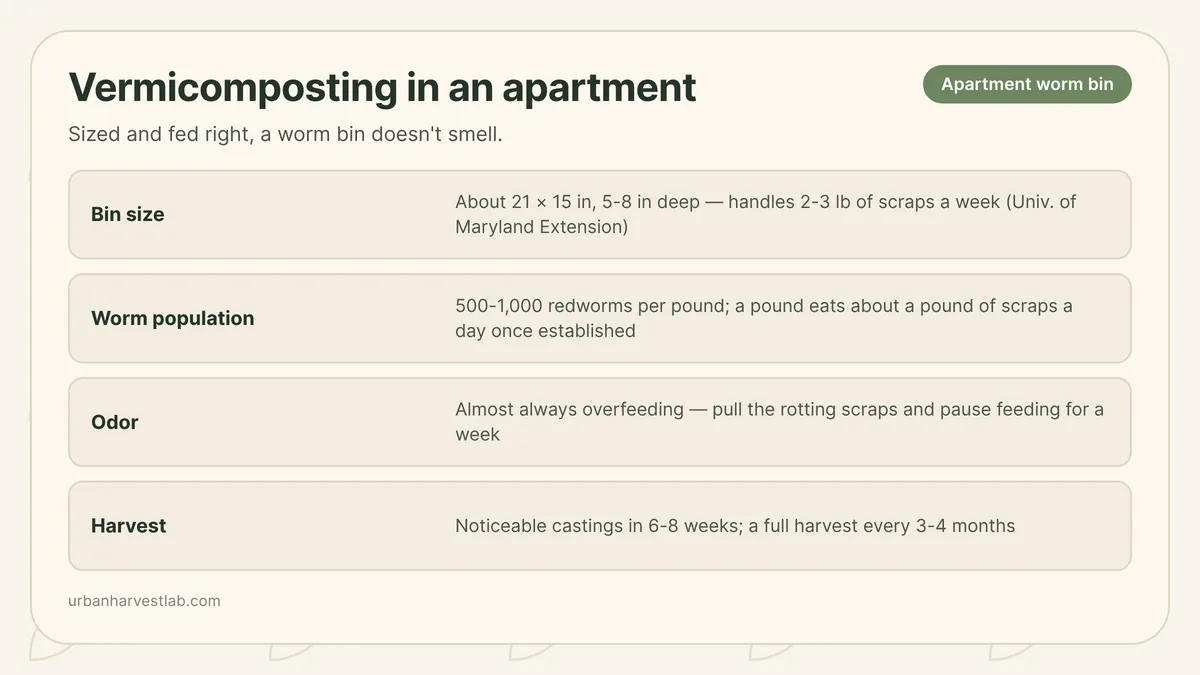
Vermicomposting in an apartment: bin setup, feeding, and harvest
A worm bin sized and fed correctly runs in a closet or under a sink without odor. Here is the setup, the feeding rules, and how to harvest the castings.
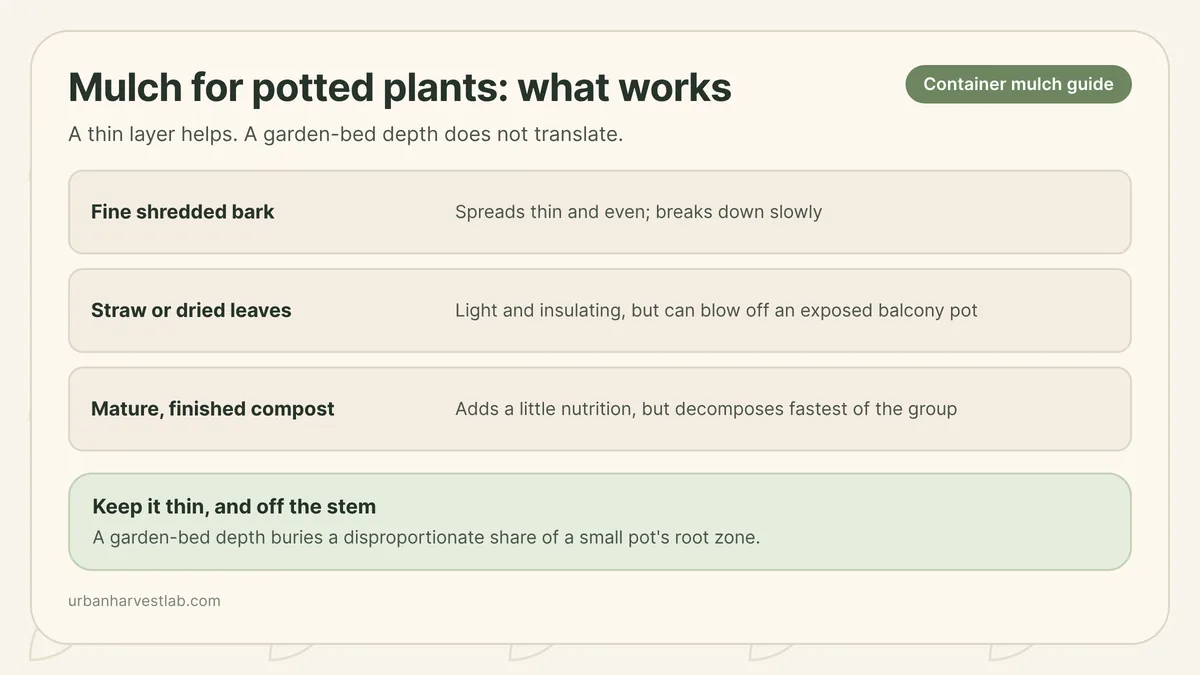
Mulch for potted plants: what actually helps in a container
A thin surface layer slows evaporation and softens heat swings in a container, but it does not fix a small pot, a compacted mix, or salt buildup on its own.
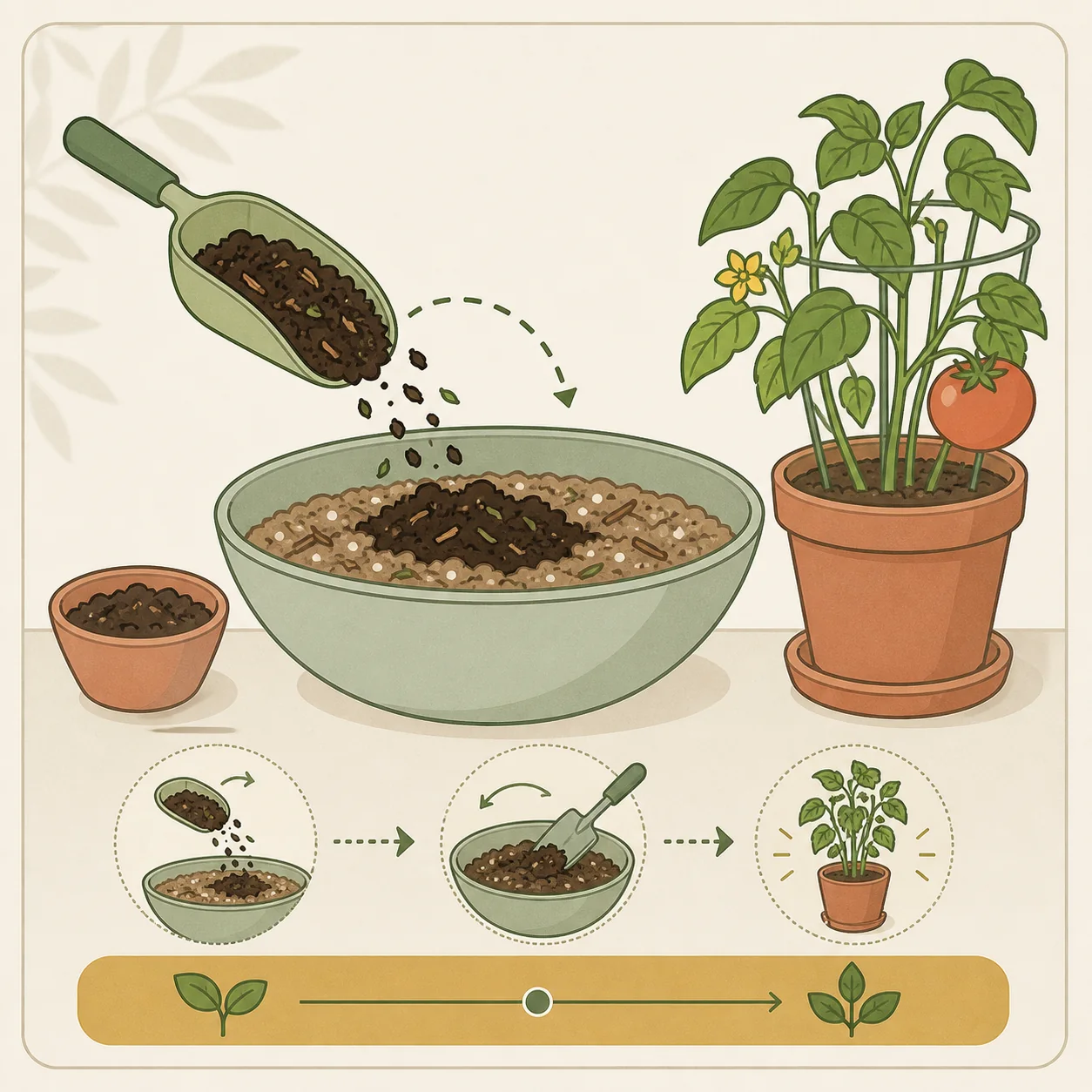
How much compost should you add to potting mix?
More compost is not automatically better. In a container, compost must share limited space with the coarse particles that preserve air around roots.