Broccoli in a pot, by season
| Season | What to do | Why |
|---|---|---|
| Spring | Plant transplants 2-3 weeks before the last frost date (Utah State) | Heads form before summer heat |
| Summer | Avoid growing through it; mulch the pot surface above 80°F if plants are standing (Utah State) | Heat reduces growth and causes loose, bitter heads |
| Fall | Count back from your first fall frost and add about 10 days to the days to harvest (Illinois) | Cool weather finishes the heads; caterpillar pressure is highest |
| Harvest | Cut the main head with 5-6 inches of stem, then pick side shoots | Side shoots grow from the lower leaf axils (Illinois) |
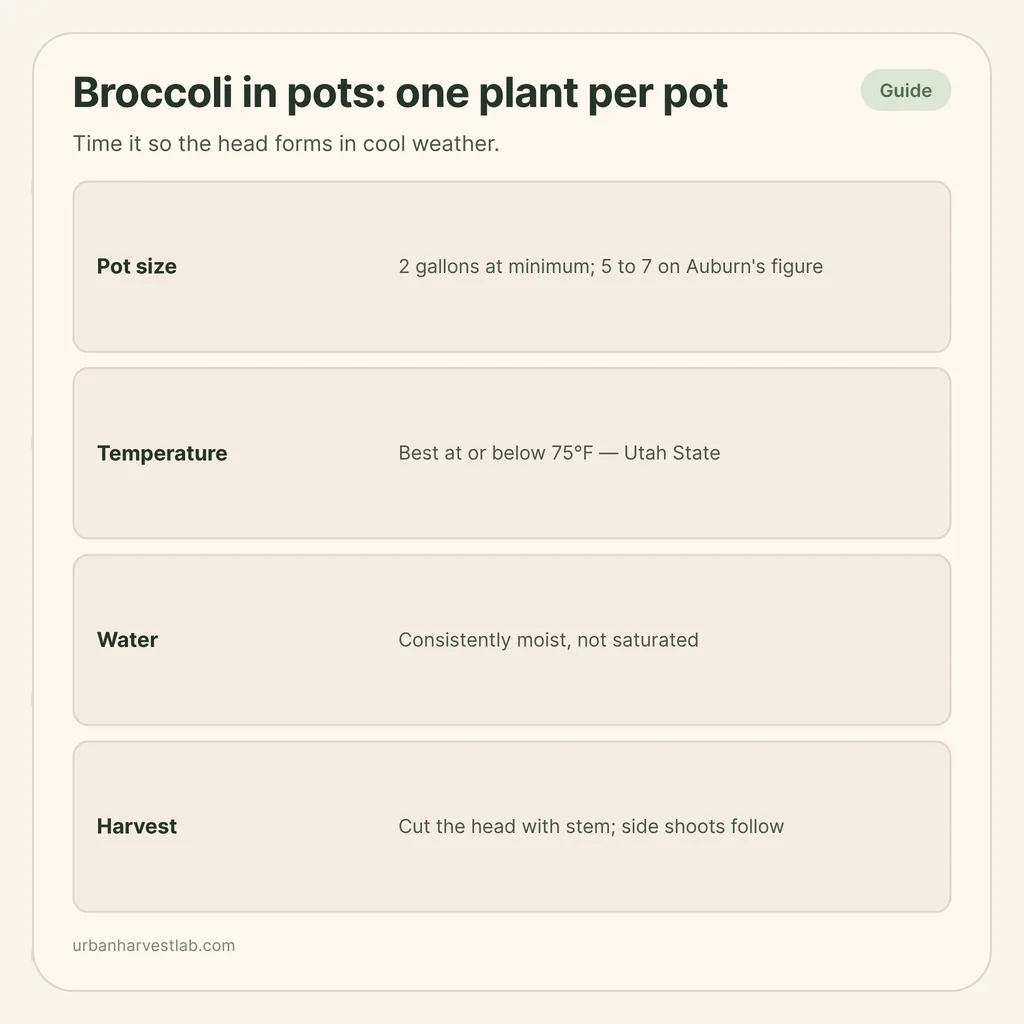
To grow broccoli in a pot, give each plant its own container of at least 2 gallons by Texas A&M’s figure, or 5 to 7 by Auburn and Alabama Extension’s, put it in full sun, and time it so the head forms in cool weather. Cut the main head with a length of stem and the same plant keeps producing smaller side shoots.
Broccoli asks for more than its leafy cousin. Kale in containers is picked leaf by leaf for months and forgives heat and neglect. Broccoli makes one big flower head on a deadline, and anything that stresses the plant before then, whether cold, drought or a cramped pot, shows up as a small or loose head.
Choose the pot
- The figures disagree: Texas A&M AgriLife Extension lists broccoli at 2 gallons, one plant.
- Auburn University and Alabama Extension say one plant per 5- to 7-gallon container, in full sun of 6 to 8 hours.
- University of Kentucky Extension lists broccoli among vegetables for which a container at least 6 to 8 inches deep is adequate, and adds that broccoli and cabbage should go in single pots if they cannot be placed at least 15 inches apart.
Depth alone is not the issue. Illinois Extension says broccoli grows upright, often reaching 2½ feet, so a pot that is too light tips in wind. The larger the pot, the more water it holds between visits. Pick a 5-gallon pot if you have room and want side shoots, and treat 2 gallons as the minimum for a single head. That choice is our judgement from the spread above, not a published rule.
One plant per pot also settles spacing. Utah State Extension notes that crowding broccoli at 1 by 1 foot reduces head size and inhibits side shoots.
Use a fertile, well-drained mix and a pot with drainage holes. Auburn and Alabama Extension suggest potting mix with drainage holes, or a self-watering container.
Time it for cool weather
Utah State Extension says broccoli grows best, with the highest yields, when temperatures do not exceed 75°F, and is not seriously damaged by temperatures down to 28°F. High summer temperatures reduce growth, decrease quality and cause loose heads that taste bitter. Illinois Extension recommends planning for a fall and a spring harvest.
Spring. Utah State plants transplants 2 to 3 weeks before the last frost-free date. Find yours with the frost date guide. A season-extension cover helps if the date is uncertain.
Fall. Illinois Extension says to count backward from your first fall frost and add about 10 days to the days to harvest from transplants. Utah State suggests early-maturing varieties planted 50 to 75 days before the expected maturity date, which can be several weeks after the first fall frost.
Start transplants, not seeds, if you can. Utah State wants transplants with 4 to 6 mature leaves and a developed root system, since larger, older transplants are prone to forming small early heads. Auburn and Alabama Extension say to avoid plants with flowers already, and to harden off for a week first. The hardening-off plan has the day-by-day routine. If you sow seed, Utah State plants it ¼ to ½ inch deep and thins to the final stand at 3 to 4 true leaves.
Water and feed steadily
Auburn and Alabama Extension say to keep soil consistently moist but not saturated. Utah State says plants stressed for water or nutrients can button or flower early, and that dry spells during heading give poorer, more open heads. In a pot, the mix dries faster than garden soil; the container vegetable watering page explains how pot volume changes how often to water.
Auburn and Alabama Extension apply nitrogen 3 to 4 weeks after planting and again when heads begin to show. Utah State’s rates are per row of garden, not per pot, so for a pot follow the label of the fertilizer you use and the container vegetable feeding schedule.
If plants are standing in warm weather, Utah State applies organic mulch above 80°F to cool the soil and reduce water stress. A layer of straw or shredded newspaper on the pot surface does the same job.
Protect it from caterpillars
Utah State says cabbage worms and loopers chew holes in leaves and hide in broccoli heads. Illinois Extension adds that they are even worse in fall plantings than in spring because the population has had several months to build up, and drop off about the time of the first frost.
Utah State notes that fabric covers protect young plants from insect pests. Put a cover over the pot from planting, weighted at the edges, since the adult moths and butterflies lay the eggs and do no other damage, as Illinois describes. Identification of the three species and what to do once they are on the plant are in cabbage worms on kale; broccoli gets the same caterpillars.
Harvest the head, then the side shoots
Harvest when the head is compact but the flower buds have not opened. Utah State gives mature heads as 6 to 12 inches across; Illinois says central heads grow to 4 to 6 inches or larger. Cut before it loosens and the flowers show bright yellow.
Cut the head with stem. Illinois says 5 to 6 inches of stem, and Auburn and Alabama Extension say to leave as much central stem as possible so smaller lateral heads grow. The side shoots grow from the axils of the lower leaves, per Illinois, and you can usually keep picking for several weeks. Utah State describes side shoots of 3 to 6 inches with additional water and fertilizer, and says some extra nitrogen after the main harvest encourages them. Illinois cautions that late ones may reach only 1 to 2 inches across, so expect a handful rather than a second big head.
Days to harvest run 55 to 75 by the Auburn and Alabama figure; Utah State lists Packman at 50 days, Green Comet at 55 and Premium Crop at 65. For a staggered harvest, start a second pot later, as described in succession planting in containers.
Sources
- Utah State University Extension: How to Grow Broccoli in Your Garden
- University of Illinois Extension: Broccoli
- Alabama Cooperative Extension System (Auburn University): Grow More Broccoli
- Texas A&M AgriLife Extension: Vegetable Gardening in Containers (E-545)
- University of Kentucky Extension: Vegetables Grown in Containers Improves Accessibility
Around cool-season crops in pots
The neighbouring brassica page, plus timing, feeding and watering for vegetables in containers.
Common questions
What size pot does broccoli need?
Published container figures differ. Texas A&M AgriLife Extension lists broccoli at 2 gallons and one plant. Auburn University and Alabama Extension say one plant per 5- to 7-gallon container. University of Kentucky Extension says broccoli needs a single pot unless plants can be 15 inches apart. A pot toward the larger end holds moisture longer, which matters in a crop that stresses easily.
Can you get more than one harvest from a broccoli plant?
Yes. University of Illinois Extension says removing the central head stimulates the side shoots to develop for later pickings. Utah State Extension describes side shoots 3 to 6 inches long with additional water and fertilizer, and Illinois notes late ones may reach only 1 to 2 inches across.
Why did my broccoli form a tiny head right after planting?
That is buttoning. Utah State Extension says plants that button were exposed to cold or stressed for water or nutrients before or after transplanting, and that larger, more mature transplants are more prone to it. Choose transplants with 4 to 6 leaves and no flowers.
How long does broccoli take to harvest?
Auburn and Alabama Extension give 55 to 75 days depending on variety. Utah State Extension lists Packman at 50 days, Green Comet at 55 and Premium Crop at 65.
Related guides

How to grow kale in pots: cold, caterpillars and picking by the leaf
Kale suits containers: it is shallow-rooted enough for a modest pot, shrugs off frost, and gives leaf after leaf if you pick from the bottom.
Succession planting in containers: how to stagger a harvest from a few pots
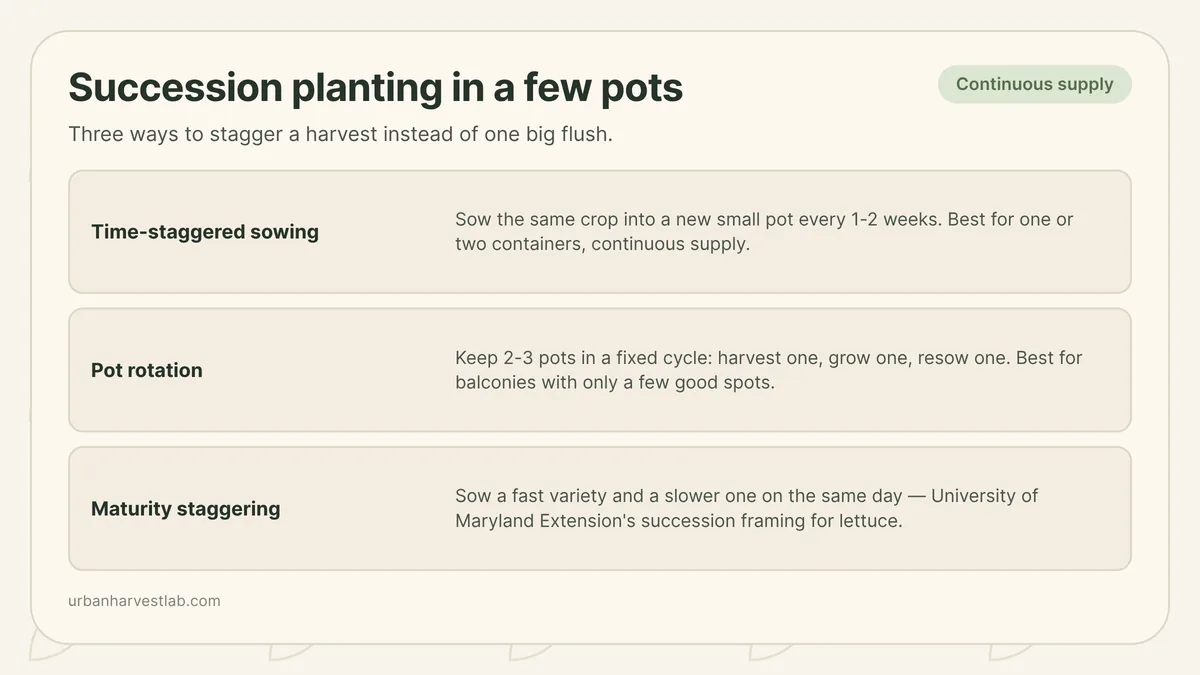
Succession planting in containers is a sowing rhythm: a few pots restarted on a schedule keep producing, where one large planting ripens together and then quits together.

How to harden off seedlings: a day-by-day plan and planner
Hardening off is a week or two of gradually longer, sunnier days outside before a seedling is planted out for good. Enter your planting-out date and get the day-by-day schedule.