Lemon verbena and lemon balm compared for pots
| Question | Lemon verbena | Lemon balm |
|---|---|---|
| Cold tolerance | Hardy to zone 8 (Penn State) | Hardy to zone 5 (Penn State) |
| Winter in a cold climate | Brought indoors, where it loses its leaves (NC State) | Dies back; stays in a sheltered pot outdoors (see the lemon balm guide) |
| Size in a pot | 2 to 4 feet tall and wide (NC State) | Thrives in a large container (Penn State) |
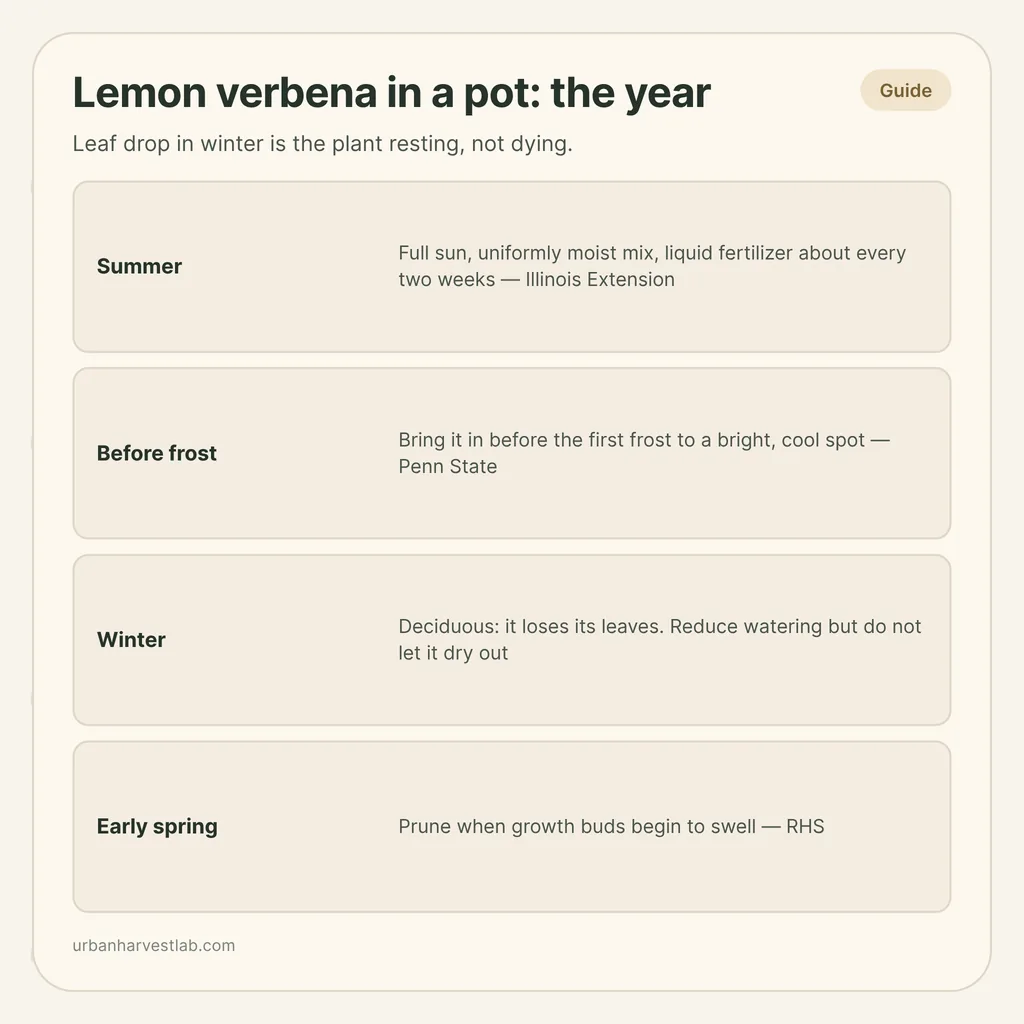
Grow lemon verbena in a well-drained pot in full sun, feed it every two weeks while it grows, and bring it indoors before frost. It drops its leaves over winter; that is the plant resting, not dying. Prune it in early spring.
Lemon verbena (Aloysia citrodora, also sold as Aloysia triphylla) is not the herb most people expect from the name. If you wanted the hardy, spreading one, lemon balm in a pot is a different plant with a different winter. Verbena is a woody shrub, and Illinois Extension describes it as having narrow, glossy green leaves and a strong lemony fragrance.
Why a pot makes sense
Illinois Extension says that because lemon verbena is frost sensitive, it is best grown as a container plant so it can easily be moved indoors during the winter. Penn State Extension says it is hardy to zone 8 and should be treated as an annual in Pennsylvania. The RHS rates it H3, which it defines as hardy in coastal and relatively mild parts of the UK, and adds that it may need winter protection in northern Britain.
So in a cold climate the choice is simple: pot it and carry it in. In a mild one, a pot still lets you give it the sunniest spot.
A pot also keeps it to a manageable size. NC State gives 6 to 8 feet tall and wide in the ground but 2 to 4 feet tall and wide in a pot. Penn State’s author grew hers to a 3-foot shrub.
Summer care: sun, water and feeding
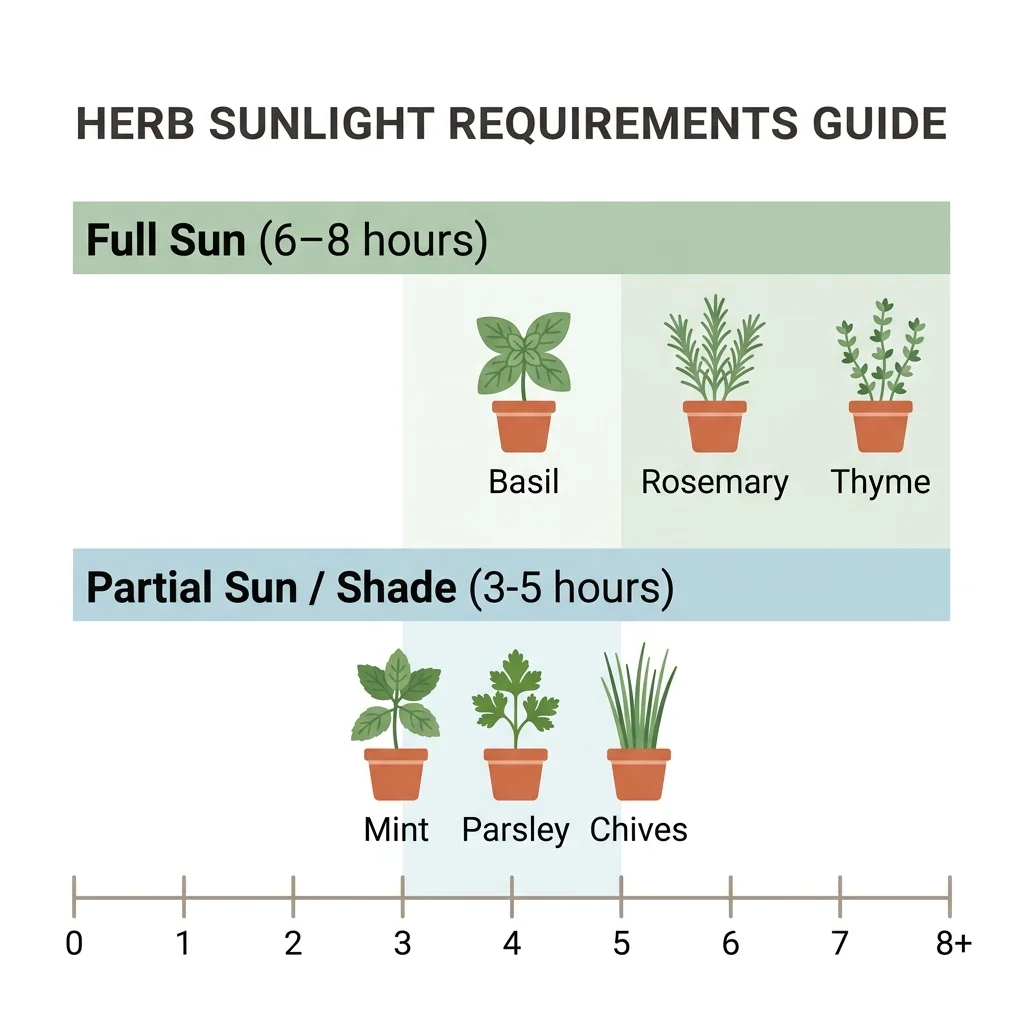
Light. Illinois Extension says to put the plant in a full sun location outdoors. NC State defines full sun as 6 or more hours of direct sunlight a day. The herb sunlight chart shows how a balcony’s hours compare.
Container and mix. Illinois Extension asks for containers with ample drainage holes filled with a prepared soil mix (a pot with drainage holes is the first thing to buy). The RHS, writing about plants under glass, specifies a peat-free, loam-based potting compost in full light. Neither gives a pot diameter, so size the pot by the plant: the herb pot size guide covers how roots and pots match up.
Water. Illinois Extension says to keep the media uniformly moist but avoid overwatering.
Feeding. Illinois Extension calls lemon verbena a heavy feeder and recommends a general purpose liquid fertilizer about every two weeks.
Why it drops its leaves
Three sources point the same way. The RHS lists the plant as a deciduous sub-shrub. NC State says that in cold climates it can be grown in a pot and brought indoors for the winter, where it will lose its leaves. Penn State adds that it may become deciduous when it is not given enough light and warmth.
Leaf drop is therefore the expected response to a short, cool, dim winter, not a diagnosis. Compare that with rosemary and thyme, which are evergreen and behave very differently on a windowsill.
Overwintering a potted lemon verbena
- Bring it in before the first frost. Penn State says to bring it in permanently before the first frost and place it in a bright, cool location. Illinois Extension says to place it in a bright light area.
- Acclimate it. Penn State says to gradually acclimate the plant to indoor living. The general routine for pests and light is in bringing potted plants indoors for winter.
- Water for a resting plant. Penn State says that if it goes deciduous, reduce watering but do not let it dry out completely. Illinois Extension says to water as needed to keep the soil uniformly moist, and to reduce how often you fertilize.
- Wait. Penn State says that as days lengthen in spring you should increase the water it receives.
Pests can come in with it. NC State lists aphids, whiteflies, mealy bugs and spider mites as occasional problems; the RHS lists the plant as generally pest-free. Check the stems and leaf undersides before it comes inside, and see spider mites on indoor herbs if you see stippling or webbing.
Prune in early spring
The RHS puts lemon verbena in pruning group 6, and describes that group’s timing as early to mid-spring when growth buds are beginning to swell. NC State agrees on the season: pruning the branches in early spring encourages a bushier form.
Neither source gives a percentage to remove, so time the cut to the RHS wording: growth buds beginning to swell.
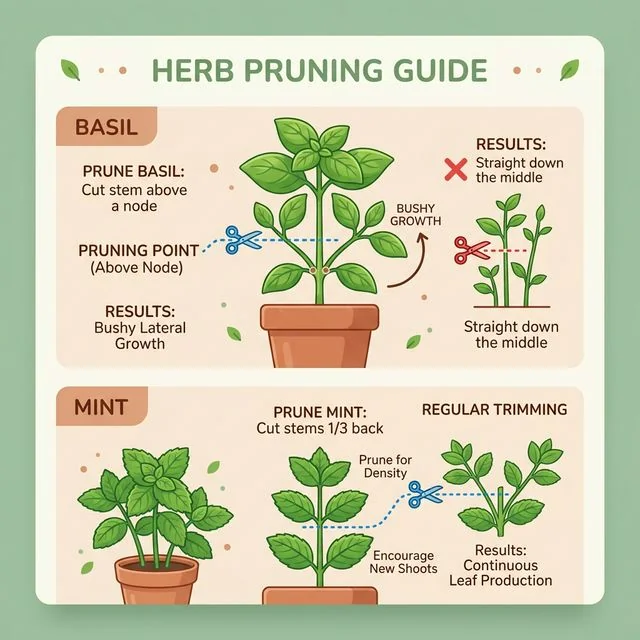
Through summer, Illinois Extension says occasional pruning or frequent harvest keeps a good form, and Penn State says to prune regularly to maintain a bushy structure. Picking leaves is the pruning. For where to cut on other soft herbs, see pruning basil, mint, parsley and chives.
Back outside in spring
Penn State says to acclimate the plant gradually to the outdoors, then set it outside when the danger of frost has passed and water it well. It adds that the plant should break dormancy and leaf out.
Renewing an old plant
Illinois Extension says that as the plant ages it develops a woody stem and foliage quality may start to decline. Its answer is to take cuttings, which it says root easily and grow fast, and discard the older plant; the new plants often look better and are more vigorous. The RHS recommends softwood cuttings. Regrowing herbs from cuttings covers the general method.
Using the leaves
Penn State says lemon verbena leaves dry easily. They may curl and brown, but the scent and flavor last two to three years.
Sources
Herbs through the seasons
Winter care and pot choices for other herbs and tender plants.
Common questions
How do you grow lemon verbena in a pot?
Use a container with ample drainage holes and a prepared soil mix, and put it in full sun outdoors (Illinois Extension). NC State defines full sun as 6 or more hours of direct sunlight a day. Keep the mix uniformly moist but not overwatered, and feed with a general purpose liquid fertilizer about every two weeks while it grows (Illinois Extension).
Why did my lemon verbena lose its leaves?
It is a deciduous plant. The RHS describes it as a deciduous sub-shrub, NC State says it will lose its leaves when brought indoors for the winter, and Penn State says it may become deciduous when it does not get enough light and warmth. Bare stems in winter are expected.
Is my bare lemon verbena dead?
Not necessarily. Penn State says to reduce watering if it drops its leaves, without letting it dry out completely, and to increase water as spring days lengthen. It says the plant should break dormancy and leaf out once it is back outside after frost.
When should I prune lemon verbena?
In early spring. NC State says pruning the branches in early spring encourages a bushier form, and the RHS places the plant in pruning group 6, pruned in early to mid-spring when growth buds begin to swell.
Related guides
How to prune basil, mint, parsley, and chives without stunting growth
Basil and mint should be cut above a node, parsley should be harvested from the outer stems, and chives should be cut like a small patch of grass.
How much sun do herbs need? A by-herb sunlight chart
A simple sunlight chart for common herbs, split into full-sun, part-shade, and low-light tolerant, so you can match what you grow to the light your space actually gets.

How to grow tarragon in a pot: French or Russian, propagation and winter
Tarragon seed usually gives you the bland Russian type, and French tarragon hates wet feet. Here is how to buy the right plant, pot it, propagate it and carry it through winter.