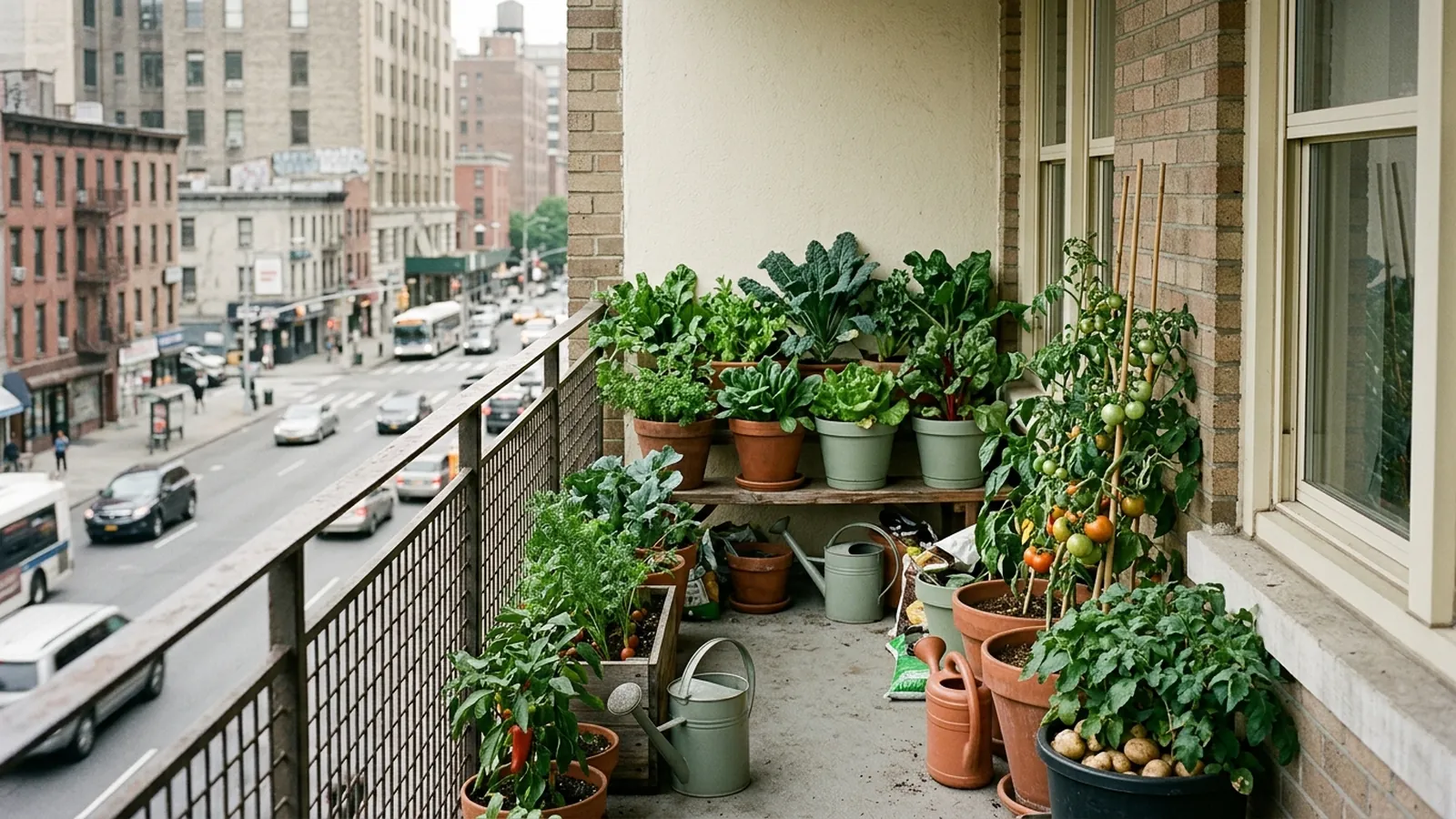
Which pathway reaches which crop, in ground soil versus a balcony container
| Crop type | Standing in contaminated ground soil | What changes in a balcony container | Practical handling |
|---|---|---|---|
| Leafy greens (lettuce, spinach, chard, kale) | Cornell lists them as least suitable — soil splash, dust, and airborne deposition | The soil-splash reason drops away; the airborne one does not, and leaf surface area is what drives it | Grow them at the back, wash thoroughly, discard outer leaves |
| Root crops (carrots, potatoes, turnips) | Cornell lists them as least suitable, mainly because they sit in direct contact with soil | Fresh bagged mix removes that direct-contact reason; little leaf area is eaten | Scrub and peel, as ATSDR advises for root crops generally |
| Fruiting crops (tomatoes, peppers, squash, beans) | Cornell's most suitable list; EPA advises giving preference to fruiting plants | Stays the most-protected group; Cornell describes a shoot-fruit barrier | Wash; these tolerate the railing-side spot best |
| Herbs eaten as leaves | Treated like leafy greens | Same airborne exposure as greens, with more surface per gram eaten | Back of the balcony, rinse before use |
Your only outdoor space faces a street with buses on it, and every time you pick something you wonder whether you should. It is a fair question, and the frustrating part is that almost everything written about it answers a different one.
Published guidance on traffic pollution and food crops is about soil — lead and other contaminants already in urban ground, and what plant roots do with them. A balcony container starts from a bag of potting mix, which takes the soil out of the equation and leaves what settles out of the air onto leaf surfaces. That flips the usual crop advice: leafy greens, the crop normally recommended as the safer option, are the most exposed thing on a traffic-side balcony, and root crops in fresh mix are among the least. The rest is placement, washing, and knowing what goes into the pot — and it pairs naturally with the crop shortlist for a small balcony, because the two decisions are really one decision.
Why every answer you have read is about soil
Follow the standard advice back to its source and you land in the same place. The Agency for Toxic Substances and Disease Registry’s fact sheet for communities near waste sites, Safe Gardening in Lead-Contaminated Soils, opens by stating that lead in dirt and dust can coat the surface of fruits or vegetables and could also be taken up into the fruits and vegetables themselves. Its recommendations follow from that: give preference to growing fruiting plants, maintain a soil pH of 6.5 to 7 to reduce plant uptake of lead, keep soil moist and use mulch as a barrier to reduce soil and dust migration, add organic materials such as peat moss or manure to bind the lead, and use raised beds.
Cornell Waste Management Institute’s Soil Contaminants and Best Practices for Healthy Gardens sets it out as three distinct pathways. First, deposition from the air. Second, uptake into plant roots. Third, direct contamination by garden soil — splash, dust, and the soil physically clinging to what you dug up.
Every one of those pathways assumes a garden planted in ground that has been sitting under the city for decades. Cornell’s companion document, Sources and Impacts of Contaminants in Soils, says so directly about traffic: a property’s distance from roadways and traffic can affect the amounts of certain chemicals in the soil, especially lead, and even though leaded gasoline was phased out, the highest concentrations of lead in soils are still generally found adjacent to busy roadways. The lowest levels, Cornell adds, would be expected in the areas of a property farthest from traffic.
That is a statement about accumulated ground. It is genuinely important if you are digging a bed in a front yard ten feet from a bus route. It is not the situation you are in on the fourth floor with eight pots and a bag of potting mix.
What actually changes when the garden is in a container
Two of Cornell’s three pathways depend on the soil under the plant, and a container filled from a fresh bag is not that soil. Root uptake stops being the dominant concern it is in urban ground — not because bagged mix is a blank slate, but because you are no longer growing in material that has been collecting whatever fell on that particular address. Direct contamination by garden soil, the splash-and-cling route, drops away for the same reason.
Airborne deposition does not. Cornell is explicit that some lead deposition still occurs due to windblown dust from contaminated soils and streets, that other airborne contaminants can also end up on plants, and — this is the sentence the balcony case turns on — that this is a particular problem for leafy crops, which have a high surface area in contact with airborne particles. Cornell makes the same point about raised beds, noting that building them with clean materials helps in many situations but may not eliminate airborne contaminants or soil dust and splashback from other areas. A pot on a railing is a raised bed with a better view and the same open top.
So the live question on a balcony is not what the roots pull up. It is what lands on the parts you eat, and how long it sits there before you wash it.
The inversion: greens are the exposed crop here
Cornell’s crop lists for contaminated soil put green leafy vegetables — lettuce, spinach, Swiss chard, cabbage, kale, collards — and root crops such as carrots, potatoes and turnips on the least suitable side, and vegetable fruits and seeds such as tomatoes, eggplant, peppers, squash, corn, cucumber, peas and beans on the most suitable side. EPA’s own guidance matches at the top: give preference to growing fruiting plants.
Read the reasons and the balcony case separates cleanly. Root crops are on the cautious list largely because they are in direct contact with soil. Replace that soil with fresh mix and the reason substantially weakens. Leafy greens are on the cautious list for soil splash and for airborne deposition onto a lot of leaf surface — and only the first of those two reasons goes away in a pot.
Fruiting crops stay the most protected group in both settings. Cornell describes a shoot-fruit barrier: most toxic metals are largely excluded from entering the reproductive parts of the crop, remaining instead in the vegetative parts. That is a property of the plant, not of the site, so it travels to the balcony unchanged.
None of this makes lettuce off-limits four floors above a bus lane. It makes lettuce the crop whose placement and washing you should be deliberate about, and a carrot in a deep enough container of new mix one of the least demanding things you can grow there.
Placement: the part you control for free
EPA’s Brownfields and Urban Agriculture: Interim Guidelines for Safe Gardening Practices gives one instruction that transfers almost word for word to a balcony: build your garden away from existing roads and rail, or build a hedge or fence to reduce windblown contamination from mobile sources and busy streets. On a plot that means the far corner. On a balcony it means:
- Leafy greens and leaf herbs go at the back, against the building wall, as far from the railing and the street as the depth allows.
- Fruiting crops take the railing-side positions, which is convenient, since those are usually the sunniest spots — worth checking against how your balcony’s light actually falls before you commit, and worth reading alongside what thrives in a full-sun balcony position.
- A screen on the street side does double duty. A planted or slatted balcony privacy screen is the balcony-scale version of EPA’s hedge or fence, and the same structure calms the wind that dries containers out. If you are building one, the windproofing considerations matter more than the botany of it.
Do not expect a screen to seal anything. It reduces what blows directly onto the plants, which is the modest, real thing EPA claims for it.
Washing, peeling, and outer leaves
This is where the standard guidance transfers intact, because it was addressing surface deposition all along.
ATSDR’s instructions are short: wash and scrub fruits and vegetables with a brush to help remove bits of soil and dust; peel or skin root crops such as carrots, potatoes, turnips and onions before eating them; discard the outer leaves of leafy vegetables such as lettuce, cabbage and brussels sprouts. Cornell adds that produce should be washed well to remove soil particles, that a 1% vinegar solution — one part vinegar to 100 parts water — can be used, and that outer leaves should be discarded since soil may cling to them.
Cornell also gives the only figure worth quoting on how much washing accomplishes: washing leafy crops can remove up to 80% of lead contamination, and much of the lead can be removed from vegetables such as carrots and potatoes by peeling. Those measurements come from gardens growing in contaminated soil, not from balconies, so treat them as evidence that the technique works on surface deposits rather than as a number that describes your particular pots.
One caution on method, because the sources diverge. Virginia Tech’s Do I Really Need to Wash That? splits the technique by texture: berries, grapes and greens should be carefully washed under clean running water with clean hands and not scrubbed, while cucumbers, potatoes, winter squash and radishes can be scrubbed with a clean produce brush. Virginia Tech also advises against soap, detergent, bleach and vinegar on produce, and recommends drying with a clean cloth or paper towel. Cornell’s vinegar-solution option and Virginia Tech’s running-water-only position are two different institutional recommendations for the same job. Pick one and apply it consistently rather than blending them.
Practical version for a street-facing balcony: rinse under running water in the kitchen, not in a bowl on the balcony; strip the outer leaves from anything leafy; scrub and peel roots; dry before storing.
What goes into the pot matters more than the traffic does
The one thing that would genuinely put the root pathway back in play is the material you fill the container with. Bagged potting mix from a garden centre is a known, consistent starting point. Soil scavenged from a vacant lot, a donation of unlabelled fill, or a homemade compost with uncertain inputs is not.
Two decisions are worth making deliberately here. The first is the compost — what is safe to put in an edible container covers which sources hold up and which are guesswork, and EPA’s guidelines take the same line for ground gardens, advising gardeners to add topsoil or clean fill from certified soil sources and noting that a state or local environmental program, extension service, or nursery can point to safe providers. The second is what you build the mix from in the first place, if you are mixing your own for container vegetables.
The container itself is a separate question with its own answers — which container materials are food-safe covers plastics, treated wood and reclaimed vessels, and it is worth settling before you plant rather than after. Cornell flags the wood point for garden beds too, warning against certain treated lumbers that in the past contained copper, chromium and arsenic.
If you are running on reused potting mix from an unknown previous life, that is the situation where testing earns its cost. Cornell’s Guide to Soil Testing and Interpreting Results says to contact your local county cooperative extension office to find a laboratory that tests for the contaminant of concern, and to contact that laboratory before collecting a sample, since forms and sampling instructions vary. Expect a total concentration in parts per million rather than a verdict: Cornell notes that many common soil tests report the total amount of a contaminant, and that results arrive without one agreed acceptable level to compare them against.
Common mistakes on a traffic-side balcony
- Applying ground-soil crop lists directly to containers. Avoiding carrots because a lead-in-soil page listed root crops as least suitable misses that the listed reason was soil contact.
- Putting the salad greens on the railing because that is where the sun is. Sun matters, but greens tolerate a back-wall position better than tomatoes do, so the trade usually runs the other way.
- Treating a screen as a seal. EPA claims a reduction in windblown contamination from a hedge or fence, and that is what it delivers.
- Rinsing produce on the balcony. Wash it in the kitchen, then dry it.
- Assuming the mix is the safe part without checking what it is. A bag from a garden centre and an unlabelled sack of fill are not interchangeable starting points.
- Skipping the outer leaves because the head looks clean. Deposited particles are not something you can see, which is exactly why both ATSDR and Cornell make removing outer leaves a routine step rather than a reaction to visible dirt.
Sources
- EPA: Brownfields and Urban Agriculture — Interim Guidelines for Safe Gardening Practices
- Agency for Toxic Substances and Disease Registry: Safe Gardening in Lead-Contaminated Soils
- Agency for Toxic Substances and Disease Registry: Gardening in Lead-Contaminated Soil
- Cornell Waste Management Institute: Soil Contaminants and Best Practices for Healthy Gardens
- Cornell Waste Management Institute: Sources and Impacts of Contaminants in Soils
- Cornell Waste Management Institute: Guide to Soil Testing and Interpreting Results
- Virginia Cooperative Extension (Virginia Tech): Do I Really Need to Wash That? A Guide to Handling Fresh Produce at Home
The rest of the balcony food-safety picture
What the container is made of, what goes into it, and how to screen the side that faces the street.
Common questions
Is it safe to eat vegetables grown on a balcony above a busy road?
For most balcony growing the answer is yes, with ordinary handling. The reason published guidance sounds alarming is that it was written about gardens planted in urban ground soil, where roots sit in whatever the site has accumulated. A container of bagged potting mix is a different starting point, and the Cornell Waste Management Institute pathway that stays live is deposition from the air onto plant surfaces. That is the one addressed by where you put the pot and by washing what you pick, rather than by giving up the balcony.
Are leafy greens or root crops the safer choice on a traffic-side balcony?
It is the reverse of the usual advice. In contaminated ground soil, Cornell lists both leafy greens and root crops as least suitable, root crops because they sit in direct contact with the soil. Fill a container with fresh bagged mix and that soil-contact reason largely goes away, while the airborne one does not — and Cornell describes deposition as a particular problem for leafy crops because of their high surface area. Tomatoes, peppers and beans stay a good bet in both settings, since Cornell describes a shoot-fruit barrier that largely excludes metals from fruits and seeds.
How should I wash produce picked from a street-facing balcony?
Cornell advises washing produce well to remove soil particles, and says a 1% vinegar solution — one part vinegar to 100 parts water — can be used. Virginia Tech's produce-handling guide splits the method by texture: berries, grapes and greens should be washed carefully under clean running water with clean hands and not scrubbed, while firm items such as cucumbers, potatoes and radishes can be scrubbed with a clean produce brush under running water. Virginia Tech also says not to use soap, detergent, bleach or vinegar on produce, so treat the two washing recommendations as the different approaches they are and pick one.
Should I get anything tested before eating what I grow?
Testing makes most sense when you are not starting from a fresh bag — reused mix, a donated soil of unknown origin, or a rooftop bed built on site. Cornell's testing guide tells gardeners to contact their local county cooperative extension office to find a laboratory that tests for the contaminant of concern, and to call the lab before collecting anything, since sampling forms and instructions vary. Cornell also notes that most common soil tests report the total amount of a contaminant and that results arrive without one agreed acceptable level to compare them against, so read the lab's own interpretation notes alongside the number.
Related guides
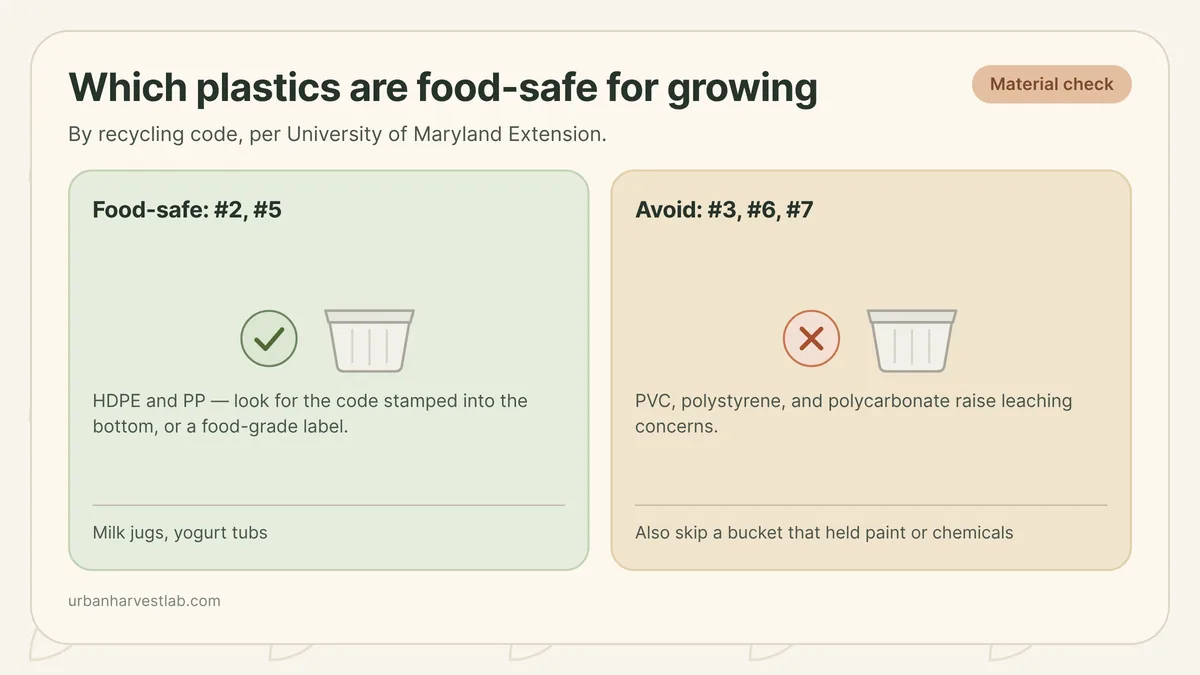
Food-safe containers for growing vegetables and herbs
A container's recycling code and its history both decide whether it's safe to grow food in -- and the two questions have different answers.
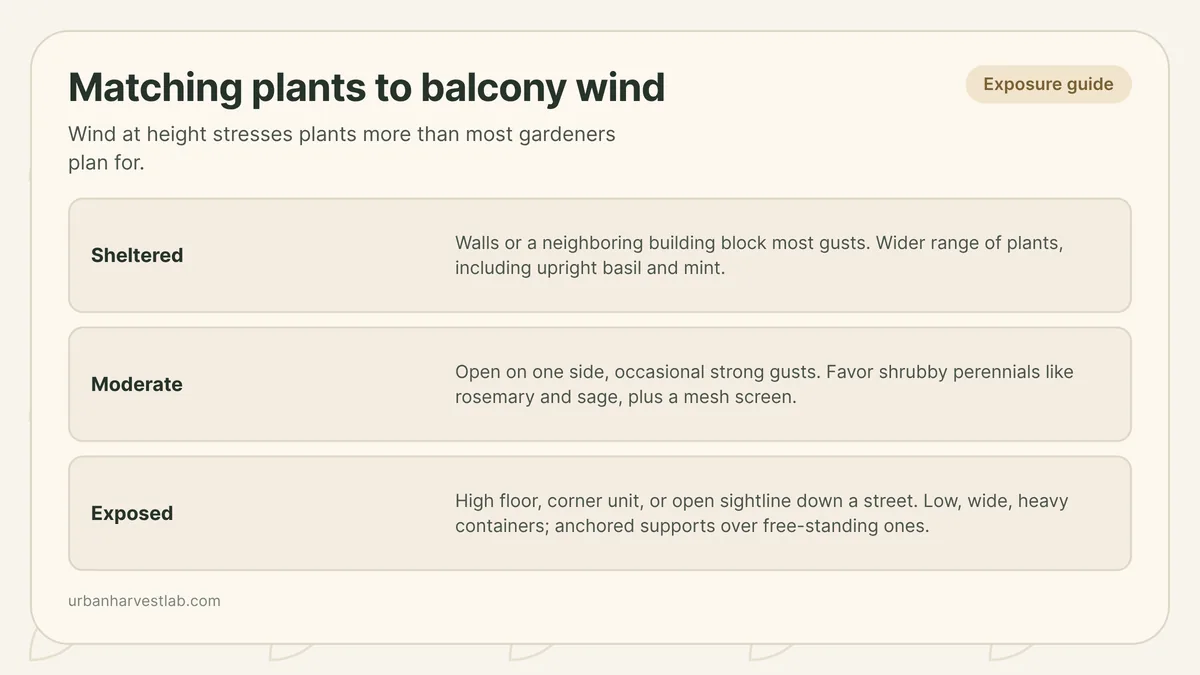
Windproof balcony garden: anchoring, plant choice, and windbreaks
A balcony catches wind differently than a yard does, and the fix is not one trick but three working together: heavier containers, plants suited to an upright or shrubby habit, and a windbreak that softens gusts instead of stopping them dead.
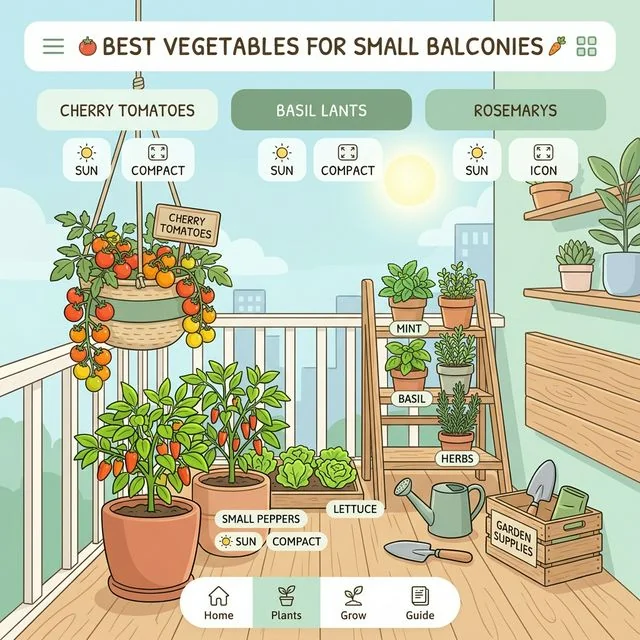
Best vegetables for small balconies: what produces well in tight spaces
Not every vegetable belongs on a balcony. These are the crops most likely to reward limited square footage without turning watering and support into a daily headache.