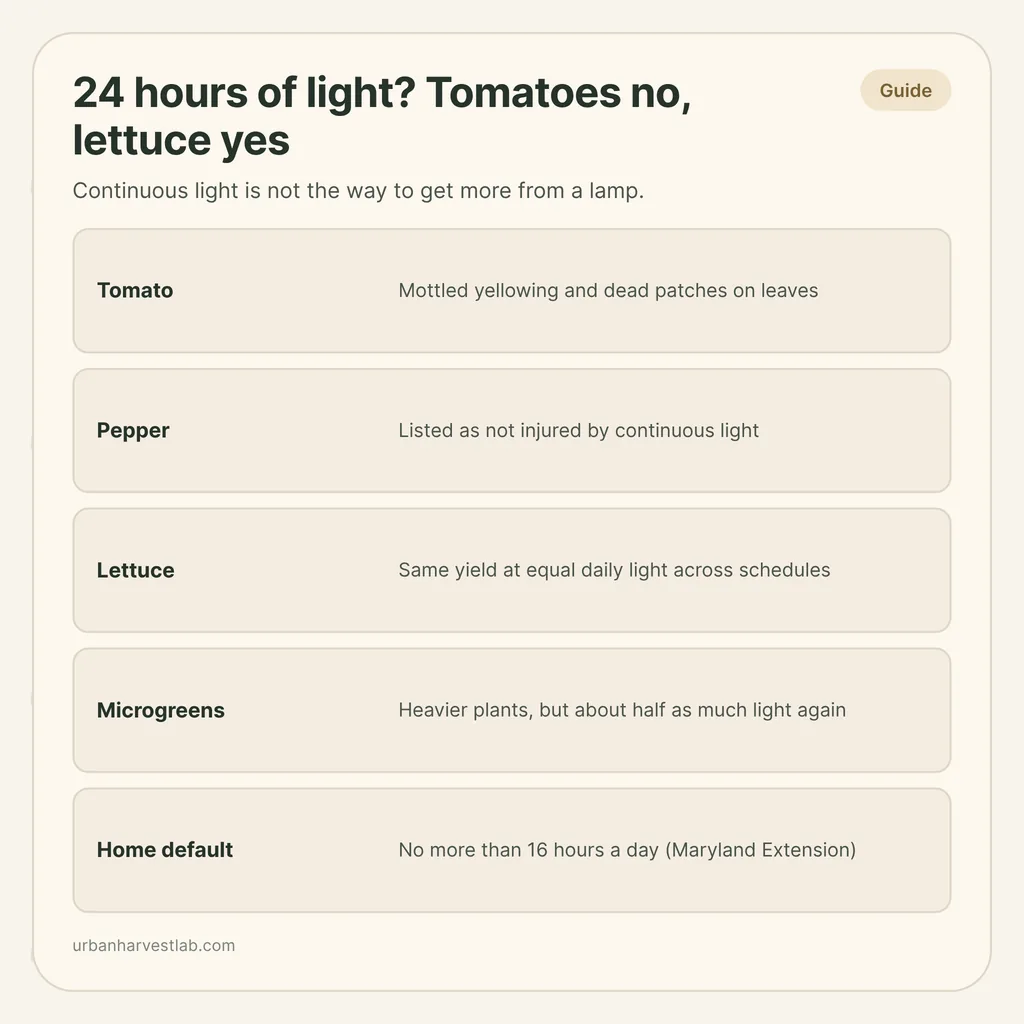
What the research reports for continuous (24 hour) light, by plant
| Plant | Reported under continuous light | Practical call for a home shelf |
|---|---|---|
| Tomato | Mottled leaf chlorosis and necrosis; most cultivated lines tested were sensitive (Nature Communications) | Keep a daily dark period; University of Maryland Extension caps light at 16 hours |
| Pepper | Listed as not injured (Nature Communications); a 15-day seedling trial found lower chlorophyll than a 16-hour day | Stay within 12 to 16 hours |
| Eggplant | Seedlings given continuous light later gave a lower fruit yield in one trial | Stay within 12 to 16 hours |
| Lettuce | Listed as not injured; same yield as 16 and 12 hour days at equal daily light in a chamber trial | Tolerated, but hours add little once the daily total is met |
| Arugula, broccoli, mizuna, radish microgreens | Heavier plants than a 16-hour day and no visible photodamage, with about 50% more light delivered | Optional for a short crop; an off period is still easy to give |
Some plants tolerate 24 hours of light and some are damaged by it. A home grow light left on around the clock is not the way to get more from it. Tomato is the clear casualty: its leaves develop mottled yellowing and dead patches. Lettuce, pepper and some microgreens cope. What continuous light cannot do is replace a lamp that is too weak, because the plant responds to the daily light total, and you can raise that total with intensity instead of hours. For the default timer on herbs and seedlings, how many hours grow lights should run gives 12 to 16.
What happens to tomato
The tomato result is the best documented in this field. Velez-Ramirez and colleagues, in Nature Communications, describe a “potentially lethal injury characterized by mottled leaf chlorosis and necrosis” in tomato grown under continuous light, a problem first reported in the 1920s. Chlorosis is yellowing from lost chlorophyll and necrosis is dead tissue, so the leaves end up blotchy and then brown.
The injury takes time. In their test, plants showed the characteristic interveinal chlorosis after 3 weeks of continuous light. In a greenhouse trial, the sensitive plants became so sick that the researchers had to prune trusses to keep them alive.
It is not specific to one type. Among the cultivated tomatoes they tested, which included hybrids and an heirloom, all but one line were sensitive. Wild relatives did better: all but one of nine wild accessions tolerated it, and the team traced the protection to a gene on chromosome 7. The same paper says the physiological basis of the injury “remains poorly understood”, so no one can give you a safe number of hours for a given tomato. The 2011 review in Trends in Plant Science says the same about the injury being poorly understood.
Pepper, eggplant and the short-trial trap
The same Nature Communications paper lists pepper among species not injured by continuous light, yet a shelf of tomato seedlings is the wrong place to learn that. A 15-day trial reported in the journal Plants on eggplant, sweet pepper, tobacco and tomato seedlings at 250 µmol per square metre per second saw no visible damage in any extended light cycle. But the continuous treatment still cut chlorophyll content in pepper and eggplant against a 16-hour day, and the eggplant seedlings later gave a lower fruit yield. The authors conclude that effects “need to be further explored for individual plant species or even cultivars.”
Fifteen days is shorter than the three weeks it took tomato to show injury. A clean-looking seedling at two weeks is not evidence that a fruiting plant will stay healthy at two months. If you grow tomatoes, peppers or eggplant under a shelf light, see grow lights for tomatoes and other fruiting plants for the daily totals those plants need.
Lettuce and microgreens: tolerated, with a catch
Lettuce is listed with pepper as not injured by continuous light, and a recent chamber trial tested it directly. The study grew crisphead lettuce under three schedules that all delivered the same daily light integral of 14.4 mol per square metre per day: 16 hours at 250 µmol, 12 hours at 340 µmol and 24 hours at 170 µmol, according to Frontiers in Plant Science. Yield, leaf shape, chlorophyll fluorescence and gas exchange did not differ. Continuous light did not make the lettuce grow better. It made the same lettuce with a gentler light.
Microgreens look better on paper. In a trial reported in Plants, arugula, broccoli, mizuna and radish microgreens under 24 hours had significantly higher fresh and dry weights than under 16 hours, with no visible signs of leaf photodamage. But read the design: the 24-hour plants received a daily light integral of 23.3 against 15.6, about half as much light again. More light made more mass, and the trial cannot separate that from the effect of removing the dark. For tray-level setups, microgreens light setup covers the fixture side.
Hours versus daily light
A lamp at a fixed intensity delivers more daily light the longer it runs. Purdue Extension gives the conversion from PPFD to daily light integral as PPFD × 0.0864 for a full 24-hour day, which scales to PPFD × hours × 0.0036 for a shorter one. At 200 µmol per square metre per second, 16 hours delivers about 11.5 mol per square metre per day and 24 hours delivers about 17.3. Michigan State University Extension recommends 12 mol or more for leafy greens and herbs, and 12-14 for lettuce, so the 16-hour shelf at 200 just misses the target.
You can close that gap two ways: add hours or raise the intensity. The lettuce trial shows the second works as well as the first at equal totals. As an illustration, at about 210 µmol, 16 hours reaches 12 mol, with 8 hours of darkness intact. The DLI calculator does this sum for your own reading, and DLI targets for herbs and leafy greens lists what to aim for per plant.
Raising intensity has its own limit. If light is too strong at the leaf, the damage is bleaching and crisp edges, covered in grow light burn signs. That is a different problem from continuous-light injury and is fixed by distance or dimming, not by shortening the day.
The running cost
Electricity is watts times hours. As an illustration, a 30 W fixture running 16 hours uses 0.48 kWh a day and running 24 hours uses 0.72 kWh, half as much again. The lettuce trial held daily light constant and measured about 130 kWh per square metre of electricity regardless of schedule, which matches the idea that daily light, not the clock, sets the energy you pay for. A chamber trial is not a home bill, so work out yours with grow light electricity cost.
What to run at home
University of Maryland Extension advises that most plants require a period of darkness, so illuminate them for no more than 16 hours each day in total. That figure agrees with the 12 to 16 hours Illinois, Iowa State and UMass Extension give for seedlings after germination, and with the herb range linked at the top.
- Pick a daily light target for the plant, using the DLI targets page.
- Measure or estimate your fixture’s output, then choose hours between 12 and 16 that reach the target.
- If you fall short at 16 hours, move the light closer or use a stronger one before adding hours.
- Put the light on a timer, as in best grow light timers, so the dark period actually happens. For a month-by-month plan see the grow light schedule planner.
The Nature Communications paper lists lettuce as not injured, and the microgreen trial saw no photodamage. It does cost electricity, and at equal daily light it buys little.
Sources
- Velez-Ramirez et al. (2014), Nature Communications: A single locus confers tolerance to continuous light and allows substantial yield increase in tomato
- Velez-Ramirez et al. (2011), Trends in Plant Science: Plants under continuous light
- Frontiers in Plant Science: Continuous lighting at low PPFD in lettuce in vertical farming
- Plants (2022): Continuous LED lighting enhances yield and nutritional value of four genotypes of Brassicaceae microgreens
- Plants (2024): Effects of extended light/dark cycles on Solanaceae plants
- University of Maryland Extension: Lighting for Indoor Plants
- Purdue Extension: Measuring Daily Light Integral in a Greenhouse (HO-238-W)
- Michigan State University Extension: Lighting Greenhouse Vegetables
- Illinois Extension: What’s wrong with my seedlings?
- Iowa State Extension: How to successfully start seed indoors
- UMass Amherst: Starting seeds indoors, caring for your seedlings
Set the daily dose instead
Work out the light your plants actually receive, then pick hours and check the running cost.
Common questions
Can plants have 24 hours of light a day?
Some can and some cannot. Tomato is injured by continuous light, with mottled yellowing and dead patches on the leaves (Velez-Ramirez et al., Nature Communications). Lettuce and pepper are listed in the same paper as not injured. Even where a plant tolerates it, University of Maryland Extension advises no more than 16 hours a day because most plants need a dark period.
Will 24 hours of light make plants grow faster?
Only when the extra hours add light the plant can use. In one lettuce trial, a 24-hour schedule at lower intensity gave the same yield as 16 and 12 hour schedules delivering the same daily total. In a microgreen trial, 24 hours gave heavier plants than 16, but it also delivered about half as much light again (23.3 versus 15.6 mol per square metre per day).
Why do tomatoes get yellow leaves under constant light?
The cause is still not fully understood. Researchers call it continuous light injury: mottled chlorosis, then necrosis, in the leaves. It has been known since the 1920s, and Velez-Ramirez and colleagues found that wild tomato species carry a gene that protects against it.
Is leaving a grow light on all night bad for seedlings?
Illinois, Iowa State and UMass Extension all describe seedlings as needing about 12 to 16 hours of light a day after germination, and University of Maryland Extension advises no more than 16. A seedling tray left lit around the clock is outside that guidance, so start with a timer set inside it.
Related guides

DLI targets for herbs and leafy greens: what to aim for
A single DLI number does not fit every herb. Here is the general target for leafy greens, and what published research on basil, sage, and mint actually measured.

Grow light mistakes that stress herbs more than they help
Most grow light problems trace back to a handful of repeatable mistakes, not a mysterious plant failure — and most of them show up as a visible sign you can check today.

Grow light schedule planner: hours by plant and season
Pick a growth stage and how bright the room already is, and the planner below returns a recommended runtime, the matching on and off times, and the dark period that goes with it.