Three ways to grow green onions hydroponically
| Start | What feeds it | What the research supports |
|---|---|---|
| Root end in plain water | Reserves stored in the base | Shoots in a week or two, then a few months before reserves are spent (Iowa State) |
| Root end in dilute nutrient solution | Solution plus remaining reserves | No trial of regrown bases was found; use the strength range from the seed trials and watch the plant |
| Seed or seedling in a jar or channel | Nutrient solution | Harvest 30 days after transplanting in the Kane 2006 trial; best growth at 50 to 100% strength in a Brazilian trial |
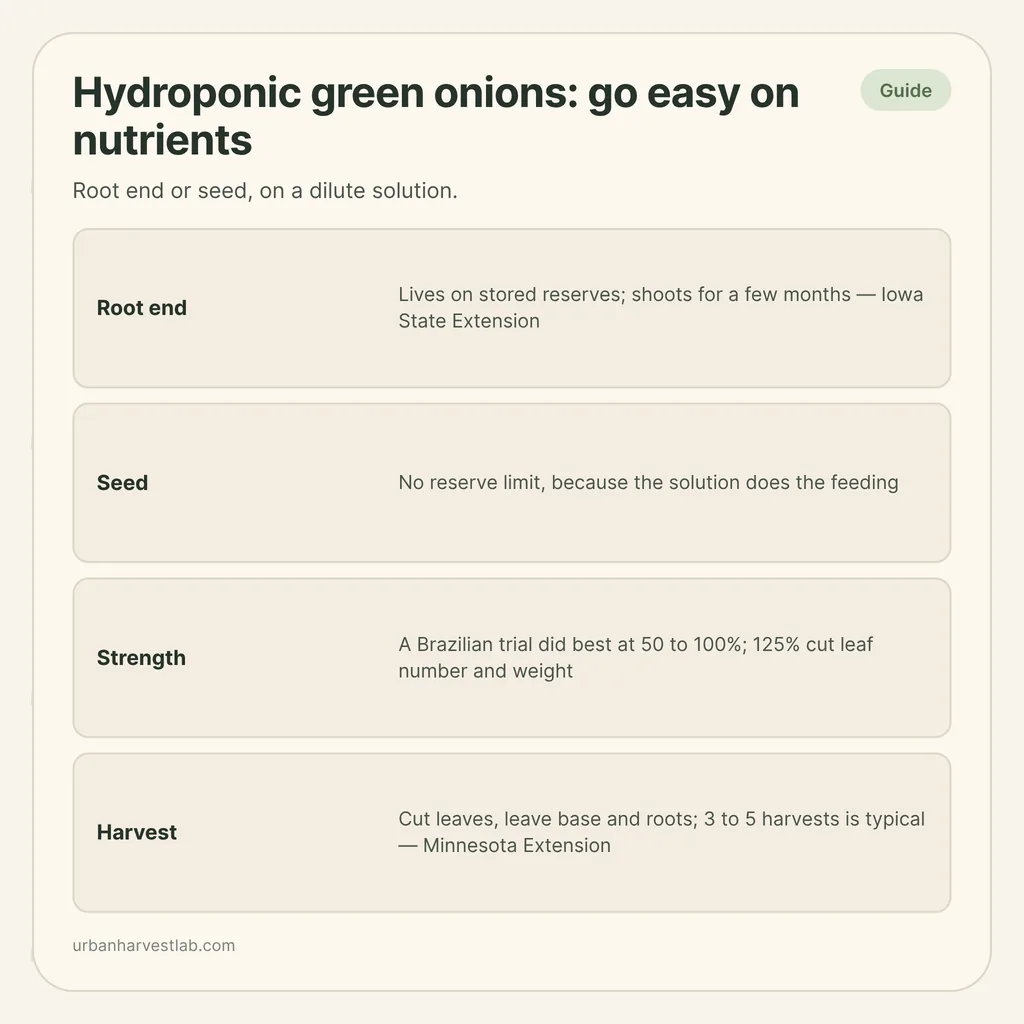
Green onions grow well hydroponically on a dilute nutrient solution, either from seed or from the root end of a store-bought bunch. Keep the solution well below full strength and cut the leaves rather than pulling the plant. In a Brazilian trial on Tokio Kuro, 125% of standard strength cut leaf number and fresh weight, so stronger is not better.
If all you want is a root end in a glass of water, regrowing green onions in water, then soil covers that. The question here is what changes once you add nutrients.
Which route to take
A root end already has roots and a growing point, so it resprouts fast. Iowa State Extension says to fill a container with just enough water to keep the roots submerged, and that green shoots should appear in a week or two. It also says the bulbs produce shoots for a few months before depleting all their reserves. That is the ceiling for plain water.
Seed or seedlings are slower to start but have no reserve limit, because a nutrient solution is doing the feeding. Kane and colleagues (Journal of Plant Nutrition, 2006) germinated seed in small foam cubes irrigated with tap water, then moved seedlings into hydroponic units once they reached the flag stage. They harvested 30 days after that move.
Pick the root end for speed and low cost. Pick seed when you want a steady supply and a repeatable plant.
What to feed them
Neither trial reports its solutions as an EC value, so the guidance below is relative to your nutrient’s label strength.
- Kane et al. (Journal of Plant Nutrition, 2006) compared a commercial hydroponic mix, modified Hoagland’s, and half-strength modified Hoagland’s, each at pH 5.8 and 6.5. Biomass was as high in the half-strength solution as in the stronger ones, and total biomass was greatest at pH 6.5. The researchers preferred half-strength Hoagland’s at pH 6.5.
- A Brazilian trial on the bunching onion Tokio Kuro tested 50, 75, 100 and 125% of a standard solution. Height, leaf number, fresh leaf weight and tillering were better between 50 and 100%, and 125% reduced leaf number and fresh weight.
The practical reading: start at the weak end of your nutrient’s label dose, aim for pH near 6.5 as Kane’s team did, and raise strength only if growth stalls. Oklahoma State Extension’s crop table, covered in the EC chart by crop, does not list green onion. Oklahoma State’s full 27-crop table lists leek, the nearest relative it includes, at EC 1.4 to 1.8 mS/cm and pH 6.5 to 7.0, which is a reference point and not a green onion target. Both trials ran in greenhouses; a windowsill jar gets less light, which is one more reason to start at the weak end.
Your tap water is part of the total. A second Brazilian trial grew green onions in brackish solutions from 1.5 to 9.0 dS/m and found that replacing evaporated water with low-EC supply water did more to reduce salinity damage than circulating the solution more often. If your source water is hard, the hard water guide shows how it raises the starting EC.
Chlorine and root ends
The UC Master Gardener Program of Solano County cautions against chlorinated water for onion scraps grown hydroponically. The residual in ordinary municipal water is far below the chlorine levels University of Missouri Extension flags for hydroponic source water, so dechlorinating is optional for most taps. Chloramine does not leave water that is left standing. Chlorine and chloramine in hydroponics is the place to decide whether your water needs treating.
Setting up the jar
The Kratky method suits green onions in principle: a lidded jar, a net pot or cut-out lid, no pump. University of Minnesota Extension advises that about half the root biomass touch the water. For a root end that means the roots in solution and the white base kept at or just above the surface, with the cut top clear. That applies Minnesota’s rule to onions; no source tested a Kratky jar with them.
Keep the jar opaque or wrapped, because light on the solution grows algae. Give the plants bright light; University of New Hampshire Extension suggests 14 to 18 hours a day for a home hydroponic setup. For general herb choices, see which herbs grow best hydroponically.
Cutting and repeat harvests
Cut the leaves and leave the white base and roots in the solution. University of Minnesota Extension says most herbs can be harvested multiple times, as can leaf lettuce, and that most hydroponic growers take three to five harvests from the same plants before starting again with new seed. That is a general figure, not one measured on green onions, so treat it as a planning guide. When regrowth thins, replace the plant.
Iowa State says garden-planted green onions (it suggests the larger onion sets) reach usable size 4 to 6 weeks after planting; Kane’s team harvested 30 days after moving flag-stage seedlings into the hydroponic units, so the total time from seed was longer. Neither source states a weight per plant, so plan by number of jars instead of grams.
Change or top up the solution by how the reservoir behaves, not by the calendar. When to change hydroponic nutrient solution explains the choice. If the base turns slimy or the roots go brown, check brown roots vs root rot.
Eating them raw
Green onions are often eaten uncooked. The U.S. FDA says to wash all produce under running water, including home-grown produce, and not to use soap or detergent.
Sources
- Kane et al. 2006, Journal of Plant Nutrition, “Nutrient solution and solution pH influences on onion growth and mineral content” (Western Sydney University record)
- Santos et al. 2021, “Establishment of hydroponic nutrient solution to the cultivation of green onion”, Comunicata Scientiae
- Silva Júnior et al. 2019, green onion in brackish nutrient solutions, Bioscience Journal
- Iowa State University Extension, “How to Grow Vegetables from Kitchen Scraps”
- Iowa State University Extension, “All About Onions”
- UC Master Gardener Program of Solano County, “Regrowing Green Onions from Scraps”
- University of Minnesota Extension, “Small-scale hydroponics”
- Oklahoma State University Extension HLA-6722, “Electrical Conductivity and pH Guide for Hydroponics”
- University of New Hampshire Extension, “Hydroponics at Home”
- U.S. FDA, “Selecting and Serving Produce Safely”
Around hydroponic green onions
Set up the jar, read the numbers and keep the solution healthy.
Common questions
Can you grow green onions hydroponically?
Yes. Kane and colleagues (Journal of Plant Nutrition, 2006) grew the bunching onion Kinka and two common-onion varieties in hydroponic units and harvested them 30 days after transplanting, and a Brazilian team grew Tokio Kuro in hydroponic channels. You can start from seed, from seedlings, or from the root end of a store-bought bunch.
What nutrient strength do green onions need?
Less than many growers assume. In the Kane 2006 trial, half-strength modified Hoagland's solution produced as much biomass as stronger solutions, and in the Brazilian trial 50 to 100% of the standard concentration performed best while 125% reduced leaves and fresh weight. Neither source gives a single EC figure for green onion.
How many times can you cut hydroponic green onions?
There is no figure for green onions specifically. University of Minnesota Extension says most hydroponic growers harvest herbs and leaf lettuce three to five times from the same plants before restarting. Iowa State notes that scraps in plain water give shoots for a few months before running out of reserves.
Do green onions regrown in water need nutrients?
A root end in a dish of plain water lives on what it stored. Iowa State says it produces shoots for a few months before depleting those reserves. Moving it to soil or to a nutrient solution is how you keep it going. The UC Master Gardener Program of Solano County advises against chlorinated water; for ordinary municipal tap water the disinfectant residual is low, and our chlorine and chloramine guide explains when it is worth removing.
Related guides
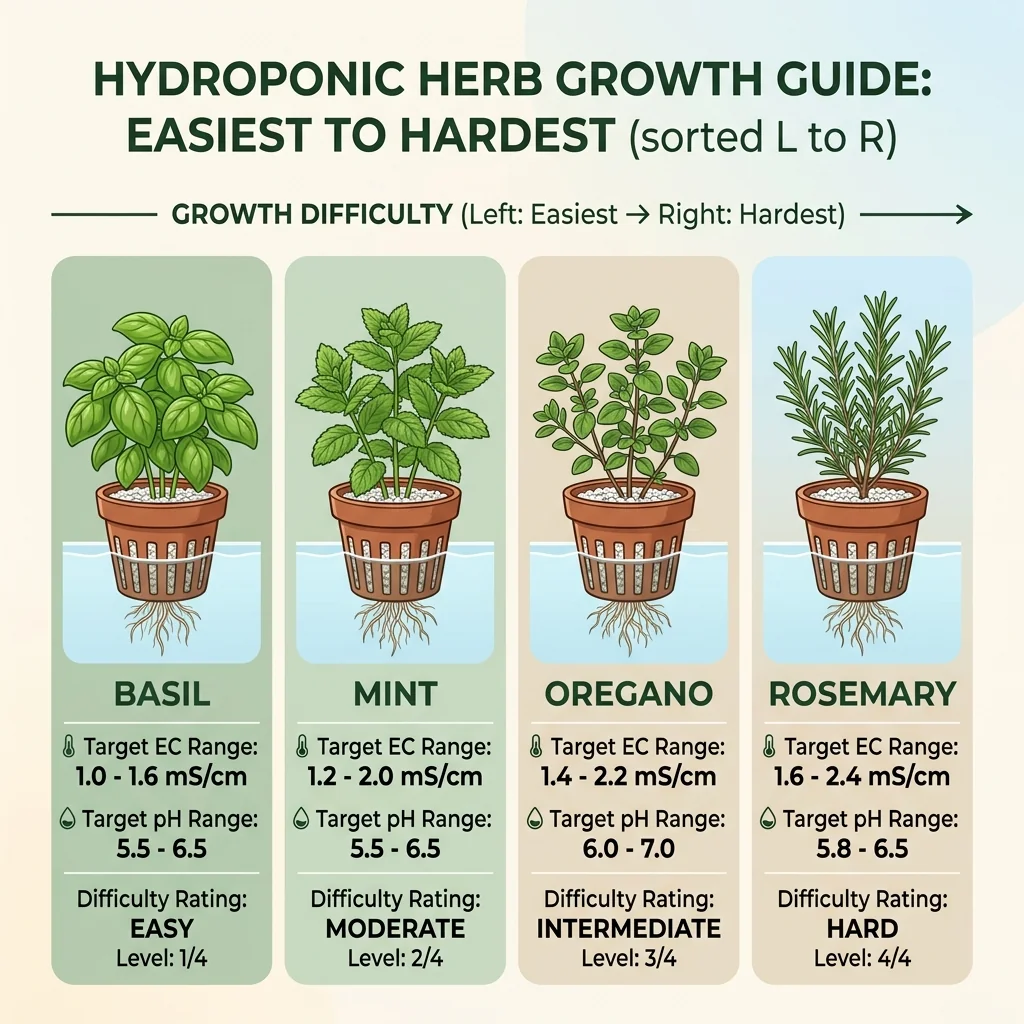
Hydroponic herbs: which grow best and how
Most soft, leafy herbs thrive in hydroponics, while woody Mediterranean herbs are trickier. Here is a ranked guide to which herbs grow best and how to set them up.
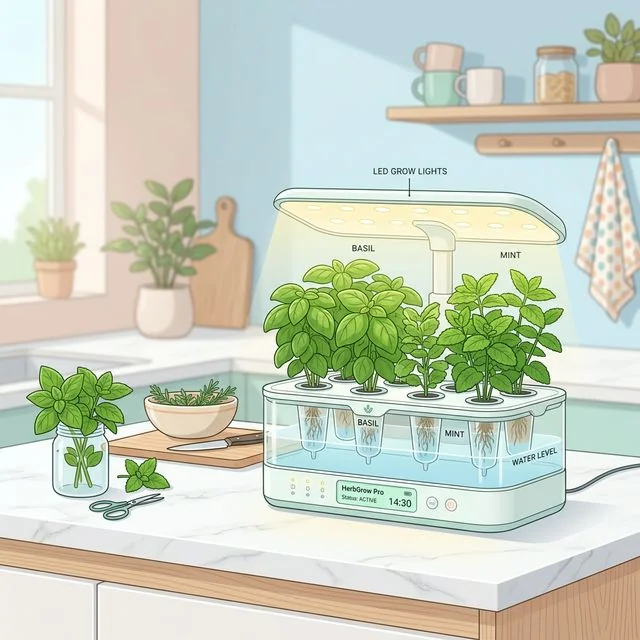
Countertop hydroponic herbs for beginners: what to buy and what to ignore
Countertop hydroponic systems can work very well for herbs, but only if you treat them as small growing systems rather than decorative appliances.
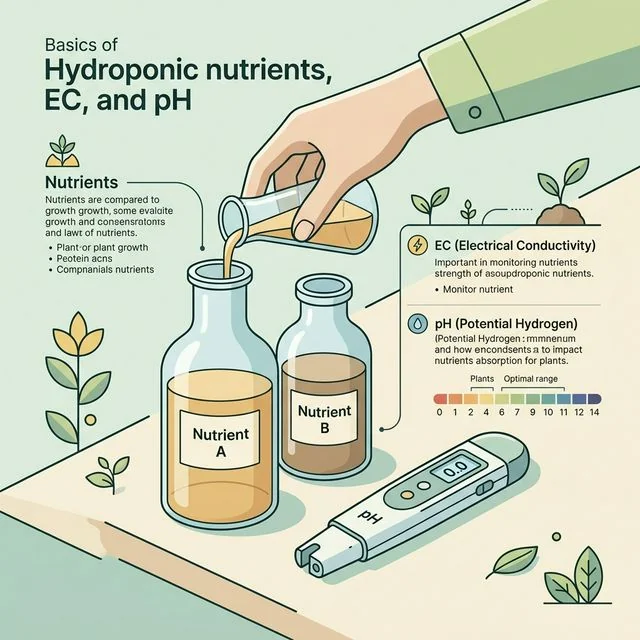
Hydroponic nutrient basics: EC, pH, dilution, and reservoir stability
Most hydroponic problems are not mysterious. They come from concentration drift, pH drift, heat, or neglected maintenance. This guide covers the basics clearly.