Cabbage in a pot, by season
| Season | What to do | Why |
|---|---|---|
| Spring | Plant transplants 2-3 weeks before the last frost-free date (Utah State) | Heads form before summer heat |
| Summer | Mulch the pot surface above 80°F and keep moisture even (Utah State) | Heat reduces growth and quality and can cause internal tipburn |
| Fall | Plant an early variety 50-75 days before the date you want heads (Utah State) | Maturity falls 1-2 weeks after the first fall frost |
| Harvest | Cut when the head is firm, before it cracks; leave the outer leaves (Illinois) | Buds in the leaf axils can make small sprouts |
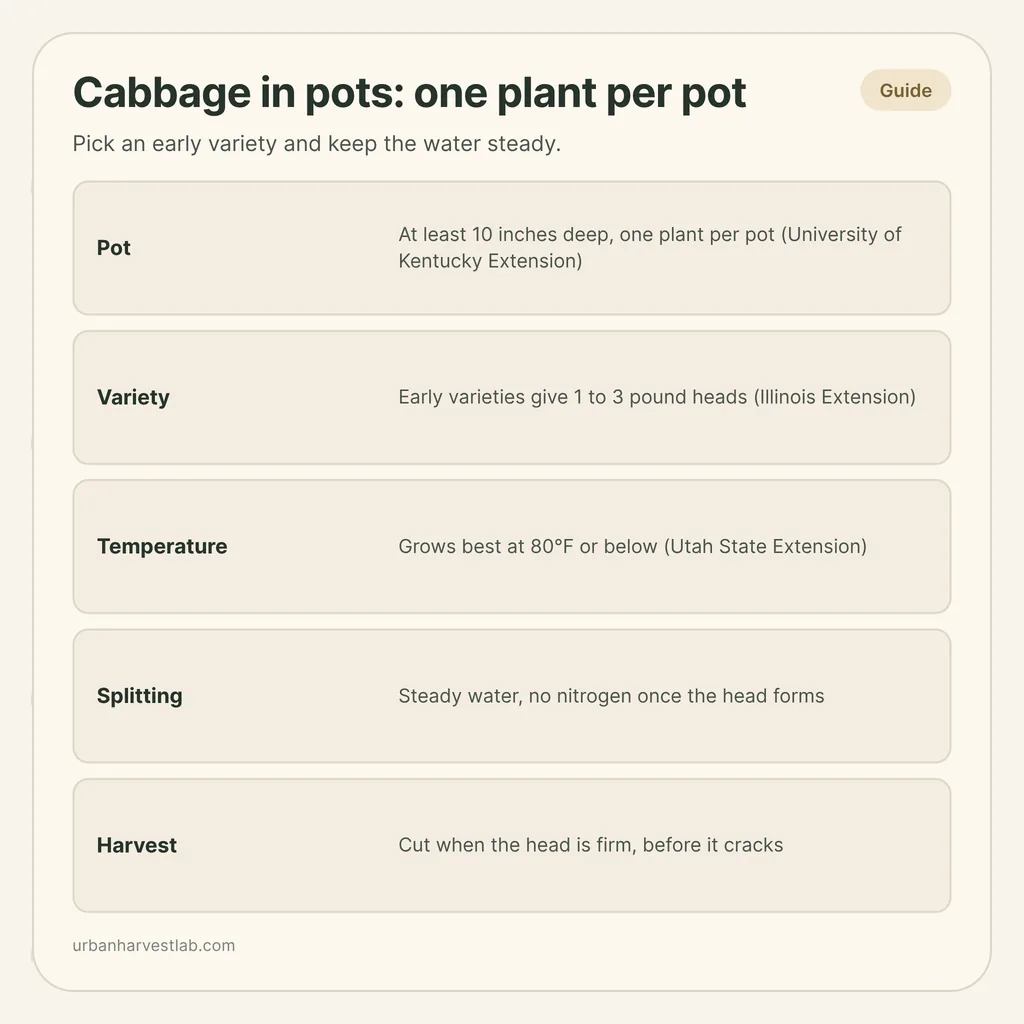
To grow cabbage in a pot, give each plant its own container at least 10 inches deep (University of Kentucky Extension), choose an early variety whose head stays small, and keep the soil evenly moist through the cool part of the year. A full-size head is a lot to ask of a balcony pot, so the variety and the watering decide whether you get a firm head or a loose, split one.
A potted cabbage gives you one harvest: a single tightly wrapped head. The whole job is getting that head to form firm and cutting it before it splits. If you want leaves to pick over weeks instead, kale in containers is the better fit; for a crop that keeps giving side shoots, see broccoli in containers.
Start with a variety whose head stays small
Head size is the main variety question. Illinois Extension says early varieties produce 1 to 3 pound heads and later varieties 4 to 8 pound heads. For a pot, take an early one.
Utah State Extension gives days to harvest for four varieties: Ruby Ball (red) at 55 days, Golden Acre at 65, Savoy Ace at 80 and Danish Ball Head at 100. Utah State describes all four as having excellent production, eating quality and storage potential. Ruby Ball and Golden Acre are the quickest of the four, and Danish Ball Head’s 100 days is a long time to hold a pot. Seed packets give head weight for each variety, and that is worth checking, because Utah State’s list gives days, not head size.
If you want harvest spread over several weeks, Illinois suggests two or three varieties with different maturities. In a pot system, a second pot started a few weeks later does the same job; see succession planting in containers.
Give the head its own pot
University of Kentucky Extension lists cabbage with green beans, carrots, collards and peas as crops that grow best in containers at least 10 inches deep. It adds that cabbage and broccoli should go in single pots if they cannot be placed at least 15 inches apart. In a pot, that means one plant per container.
Illinois Extension plants early varieties 12 inches apart in all directions and says the closer the spacing, the smaller the heads. A pot roughly a foot wide is the practical floor for one early cabbage, and a 5-gallon pot gives the roots more room and holds water longer between visits. The 5-gallon figure is our judgement from those two numbers, not a published rule. Use a pot with drainage holes and a standard potting mix.
Cabbage tolerates some shade. Texas A&M AgriLife Extension says leafy crops such as lettuce, cabbage and greens can tolerate more shade than root crops, which makes a balcony that is too dim for tomatoes worth trying.
Keep the water steady and the nitrogen short
Illinois Extension says ample soil moisture is necessary throughout the season, and Utah State says to keep it even. The per-week amounts Utah gives are for a garden bed, so in a pot rely on the finger test and the guidance on watering container vegetables. A pot swings from wet to dry faster than a bed, and a swing late in the season is what splits heads.
The two extension sources time the feeding differently. Utah State applies nitrogen 4 weeks after transplanting and then stops once heads begin to form, because high nitrogen at that stage causes loose heads and splitting. Illinois side-dresses with nitrogen when plants are half grown. Neither gives a per-pot amount: Utah State’s rate is for a row of garden. Follow your fertilizer’s label and the container vegetable feeding schedule.
A layer of straw over the soil in hot weather helps hold moisture (Utah State).
Why heads split and how to stop it
Illinois Extension explains the cause plainly: splitting is the pressure of excessive water taken up after the heads are solid, and a sudden heavy rain can crack mature heads wide open. Utah State ties it to moisture fluctuations during heading. A rain-fed pot on an open balcony takes the same shock as a bed, and a dry pot that gets a deep soak does too.
Prevention is steady watering and not feeding nitrogen once the head forms. If the head is firm and a storm is forecast, cut it early or move the pot under cover.
There is also a rescue. Utah State says to pull the head up out of the soil to break some of the side roots, which stops excess water reaching the head. Illinois Extension describes lifting and twisting the head to one side, and warns that it damages the plant and means harvesting fairly soon. Both are bed techniques, so in a pot the better defence is the watering above.
Plant by the thermometer, not the calendar
Utah State Extension says cabbage grows best when temperatures do not exceed 80°F and is not seriously damaged by temperatures down to 25°F. High temperatures reduce growth, decrease quality and may cause internal tipburn, where tissue in the centre of the head breaks down and turns dry and brown or black.
Spring. Utah State plants transplants 2 to 3 weeks before the last frost-free date. Work out yours with the frost date guide. Illinois says hardened plants tolerate frost, which is why cabbage goes out among the earliest crops; the hardening-off routine covers the week of preparation.
Cold snap warning. Illinois says cabbage bolts, forming a seedstalk instead of a head, when plants are exposed to temperatures of 35 to 45°F for extended periods once the stem is as thick as a pencil. Setting out too early invites this. A season-extension cover or a night indoors protects a pot in a cold week.
Fall. Utah State says to choose early-maturing varieties and plant them 50 to 75 days before the date you want to harvest, and notes that maturity should fall about 1 to 2 weeks after the first fall frost.
Buy or grow transplants if you can. Utah State wants transplants with 4 to 6 mature leaves and a developed root system, and says it generally takes 6 to 7 weeks to grow them from seed. If you sow in the pot, Utah State plants seed ¼ to ½ inch deep and thins to the final stand at 3 to 4 true leaves.
Look inside the head for worms
Utah State says cabbage worms and loopers chew holes in leaves and hide in cabbage heads, so a head that looks clean outside can still hold a caterpillar. Illinois Extension explains that the white or brown butterflies fluttering around the pot are laying eggs. Fabric covers protect young plants from insect pests (Utah State), so lay one over the pot from the day you plant it and pin the edges down. When you cut, peel back the wrapper leaves and look between them. Identifying the three caterpillars and dealing with them is covered in green caterpillars on kale; cabbage gets the same ones.
Utah also lists aphids, soft-bodied insects on the underside of leaves that curl and crinkle them, so check under the leaves when you water.
Harvest, then look for sprouts
Cut when the head is full size and firm. Illinois says to cut when the head is solid to hand pressure but before it cracks. Utah State cuts the stem below the head and leaves 2 to 3 wrapper leaves for protection. Illinois adds that fresh, uncut heads keep in the refrigerator for up to two weeks, loosely covered, and should not be washed before storing.
If you cut as close under the head as you can and leave the loose outer leaves, Illinois Extension says buds in the leaf axils later form sprouts 2 to 4 inches across, which you pick when firm. Expect small heads rather than a second cabbage.
When the plant is finished, Illinois warns that clubroot, a disease that makes roots swell and distort, stays in garden soils for many years and travels on infested soil and infected transplants, and says to avoid the cabbage family there for at least 4 years. In a pot, the sensible reading is to start the next brassica in fresh mix and a clean pot instead of reusing the old soil; that step is our inference, not an extension instruction.
Sources
Around cool-season crops in pots
The neighbouring brassica pages, plus timing, feeding and watering for vegetables in containers.
Common questions
How big a pot does a cabbage need?
University of Kentucky Extension says cabbage grows best in containers at least 10 inches deep, and that cabbage and broccoli should go in single pots if they cannot be placed at least 15 inches apart. University of Illinois Extension plants early varieties 12 inches apart in the ground. A 5-gallon pot with drainage holes gives one plant that much room; that size is our judgement, not a published figure.
Why did my cabbage head split open?
University of Illinois Extension says splitting is caused by the pressure of excessive water taken up after the heads are solid, and that a sudden heavy rain can split mature heads. Utah State Extension adds that moisture fluctuations during heading cause maturing heads to split. Keep watering even, and harvest once the head is firm.
How long does cabbage take to grow?
It depends on the variety. Utah State Extension lists Ruby Ball (red) at 55 days, Golden Acre at 65, Savoy Ace at 80 and Danish Ball Head at 100. It also says transplants take 6 to 7 weeks to grow to planting size.
Can I get a second harvest from the same cabbage?
Often a small one. University of Illinois Extension says that if you cut the head close to its base and leave the loose outer leaves, buds in the leaf axils form sprouts 2 to 4 inches across that are picked when firm.
Related guides
How to grow broccoli in pots: pot size, cool weather and side shoots
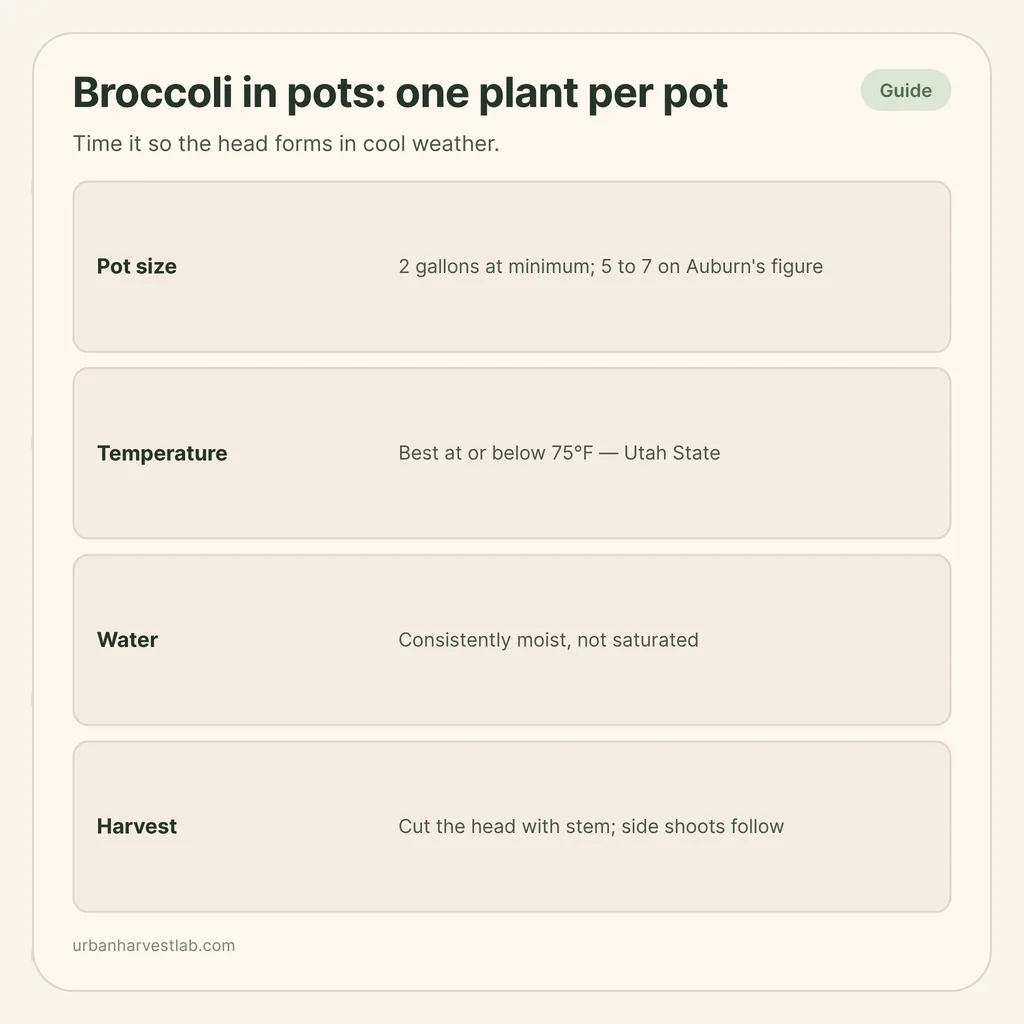
Broccoli works on a balcony if you give each plant its own pot, aim for cool weather, and cut the main head so the side shoots can follow.

How to grow kale in pots: cold, caterpillars and picking by the leaf
Kale suits containers: it is shallow-rooted enough for a modest pot, shrugs off frost, and gives leaf after leaf if you pick from the bottom.
Succession planting in containers: how to stagger a harvest from a few pots
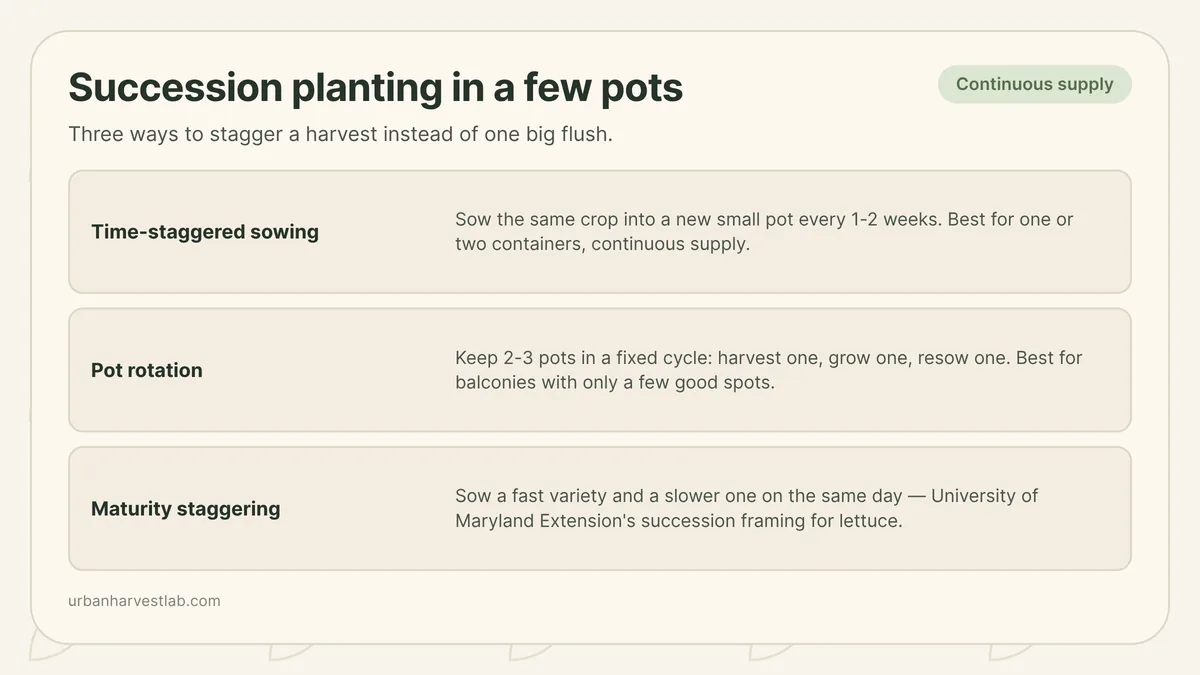
Succession planting in containers is a sowing rhythm: a few pots restarted on a schedule keep producing, where one large planting ripens together and then quits together.