What your climate means for a potted curry leaf
| Your situation | What the sources say | What to do |
|---|---|---|
| Winters with frost | The RHS describes the plant as suited to indoor growing or a cool conservatory in frost-prone climates | Grow it in a pot and bring it indoors before the first frost |
| Mild, frost-free winters | The UC Master Gardeners call it evergreen to Zone 10, dropping leaves in colder microclimates | Leave it outside, and shield young plants on the coldest nights |
| Hot summer afternoons | The UC Master Gardeners advise protecting it from direct sun in hot summer weather so leaves do not scorch | Move the pot to afternoon shade |
| Sticky leaves or bumps on stems | The RHS lists red spider mite, scale insects and mealybug as likely pests | Check stems and leaf undersides, then follow the matching pest guide |
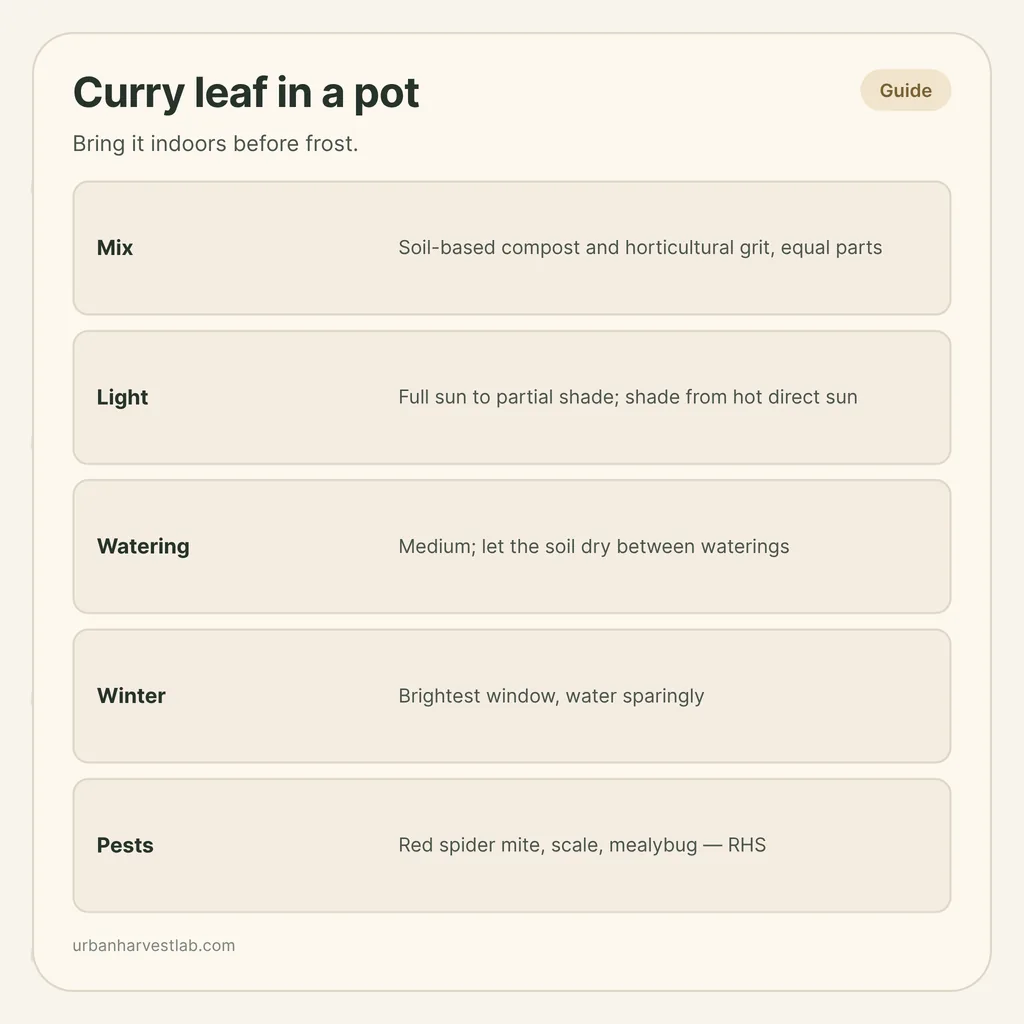
To grow a curry leaf plant in a pot, use a free-draining mix with grit, put it in full sun to partial shade, let the soil dry a little between waterings, and bring it indoors before frost. It is a tender tree from India, so in most climates the pot is not a compromise. It is how you keep the plant alive through winter. If you already grow bay or rosemary, the routine will feel familiar; the main difference is that curry leaf has less cold tolerance than bay laurel.
A note on names: the plant is now listed as Bergera koenigii, and the UC Master Gardeners say older references may still use Murraya koenigii. You will see both on plant labels. The UC Master Gardeners point out that it is not to be confused with curry powder, and that the leaves have a citrus-like flavor.
Winter indoors decides survival
This is the job that decides whether the plant survives. The RHS says curry leaf is suitable only for growing as an indoor plant, or overwintered in a cool conservatory in frost-prone climates, and may go outdoors in summer for the extra light and humidity. The UC Master Gardeners say it can be grown as an indoor plant and that young trees need frost protection.
In practice: bring it in before the first frost, put it in your brightest window, water sparingly, and check it for pests before it comes through the door. In a Zone 10 or milder climate, the UC Master Gardeners say it is evergreen, though it will drop leaves in colder microclimates. Because it drops leaves in colder microclimates, some winter leaf loss is not by itself a sign the plant is dying. The step-by-step move, including acclimating the plant on the way in and out, is in bringing potted plants indoors for winter.
A gritty mix, part shade in summer
The UC Master Gardeners give a caution worth knowing before you buy: some gardeners have found that the tree grows more vigorously in the ground than in a container. In a pot, expect a smaller, slower plant than the photos of tropical trees suggest.
For the mix, the University of Washington Miller Library quotes herbalist Jekka McVicar: a soil-based potting compost mixed in equal parts with horticultural grit. The RHS describes the compost as moisture-retentive and well drained. Those two fit together: a mix that holds some moisture but sheds the excess. Use a pot with drainage holes, and see the drainage hole guide if you are tempted by a decorative pot without them.
Light is a two-part answer. The UC Master Gardeners and the RHS both give full sun to partial shade. The UC Master Gardeners add that in hot summer weather the plant should be protected from direct sun so the leaves do not become sunburnt, and the UW Miller Library’s source puts the container in partial shade. On a south- or west-facing balcony, that usually means morning sun and a shaded pot from early afternoon.
Heat is welcome, within reason. The UC Master Gardeners call the plant evergreen to Zone 10, and the RHS says it may go outdoors in summer for the extra light and humidity.
The UC Master Gardeners rate its water needs as medium and say to allow the soil to dry between waterings. So water thoroughly, empty the saucer, and wait until the top of the mix has dried before watering again. The routine in the potted herb care guide applies here.
For feeding, the UW Miller Library’s source says to water sparingly while the plant is protected over winter, and to reintroduce water and feed as light levels and temperatures rise in spring.
Trimming, pot size and which type to buy
When the roots fill the container, move up a pot size. If a larger pot is not practical, root pruning is the usual alternative for woody herbs.
Trim regularly. The UW Miller Library’s source says to keep trimming the plant to maintain a supply of young leaves for cooking.
The UC Master Gardeners list regular, dwarf and compact (Gamthi) varieties. For a balcony, a dwarf or compact type is the sensible buy.
Pests to check when it comes inside
The RHS says curry leaf may be susceptible to red spider mite, scale insects and mealybug. Look over the stems and the undersides of the leaves when you bring the plant in, and again as winter goes on. Sticky leaves and small immobile bumps on stems point to scale, which the guides below describe.
Each has its own guide: scale on woody herbs, mealybugs and spider mites. Because you eat the leaves, read the label of anything you spray and check that it lists your plant. Do not rely on the active ingredient alone.
California: the psyllid rule
If you garden in California, one rule applies: curry leaf is a listed host of the Asian citrus psyllid. The California Department of Food and Agriculture lists Bergia (=Murraya) koenigii, curry leaf, on its Asian citrus psyllid host list, and its quarantine regulation applies to the pest, its hosts and possible carriers. The UC Master Gardeners of Santa Clara County say leaves should not be taken outside the local quarantine zone.
So do not mail cuttings, gift a rooted sucker or carry leaves to a relative in another county without checking the current CDFA quarantine map for both addresses. Quarantine boundaries change. Outside California, ask your state agriculture department what applies.
Harvesting, freezing and a second plant
The UC Master Gardeners say you can harvest leaves anytime to use fresh. Leaves may be frozen for later use, but drying is not recommended because they lose a lot of flavor.
To start a second plant, the UC Master Gardeners say root suckers or cuttings work, and that seed from fresh ripe fruit sown in autumn at a minimum of 68°F can germinate erratically and may take more than a month. For most balcony growers, a small nursery plant is the quicker route.
Sources
More tender and woody plants in pots
Curry leaf shares its winter routine and its pests with other woody herbs and citrus.
Common questions
How do I grow a curry leaf plant in a pot?
Plant it in a well-drained mix with grit, such as the soil-based compost and horticultural grit mix quoted by the University of Washington Miller Library, and give it full sun to partial shade. Let the soil dry a little between waterings, shade it from hot summer sun, and bring it indoors before frost.
Can a curry leaf plant live indoors?
Yes. The UC Master Gardeners say curry leaf can be grown as an indoor plant, and the RHS describes it as suitable only for growing indoors or overwintered in a cool conservatory in frost-prone climates. Give it your brightest window.
Can I dry curry leaves?
You can, but the UC Master Gardeners do not recommend it because the leaves lose a lot of flavor. They suggest harvesting leaves fresh whenever you need them and freezing any extras.
Is it legal to move curry leaf plants or leaves in California?
Not out of a quarantine zone. The California Department of Food and Agriculture lists curry leaf on its Asian citrus psyllid host list, and the UC Master Gardeners say leaves should not be taken outside the local quarantine zone. Check the current zone map for your address before moving any plant material.
Related guides

How to grow bay laurel in a pot
Bay laurel suits a pot because it grows slowly, but slow is not the same as stuck. Here is what a container bay needs, how to prune it, and what to do about scale and winter.

Bringing potted plants indoors for winter: what to move and what to leave
Not every pot deserves a spot on the windowsill. Here is how to decide what comes in, clear the pests, and get the plants through the light drop.

How to grow a lemon tree indoors: light, water, pollination and winter
A potted dwarf lemon can fruit on a windowsill, but only with strong light, careful watering and a paintbrush. Here is what each stage needs, winter included.