Should you grow corn in containers?
| Your situation | Verdict | Why |
|---|---|---|
| Room for 12 or more stalks across several large pots | Go | Extension sources ask for a block of four or more short rows (Purdue, Iowa State, Georgia) |
| Room for a single pot or a window box | Skip | One or two long rows are the layout extension sources warn gives poorly filled ears |
| 6 to 10 hours of direct light | Go | Maryland sets a minimum of 6 hours and prefers 8 to 10; Georgia asks for at least 8 to 10 hours of sunlight |
| Shady or windswept balcony | Skip or shelter it | Georgia lists wind damage and lodging among the common problems |
| You want cobs to eat within hours of picking | Go | Sweet corn loses about half its flavour within 12 to 18 hours unrefrigerated (Georgia) |
| Neighbours grow popcorn or ornamental corn nearby | Stagger planting dates | Pollen from popcorn makes sweet corn tough and starchy (Iowa State) |
Yes, you can grow sweet corn in containers, but only as a block: about a dozen stalks in several large pots set close together, in full sun, with a hand to help the pollen along. One pot of corn grows tall and gives you poorly filled cobs. Corn is wind-pollinated, and that single fact decides everything else.
Whether it is worth the pots is a balcony question as much as a plant question. A stalk is tall, a block needs room and weight, and a cob has to be eaten fresh to be worth it. The full-sun balcony vegetables list shows what else could use the same space.
Why one pot does not work
Corn pollen is carried by the wind from the tassels at the top of the plant to the silks on the ears, as Purdue Extension puts it. Each silk belongs to one potential kernel. Purdue Agronomy explains that each ovule on the ear develops a silk, and a kernel forms only when pollen fertilizes that ovule. A silk that catches no pollen leaves a gap on the cob.
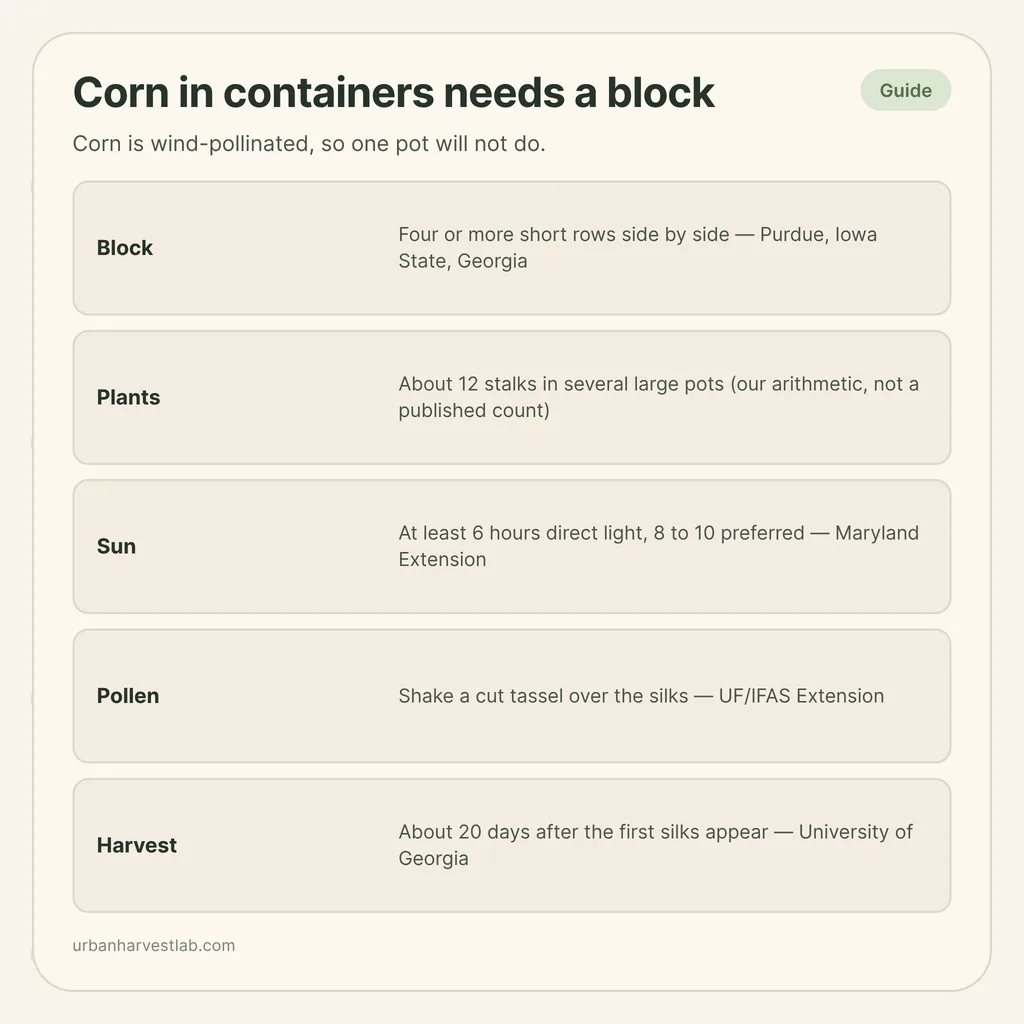
So the number of pollen grains landing on silks sets how full the ear is. Iowa State says inadequate pollination results in poorly filled ears and advises several short rows or blocks instead of one or two long rows. Purdue and the University of Georgia both say four or more short rows side by side. The University of Maryland says at least three to four.
In a field, a block lets pollen arrive from several directions. A single pot is a row of one.
How many plants make a block
The sources above are written for garden beds. Iowa State spaces seed 8 to 12 inches apart in rows 2½ to 3 feet apart, which no balcony pot layout copies. Colorado State’s container vegetable guide, which gives minimum depth and gallons per plant for crops such as tomato, pepper and squash, has no entry for corn. None of the pages checked gives a per-pot plant count.
What the sources do give is a rule about rows. Take the smallest version: four rows. Purdue notes that even small plantings can succeed if planted in blocks rather than rows, and also allows planting in hills, sowing 5 or 6 seeds and thinning to 3 strong plants per hill. A large pot works like one hill, so four pots of three, set in a square, gives 12 stalks. That adapts the extension rules and is not a published pot count. Purdue spaces hills about 3 feet apart; touching pots on a balcony are a compromise, so give the stalks as much air and light as you can. More is better, and fewer is a gamble. UF/IFAS Extension writes up hand pollination of corn for small gardens, where wind alone may not deliver enough pollen (below). It also notes that even in large commercial fields, stalks along the edges may not receive enough pollen, which is the case against a lone pot.
Practical layout:
- Spread the 12 over as many large pots as you can lift and weigh. Set the pots touching, in a square rather than a line.
- Count the weight before you buy. Twelve stalks means several heavy pots, so check the total against your balcony weight limit.
- The how many plants per container method gives the way to work out spacing and volume per pot, and the 5-gallon bucket guide covers drainage and heat if buckets are your pots.
Expect modest returns. Iowa State says plants typically produce one good ear per stalk and at least one smaller secondary ear, and Purdue says one or two ears per plant. Twelve stalks therefore means about a dozen good cobs, once.
Dwarf varieties
Shorter corn helps on a balcony, because tall stalks are the part that catches wind. University of Maryland Extension says early-maturing cultivars tend to produce relatively small plants, and gives them closer spacing (rows 30 inches apart, plants 8 to 9 inches apart, against 36 and 12 for larger varieties). It also notes that baby corn is grown from cultivars with a dwarf habit. Still check the mature height printed on the seed packet, and read what the labels promise in what “patio”, “bush” and “dwarf” mean on a seed packet.
Type matters for another reason. Iowa State says standard sweet corn seeds germinate well at soil temperatures of 55 to 60 °F, while supersweet types need soil of at least 60 °F, so supersweets suit a warm start.
Sun, wind and support
University of Maryland Extension sets a minimum of 6 hours of direct light and prefers 8 to 10; Georgia asks for at least 8 to 10 hours of sunlight. Either rules out most shaded balconies. Georgia also lists lodging, meaning plants falling over, from too much nitrogen or wind damage among the common problems. A tall stalk in a light pot on an open railing is exactly that setup, so read the windproof balcony garden guide before choosing the spot, and keep the block against a wall or in a corner where the air moves less.
Sowing and feeding
Corn is a warm-season crop. The University of Georgia gives soil temperatures of 60 to 90 °F and says to wait until at least two weeks after the last average killing frost. Find that date on your frost dates guide first. Iowa State sows 1 inch deep in heavy soil and up to 2 inches in light sandy soil; a light potting mix is closer to the second.
Feeding is heavy. Iowa State says sweet corn requires high levels of nitrogen, and Maryland suggests side-dressing twice, when plants are 12 to 18 inches high and again when tassels appear. Georgia warns that too much nitrogen can contribute to lodging, so apply to the label rather than extra. The container vegetable fertilizer schedule covers the routine.
Water and pollination at tasseling
Georgia names pollination and final ear filling as the most critical periods for water, and gives a minimum of 1 inch of water per week for normal development. Mississippi State adds that a water shortage, shown by rolled leaves at silk emergence, reduces yield and quality, and that hot, dry conditions during pollination result in missing kernels and small ears. Pots dry out faster than a bed, so check the block daily around silking. The container watering guide explains the finger test.
For pollination, give the wind help. When the tassels are shedding yellow pollen and silks have emerged, UF/IFAS Extension gives two methods: cut an entire tassel and use it as a wand, shaking pollen onto the silks, or strip the tassel and deposit the pollen from the anthers directly onto the silks. Be thorough, it says, so chances for a bountiful harvest are increased. Purdue says silks of unfertilized ovules stay receptive for up to 10 days after emerging from the ear shoot, so repeating this over several days adds chances. These are small-garden methods, not tests in pots.
Two things to watch for. Iowa State says Japanese beetles frequently feed on green corn silks, inhibiting pollination, so check the silks for chewing. And Purdue Agronomy says drought and heat stress can throw off the timing between pollen and silks, which is the case for shelter in a heatwave. The heatwave guide lists the options.
Other corn nearby
Sweet corn pollinated by popcorn will be tough and starchy, Iowa State says, and it advises isolating sweet corn from popcorn and field corn. Its distance is at least 250 feet, which is not practical on a balcony, so it offers another route: a minimum of 14 days between tasseling times of different corn types. Stagger sowing to get it. If a neighbour grows ornamental or popcorn on the same block, plant yours two or more weeks apart.
Picking and eating
Georgia says sweet corn matures in 60 to 100 days depending on variety and should be ready about 20 days after the first silk strands appear, and Iowa State says to harvest at the milk stage, when silks are brown and dry at the ear tip. The ripeness guide for container vegetables puts it next to your other crops.
Eat the cobs soon. Georgia says most lose 50 percent of their flavor within 12 to 18 hours of picking if left unrefrigerated, and Iowa State says standard sugary cultivars hold their high quality for only 1 or 2 days. Supersweet types keep up to one week with refrigeration. For a longer harvest, Iowa State suggests planting the same cultivar in blocks every two weeks, which only makes sense if you have the space; the succession planting guide shows how to stagger within a small footprint.
Sources
- Iowa State University Extension, Growing sweet corn in the home garden
- Purdue Extension, HO-98: Growing sweet corn
- University of Georgia Extension, Circular 905: Growing home garden sweet corn
- University of Maryland Extension, Growing sweet corn in the home garden
- Mississippi State University Extension, Corn, sweet
- Purdue Agronomy, R.L. Nielsen, A fast and accurate pregnancy test for corn
- UF/IFAS Extension, HS1149: Hand pollination of squash and corn in small gardens
- Colorado State University Extension, Vegetable gardening in containers
Sun-hungry crops for a balcony
Wind, weight and sun checks that decide whether corn fits your space.
Common questions
Can you grow corn in a single pot?
You can grow stalks, but ears are unlikely to fill. Iowa State says inadequate pollination results in poorly filled ears, and it advises several short rows or blocks rather than one or two long rows. Purdue says even small plantings can succeed when planted in blocks, so the answer is several pots set close together, not one.
How many corn plants do I need in containers?
No extension source in the pages checked gives a per-pot count for corn. Purdue, Iowa State and Georgia ask for four or more short rows side by side, and Maryland says at least three to four. Four rows of three stalks, about 12 in all, is a reasonable floor you can build from that. UF/IFAS Extension writes up hand pollination of corn specifically for small gardens, where wind alone may not deliver enough pollen.
Do I need to hand-pollinate corn on a balcony?
UF/IFAS Extension (HS1149) recommends it for small gardens and gives two methods: cut a whole tassel and use it as a wand, shaking pollen onto the silks, or strip the tassel and deposit pollen from the anthers directly onto the silks. Purdue explains why it matters: each kernel develops from an ovule with its own silk, and forms only when a pollen grain reaches that silk. Unpollinated silks stay receptive for up to 10 days, so repeating it over several days gives you more chances.
How long does container corn take to be ready?
University of Georgia Extension says sweet corn matures in 60 to 100 days depending on variety; Mississippi State splits that into early (65 to 70 days), midseason (70 to 80) and late (80 or more). Once silks appear, Georgia puts harvest about 20 days later, and Iowa State says to pick at the milk stage, when the silks are brown and dry at the ear tip.
Related guides
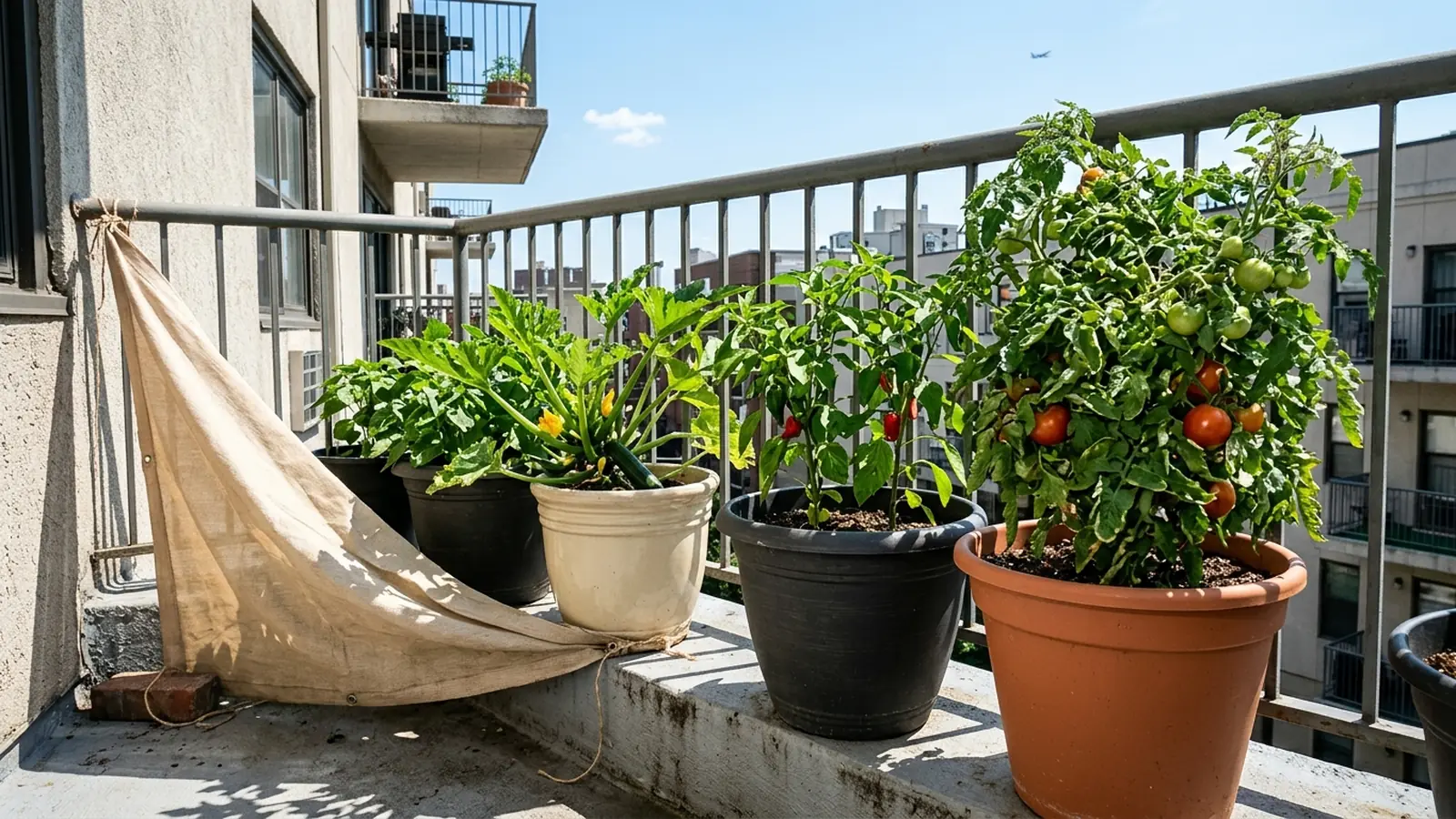
Best vegetables for a full-sun balcony: what to grow in 6 or more hours of direct light
A balcony that tracks 6 or more hours of direct sun can carry the fruiting crops every shadier balcony has to skip. The trade is a container that heats up far faster than garden soil, and managing that trade is the real work.
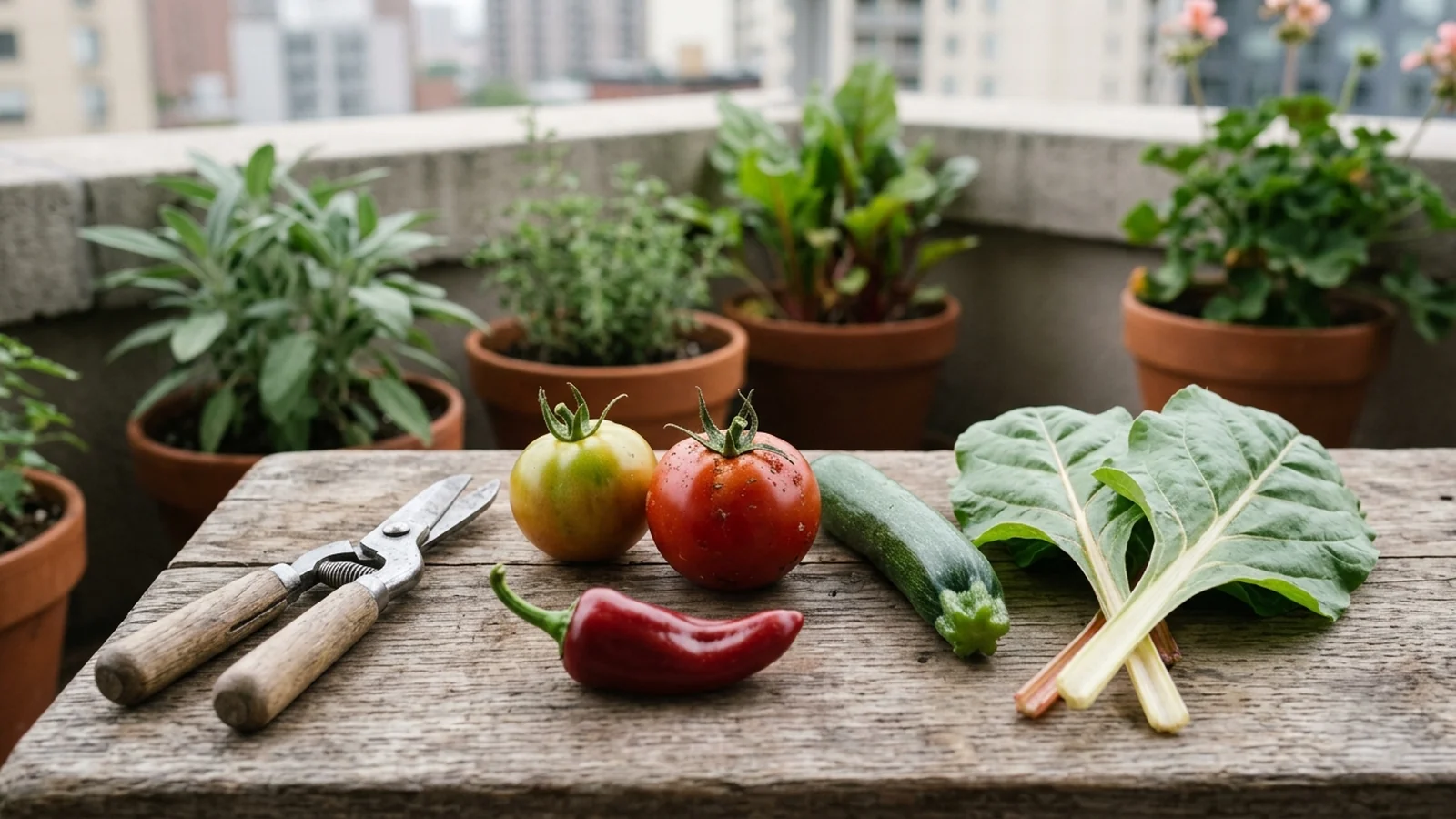
When container vegetables are ripe, crop by crop
A tomato tells you it's ready with color and give. A zucchini tells you with size and how easily it lets go. The signal is different for every crop, and waiting costs more when the plant only has a pot's worth of reserve behind it.
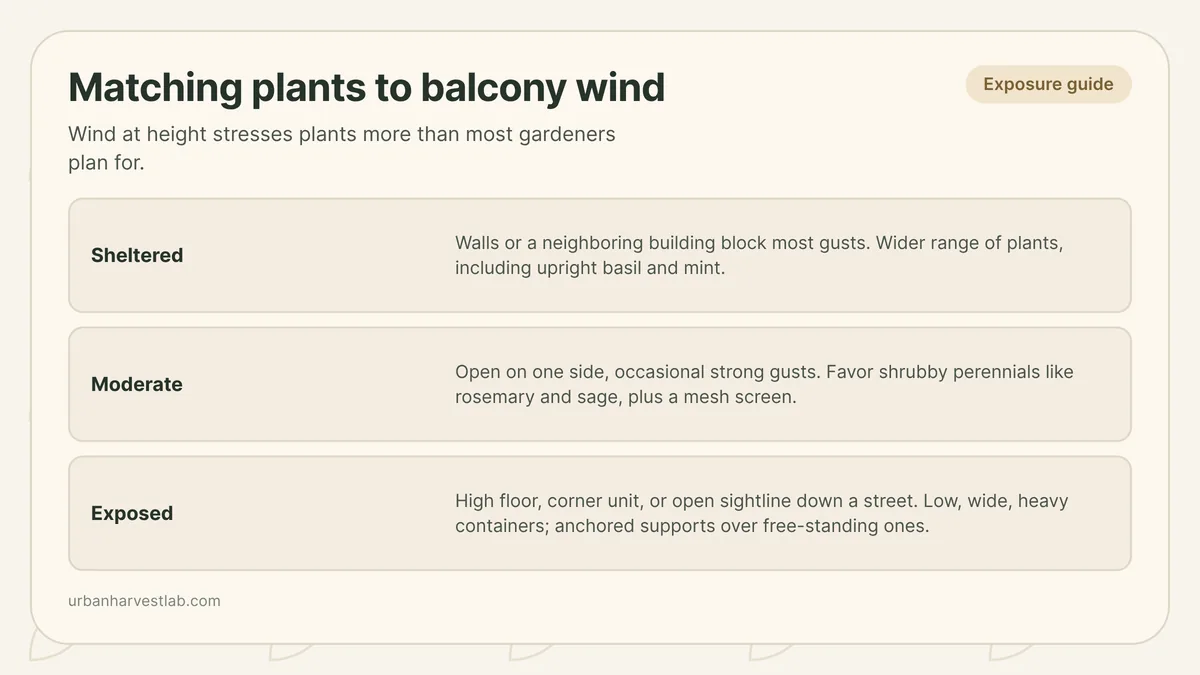
Windproof balcony garden: anchoring, plant choice, and windbreaks
A balcony catches wind differently than a yard does, and the fix is not one trick but three working together: heavier containers, plants suited to an upright or shrubby habit, and a windbreak that softens gusts instead of stopping them dead.