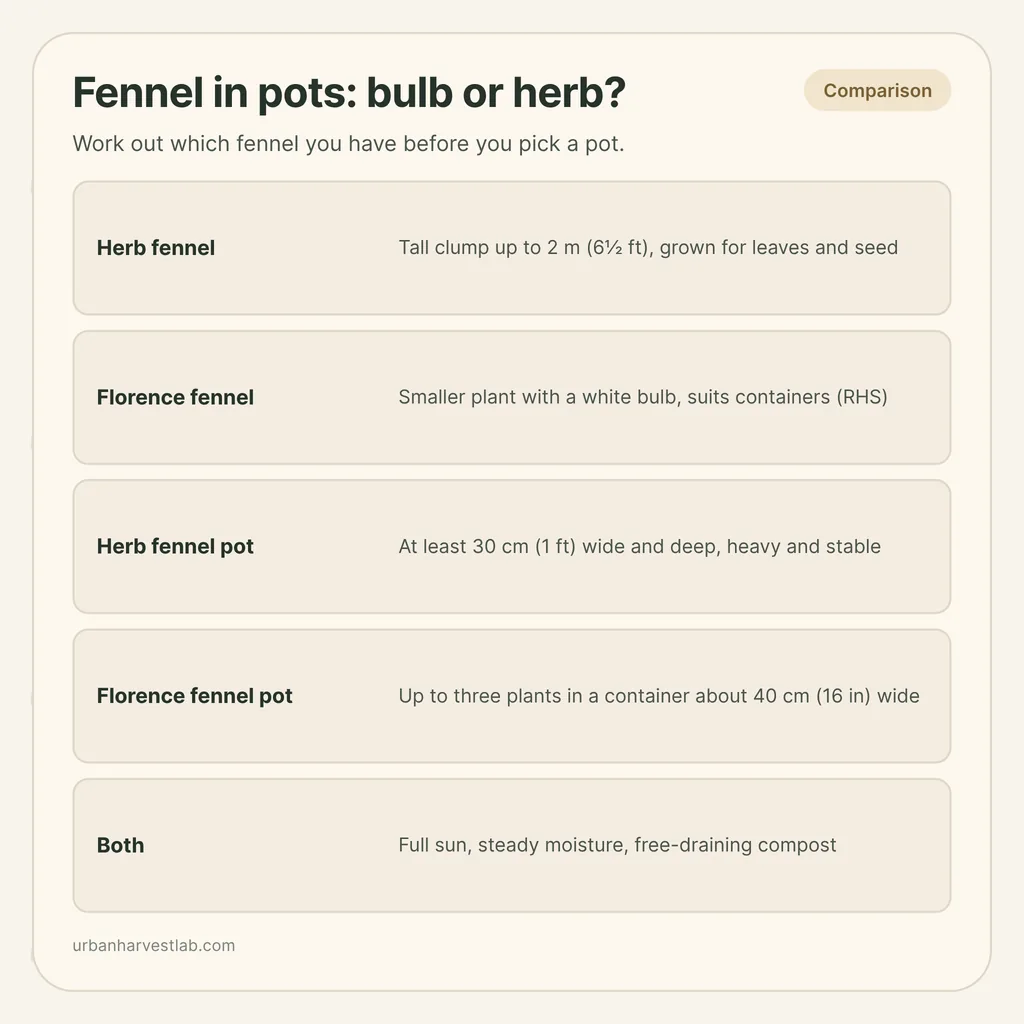
Herb fennel and Florence fennel in a pot
| Question | Herb fennel | Florence (bulb) fennel |
|---|---|---|
| What you eat | Leaves, flowers and seeds | Swollen leaf bases, plus young leaves |
| Size | Clump up to 2 m (6.5 ft) tall | Smaller plant, ready in a few months |
| Pot | At least 30 cm (1 ft) wide and deep, heavy | Up to 3 plants in about 40 cm (16 in); 10-15 cm (4-6 in) apart for baby bulbs |
| Main risk | Blowing over; roots rot if waterlogged | Bolting before the bulb forms |
| Life cycle | Dies back each autumn, resprouts in spring | Grown for one crop; bulb takes three to four months |
Fennel will grow in a pot, but first work out which fennel you have: herb fennel is a tall clump grown for leaves and seed, and Florence (bulb) fennel is a smaller vegetable grown for its swollen base. Give either a deep, heavy container, sow it where it will stay and keep the mix evenly moist. The RHS recommends a container at least 30 cm (1 ft) wide and deep for herb fennel, and warns that Florence fennel bolts easily when its pot dries out.
Fennel is one of the less compact choices in the small-space herb garden, so it is worth choosing deliberately.
Bulb fennel or herb fennel
The RHS treats them as close relatives: herb or common fennel (Foeniculum vulgare) and Florence fennel (F. vulgare var. azoricum). Seed packets and plant labels often just say “fennel”, and the RHS cautions to make sure you choose herb fennel rather than the vegetable Florence fennel when you want the herb, because both are often sold simply as fennel.
Herb fennel forms a clump of stems up to 2 m (6½ ft) tall that die back in autumn and resprout from the base each spring. Florence fennel forms a smaller plant, ready to harvest in a few months, and the RHS calls it ideal for small gardens and containers. It forms a white “bulb” that is really the overlapping, swollen bases of the leaf stalks.
Decide by what you want on the plate:
- Leaves and seed for cooking or tea: herb fennel. Harvest sprigs of young leaves from early summer to autumn.
- A crisp vegetable to slice into salads: Florence fennel, which is the harder of the two to get right in a pot.
Fennel also looks like dill, but the RHS describes it as much taller, more vigorous and longer-lived. Dill has its own sizing rules, covered in what size pot dill needs. Do not borrow them for fennel. For which crops can share a container, see companion planting in containers.
Pot size and weight
For herb fennel the RHS says a large container at least 30 cm (1 ft) wide and deep, filled with peat-free multi-purpose compost, and a heavy, stable pot in a sheltered position, because the tall plant could easily blow over. University of Maryland Extension agrees on the scale from a different angle, listing fennel among the large-statured herbs that need 5-gallon or larger pots. University of Wisconsin Extension notes that fennel can be grown in large containers but typically does better in the ground because of its deep taproot. That is the reason to go for the deepest pot you have room for.
Florence fennel is smaller. The RHS says you can grow up to three mature plants in a container about 40 cm (16 in) wide. For baby vegetables, space plants just 10-15 cm (4-6 in) apart.
A tall herb fennel plant in a pot catches wind. The RHS says its flower stems may need supporting with a cane in windy places. On an exposed balcony, read windproofing a balcony garden before picking a spot. For other herbs, the herb pot size chart lists them side by side.
Sowing: put it in the final pot
Fennel dislikes root disturbance. The RHS recommends sowing it straight into its final site, or one seed per module if starting indoors, so the rootball stays intact.
- Herb fennel: sow into the final container from mid-spring, about 1 cm (½ in) deep (RHS). Thin seedlings until plants stand at least 30 cm (1 ft) apart, which means one plant in a pot of the RHS minimum size. Thinnings go in salads. The thinning guide covers the cutting technique.
- Florence fennel: the RHS says to sow outdoors in June or July once temperatures have warmed up. Early sowings are liable to bolt. University of Wisconsin Extension also sows after the last frost, or in mid-summer for a fall crop.
- Indoor start: if you must, harden off before moving out and move plants while still very young, before the taproot forms (RHS).
Watering, feeding and light
Both types want full sun and light, free-draining compost. For containers, the RHS says fennel will need a steady supply of moisture through the growing season: check plants every few days and water as needed, keeping the compost just moist. The same page says fennel needs no feeding.
Florence fennel is far less forgiving. University of Wisconsin Extension says it does better in more fertile soil with more even moisture than common fennel prefers. The RHS says it needs consistently moist compost and tends to bolt in dry conditions. Check the compost regularly, as the RHS advises, because containers dry out very rapidly. The method for judging when to water is in how often to water container vegetables.
Waterlogging is the opposite risk, because the RHS says roots may rot in waterlogged conditions. Use a pot with drainage holes.
Stopping bulb fennel bolting
Bolting is flowering too early. In Florence fennel the bulb then does not form or turns woody. The RHS lists the causes as cold temperatures in spring, root disturbance when transplanting and dry conditions in summer. Its fixes:
- Choose a bolt-resistant variety. The RHS says most Florence varieties are, though they can still bolt in dry or cold conditions.
- Sow one seed per module if starting indoors, and avoid disturbing roots.
- Wait for warm weather to sow outdoors.
- Water regularly and keep the compost from drying out completely.
University of Wisconsin Extension lists several named varieties with days to maturity, including ‘Finale’ (75 to 80 days) and ‘Dragon’ (90 days). The RHS says the bulb takes three or four months to mature, so count that before committing a pot. The cilantro bolting guide covers the same heat and dryness pattern in a different crop.
Harvest
Bulb fennel: the RHS says harvest is usually when the bulb is 10-15 cm (4-6 in) across (University of Wisconsin Extension’s cue is a bulb about the size of a tennis ball), though any size from about 5 cm (2 in) works, and mini vegetables are possible after about six weeks. Harvest before the bulb starts to elongate and send up a flower stem, when it becomes woody and inedible. Cut just below the bulb with a sharp knife and leave the base and roots in the pot; small leafy shoots will appear, but it will not form another bulb (RHS).
Herb fennel: pick young sprigs as needed. For leaves only, the RHS suggests cutting off the developing flower stems as they appear, or trimming the whole plant back to about 30 cm (1 ft) several times a season so fresh foliage keeps coming. Leave flowers to set seed if you want to collect it later in the season.
Wisconsin Extension warns that the sap can cause skin irritation in sensitive people, especially when exposed to sunlight, so wear gloves if you have reacted to similar plants.
Sources
Fennel's neighbours
Pot sizing, watering and wind for tall or bolt-prone crops in containers.
Common questions
Can you grow fennel in a pot?
Yes. The RHS recommends a heavy, stable container at least 30 cm (1 ft) wide and deep for herb fennel, in a sheltered spot, and says Florence fennel suits containers. University of Wisconsin Extension adds that fennel typically does better in the ground because of its deep taproot, so give it the biggest pot you can.
What size pot does fennel need?
For herb fennel, at least 30 cm (1 ft) wide and deep according to the RHS, and University of Maryland Extension puts fennel in its group needing 5-gallon or larger pots. For Florence fennel, the RHS says up to three mature plants fit a container about 40 cm (16 in) wide.
Why does my bulb fennel flower instead of forming a bulb?
That is bolting. The RHS lists cold temperatures in spring, root disturbance when transplanting and dry conditions in summer. Wisconsin Extension says dry conditions promote blooming at the expense of bulb formation. In a pot the mix dries fast, so check it often.
Is fennel the same as dill?
No. The two look alike, but the RHS describes fennel as much taller, more vigorous and longer-lived than dill. Fennel has its own sizing and care, separate from dill pot size.
Related guides
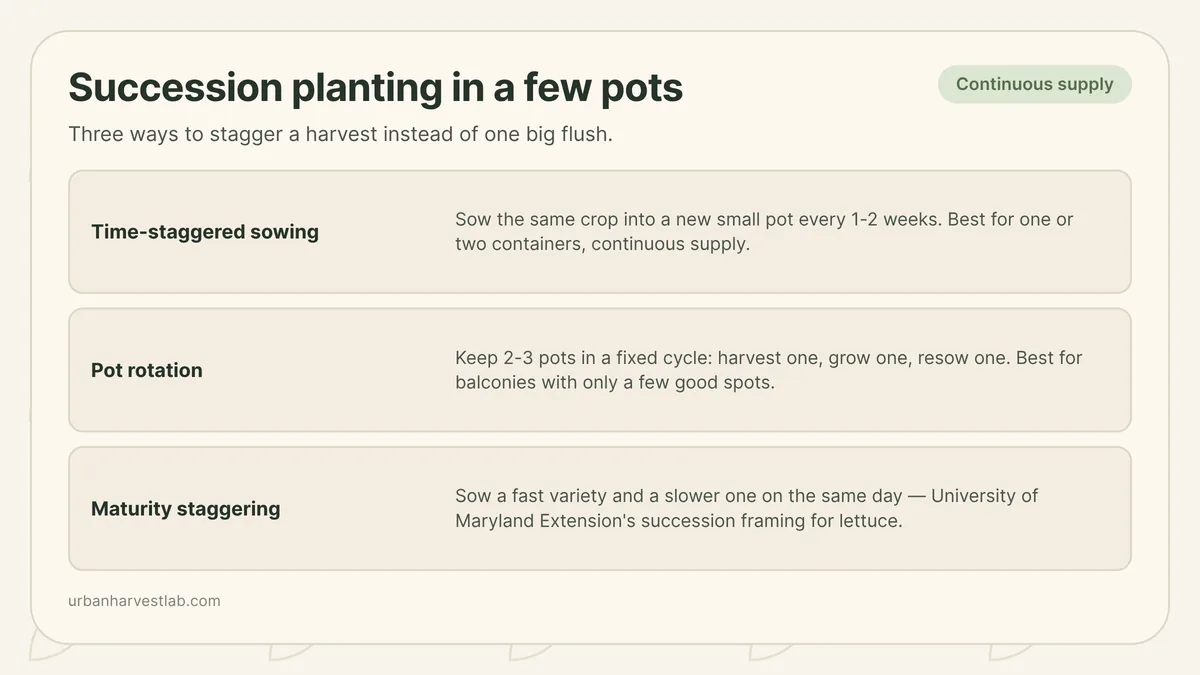
Succession planting in containers: how to stagger a harvest from a few pots
Succession planting in containers is a sowing rhythm: a few pots restarted on a schedule keep producing, where one large planting ripens together and then quits together.
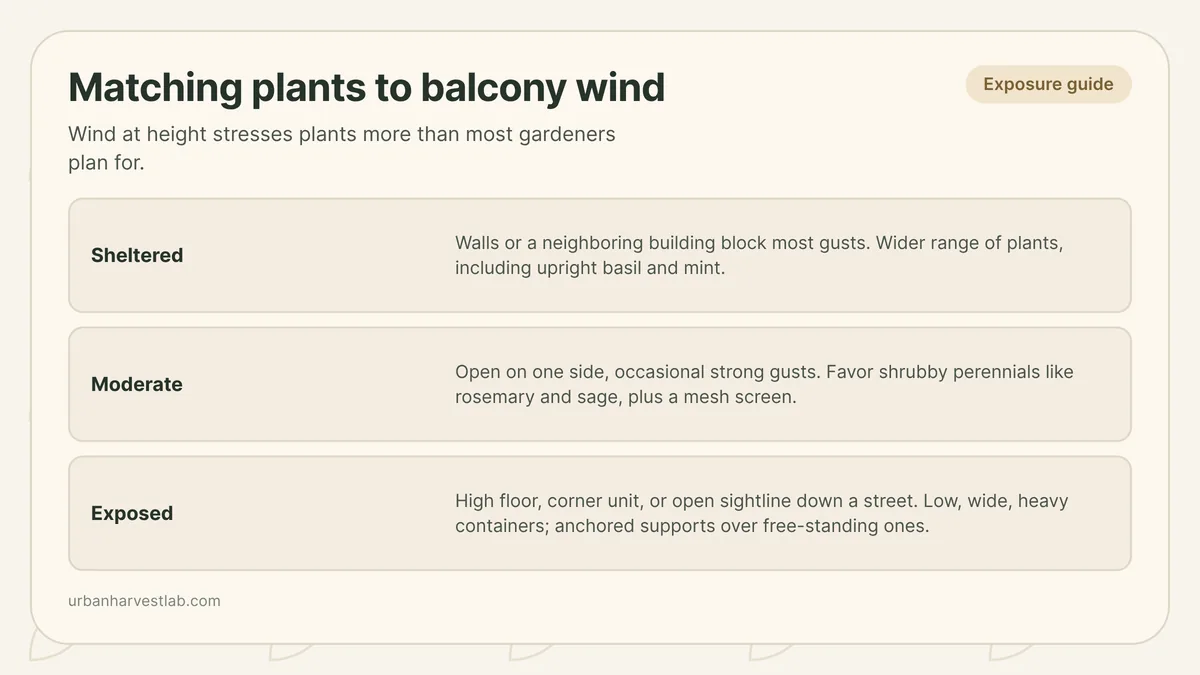
Windproof balcony garden: anchoring, plant choice, and windbreaks
A balcony catches wind differently than a yard does, and the fix is not one trick but three working together: heavier containers, plants suited to an upright or shrubby habit, and a windbreak that softens gusts instead of stopping them dead.

How to grow lemon balm in a pot and keep it from self-seeding
Lemon balm is a mint-family herb that behaves differently from mint: it spreads by seed, not runners. A pot keeps it in bounds if you cut it back before the seed forms.