
Melon choices for a balcony at a glance
| Decision | What the extension sources say | On a balcony |
|---|---|---|
| Variety | Wisconsin: bush-type melons suit containers. Cornell: some bush vines are just 3 feet long | Pick a bush or small-fruited type; skip full-size sprawling vines |
| Pot | Wisconsin: 2 gallons general minimum, 5 gallons for larger plants | Start at 5 gallons and go larger if the floor can take it |
| Support | Maryland and Cornell: sling every trellised fruit | Pantyhose, netting or cheesecloth tied to the trellis |
| Pollination | Nebraska: insect-pollinated only. South Dakota State: brush within 4 hours of opening | Paintbrush, early morning, male to female |
| Water | Cornell: steady moisture until tennis-ball size. Clemson: ease off in the last week | Keep even early, then taper before harvest |
A melon will fruit on a balcony if you grow a bush or small-fruited variety in a large pot, train it up a trellis with a fabric sling under each fruit, and carry pollen between flowers with a paintbrush. Expect 2 to 4 fruit per plant, which is Maryland Extension’s figure, not a harvest. Maryland Extension says most melon cultivars are not suited to small gardens because of the space they need, so the variety you buy matters more than any other choice.
Pick a variety that fits the space
University of Wisconsin Extension separates the two cases clearly. Most melons are impractical in containers, it says, but some small-fruited cultivars can be raised in containers and trained up a trellis, and the newer bush-type melons grow as a compact bush rather than a sprawling vine and are ideal for small-space and container growing. Cornell adds that bush varieties have more compact vines, some just 3 feet long, and that fruit size is the other lever: it advises sticking with smaller fruits if you plan to trellis the vines. Virginia Tech also notes that newer bush varieties exist for small gardens.
So the seed packet is your first filter. Look for the words “bush”, “compact” or “small-fruited”, and a fruit size you could hold in one hand. A full-size vine that runs 3 to 12 feet, which is Cornell’s stated spread for the crop, will outgrow a railing and a pot at the same time.
Check the fruit type too. What most North American shops sell as cantaloupe is a netted muskmelon; Maryland Extension notes that true cantaloupes are smooth-skinned, unnetted and do not slip from the stem when ripe. The ripeness advice below is for the netted, slipping type that Clemson and Utah State describe.
Sun, season and starting plants
Maryland Extension lists full sun as at least 6 hours of direct light a day and says melons prefer 8 to 10. With less than 6 hours a melon is a poor bet; the crops in full-sun balcony vegetables are a better use of that pot.
Melons are tender and need warmth. Cornell says soil below 50 F slows growth and gives 70 F soil, 1 to 2 weeks after the average last frost, as the point to direct-seed. Utah State plants at 65 F soil or once frost danger has passed. The two figures overlap in practice: wait for settled, warm weather, and check your own date with the frost dates guide.
Transplants buy time. Maryland Extension says to start seeds indoors 3 weeks before transplanting and that transplants can be harvested as much as four weeks earlier than direct-sown melons. Virginia Tech says two weeks. Either way, handle them gently: Cornell warns that melon transplants are delicate and the roots are sensitive to disturbance, so keep the root ball intact.
Season length is the real limit. Maryland Extension gives 80 to 100 days from transplanting to maturity. Count forward from your planting date to your first autumn frost before you commit a pot to a melon.
The pot
University of Wisconsin Extension says containers holding at least 2 gallons of soil work best in general, and that larger plants, including tomatoes, peppers, bush cucumbers and summer squash, grow best in containers of at least 5 gallons. It advises using the larger size when you do not know. Melons are not named in that list, so take 5 gallons as a floor for a single plant rather than a target, and go up if your balcony allows. Utah State Extension simply says “a large pot”.
Wisconsin also warns that small containers dry out quickly and blow over easily, and that big ones get heavy when wet. A trellised melon in a large pot is both tall and heavy, which is a wind and load question. Work out the numbers with the balcony weight limit calculator before you fill it, and see windproofing a balcony garden for anchoring. The bush cucumber is the closest relative Wisconsin does list at 5 gallons, and the cucumber pot size guide compares what different extension sources give for it.
Trellis and slings
Cantaloupe plants can be trained to a fence or trellis, Utah State says, but once the fruits start to enlarge they need support or the weight may damage the vine. Maryland Extension is specific: each trellised melon, using a small-fruited cultivar, must be held in a sling made from a material that dries quickly, to prevent rot. Cornell names netting, fabric or pantyhose, and Virginia Tech adds old nylon stockings and cheesecloth. Tie the sling to the trellis, not to the vine.
A renter can build the frame without drilling; the no-drill trellis guide shows tension poles, obelisks and weighted frames that stand in a pot. Choose one that can carry a vine plus several slung fruit, and weight the base.
Trellising has a second benefit. Cornell says it improves air circulation around the plants and can reduce foliar disease. Fruit that cannot be slung, such as one resting on the pot rim or floor, should sit on a pot or a piece of wood, as Cornell recommends, to keep insects off the underside.
Pollination by hand
Melon flowers do not pollinate themselves. The University of Nebraska says melon and cucumber flowers are pollinated exclusively by honey bees and other insect pollinators and are not wind- or self-pollinated. Clemson names missing bee pollination as one of the most common causes of poorly formed or scarce fruit, and Maryland Extension notes that set is often poor in rainy weather when bees are inactive. Several floors up, bees may be rare too.
Learn the two flowers first. Utah State says the first blooms are male and drop off, and the female flowers open later with a swelling at the base that becomes the fruit. Nebraska says most muskmelon varieties produce male flowers from the start and that female flowers appear generally 10 to 14 days after the first males. Do not panic if the first blooms fall.
Then move the pollen. South Dakota State Extension describes using a small paintbrush early in the morning to collect pollen from a male flower and transfer it to a female flower, ideally within 4 hours of the female opening. It identifies the female by the miniature fruit just below the petals. Nebraska says each flower stays open for a single day and aborts if not pollinated. Check every morning while the plant flowers. Tomatoes and peppers can be shaken loose inside one flower, as the tomato and pepper pollination guide explains. Melons need pollen carried from one flower to another.
Utah State also lists very hot weather and water stress as reasons female flowers fail, so a heatwave can undo careful brushing. Shade and water plans are in protecting container plants in a heatwave. Keep pesticides off the plant during bloom, as Maryland Extension advises.
Water and feeding
Cornell wants consistent, plentiful moisture until the fruit is about the size of a tennis ball, then watering only when the soil is dry and the leaves wilt. Clemson adds that melons need extra water during fruit set and development but that too much in the last week reduces sweetness; Maryland Extension says to stop watering once fruits ripen unless there is a prolonged dry spell. A pot dries faster than a bed, so check it daily in warm weather; the watering container vegetables guide explains the check.
Go easy on nitrogen. Clemson says too much encourages vine growth at the expense of fruit.
Knowing when to pick
Clemson gives 30 to 35 days from pollination to harvest for most cantaloupe; Utah State gives 35 to 45 days from flowering. Both treat full slip, when the stem parts easily from the fruit, as the sign. Mark the pollination date on a tag so you know when to start testing. Maryland Extension says muskmelons continue to ripen after picking but peak in flavour at full slip.
Sources
- University of Maryland Extension: Growing Melons in a Home Garden
- Utah State University Extension: How to Grow Cantaloupe (Muskmelon) in Your Garden
- Clemson Cooperative Extension HGIC: Cantaloupe
- Cornell Home Gardening: Melons growing guide
- University of Wisconsin Extension: Container Gardening (A3382)
- Virginia Cooperative Extension: Cucumbers, Melons, and Squash
- University of Nebraska-Lincoln Extension: Bee Pollination of Cucurbit Crops (G1754)
- South Dakota State University Extension: Saving Seed of Pumpkins, Squash, Cucumbers, Melons and Gourds
Supporting a heavy fruit on a balcony
Melons add vine, fruit weight and wet soil to a balcony, so these guides cover the support, the pollination and the load.
Common questions
Can you grow melons in containers?
Yes, with the right type. University of Wisconsin Extension says some small-fruited melon cultivars can be raised in containers and trained up a trellis, and that the newer bush-type melons are ideal for container growing. Utah State Extension adds that cantaloupe can be trained to a fence or trellis or grown in a large pot. Cornell says bush varieties can be grown in large containers on patios and decks. Full-size sprawling vines are a poor fit.
How big a pot does a melon need?
University of Wisconsin Extension sets 2 gallons as the general minimum for containers and 5 gallons for larger plants such as tomatoes, peppers and bush cucumbers, and advises taking the larger size when unsure. Melons are not on its list, so treat 5 gallons as a floor for one plant and go bigger if the balcony can carry the weight.
How long do container melons take to ripen?
Maryland Extension gives 80 to 100 days from transplanting to maturity. Once the fruit has set, Clemson Extension gives 30 to 35 days from pollination to harvest for most cantaloupe, and Utah State Extension gives 35 to 45 days from flowering, depending on temperature and variety.
How do you know a muskmelon is ripe?
Look for full slip: the stem separates easily from the fruit. Utah State Extension also lists a coarser net and a background colour that turns from green to yellow. Clemson Extension says a cantaloupe at full slip has reached its maximum sugar development.
Related guides
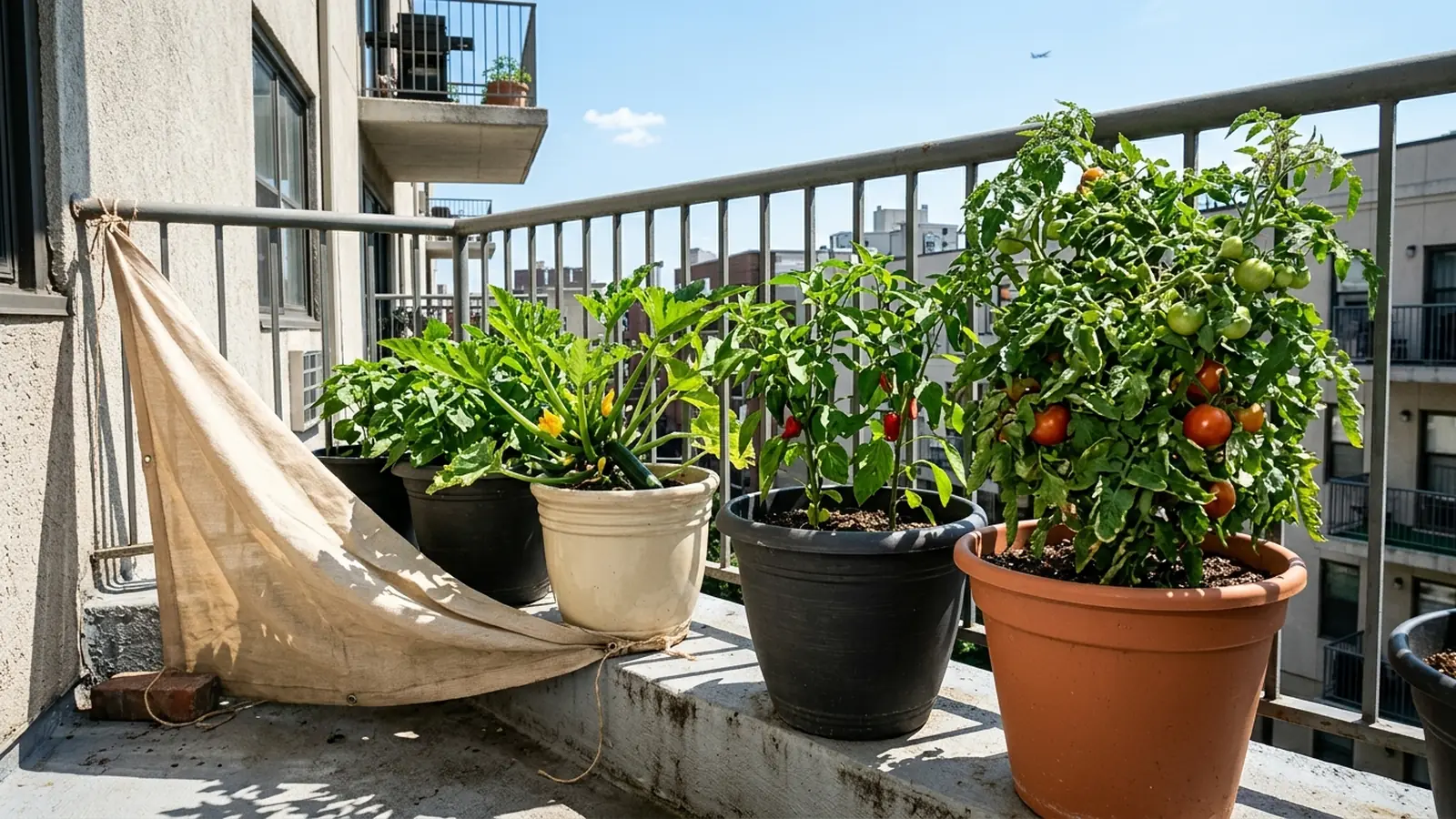
Best vegetables for a full-sun balcony: what to grow in 6 or more hours of direct light
A balcony that tracks 6 or more hours of direct sun can carry the fruiting crops every shadier balcony has to skip. The trade is a container that heats up far faster than garden soil, and managing that trade is the real work.
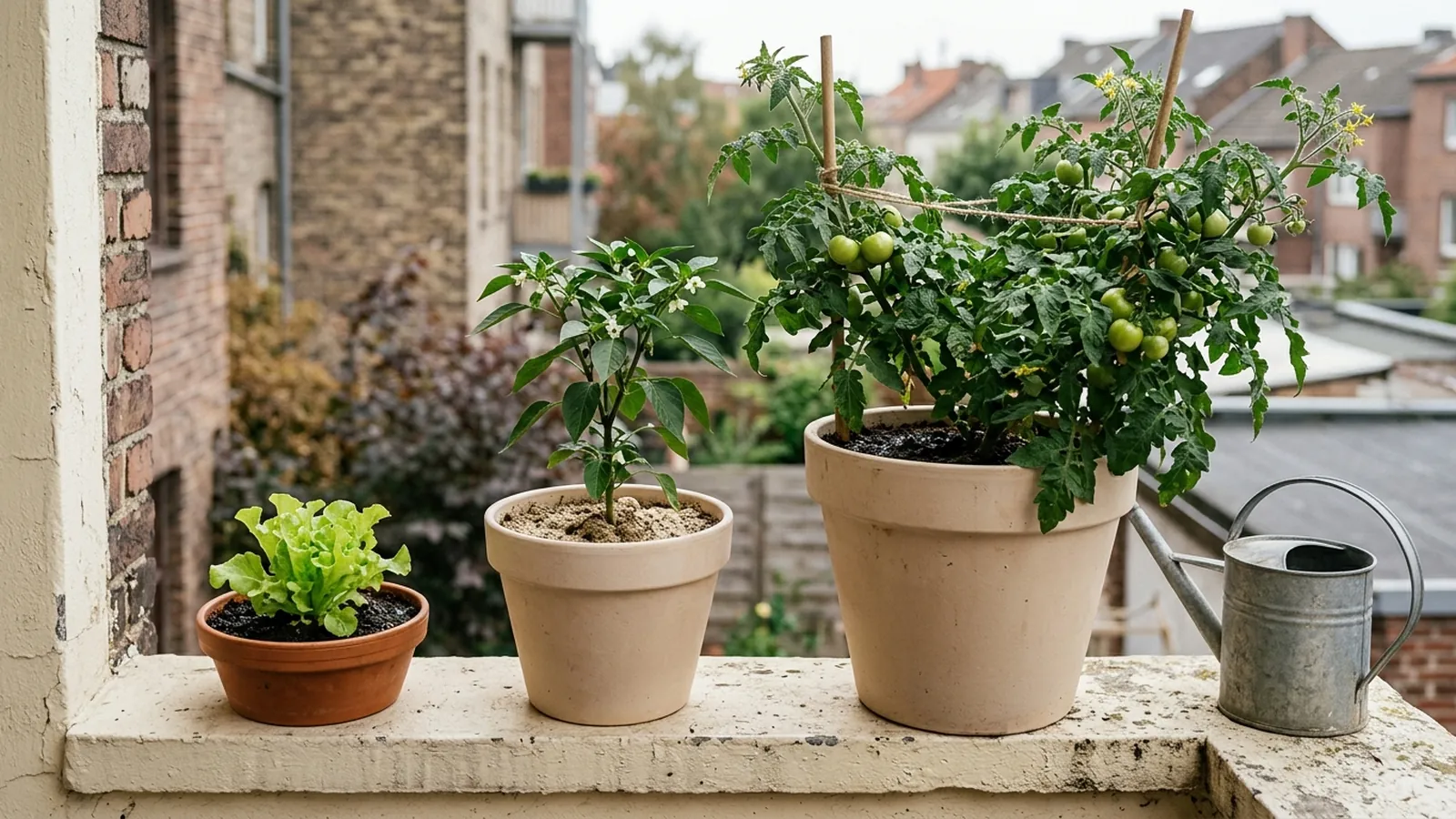
How often to water container vegetables: volume and crop stage set the interval
A pepper in a 2-gallon pot in May and the same pepper in the same pot in August are two different watering problems. Once you can see why, the question stops being how often and becomes how much mix you gave the plant, and what it is carrying right now.

How to protect container plants during a heatwave
Watering more is only one piece of getting containers through a heatwave. This is the wider plan: cutting the heat load, grouping and staging pots, and reviving one that has already dried out.