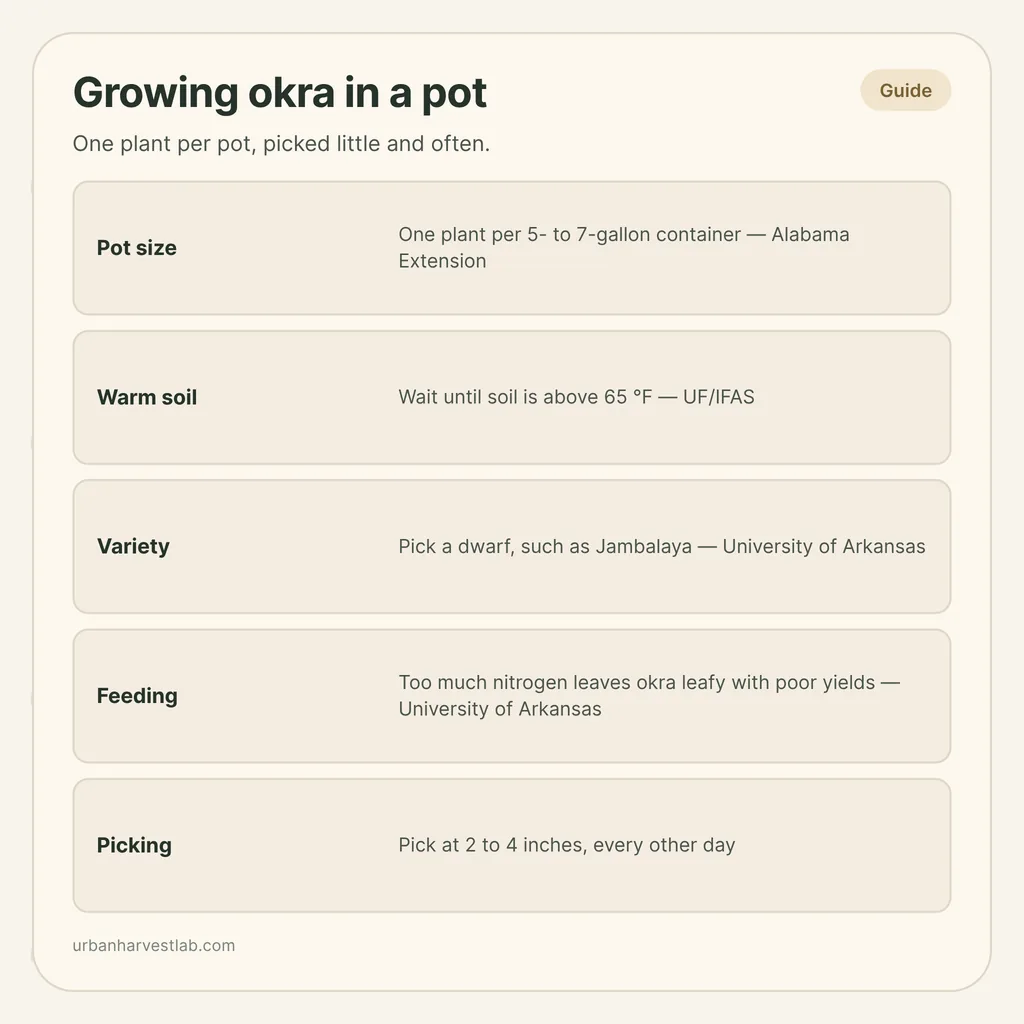
Okra in a pot: the numbers by source
| Question | Figure | Source |
|---|---|---|
| Pot size | 1 plant per 5- to 7-gallon container | Alabama Extension |
| Soil to plant into | At least 65 °F at 4 inches (62 °F in Arkansas) | NC State, UF/IFAS, Arkansas |
| Best air temperature | 75 to 90 °F | NC State Extension |
| Days to harvest | 45 to 55 (Alabama); 50 to 70 (Florida); 60 to 70 (NC State) | Alabama, UF/IFAS, NC State |
| Pod length to pick | 2 to 4 inches (2 to 3 in Florida and NC State) | Iowa State, Arkansas, Alabama, UF/IFAS |
| Flower to pod | 4 to 7 days (Arkansas); 5 to 6 (Iowa State); 1 to 3 (Maryland) | Arkansas, Iowa State, Maryland |
Give okra one 5- to 7-gallon pot per plant, a dwarf variety, full sun and soil that has warmed past 65 °F, then pick pods every other day while they are 2 to 4 inches long. Alabama Cooperative Extension’s container advice is one plant per pot; the rest of the work is timing and a short harvest routine.
Okra is a crop for the hottest spot you have. NC State Extension puts its best growth at 75 to 90 °F, and UF/IFAS calls it well suited to hot, humid summers. If your balcony bakes, it is one of the best uses of that space, and the full-sun balcony vegetables list is the wider menu it belongs to.
Pot size and mix
Alabama Cooperative Extension says to plant one okra per 5- to 7-gallon container, filled with potting mix and with drainage holes. It also says self-watering containers are an option. The University of Arkansas warns that okra is quite sensitive to salt, and that over-fertilizing and poor drainage in containers can damage plants. That is a reason to use fresh potting mix in a pot with drainage holes.
A 5- to 7-gallon pot of wet mix is heavy. Add it up against your balcony weight limit before you buy a row of them. For how depth and volume trade off against watering frequency in other fruiting crops, see container depth for tomatoes, peppers and herbs.
Pick a variety that stays small
Full-size okra gets big. UF/IFAS says most plants fall in the 3 to 6 foot range, University of Maryland Extension says plants can reach 6 to 10 feet, and the University of Arkansas lists the heirloom Cow’s Horn at 8 feet. A tall plant in a pot is a sail.
Compact choices:
- Jambalaya. The Arkansas table calls it a dwarf plant that yields well and is good for containers, ready in 50 days.
- Annie Oakley II. Arkansas lists spineless dwarf plants with pods tender to 4 1/2 inches, in 48 days. Iowa State gives its height as 4 1/2 feet.
- Clemson Spineless. Iowa State gives 4 to 5 feet. Arkansas says it is less sensitive to day length than other cultivars.
- Carmine Splendor and Caselode. Both appear with Jambalaya and Clemson Spineless in the University of Wisconsin’s list of vegetable varieties for containers.
Alabama Extension adds that dwarf varieties are less likely to fall over in a container and are often spineless. For what “dwarf”, “patio” and “compact” actually promise on a packet, see what the labels on compact varieties mean.
Wait for warm soil, then sow in the pot
NC State Extension says to hold off when soil is below 65 °F at a depth of 4 inches, and UF/IFAS says okra grows best when soil is above 65 °F. The University of Arkansas uses 62 °F and adds that damping off is a problem when seed goes into soil that is too cold. If you are guessing your date, start from your frost dates: Iowa State sows about two weeks after the last frost, and Maryland Extension says 2 to 3 weeks after.
The seed coat is hard. Soak seed before sowing: six hours (UF/IFAS and Alabama), overnight (Arkansas, which also says to discard seeds that float), or 12 to 24 hours after scratching with sandpaper (Maryland). Iowa State notes okra seed stays viable only 1 to 2 years, so buy fresh packets.
Sow seed 1 inch deep (Alabama and Iowa State). Sow two seeds in the pot and thin to the stronger one, as Iowa State recommends for peat pots. Starting seedlings indoors is possible, but Iowa State says okra seedlings do not transplant well, so it recommends peat pots for indoor starts. Direct sowing into the final container avoids the problem.
Sun, water and feeding
Alabama Extension asks for full sun, 6 to 8 hours. It wants soil kept consistently moist but not saturated, around 1 to 2 inches of water a week and more on hot summer days. Iowa State says moisture matters most during flowering and pod development, and UF/IFAS says okra is drought tolerant but more productive when well watered. In a pot the soil dries far faster than in a bed, so check by finger; the container watering guide covers the method, and the heatwave guide covers the days when even okra flags.
Feed lightly, and later than you would a tomato. NC State Extension says to avoid extra nitrogen on vigorous plants until fruiting begins, and the University of Arkansas says too much nitrogen leaves okra excessively leafy with poor yields. Alabama Extension suggests an all-purpose 8-8-8 or 10-10-10 at planting, then another dose placed 4 to 6 inches from the stem after the first pods are picked. Maryland Extension, by contrast, says okra needs a continuous supply of nitrogen for prolonged pod set and recommends side-dressing at least once after pods begin to form. The sources agree on the pattern: modest at the start, a top-up once pods are coming. Follow the product label for the amount, and see the container vegetable fertilizer schedule for the general routine.
Maryland Extension suggests pinching the growing point at 24 inches to promote branching.
Picking: little and often
Pods grow fast, and Arkansas, NC State and Maryland all say a pod left to mature on the plant cuts further production.
- Size. Iowa State, Arkansas, Alabama and Maryland all say to pick at 2 to 4 inches. UF/IFAS and NC State say 2 to 3 inches. Iowa State says pods over 5 inches become tough and stringy.
- Timing. Arkansas says pods are ready 4 to 7 days after the flower opens, Iowa State says 5 to 6, and Maryland says 1 to 3. Pick every other day, or daily at peak, as UF/IFAS puts it.
- Test. Arkansas says when the stem is too difficult to cut, the pod is too old.
- Remove the old ones. Cut mature pods off and compost them.
Each flower opens for one day (Arkansas), so there is no stockpile building up on the plant. For ripeness cues across your other pots, see when container vegetables are ripe.
The leaves, stems and pods carry fine hairs. UF/IFAS and Iowa State both recommend long sleeves and gloves for people who get skin irritation, and UF/IFAS suggests shears to cut the fibrous stems.
When production slows
NC State Extension says okra may slow or stop flowering in the hottest, driest stretch of summer, mid-July to mid-August in its region. Its fix is ratooning: cut the stems to 6 to 12 inches above the soil, then fertilize and water to stimulate new growth. It adds that this also makes pods easier to reach. Arkansas notes that planting too late in spring can leave okra vegetative until late summer, because short days under 11 hours promote flowering in most cultivars.
Misshapen pods point to sucking insects. Arkansas names stink bugs and leaf-footed bugs. Check the pods when you harvest.
Storing what you pick
Iowa State says pods keep 7 to 10 days at 45 to 50 °F and 90 to 95 percent humidity, and may discolour below 45 °F. In a home fridge, Maryland Extension says to keep them unwashed in a paper bag and notes pods become pitted after more than a week. NC State agrees not to wash before storing.
Sources
- Alabama Cooperative Extension System, Grow More card: Okra (ANR-2876-A)
- University of Arkansas Division of Agriculture, Okra (FSA6013)
- UF/IFAS Gardening Solutions, Okra
- Iowa State University Extension, Growing okra in the home garden
- University of Maryland Extension, Growing okra in a home garden
- NC State Extension (Union County), Growing okra in the home garden
- University of Wisconsin Extension, Vegetable varieties for containers
Growing heat-loving vegetables on a balcony
Sun, pot size and ripeness checks for the crops that share okra's needs.
Common questions
What size pot does okra need?
Alabama Cooperative Extension gives one plant per 5- to 7-gallon container, with drainage holes and a potting mix. Dwarf types are less likely to topple in a pot, but the volume still matters because okra drinks heavily in hot weather.
Can okra grow in a pot on a balcony?
Yes, if the spot gets full sun. Alabama Extension says 6 to 8 hours, and NC State Extension says okra grows best at 75 to 90 degrees F. University of Wisconsin Extension lists Carmine Splendor, Clemson Spineless, Jambalaya and Caselode as varieties for containers.
How often should I pick okra?
Every other day while it is producing. Arkansas Extension says pods are ready 4 to 7 days after the flower opens, and Iowa State Extension says pods over 5 inches become tough and stringy. At peak season UF/IFAS says you may need to pick daily.
Why is my okra not producing pods?
Common reasons from the extension sources: soil that was planted too cold, too much nitrogen (Arkansas Extension says it leads to excess leaf growth and poor yields), pods left to mature on the plant (several sources), and mid-summer slowdown. NC State Extension says okra may slow or stop flowering in the hottest, driest weeks.
Related guides
Best vegetables for a full-sun balcony: what to grow in 6 or more hours of direct light
A balcony that tracks 6 or more hours of direct sun can carry the fruiting crops every shadier balcony has to skip. The trade is a container that heats up far faster than garden soil, and managing that trade is the real work.
How often to water container vegetables: volume and crop stage set the interval
A pepper in a 2-gallon pot in May and the same pepper in the same pot in August are two different watering problems. Once you can see why, the question stops being how often and becomes how much mix you gave the plant, and what it is carrying right now.
When container vegetables are ripe, crop by crop
A tomato tells you it's ready with color and give. A zucchini tells you with size and how easily it lets go. The signal is different for every crop, and waiting costs more when the plant only has a pot's worth of reserve behind it.