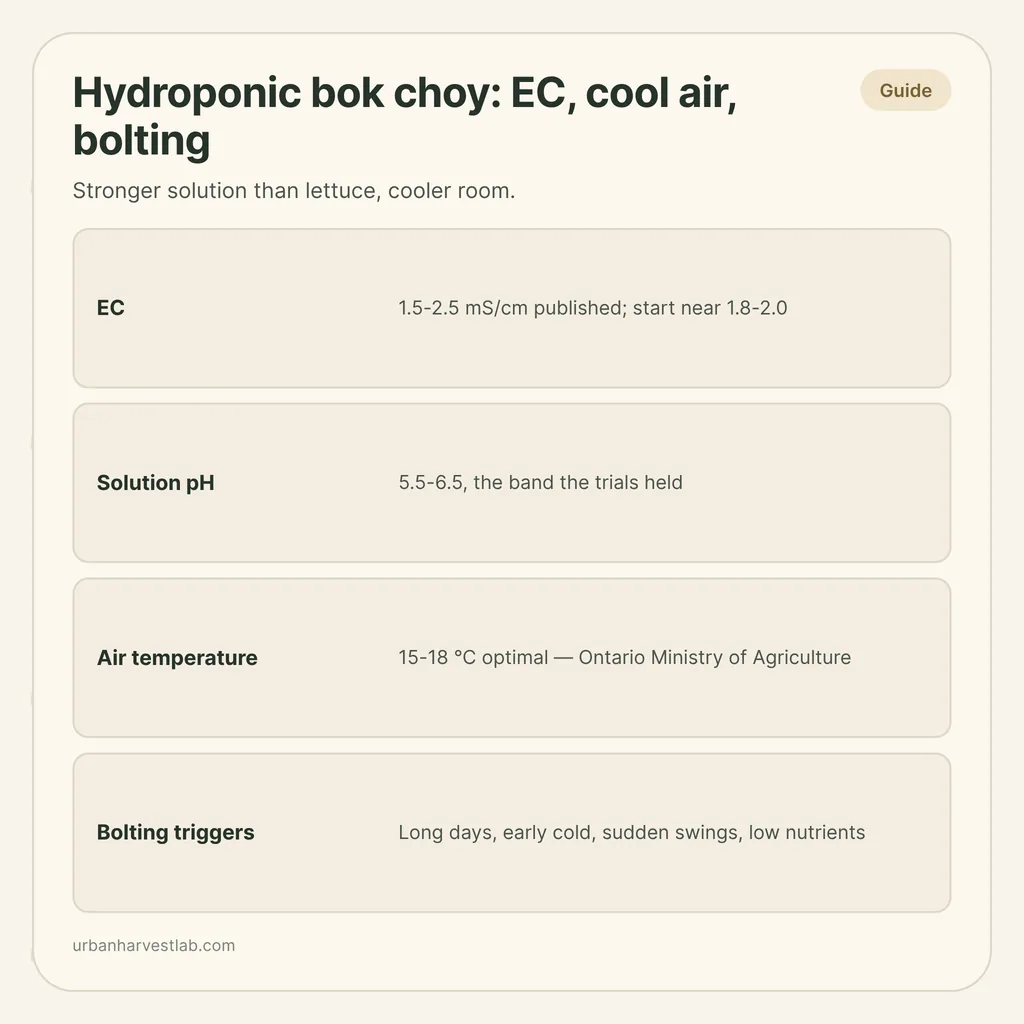
Published conditions for hydroponic bok choy (pak choi)
| Source | EC (mS/cm) | pH | What it covers |
|---|---|---|---|
| Oklahoma State University Extension | 1.5-2.0 | 7 in the crop table; solution 5-6 in general text | Crop table covering 27 crops |
| Ding et al., PLoS ONE (Shanghai) | 1.8 or 2.4 best of eight levels | 5.8 | Greenhouse trial, 20 days of treatment |
| Thaenkaew et al. (Bangkok) | 1.5-2.5 | 5.5-6.5 | Laboratory trial, 35 days, DFT vs NFT vs drip |
| Revista Caatinga trial (Brazil) | Tested 1.0 to 5.0; NFT peak yield near 3.1 | 5.5-6.5 | Greenhouse trial, 35 days, NFT vs substrate |
Hydroponic bok choy grows in a stronger solution than lettuce: published EC runs from 1.5 to 2.5 mS/cm at a solution pH of about 5.5 to 6.5, in cool air. Oklahoma State University Extension lists pak choi (the same plant under its British name) at EC 1.5-2.0, and two journal trials, one from Shanghai and one from Bangkok, bracket it. If you are growing it in a pot of soil instead, growing bok choy in containers covers pot width, spacing and sowing windows.
How strong to make the solution
Start with the units: EC in mS/cm, dS/m and mmho/cm are the same number. If your meter reads ppm, the factor depends on its scale, which the EC to ppm converter sorts out.
Four sources give figures:
- Oklahoma State University Extension’s crop table lists pak choi at EC 1.5-2.0.
- Ding and colleagues, writing in PLoS ONE, grew pak choi at eight EC levels from deionized water up to 9.6 and concluded that “the optimal EC treatment would be EC1.8 or EC2.4.” Too low and too high both suppressed growth and quality.
- Thaenkaew and colleagues at the Pathumwan Institute of Technology in Bangkok held the solution at EC 1.5-2.5 mS/cm for 35 days across three systems.
- A trial at the Federal Rural University of the Semi-Arid Region (UFERSA) in Brazil, published in Revista Caatinga, tested 1.0, 2.0, 3.0, 4.0 and 5.0 dS/m. In the NFT channels, shoot weight peaked near EC 3.1, at 278 g per plant against 92 g at EC 1.0.
That last result looks like a case for going stronger. Read the rest of it first. The UFERSA paper reports that raising EC “did not affect the visual quality of pak choi, but reduced the physicochemical quality of its leaves.” In the Shanghai trial of Ding and colleagues, leaf nitrate climbed from 0.686 mg per gram at EC 1.8 to 1.18 at EC 4.8. So the sources disagree on where size peaks, and agree that pushing EC up costs something in the leaf.
A working starting point is 1.8 to 2.0 mS/cm, which is the stretch where Oklahoma State, the Shanghai result and the Thai range overlap. Check your tap water before mixing, because a high starting EC eats into that budget; hard water in hydroponics explains how much. To compare this range with lettuce, spinach and the other crops, see the hydroponic EC chart by crop.
Two details change how far you can lean on these numbers. The Shanghai plants sat in rockwool blocks watered three times a week with fresh solution rather than in a recirculating tank, and Ding and colleagues treated them for 20 days. The UFERSA paper found NFT plants “had a lower nutritional requirement to reach maximum growth” than plants in a substrate tray. Your system moves the best EC.
pH
The Thai and Brazilian trials held pH between 5.5 and 6.5, and the Shanghai team set 5.8. Oklahoma State’s crop table prints pH 7 against pak choi, but the same fact sheet says solutions for soilless culture should sit between pH 5 and 6, usually 5.5, so that the root environment stays between 6 and 6.5. Aim for the 5.5-6.5 band the trials used. If yours drifts upward, why pH keeps rising in hydroponics walks through the usual causes.
Temperature, day length and bolting
Ontario’s Ministry of Agriculture gives an optimal temperature range of 15-18 °C for bok choy, and calls it frost tolerant. That is a field-production figure for air. The Thai laboratory trial (Thaenkaew and colleagues) ran its air at 20-25 °C, relative humidity 60-70%, and 200-250 µmol per square metre per second of light on a 16-hour day, and harvested a crop in 35 days. So pak choi grows across a wide band; the 15-18 °C figure describes where it does best outdoors, not a limit.
For the reservoir, the sources checked do not give a bok choy-specific solution temperature. Oklahoma State gives 72-75 °F (22-24 °C) as the optimal water temperature for hydroponics in general, and Cornell’s lettuce handbook caps lettuce solution at 25 °C (77 °F). Treat those as general guides to aim near, and measure rather than assume.
Ontario lists the bolting triggers for bok choy:
- Low temperatures early in the growing season.
- Extreme changes in temperature.
- Low nutrient levels.
- Long-day photoperiods: “bok choy is also sensitive to daylength and will bolt if exposed to long-day photoperiods.”
Indoors, two of these are yours to set. A swinging room, such as a grow tent that heats while the lights are on and chills when they are off, is the temperature swing Ontario describes. And a light schedule is a day length. The Thai trial ran a 16-hour day, and Ontario gives no day-length threshold. If a plant starts a flower stalk, shorten the lit period and flatten the temperature swing before you touch the nutrients. A starved reservoir is also on the list, so do not let EC sag unnoticed. For bolting in another hydroponic leafy crop, with a different set of triggers, see the lettuce bolting guide.
Which system
In the Thai trial by Thaenkaew and colleagues, 35-day pak choi fresh weight averaged 64.8 g per plant under drip irrigation, 44.5 g in NFT and 26.9 g in deep flow technique (DFT), the system closest to a home deep-water bucket. In the Brazilian trial, a substrate tray produced more than NFT at high EC (397.6 g per plant at EC 5.0, against 278.3 g for NFT at its best), but NFT plants reached their best growth at a lower EC. These are single trials in greenhouses and labs, not rankings you can carry to a kitchen counter. In the Thai one, though, the deep-flow tanks came last, which is a reason to watch root health closely if you grow bok choy in a deep-water bucket. For how the common home systems differ, read NFT vs DWC and the beginner system comparison.
Harvest timing and what to expect
The Thai trial and the Brazilian trial both harvested whole plants 35 days after transplanting. In the Shanghai work, plants had 20 days on the EC treatments after seedling stage. Those are research timelines, and plant size differed several-fold between the two: 26.9 to 64.8 g per plant in the Thai trial, 91.7 to 397.6 g in the Brazilian one. Do not plan a yield from either.
For baby leaves, cut early and let the leaf size decide; none of the trials reviewed here measured a baby-leaf harvest, so there is no hydroponic timing to quote. Soil-grown cut-and-come-again timings and spacing from the Royal Horticultural Society are in the container guide. Keep a log of dates and EC alongside your harvest weights, so that your own second crop tells you more than any trial. A weekly grow log is built for that.
Sources
- Oklahoma State University Extension, Electrical Conductivity and pH Guide for Hydroponics (HLA-6722)
- Ding et al. (2018), Electrical conductivity of nutrient solution influenced photosynthesis, quality, and antioxidant enzyme activity of pakchoi in a hydroponic system, PLoS ONE
- Thaenkaew et al. (2026), Effects of hydroponic cultivation systems on growth performance and yield of pakchoi, ASEAN Journal of Scientific and Technological Reports
- Production and quality of pak choi grown in different hydroponic systems and electrical conductivities, Revista Caatinga (Universidade Federal Rural do Semi-Árido)
- Ontario Ministry of Agriculture (OMAFRA), Bok choy
- Cornell University CEA Program, Hydroponic Lettuce Handbook
- Royal Horticultural Society, How to grow pak choi
Hydroponic greens and systems
Reference charts, system comparisons and the lettuce bolting guide to read alongside bok choy.
Common questions
What EC does hydroponic bok choy need?
Oklahoma State University Extension lists pak choi at EC 1.5-2.0 mS/cm. A peer-reviewed Shanghai trial found EC 1.8 or 2.4 gave the best growth and quality, and a Pathumwan Institute of Technology trial held 1.5-2.5. Starting near 1.8-2.0 sits inside all three. Leaf nitrate rose steadily with EC in the Shanghai work, so there is no gain in going higher.
What pH should I use for hydroponic bok choy?
The Thai and Brazilian trials held the solution at pH 5.5-6.5, and the Shanghai trial set 5.8. Oklahoma State lists pH 7 for pak choi in its crop table but states that solution pH should generally sit between 5 and 6, usually 5.5, so the root environment lands between 6 and 6.5.
How long does hydroponic bok choy take to harvest?
Two trials, one in Thailand and one in Brazil, harvested whole plants 35 days after transplanting. Plant size at that point varied enormously between the trials, so treat 35 days as a trial timeline rather than a promise. No hydroponic trial reviewed here measured a baby-leaf harvest, so there is no sourced baby-leaf timing for hydroponics; the container guide covers soil-grown cut-and-come-again.
Why does my hydroponic bok choy bolt?
The Ontario Ministry of Agriculture lists low temperatures early in the season, extreme temperature changes, low nutrient levels and long-day photoperiods as bolting triggers. Indoors under lights, day length and a swinging room temperature are the two you control directly.
Related guides
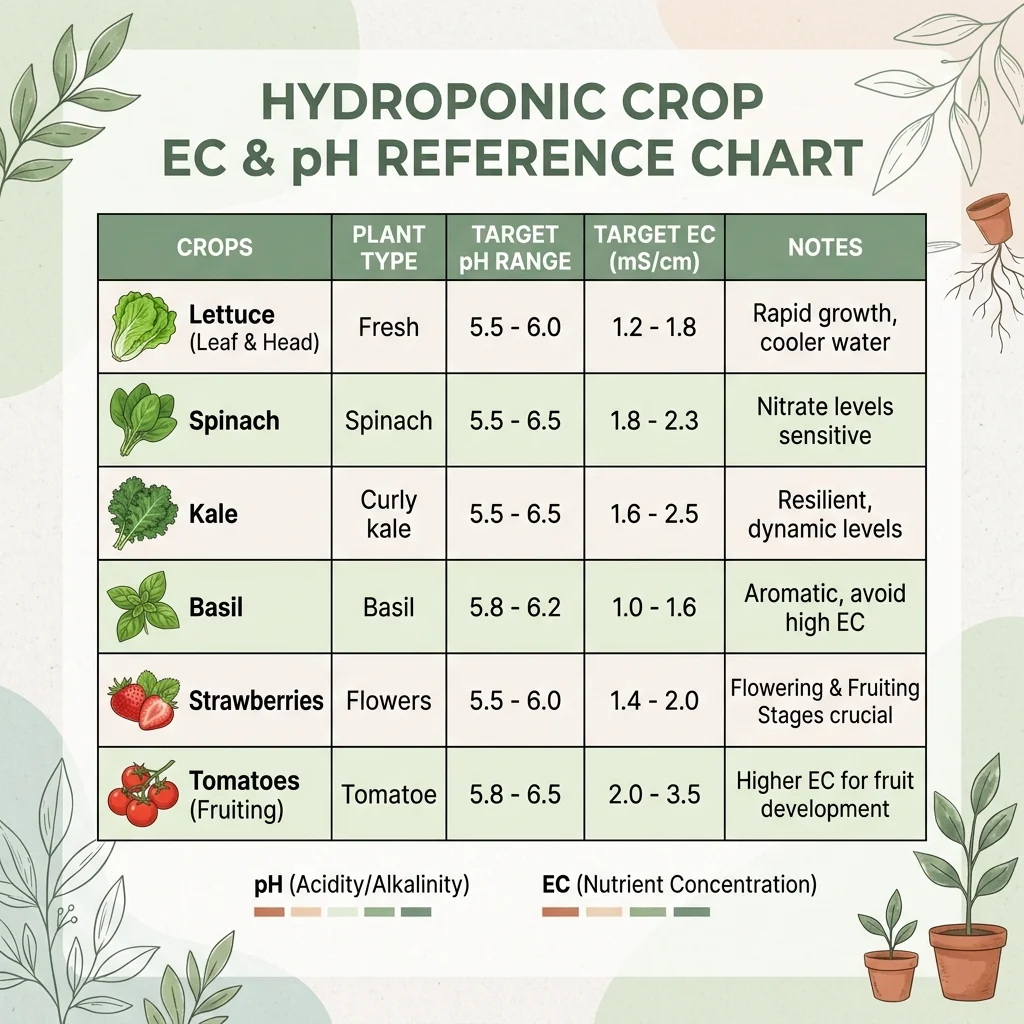
Hydroponic EC chart by crop (not just lettuce)
One reference chart for the EC and pH targets of common hydroponic crops, from leafy greens and herbs to fruiting plants, plus how to use the numbers safely.
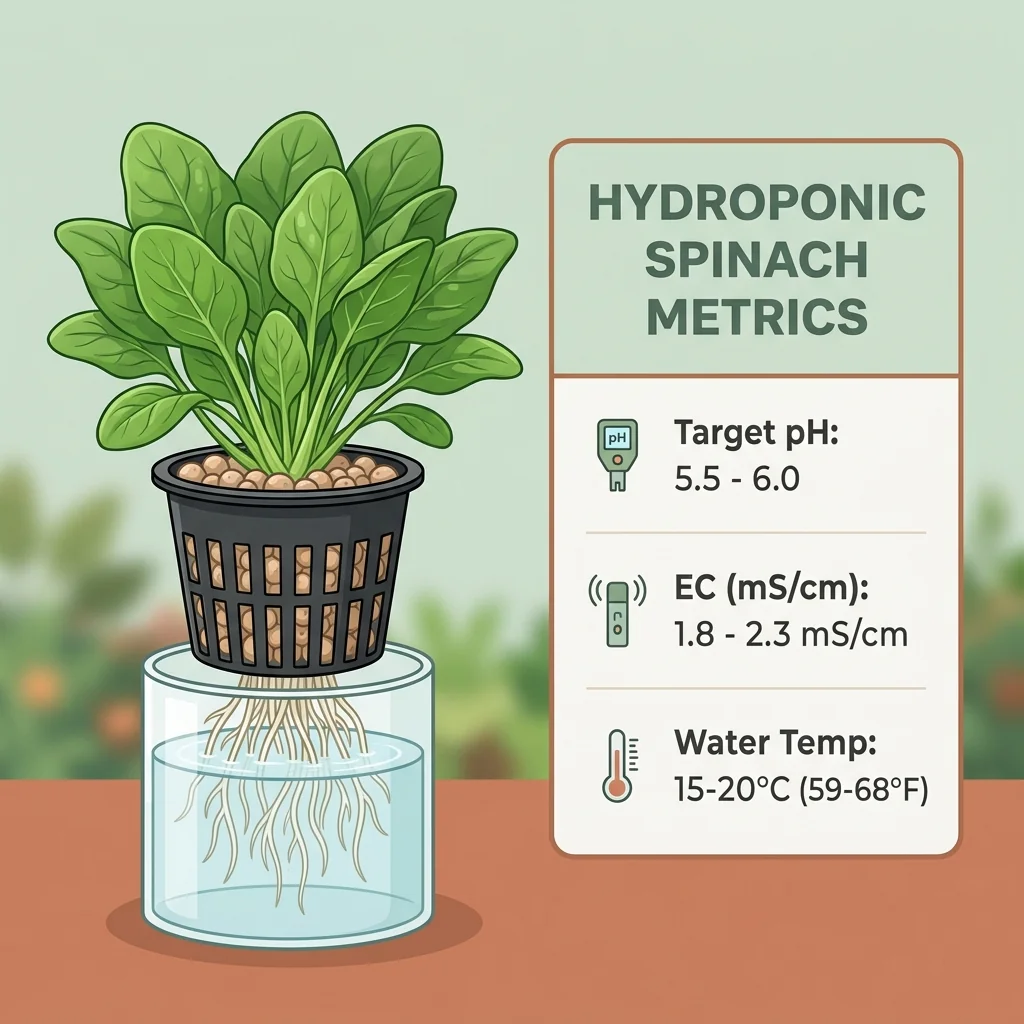
Hydroponic spinach: EC, pH, and temperature guide
Spinach is a cool-season hydroponic crop that bolts in heat. Get the EC, pH, and especially the temperature right and it stays leafy and productive.

How to grow bok choy in containers: pot size, timing, and stopping it bolting
Bok choy suits a balcony pot better than most brassicas, but only in cool weather. Here is the pot, the spacing, the sowing window and the bolting fixes.