
What is documented about rice water, and how a labelled fertilizer is read
| Input | What is documented | Dosing |
|---|---|---|
| Unfermented rice rinse water | Universiti Putra Malaysia: about 160 mg/kg N, 91 mg/kg P, 118 mg/kg K | No tested pot rate; composition varies with rice and rinsing |
| Rice water fermented three days | Same trial: about 220 mg/kg N, 210 mg/kg P, 136 mg/kg K, pH 4.5, dense bacterial growth | No tested pot rate |
| Daily 5 mm rice water, 90 days | Same trial, Table 3: 8.24 g total N per plot, against 7.83 g for the full NPK rate | Field plot watered daily; no pot rate |
| Labelled fertilizer | Clemson Extension: the three numbers are percent N, P₂O₅ and K₂O by weight | Label directions |
Rice water carries real nitrogen, phosphorus and potassium, but the strength of any batch you make at home is unknown and variable, and the Malaysian trial that got fertilizer-like results did it by watering a field plot every day, which a pot should not get. One Universiti Putra Malaysia analysis measured about 160 mg/kg nitrogen (0.016 percent) in unfermented rinse water. In a pot, the wet residue it leaves on the soil is the part most likely to cause trouble.
If your herbs need feeding, a label-first fertilizer guide gets you a known dose. For setting up herbs on a small footprint in general, see the small-space herb gardening hub.
What is actually in rice water
Washing rice pulls some water-soluble minerals off the grain. A paper from Universiti Putra Malaysia, citing earlier work, puts the loss at 7 to 70 percent of the grain’s water-soluble nutrients, a range wide enough that any single batch is a guess.
The Universiti Putra Malaysia team analysed their own rinse water. Unfermented, it held about 160 mg/kg of total nitrogen, 91 mg/kg phosphorus and 118 mg/kg potassium. After three days of fermentation those figures became about 220, 210 and 136 mg/kg. Fermenting also dropped the pH from 6.5 to 4.5 and raised the electrical conductivity from about 286 to 551 µS/cm. The bacterial count went from about 100 to about 200 million colony-forming units per millilitre. That is a culture, not a clean liquid.
Clemson Extension explains that the three numbers on a fertilizer label are percentages by weight, so an 18-4-10 contains 18 percent nitrogen, and the label tells you how much to use. 160 mg/kg is 0.016 percent. Rice water has no label, and the next batch will come out differently. A low concentration does not settle the question, though: what a plant receives depends on how much liquid goes on and how often, and that is where the field trial below becomes interesting.
The field trial everyone cites, and its limits
The most detailed open-field test grew choy sum, a leafy brassica, in a field plot in Malaysia over three consecutive 30-day cycles. The authors describe it as a follow-up to their own earlier rain-shelter trials, which also favoured rice water; none of these tested a potted herb in commercial potting mix. Plots received tap water, full-rate 15-15-15 NPK, three-day fermented rice water, or half the NPK plus rice water. The rice water went on daily at 5 mm.
The result is real. Rice water plots grew about as well as the full NPK plots, and half NPK plus rice water produced the best results in plant growth, nutrient uptake and soil nutrient levels. The paper’s Table 3 shows why: over the 90 days, the daily 5 mm of rice water added 8.24 g of total nitrogen per plot, against 7.83 g for the full NPK rate (Nabayi et al. 2023, Universiti Putra Malaysia). It matched the fertilizer through volume and frequency, not concentration. The same trial also found the rice water soils ended up the most acidic of the four, at pH 4.7, in a soil that started at pH 4.97.
One caution about the numbers themselves: this is a single field study, and its Table 2 concentrations and Table 3 totals are hard to reconcile with each other, so read both as that group’s figures, not as a rule for rice water in general.
Three things stop that result from transferring to a balcony pot:
- The setting. It was an acidic sandy clay (pH 4.97) in an open field with 158 to 492 mm of monthly rain, not a container of potting mix.
- The volume. Getting the same dose in a pot would mean wetting it daily, which is exactly what Iowa State and Wisconsin extension warn against for fungus gnats, as the next section shows.
- The pH drift. The fermented water measured pH 4.53 and the trial soil ended at pH 4.7. If you are watching acidity in a pot, container soil pH explains what moves it and how fast.
The authors themselves note that surface mulching matters to keep the nutrients from leaching away, which hints at how little of this stays put when it rains or you water again.
The risk is moisture and residue, not nutrients
The realistic downside in a pot is not toxicity. It is a damp, starchy film on top of the mix.
Iowa State University Extension states that fungus gnat larvae feed on fungi and organic matter, usually in soil, and that houseplants are by far the most common source of fungus gnats indoors. University of Wisconsin Extension adds that larvae typically feed on decaying organic matter and fungi, and that keeping the soil surface dry removes the egg-laying sites. Rinse water that stays on the surface, especially fermented water with its heavy bacterial load, adds exactly the wet organic residue those larvae and surface molds use. If you already see gnats, why fungus gnats keep coming back walks through the fix, and if the surface has grown a fuzzy film, white mold on plant soil covers what it means.
Frequent feeding has another cost. Utah State Extension notes that many organic materials contain salts that burn plants when over-applied, and the fermented water’s higher conductivity (551 against 286 µS/cm) points the same direction. Salt buildup in herb pots explains how that shows up and how to clear it.
If you still want to use it
Treat rice water as a way to reuse water. Let the rinse water settle, use it fresh rather than fermented, water it into the soil rather than over the surface, and then let the top of the mix dry before the next watering. Cold, plain rinse water from uncooked rice is the only version the trial actually measured; nobody in this trial analysed water from boiled rice, so its content is unknown.
If you use it often, treat it as a light feed of unknown strength and do not stack it on a full-strength fertilizer; signs of overfertilizing herbs shows what too much looks like. Before adding any home remedy, check whether the plant needs feeding at all with whether potted herbs need fertilizer.
Rice water sits next to banana peel water and coffee grounds in the same family: a real ingredient with a real nutrient in it, delivered at a strength nobody has measured for pots. Aquarium water is the closest cousin among reused household liquids.
Sources
- Nabayi et al. 2023, Heliyon — Combined benefits of fermented washed rice water and NPK mineral fertilizer on plant growth and soil fertility (Universiti Putra Malaysia)
- Clemson Cooperative Extension, HGIC — Reading a Fertilizer Label
- Utah State University Extension — Selecting and Using Organic Fertilizers
- Iowa State University Extension — Fungus Gnat
- University of Wisconsin-Madison Extension — Fungus gnats on houseplants
The other kitchen-scrap feeding habits
Rice water belongs to a family of home remedies that extension sources test and correct the same way.
Common questions
Is rice water good for plants?
It contains real nutrients, but the strength of any batch you make at home is unknown and variable. A Universiti Putra Malaysia analysis measured about 160 mg/kg nitrogen in unfermented rice water, and a field trial there got fertilizer-like results by watering daily. The Malaysian trial gives no pot rate, so treat it as a light feed of unknown strength at most.
Should you ferment rice water before using it?
Fermenting for three days raised the measured phosphorus from about 91 to about 210 mg/kg and nitrogen from about 160 to about 220 mg/kg, but it also dropped the pH from 6.5 to 4.5 and produced a dense bacterial culture. The paper reports no pot test, so the added acidity is a risk to weigh, not a measured benefit.
Can rice water cause mold or gnats?
Iowa State and Wisconsin extension both describe fungus gnat larvae feeding on fungi and decaying organic matter in moist soil. Starchy water that keeps the surface wet and leaves residue creates that habitat, so the risk comes from the moisture and residue, not from the nutrients.
How often can you water plants with rice water?
Neither Iowa State nor Wisconsin extension, nor the Malaysian trial, gives a pot rate. That trial watered a field plot daily, which is not a pattern to copy in a container, where frequent wetting is the usual route to gnats and root problems.
Related guides

Aquarium water for plants: what it feeds and when to skip it
Old water from a freshwater tank is a mild, incomplete feed. What it holds, which tanks to rule out, and how to use it on a pot without adding to salt buildup.
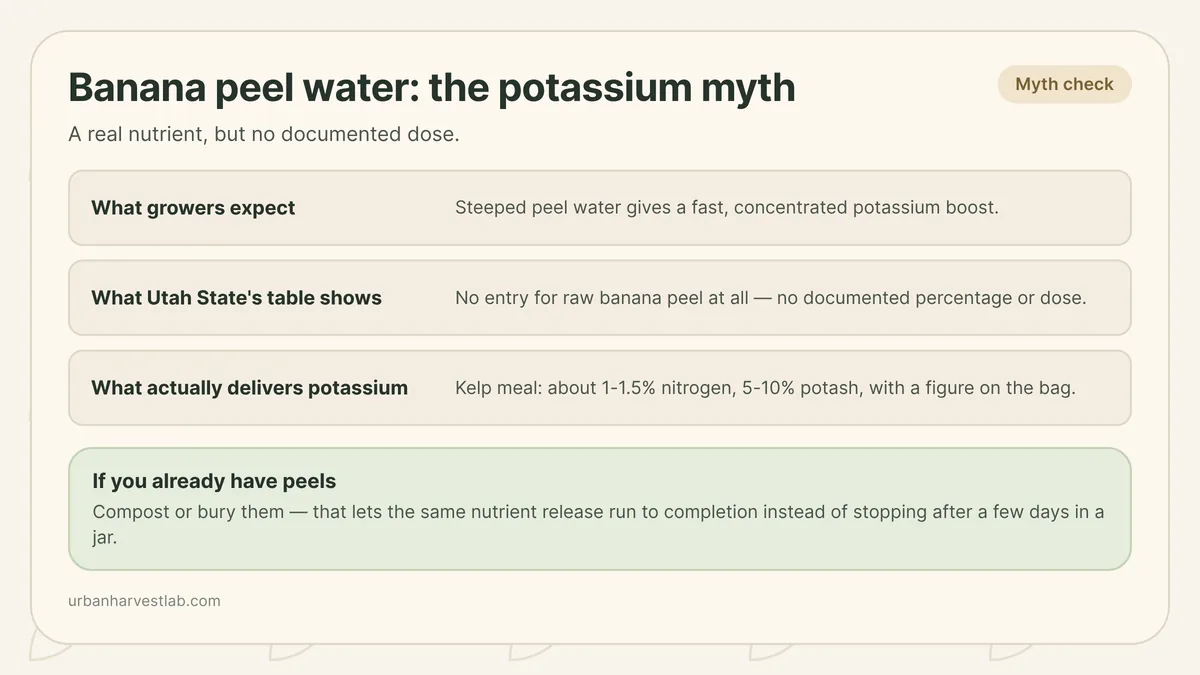
The banana peel water myth: what it actually feeds your plants
Soaking banana peels in water is a popular DIY feed, but Utah State's organic-fertilizer table has no entry for it, and the mechanism explains why the soak barely helps.
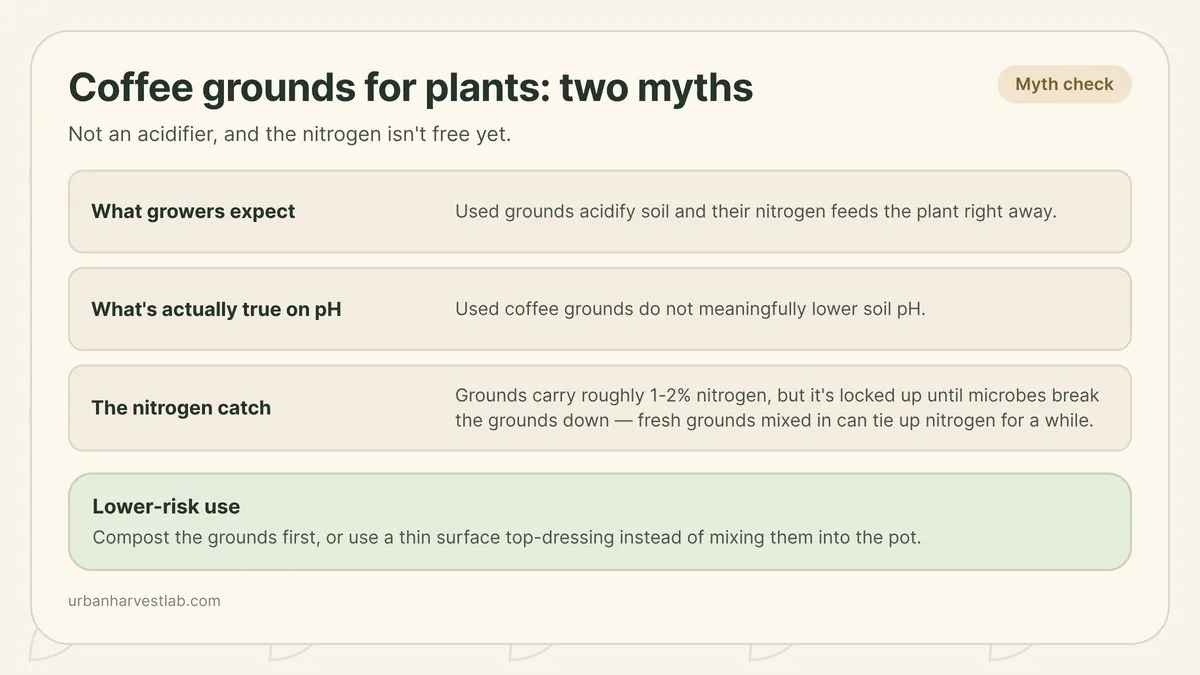
Coffee grounds for plants: the acidity myth and the nitrogen catch
Used coffee grounds do not meaningfully lower soil pH, and the nitrogen inside them stays locked up until soil microbes finish decomposing the grounds.