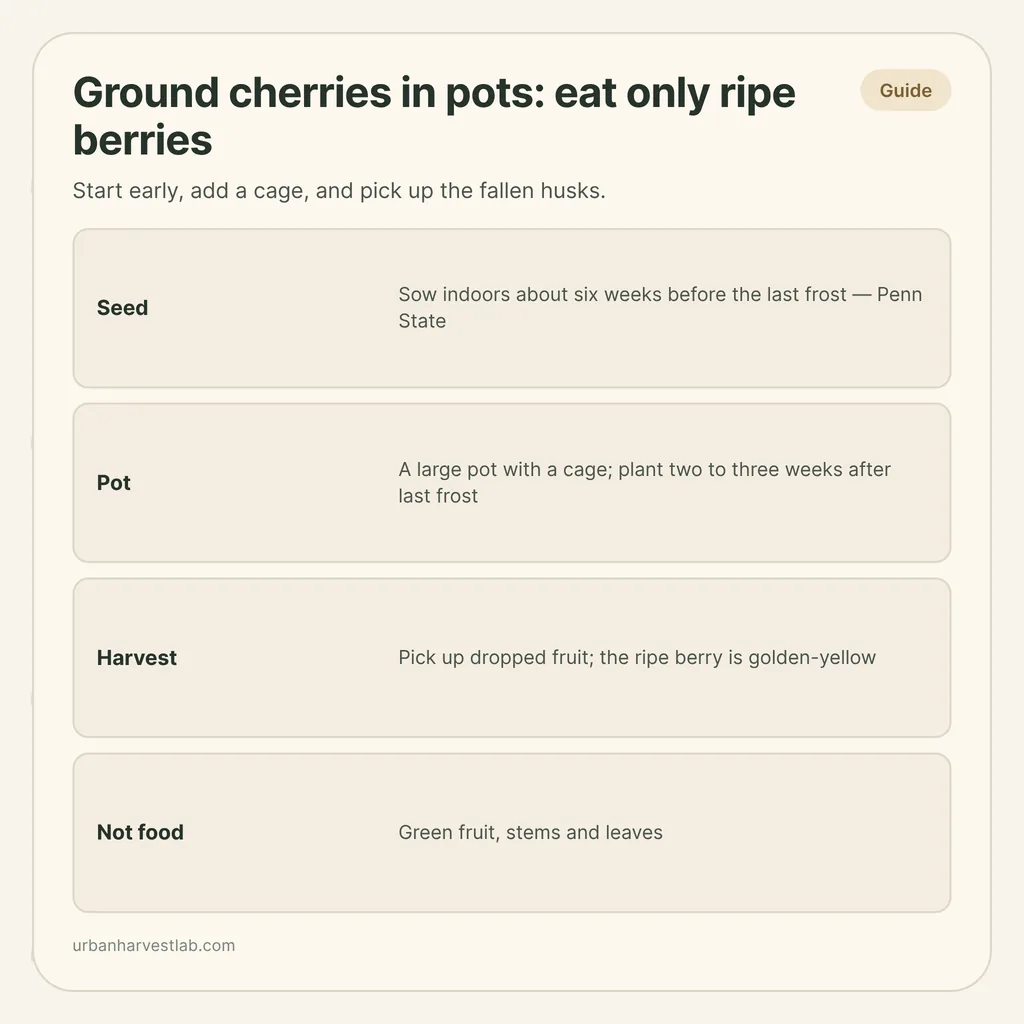
Which parts of a ground cherry plant are safe, by source
| Plant part | What the sources say | Source |
|---|---|---|
| Ripe golden-yellow berry | Eaten fresh, or made into jams, salsa and pies | Penn State Extension |
| Ripe fruit, toxicity | Not as toxic as unripe fruit | Ohio State University |
| Unripe fruit | Contains toxins; poisonous | Penn State Extension; Ohio State University |
| Stems and leaves | Contain toxins | Penn State Extension |
Start ground cherry seed indoors about six weeks before your last frost, plant out two to three weeks after it into a large pot with a cage, and collect the husks as they fall. Eat only the ripe golden-yellow berries. The green fruit, the stems and the leaves are not food.
Ground cherries are first cousins of the tomato and the tomatillo, and they grow much the same way. The difference is the habit. Penn State Extension says most plants are 1 to 3 feet tall but sprawl, and that the berry ripens inside its papery husk, which then falls to the ground. A pot on a balcony changes how you harvest, not whether you can.
Starting seed
The timing below comes from Penn State Extension, which describes the whole sequence. Work out your own dates with your frost dates and the seed starting calculator.
- Sow indoors about six weeks before the last frost. Penn State says the seed can take up to three weeks to germinate, so do not give up early.
- Give bottom warmth. Penn State says that, like peppers, ground cherries prefer it, and suggests a heat mat. A thermostat-controlled heat mat keeps the tray steady.
- Treat seedlings like tomatoes or peppers. After sprouting, Penn State advises bright light and a temperature of about 70 °F.
Nothing about this is hurried. Penn State’s own warning is that ground cherries, like other nightshades, do poorly in cool soil, and that you should not rush planting outdoors.
Moving them to the pot
Harden the seedlings off first; the hardening-off plan covers the 7-to-14-day routine. Then plant two to three weeks after the last frost, once the soil has warmed.
One detail differs from tomatoes. Penn State says ground cherry stems do not root well at the nodes, so keep the base of the plant level with the soil surface, as you would with a pepper or eggplant. Do not bury the stem the way you would a leggy tomato.
On pot size, Penn State says only “large containers”. For the volume question, the tomato pot size guide sets out what extension sources give for a full-size fruiting nightshade, and a sprawling ground cherry is a reasonable thing to size the same way. Use a free-draining potting mix and a pot with holes.
Place it in the sunniest spot you have; the full-sun vegetable list covers what that means in practice.
Water, space and support
Penn State asks for a deep and regular supply of water and adds that rain rarely supplies enough. In a pot that means checking the mix by finger rather than by calendar.
The sprawl is the real design problem. Penn State says ground cherries are often grown in trellises or tomato cages to save space. A cage inside the pot keeps stems from spilling over the railing and keeps the fruit-bearing branches up where you can see them. If you cannot fix anything to a railing, see trellising without drilling.
Penn State also suggests a mulch under the plants to make fallen fruit easy to see and harvest. On a balcony, a layer of straw or a clean tray under the pot does the same job.
Flowers and fruit set
Penn State says the creamy yellow flowers with purple centers are commonly buzz-pollinated by bumble bees, and that ground cherries are indeterminate: the plant keeps growing and flowering throughout the season. Flowering and fruit production decline as autumn air cools.
That points to a long, steady harvest rather than one flush. If you want bees visiting, the pollinator-friendly balcony guide has plants to pair with it. Tomatillos are the same genus; the tomatillo guide covers how they set fruit if you are growing both.
Harvest: pick up what falls
Penn State says fruit usually ripens ten to eleven weeks after transplanting outdoors, from late summer through autumn. The berry ripens inside its husk; once it is ready, the beige to tan papery husk falls. The instruction is blunt: pick up all the dropped fruits.
On a balcony that is easy to manage. Check the pot’s surface and the tray beneath it often, collect the husks, and open one to look. The ripe berry is golden-yellow. Penn State says to eat these fresh out of their husks, and that they also make jams, preserves, salsa and pies, or can be dried like raisins. For crops in general, when container vegetables are ripe helps you read the signs.
Storage figures, all from Penn State:
- In their husks in a cool area, up to three months.
- In the refrigerator, two to three weeks.
- Frozen on a baking sheet, then bagged, six months.
What is safe to eat
This is the part to take seriously. Penn State Extension says that, like other nightshade plants, the unripe fruits of ground cherries, as well as their stems and leaves, contain toxins. Ohio State University’s weed guide is stronger: it says the leaves and unripe fruits of groundcherries are poisonous and that ingesting them can even cause death in humans, while ripe fruits are not as toxic. UC IPM takes a more cautious line, noting there are reports that unripe fruit and leaves of some species may be toxic, but that the toxicity of any Physalis species has not been confirmed experimentally.
The sources differ in strength, but they point the same way. Eat ripe golden-yellow berries only. Do not taste green fruit, and keep the plant out of reach of small children. If a dropped husk is still green or the berry inside is pale, do not eat it.
Self-seeding and pests
Penn State calls ground cherries notorious self-seeders, and recommends growing them in containers on a solid surface to stop them seeding into garden beds. A pot on a balcony floor suits that advice. Clear fallen husks you do not eat, or volunteers will turn up in neighbouring pots.
Penn State says pests of other nightshades will be pests of ground cherries, and names tomato and tobacco hornworms, cutworms and Colorado potato beetles. With a few plants, its advice is to handpick them and drop them into soapy water.
Sources
Growing relatives of the tomato in pots
Pot size, seed timing and support for warm-season nightshades on a balcony.
Common questions
Can you grow ground cherries in pots?
Yes. Penn State Extension describes planting them in large containers about two to three weeks after the last frost, and even recommends containers on a solid surface to stop them self-seeding into garden beds. The plants are 1 to 3 feet tall but sprawl, so give them a big pot and a cage.
Are ground cherries poisonous?
Parts of the plant are. Penn State Extension says the unripe fruits, stems and leaves contain toxins, and Ohio State University says the leaves and unripe fruits of groundcherries are poisonous and that ingesting them can even cause death in humans. Ripe fruit is not as toxic, according to Ohio State. UC IPM adds that toxicity of any Physalis species has not been confirmed experimentally, so treat unripe parts with caution anyway.
How do I know when a ground cherry is ripe?
Penn State Extension says the berry ripens inside its husk and the beige to tan papery husk then falls to the ground. The ripe berry is golden-yellow. Pick up the dropped husks and peel them open just before eating.
How long do ground cherries take to fruit?
Penn State Extension says fruit usually ripens ten to eleven weeks after transplanting outdoors, with ripe fruit from late summer through autumn. Seed started indoors can take up to three weeks to germinate, so count that into your timeline.
Related guides
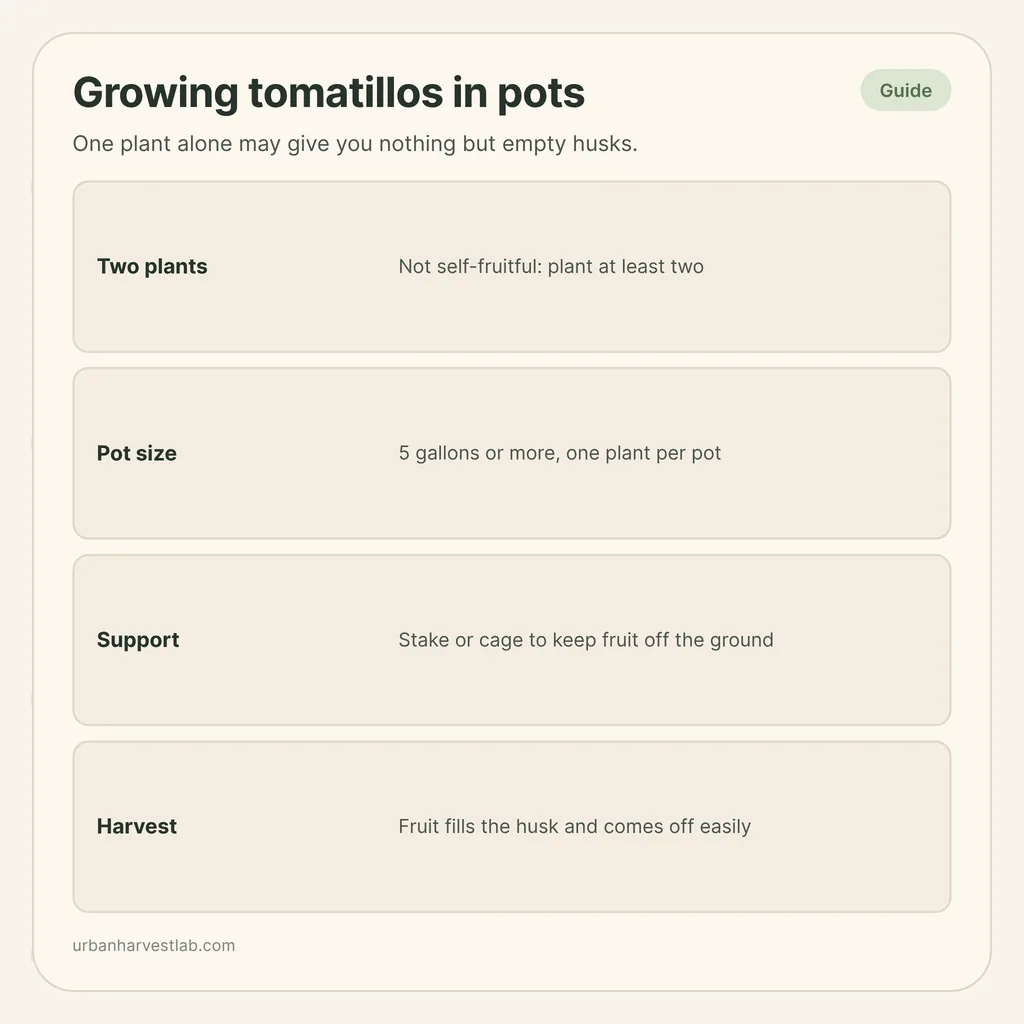
How to grow tomatillos in pots: two plants, support and when to pick
A single tomatillo in a pot flowers happily and gives you papery husks with nothing inside. Grow two, give each a cage, and pick when the fruit fills its husk.
When container vegetables are ripe, crop by crop
A tomato tells you it's ready with color and give. A zucchini tells you with size and how easily it lets go. The signal is different for every crop, and waiting costs more when the plant only has a pot's worth of reserve behind it.
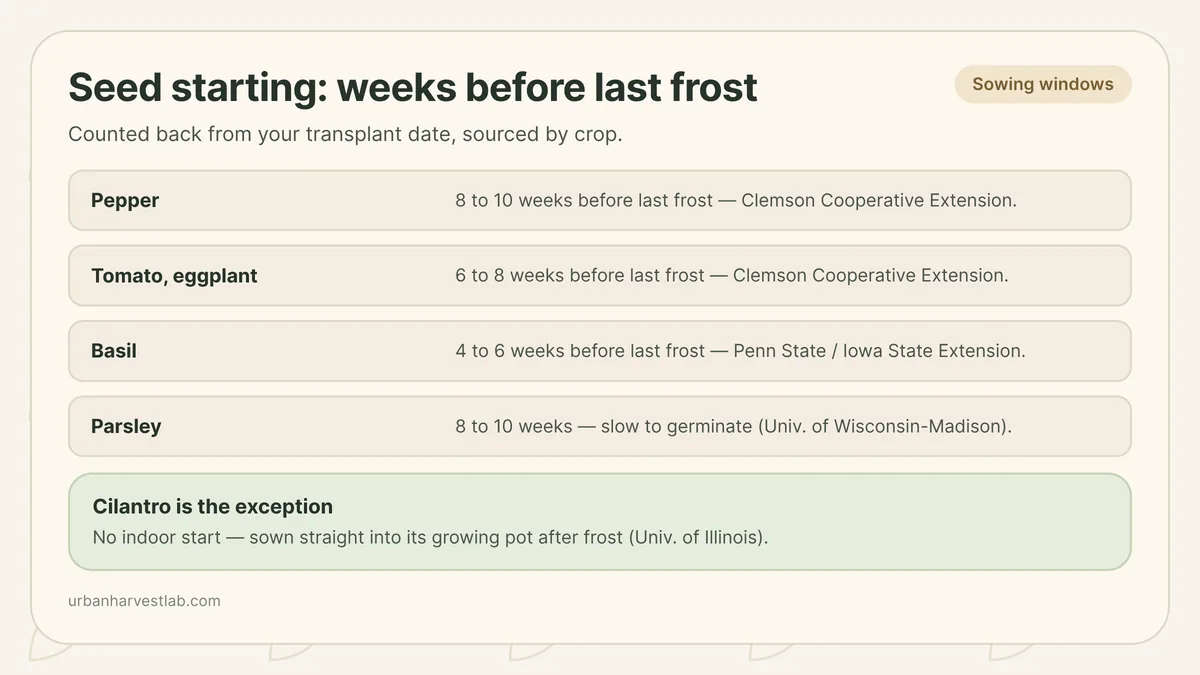
Seed starting calculator: sowing dates from your last frost date
A last frost date is only useful once you count backward from it. This works out that count crop by crop, instead of applying one week figure to everything in the seed drawer.