
Pea types and when to pick each one
| Type | What you eat | Pick when |
|---|---|---|
| Shelling (English or garden) peas | The peas, removed from a firm pod | The pods look round and swollen (UConn Extension). Penn State Extension gives 3 to 4 inches for the pod length. |
| Snow peas | The whole flat pod | The pod is still flat with BB-sized peas visible (UConn Extension). Penn State Extension gives 2 to 3 inches. |
| Sugar snap peas | The whole plump pod | The pod has fattened, the peas are small, and it snaps when broken in two (UConn Extension). |
Peas grow well in containers if you sow them in cool weather, put the support in at the same time as the seed, and plan to be finished before summer heat. University of Wisconsin-Madison Extension gives at least 2 gallons and 4 to 6 inches of depth as the minimum for peas, University of Kentucky Extension asks for 10 inches, and most of the work after that is timing and support.
Why timing matters more than anything else
Peas are a cool-season crop, as Penn State Extension puts it. They are a good first sowing of the year because they germinate in cool mix. University of Maryland Extension describes a hardy annual that can withstand heavy frosts in spring and fall, sown once soil reaches at least 40 degrees F. UConn Extension gives a slightly higher floor: seed germinates in soil as cool as 50 degrees F, but slowly in cold, wet weather. Penn State Extension’s range is 40 to 85 degrees F, so germination is not the narrow part. Growth is.
The University of Maryland Extension says plant growth is favored by 65 to 70 degrees F, and flowering is accelerated by long, cool days. UConn Extension says most varieties reach maturity in about 60 days when temperatures sit between 55 and 70 degrees F, and that peas do not do well in higher temperatures. A pot on a sun-baked balcony is a poor place to be when a warm spell arrives, so sow early and be ready to pull the plants when pods stop coming.
Work backwards from your own last frost. The method for finding it is in first and last frost dates for a balcony, and the balcony vegetable garden calendar shows where peas sit among the other early crops.
A fall crop is possible in some climates. UConn Extension suggests re-sowing 8 to 10 weeks before the first projected frost. University of Maryland Extension reports the opposite result for Maryland, where fall-planted peas often perform poorly because seed does not germinate readily in warm soil, plants do not grow well in hot weather, and the first killing frost usually arrives before pods mature. If your late summer is hot, treat a fall sowing as an experiment in one pot, not a plan.
Choosing a container and a variety
The University of Wisconsin-Madison Extension includes peas with leaf lettuce, spinach, radishes and cilantro as the smaller container plants, needing at least 2 gallons of volume and a depth of at least 4 to 6 inches. It adds that vining plants such as peas can be grown in containers with proper supports. Wisconsin’s figure is a minimum, not a target. University of Kentucky Cooperative Extension is more generous: it lists peas with green beans, cabbage, carrots and collards as crops that grow best in containers at least 10 inches deep. Dwarf types can stay nearer the shallow end; tall climbing varieties belong at the deeper one.
Penn State Extension spaces seeds 1.5 to 3 inches apart, 1 to 2 inches deep, and says a 12-by-12-inch area can accommodate up to eight plants. UConn Extension suggests shallower sowing if the mix is cool and wet, and deeper if it is dry. For how many plants other pot sizes hold, see how many plants per container.
Variety decides how much support you need. The University of Maryland Extension describes determinate peas as bushy and under 3 feet, ready to harvest at the same time, and indeterminate peas as over 5 feet, harvested over several weeks. UConn Extension adds that dwarf or bush varieties set their crop all at once, while climbing vines are easier to harvest and bear over a longer period.
Penn State Extension lists some named varieties with their habit:
- ‘Oregon Sugar Pod II’, a snow pea with a dwarf habit and 4 to 5 inch pods.
- ‘Oregon Giant’, a snow pea with 30-inch vines that should be trellised.
- ‘Sugar Heart’, a sugar snap with 48-inch vines that Penn State calls heat tolerant.
Check the packet for the height of whatever you buy. If you only have a small railing planter, a dwarf type is the lower-effort choice. If you have a deep tub and a wall to train against, a climbing type gives more over a longer stretch.
Set the support before the seed
Penn State Extension says to place stakes in the soil about 3 inches from the seed at the time of planting, and that inserting support while the plants are actively growing may damage the roots. In a pot there is nowhere for those roots to go, so this matters more than it does in a bed. The same source notes that vertical growth increases airflow around the plants, which may help reduce disease.
A tripod of canes pushed into the mix suits a light annual vine like a pea, and the options that avoid drilling into a railing or wall are covered in how to trellis a plant without drilling a single hole. A tall vine on a light pot will act like a sail. University of Illinois Extension says square pots are the most stable, that traditional tapered pots tip over easily, and to strap or anchor tall plants in place if they become top heavy, naming balconies, rooftops and decks as places where this is a particular problem. More on wind is in windproof balcony garden.
Sun, water and feeding
University of Maryland Extension gives full sun, direct light for at least 6 hours a day, and prefers 8 to 10.
Penn State Extension gives about 1 inch of water per week where rain is not enough, applied to the soil rather than over the leaves, which may reduce disease risk. Peas in a pot dry out far faster than a bed does, so use the finger test rather than a weekly number: the University of Maryland Extension says to keep the root zone moist by watering deeply and regularly, and to water more often once pods begin to develop. How often to water container vegetables covers the test for your pot size. UConn Extension also suggests a 3 to 4 inch mulch of organic material to keep soil moist, which is a lot of depth in a small pot, so use a thin layer instead.
Go easy on nitrogen. UConn Extension says peas can fix a portion of their own nitrogen with the help of a soil bacterium, and that plants given nitrogen fertilizer have lots of foliage but less fruit. University of Maryland Extension disagrees: it calls peas a heavy user of nitrogen that fix little, and incorporates fertilizer before seeding. A middle ground: if your potting mix already contains fertilizer, skip extra nitrogen until flowering, then side dress with compost, as Penn State Extension suggests. UConn also says inoculated seed is only needed where peas have not been grown on a site before. By that rule, a pot of fresh potting mix is exactly where inoculated seed (Rhizobium leguminosarum, sold for peas) is worth using. For a feeding routine in pots generally, see fertilizer schedule for container vegetables.
Pests and disease
Penn State Extension calls peas relatively free from pests, and names cutworms, armyworms, leafhoppers, aphids, mites and pea weevils as the common ones. It names powdery mildew and damping off as the two primary diseases. Damping off is a fungus that can grow on seedlings in cold, wet soil. That makes an early sowing in a pot that stays soggy a real risk. Sow into a free-draining mix and hold off watering if the pot is still wet.
Penn State also says not to apply neem oil to peas if the temperature is above 90 degrees F. Any other product must be labeled for peas, and Penn State’s own advice on airflow and watering the soil rather than the leaves applies first.
Harvest, and what to do with the pot afterwards
Pick often. UConn Extension says pods should be picked every 2 to 3 days, and that garden peas turn starchy quickly once picked, so eat them soon. The table above gives the cue for each type. University of Maryland Extension says to remove the strings from the pod seam before cooking edible-pod types. For tomatoes, peppers and the other summer crops that might follow in the same pot, see when container vegetables are ripe.
Penn State Extension says 50 to 70 days from sowing for most peas, and recommends sowing new seed every two to four weeks for a steady supply. UConn Extension suggests every two weeks. In a pot this means a second container started while the first is still climbing, and the routine is in succession planting in containers. UConn Extension says peas do not do well in higher temperatures, so a late sowing may not have time to crop.
When the plant turns yellow and is free of pests and disease, Penn State Extension says it can be cut down at ground level, leaving the roots to keep the nitrogen they fixed for the next crop. The empty pot then suits a warm-season plant, or a fall crop of greens as in growing salad greens in containers this fall.
If what you want is the tender tips rather than pods, that is a different crop on a different clock. UConn Extension says young shoots can be eaten in salad, but harvesting them prevents fruit development. For tray-grown shoots, see the pea shoots grow log. If you only have a small balcony, best vegetables for small balconies shows what to put beside peas.
Sources
- Penn State Extension, “A Gardener’s Guide to Peas”
- UConn Home Garden Education Center, “Peas”
- University of Maryland Extension, “Growing Green Peas in a Home Garden”
- University of Wisconsin-Madison Extension, “Growing vegetables in containers”
- University of Kentucky Cooperative Extension, Daviess County, “Vegetables Grown in Containers Improves Accessibility”
- University of Illinois Extension, “Container Size”
Support, timing and next sowings
The reversible trellis options, the frost-date method and the staggered-sowing routine that a pot of peas depends on.
Common questions
How deep and how big should a container for peas be?
The University of Wisconsin-Madison Extension puts peas among the smaller container plants that need at least 2 gallons of volume and a depth of at least 4 to 6 inches, but University of Kentucky Cooperative Extension says peas grow best in containers at least 10 inches deep. The sources disagree, so give tall climbing varieties the deeper pot. Penn State Extension spaces seeds 1.5 to 3 inches apart and 1 to 2 inches deep, and says a 12-by-12-inch patch can hold up to eight plants.
When should I plant peas in pots?
As early in spring as the mix is workable. The University of Maryland Extension calls peas a hardy annual that withstands heavy frosts and sows once soil reaches at least 40 degrees F. UConn Extension says seed germinates in soil as cool as 50 degrees F, though slowly in cold, wet weather. For a fall crop UConn suggests sowing 8 to 10 weeks before the first projected frost.
Do container peas need a trellis?
Tall varieties do. The University of Maryland Extension lists indeterminate peas at over 5 feet and determinate ones at under 3 feet, and UConn Extension says climbing types are easier to harvest and bear over a longer period. Dwarf types can manage with little or no support, but a few short stakes keep the vines off the soil.
How long until I can pick peas from a pot?
Penn State Extension gives 50 to 70 days from sowing for most peas, and the University of Maryland Extension gives the same range from direct seeding. The seed packet is the best guide for a specific variety. Once pods start, UConn Extension says to pick every 2 to 3 days.
Related guides
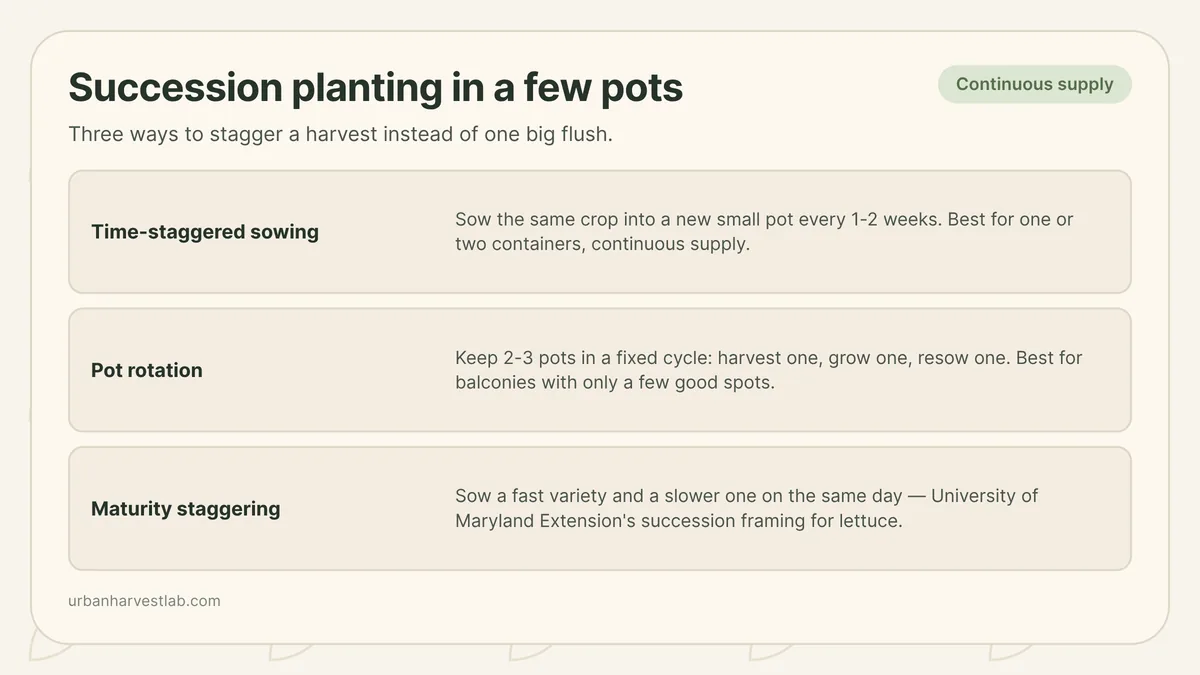
Succession planting in containers: how to stagger a harvest from a few pots
Succession planting in containers is a sowing rhythm: a few pots restarted on a schedule keep producing, where one large planting ripens together and then quits together.
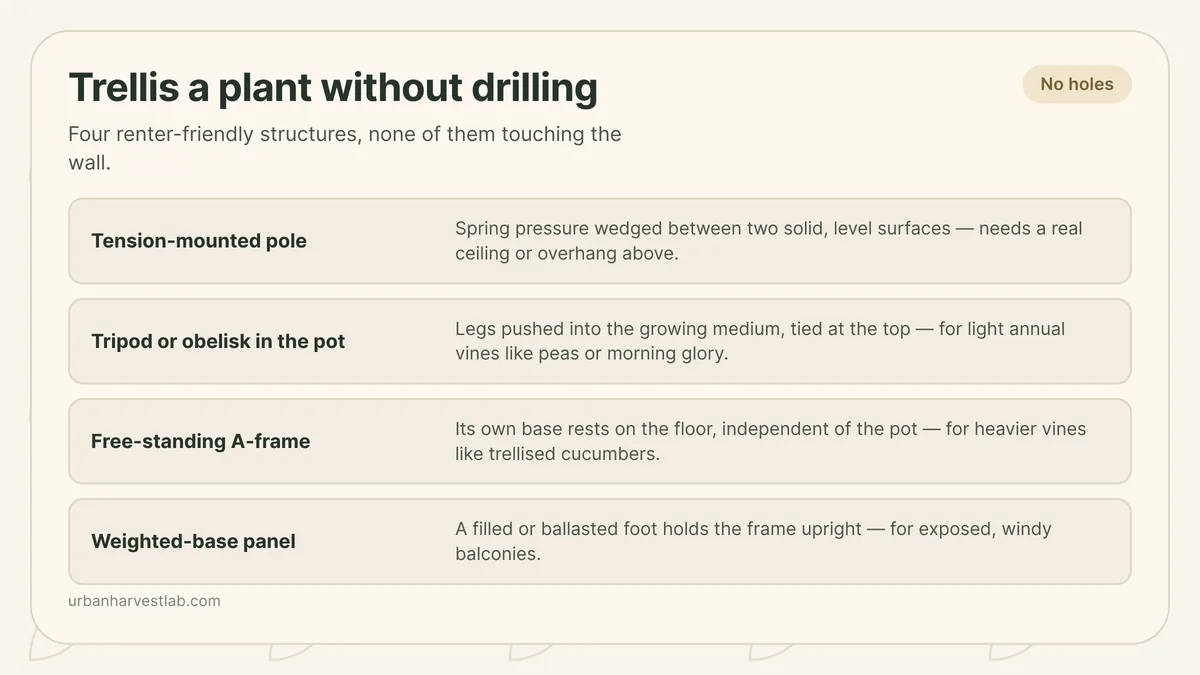
How to trellis a plant without drilling a single hole
A container has no ground to sink a post into, so a renter-friendly trellis has to get its stability from somewhere else. Four approaches do that without touching a wall, railing, or ceiling.
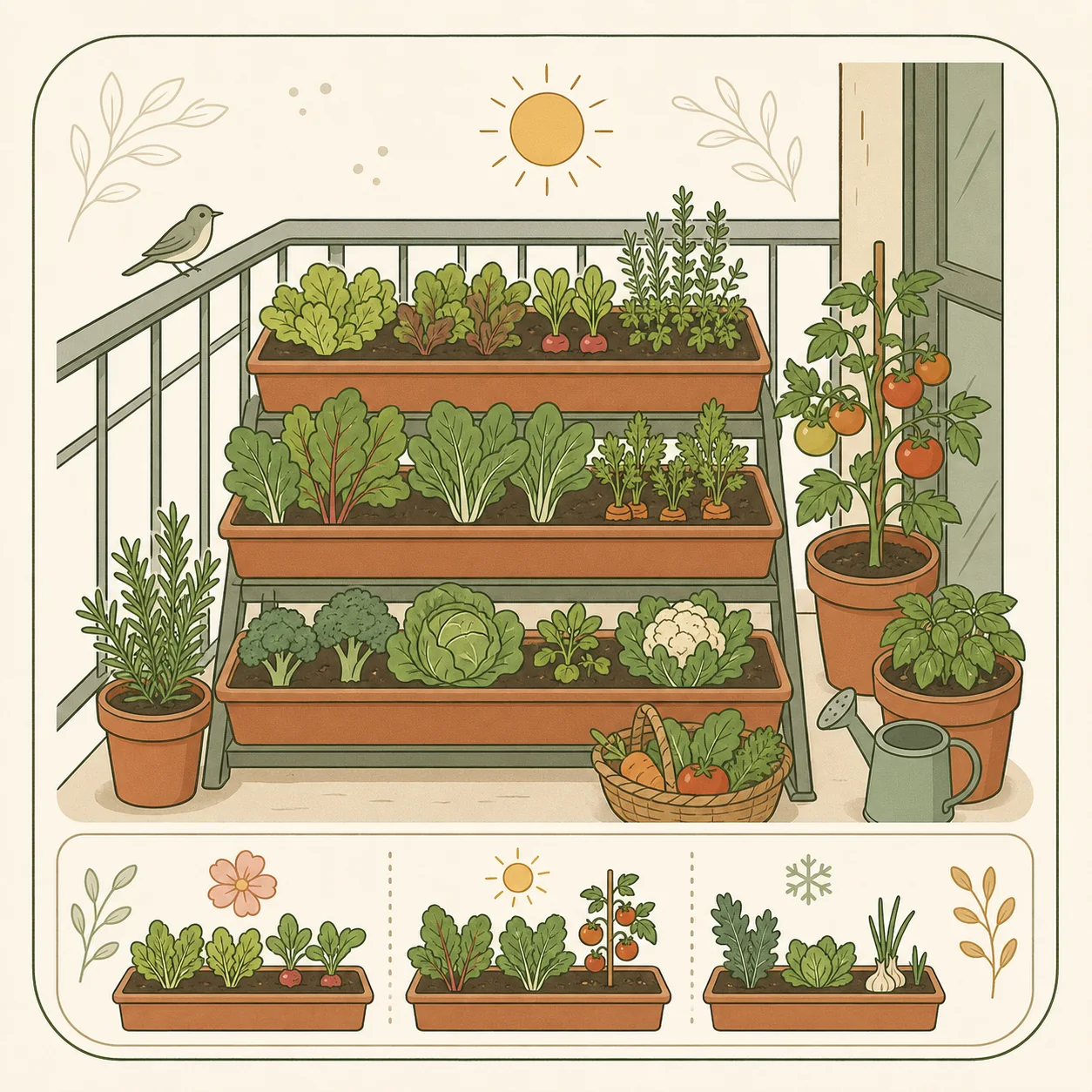
Balcony vegetable garden calendar: what to do each season
A useful balcony calendar is a set of seasonal decisions, not twelve fixed planting lists. Use temperature, light, and container conditions to decide what happens next.