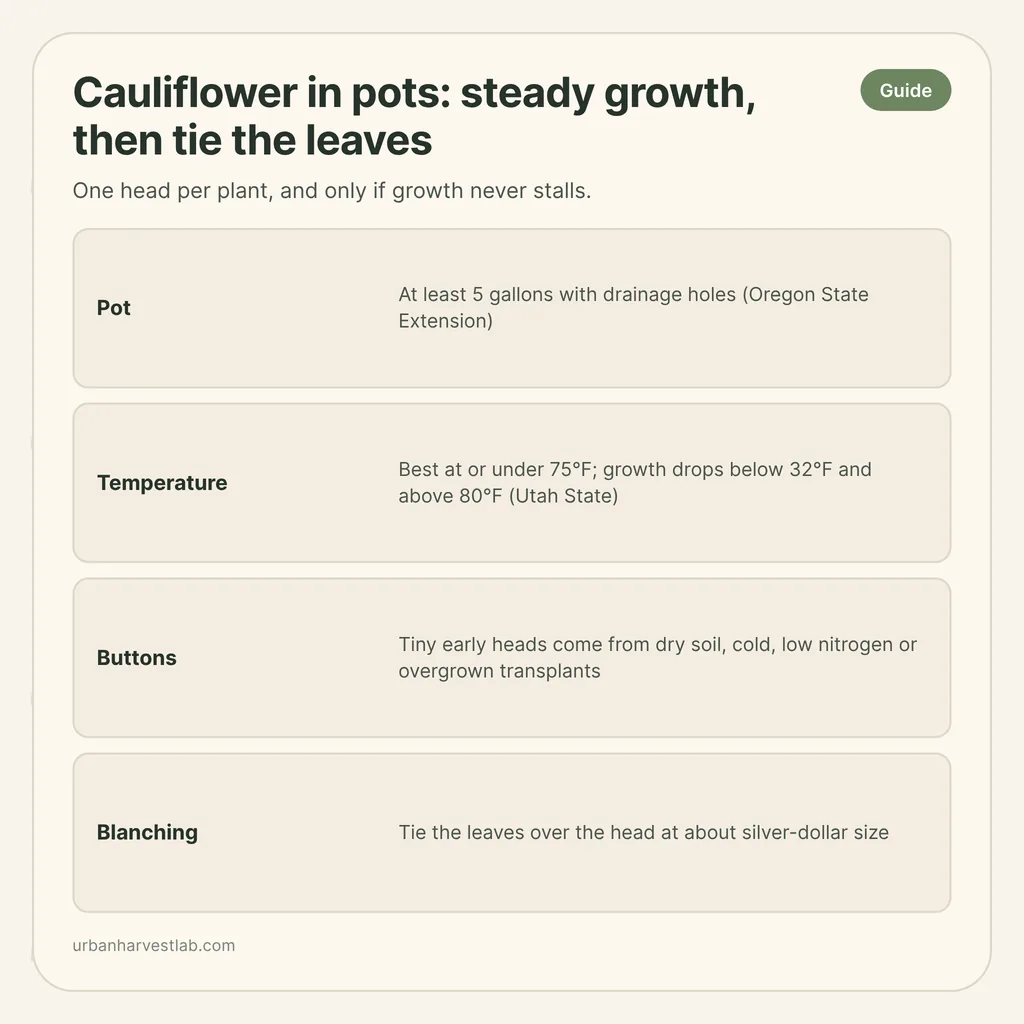
Cauliflower in a pot, stage by stage
| Stage | What to do | Why |
|---|---|---|
| Transplant | Young plants with 4-6 mature leaves, 2-3 weeks before the last spring frost (Utah State, Illinois) | Old or stunted transplants button |
| Growing | Steady water and no check in growth; feed every 3-4 weeks once about 4 inches tall (Oregon State) | Any interruption can abort the head (Illinois) |
| Heading | Tie leaves over the head at about silver-dollar size (Utah State) | Light turns the curd yellow and bitter |
| Harvest | Cut the main stem 7-12 days after blanching starts (Illinois) | Overmature heads turn coarse and ricey |
Cauliflower gives one head per plant, and only if growth keeps going without a check: Oregon State Extension says to use a container of at least 5 gallons with drainage holes, so set young transplants out in cool weather and keep the water and feeding steady until the head forms. Then tie the outer leaves over the head to keep it white.
Cauliflower asks more of you than its relatives. University of Illinois Extension calls it more difficult to grow than other members of the cabbage family, and more sensitive to cold than they are. Broccoli in containers forgives a bit more and keeps giving side shoots after the first cut. Cauliflower makes one head, once, and the head only forms if growth keeps going. For the other cabbage-family crops, see cabbage in pots and kohlrabi.
Pot and spacing
Oregon State Extension says to choose small, compact varieties and use at least a 5-gallon container with holes in the bottom for drainage. A bigger pot holds moisture longer between waterings, which matters for a crop that cannot cope with swings.
These are garden row spacings, not container figures, but they give a sense of how much room a plant claims: Utah State Extension spaces plants 12 to 18 inches apart, and Illinois Extension 18 to 24 inches, with the wider spacing for fall plantings. For per-plant container sizing across crops, see how many plants per container. Giving each cauliflower its own pot keeps it inside that footprint.
Use a fertile, well-drained mix. For general pot sizing and what the gallon numbers mean, see nursery pot sizes explained.
Fit it between frost and heat
Utah State Extension says cauliflower grows best when temperatures do not exceed 75°F, and that both low (32°F) and high (above 80°F) temperatures decrease plant growth, lower yields and reduce head quality. Oregon State says to plan for a harvest in spring or fall. The window is narrow. Illinois Extension notes that the aim is to mature before summer heat without being injured by the cold, and that in some seasons that compromise may be almost impossible.
Spring. Illinois says not to transplant sooner than 2 to 3 weeks before the average frost-free date; Utah State allows 1 to 2 weeks before the last frost-free date. Find yours with the frost date guide. A season-extension cover helps in a cold snap, and Utah State notes that fabric covers protect transplants from frost and from insects.
Fall. Illinois transplants autumn cauliflower about when fall cabbage goes in, around mid to late July in its region. Utah State says to pick early-maturing cultivars and plant 50 to 75 days before the expected maturity date, which it puts at 1 to 2 weeks after the first fall frost. The fall planting calculator does that count-back from your own frost date.
Start with transplants. Illinois says to use young, active transplants and to avoid stunted plants held too long in flats; Utah State wants 4 to 6 mature leaves and a developed root system. Harden them off first with the hardening-off plan.
Why cauliflower buttons
Buttoning is a head the size of a button, formed soon after planting. Utah State says it often occurs in plants exposed to dry soils, low temperatures, low nitrogen or other shocks at planting, and that larger, more mature transplants are more prone to it. Illinois frames the same thing more broadly: any interruption, whether extreme cold, heat, drought or plant damage, can abort development of the edible portion, and growth can stop from plants being held too long before transplanting or from too much chilling.
In a pot, that translates into a few habits:
- Plant a young transplant, not an overgrown one.
- Do not put it out on a night forecast near freezing without a cover.
- Do not let the mix dry out, even once.
- Start feeding on time.
Water and feed
Illinois says cauliflower needs a consistent and ample supply of soil moisture. Utah State adds that hot weather and thirst give poorer, more open heads, and that water stress and high temperatures can make leaves grow up through the head. Its garden figure of 1 to 2 inches per week does not convert to a pot; check the mix by touch, as in watering container vegetables.
Oregon State suggests a balanced fertilizer every 3 to 4 weeks once the plant is about 4 inches tall, following the package directions. Illinois side-dresses nitrogen when plants are half grown. For rates in a pot, use the label and the vegetable feeding schedule.
Utah State applies organic mulch above 80°F to cool the soil and reduce water stress; straw or shredded newspaper on the pot surface does that job.
Blanch the head
The exposed head turns yellow and bitter in light. Utah State says to tie the leaves together with strong twine or rubber bands when the heads are the size of silver dollars; this keeps the sun off the head and helps whiten it. Illinois gives a different cue, 2 to 3 inches of white curd at the growing point, and says tying protects the head from sunburn, from turning green and from an off-flavor. Gather the outer leaves loosely over the centre and tie them above the head, with room for it to swell.
Some varieties do the work themselves. Illinois names Self-Blanche, and says several others curl their leaves over the head, especially in fall; under cool conditions tying is unnecessary. Check the seed packet or plant tag. Illinois also says purple cauliflower is actually a type of broccoli and does not require blanching.
Harvest
Illinois says heads are ready to cut 7 to 12 days after blanching begins, at 6 to 8 inches across. Utah State gives 6 to 12 inches, compact and white. Cut the main stem and leave a few green outer leaves attached to protect the head. Do not wait: overmature heads go coarse and “ricey,” and once individual florets show, Illinois says quality deteriorates rapidly. Utah State stores heads for 3 weeks at 32°F.
Because cauliflower does not ordinarily develop side shoots, Illinois says the plant can be composted after the head is cut. Oregon State says not to plant cole crops in the same place more than once every 3 or 4 years, so refresh the mix or change crops in that pot.
Problems to expect
- Caterpillars. Utah State says cabbage worms and loopers chew holes in the leaves and hide in the head. Oregon State advises plant covers early in the season. Identification is in cabbage worms on kale; cauliflower gets the same pests.
- Loose, ricey or leafy heads. Illinois links leaves in the head and loose, smaller curds to maturing in hot weather. Time the harvest for cooler weeks.
- Brown spots and a hollow stem. Utah State attributes brown spotting on the head and a hollow, discoloured stem to boron deficiency, which it says may occur in high-pH soils or where plants were water stressed.
- Browning curd. Illinois says this is downy mildew, brought on by wet conditions, and that good drainage and air movement lower the risk.
Sources
Around cool-season brassicas in pots
The neighbouring cabbage-family pages, plus timing, feeding and pests for vegetables in containers.
Common questions
Can you grow cauliflower in pots?
Yes. Oregon State Extension recommends a container of at least 5 gallons with drainage holes and small, compact varieties. University of Illinois Extension calls cauliflower more difficult than other cabbage-family crops, because any interruption in growth can abort the head, so a pot that dries out or overheats is the main risk.
Why did my cauliflower make a tiny head?
That is buttoning. Utah State Extension says it often occurs in plants exposed to dry soils, low temperatures, low nitrogen or other shocks at planting, and that larger, older transplants are more prone to it. Choose young transplants with 4 to 6 mature leaves.
How do you keep cauliflower white?
Blanch it. Utah State Extension says to tie the leaves together with strong twine or rubber bands when the head is the size of a silver dollar. University of Illinois Extension says to do it when 2 to 3 inches of white curd show, and notes that some self-blanching types curl their own leaves over the head under cool conditions.
Will cauliflower grow back after cutting the head?
Not in the usual way. University of Illinois Extension says cauliflower does not ordinarily develop side shoots, so the plant can be composted once the head is cut. Broccoli is the cabbage-family crop that keeps producing side shoots.
Related guides
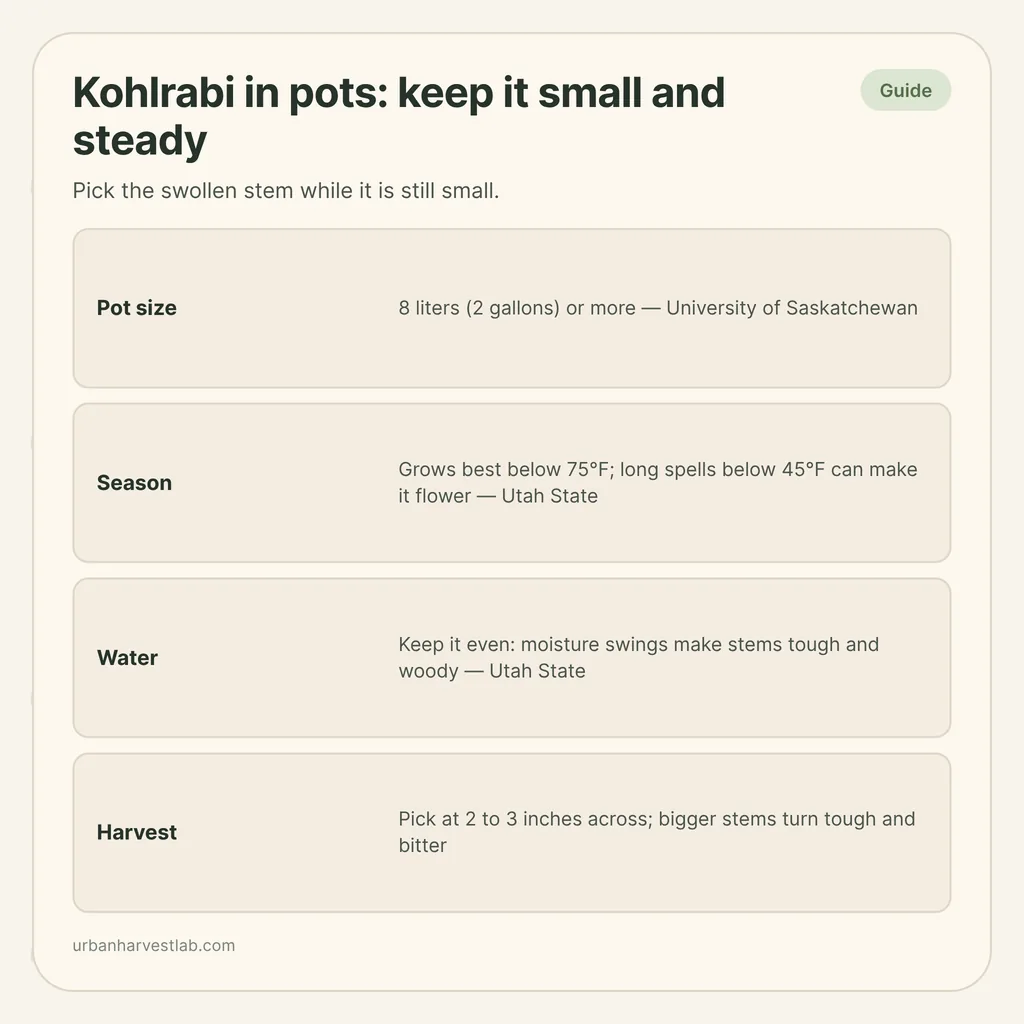
How to grow kohlrabi in containers: pot size, timing and when to pick
Kohlrabi is a fast cool-season crop that suits a deep pot if you keep the water steady and pick the swollen stem while it is still small.
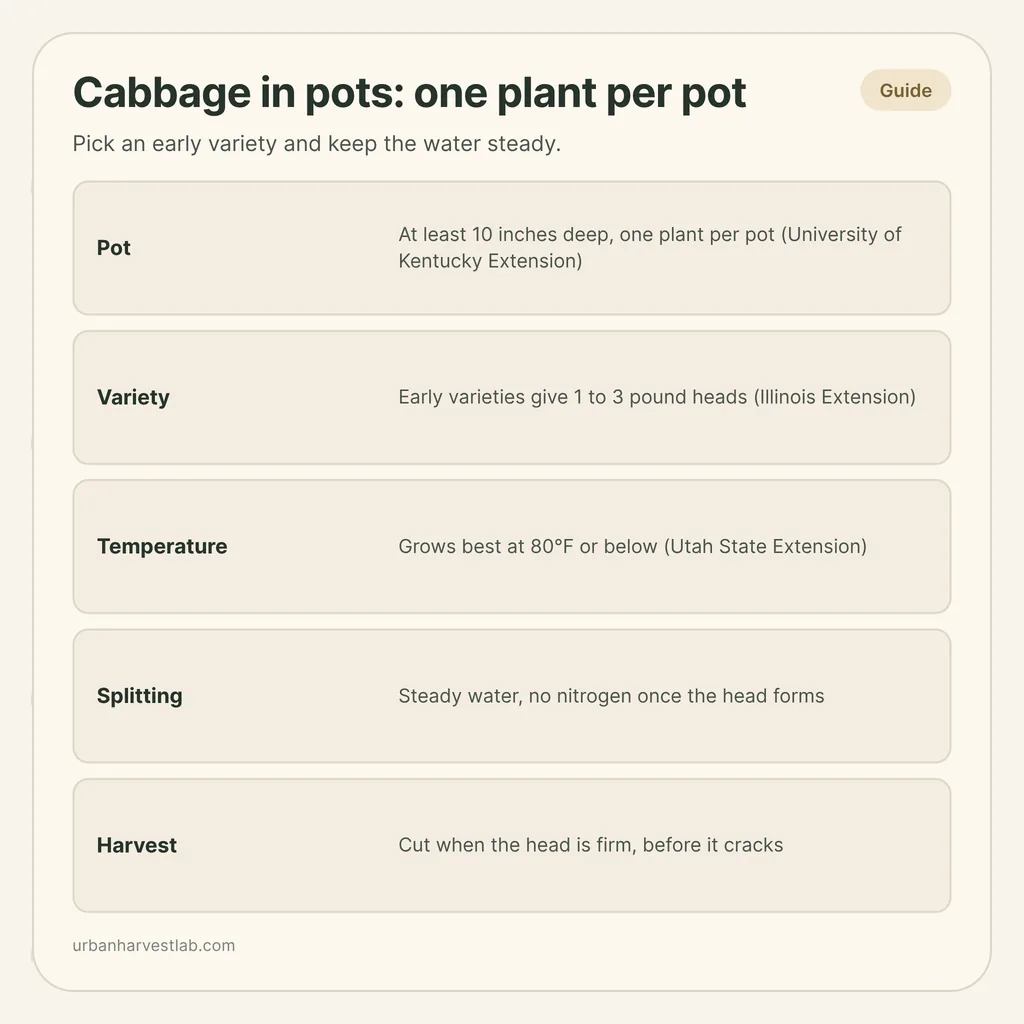
How to grow cabbage in pots: small varieties, split heads and timing
Cabbage works on a balcony if you give each plant its own pot, choose an early variety with a 1 to 3 pound head, and keep the water steady so the head does not split.
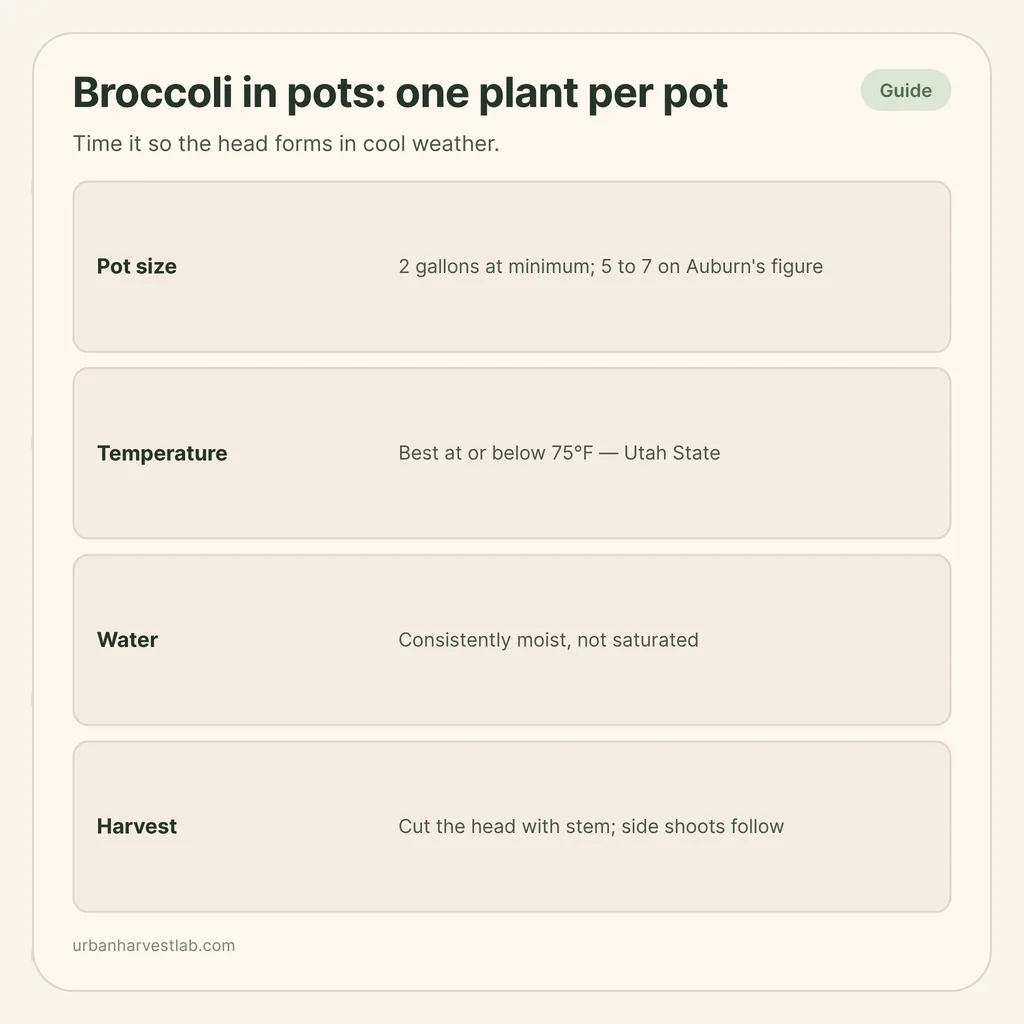
How to grow broccoli in pots: pot size, cool weather and side shoots
Broccoli works on a balcony if you give each plant its own pot, aim for cool weather, and cut the main head so the side shoots can follow.