Kohlrabi varieties named by extension services, by days to harvest
| Variety | Days | Source |
|---|---|---|
| Quickstar (green skin, or purple per Utah State) | 37-40 | University of Delaware, Utah State |
| Grand Duke | 50 | Utah State |
| Delicacy White | 60 | University of Delaware |
| White Vienna or Purple Vienna | 60 | Utah State |
| Delicacy Purple | 65 | University of Delaware |
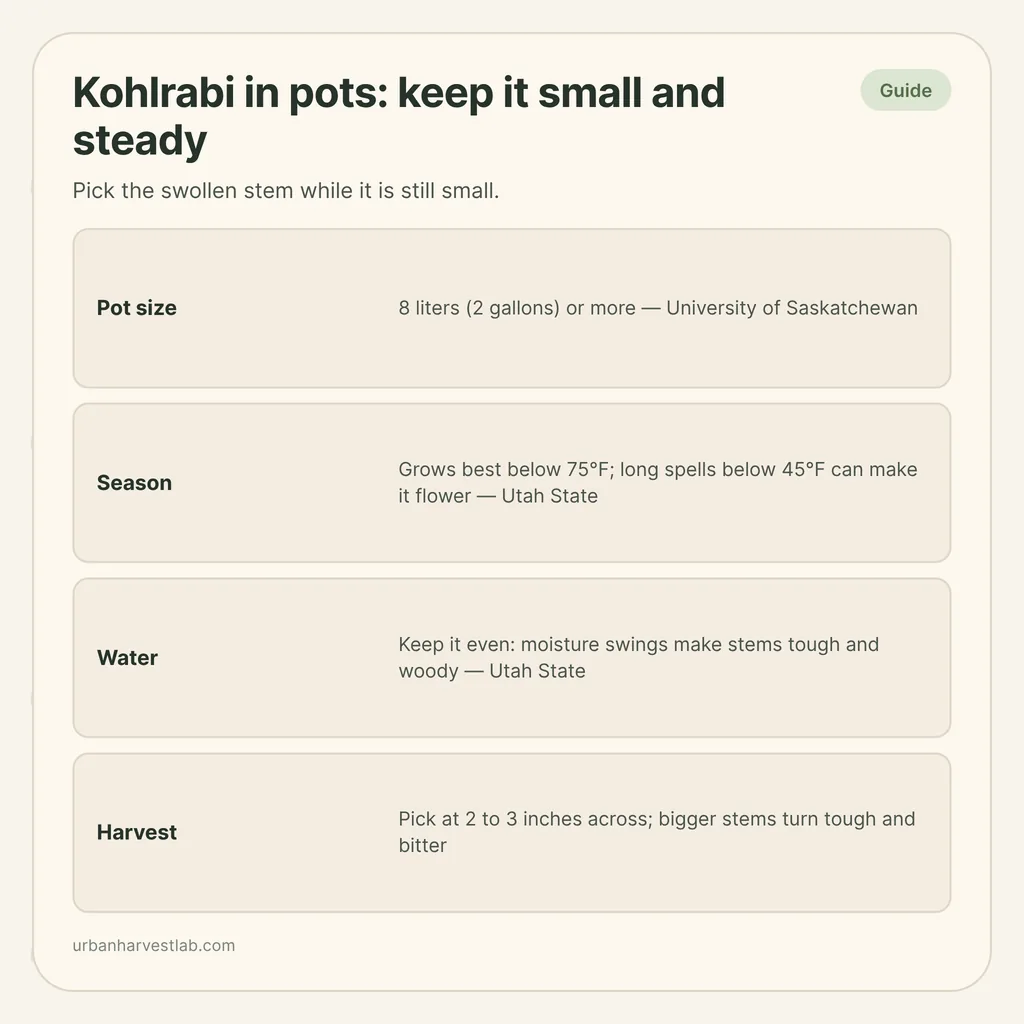
To grow kohlrabi in a container, use a pot of at least 8 liters (2 gallons, per the University of Saskatchewan), sow in cool weather, keep the soil evenly moist and pick the swollen stem when it is 2 to 3 inches across (Iowa State Extension). It is one of the quickest brassicas you can grow: the University of Saskatchewan gives 38 to 55 days to maturity and Utah State lists varieties at 40 to 60 days. Broccoli and cabbage each give a head or florets from a larger plant; kohlrabi gives a round, crisp stem.
What you eat is not a root. Illinois Extension describes it as a rounded, enlarged stem section growing just above the soil line, with the leaves standing out from it like spokes.
Is kohlrabi worth a pot?
Yes, with one caveat. The University of Saskatchewan says kohlrabi could be grown in a container outdoors, and that it is best grown in the ground, noting that it is not typically suitable for most container methods. Its advice is to choose a large container and, if space is tight, to look at smaller or leafy brassicas such as kale, bok choy or radishes instead. Take that as a reason to size up, not to skip the crop.
If you want leaves for weeks rather than a single stem, kale in containers or bok choy fit better. Kohlrabi suits you if you want a fast, crunchy crop from a pot you can fill and empty within a cool season.
Pot size and spacing
The University of Saskatchewan says to choose a container of at least 8 liters (2 gallons) or larger. Pick one with drainage holes and fill it with a standard potting mix.
For spacing, Utah State Extension puts kohlrabi 6 inches apart in the row, and Iowa State says to thin to 6 to 8 inches. Illinois Extension is looser and thins to 2 to 5 inches. All three figures describe garden rows, not pots. By Utah State’s 6 inches, a pot about 12 inches across has room for two plants comfortably, or three set in a triangle close to the rim; that count is our arithmetic, not a published figure. The University of Saskatchewan says thin stems can be a result of plants spaced too close together.
Sow seed ¼ to ½ inch deep (Utah State and Illinois Extension). Utah State thins to the final stand when plants have 3 to 4 true leaves, and Iowa State thins at the first or second set. For how to cut and what to keep, see thinning seedlings in pots. Transplants work too, and they give an earlier harvest: Utah State wants 4 to 6 mature leaves and a well-developed root system, and says that takes generally 5 to 6 weeks from seed. Cover the whole plug with mix when you plant it. The University of Saskatchewan warns that exposed peat or coir acts as a wick and dries out the root ball.
Pick the right season
Kohlrabi is a cool-season crop. Iowa State Extension says cole crops grow best between 60° and 70°F and can withstand light frosts. Utah State is a little more specific: kohlrabi grows best when temperatures do not exceed 75°F, and it calls kohlrabi the least hardy of the cabbage-like vegetables.
Spring. Utah State plants seed or transplants 1 to 2 weeks before the last frost date. Work out that date with the frost date guide and harden off any transplants first. The University of Saskatchewan says to transplant once daytime temperatures reach 10°C and nights stay above -2°C for several nights in a row.
Fall. Utah State says to select early-maturing cultivars and plant 50 days before the anticipated maturity date, which can be timed for 2 to 3 weeks after the first fall frost. A fall pot also dodges the summer heat problem: Utah State says high summer temperatures reduce growth, decrease quality and cause the enlarging stems to become tough and woody, and that in hot areas kohlrabi is best grown as a spring or autumn crop. If you want other fall pots to sit beside it, see salad greens in containers this fall.
The cold side. Utah State says mature plants will flower if average temperatures during growth are less than 45°F. The University of Saskatchewan also says that if temperatures are too cold, kohlrabi may bolt, meaning it sends up a flower stalk. The trigger Utah State names is the average temperature over the growing period, not a single cold night. A season-extension cover helps in an early or late cold week.
Water: keep it steady
Kohlrabi roots are shallow. Iowa State Extension says cole crops have shallow root systems and need weekly irrigation if rain does not provide one inch of water per week; Utah State gives 1 to 2 inches per week and says to water frequently. Those are bed amounts. A pot dries faster, so check it with your finger and use the guidance on watering container vegetables.
Utah State says moisture fluctuations will cause the stems to become tough and woody, and adds to avoid water or fertilizer stress during growth. In a pot, that usually means a mix that dries out completely and then gets drenched. Heat does the same: Utah State says high summer temperatures make the enlarging stems tough and woody, and Iowa State says stems over 3 inches turn tough and woody too. Utah State suggests organic mulch once temperatures pass 80°F, to cool the soil and reduce water stress; on a hot balcony, a layer of straw or shredded newspaper on the pot surface is the pot-sized version of that. The University of Saskatchewan lists too little water, too much heat and freezing temperatures as reasons for thin stems.
For feeding, Utah State applies a nitrogen fertilizer 3 weeks after transplanting or thinning. Utah State gives ½ cup of 21-0-0 per 10 feet of row; there is no pot equivalent, so dose by your fertilizer’s label and see the container vegetable feeding schedule.
Pests: cover the pot early
Kohlrabi gets the same insects as the rest of the cabbage family. Illinois Extension names imported cabbageworm, cabbage looper and diamondback moth as common insect pests, and says cabbage maggots can feed on the roots. Utah State adds aphids and flea beetles, and says flea beetles can reduce plant stands or kill seedlings.
Utah State says fabric covers protect seedlings and transplants from frosts and insect pests. The University of Saskatchewan says to install row covers very soon after planting, long before the insects arrive. Lay a cover over the pot on planting day and weigh the edges down. For finding and dealing with caterpillars, see green caterpillars on kale, and for the tiny shot holes in young leaves, flea beetles on container vegetables.
When to pick, and what to do with it
Illinois Extension says kohlrabi has its mildest and best flavor when small, and that many gardeners let it grow too large. It says to begin harvesting when the first stems are about 1 inch across and to continue until they are 2 to 3 inches. Iowa State and Utah State both give 2 to 3 inches too, and Iowa State says anything over 3 inches will be tough, woody and bitter. A 3-inch stem is a little bigger than a tennis ball; Illinois’s 1-inch starting size is smaller than a golf ball.
Cut at soil level, or pull the plant and trim the leaves and roots. Utah State says to peel the outer skin, which is the tougher part, before eating the inner flesh raw or cooked.
Even an overgrown one is not a total loss: Illinois says it can still have tender, tasty tissue at the top where the youngest leaves emerge.
Iowa State keeps trimmed kohlrabi in perforated plastic bags in the refrigerator for up to 3 weeks; Utah State says 2 to 3 weeks at 32°F and 95% relative humidity; Illinois says about two weeks at 32 to 40°F.
Because it matures so fast, it rewards staggering. Illinois Extension suggests small plantings every 2 to 3 weeks for continuous spring and early summer harvest. A second pot started a few weeks after the first does the same in a container, and succession planting in containers shows how to plan it.
Sources
Around cool-season crops in pots
The neighbouring brassica pages, plus timing and watering for vegetables in containers.
Common questions
How big a pot does kohlrabi need?
The University of Saskatchewan says to choose a large container, at least 8 liters (2 gallons) or larger. Utah State Extension spaces plants 6 inches apart in the row, so a pot about 12 inches across has room for two plants comfortably, or three set in a triangle close to the rim, by that spacing. That plant count is our arithmetic from garden spacing, not a published pot figure.
How long does kohlrabi take to grow in a pot?
It depends on the variety. Utah State Extension lists Quickstar at 40 days, Grand Duke at 50 and White or Purple Vienna at 60. Iowa State Extension says plants are ready 50 to 60 days after sowing, depending on the cultivar, and the University of Saskatchewan gives 38 to 55 days.
How big should kohlrabi be when I pick it?
Iowa State, Utah State and Illinois Extension all put the target at a stem 2 to 3 inches across. Illinois Extension says stems much bigger than 3 inches develop woody fibers, and Iowa State says anything over 3 inches will be tough, woody and bitter. Illinois says you can start picking at about 1 inch.
Can you eat the leaves?
Yes. Utah State Extension says the young leaves can be eaten like cabbage or kale, and Illinois Extension says the leaves may be cooked like other greens. Illinois suggests keeping them in a damp paper towel in a loose plastic bag and using them within three days.
Related guides
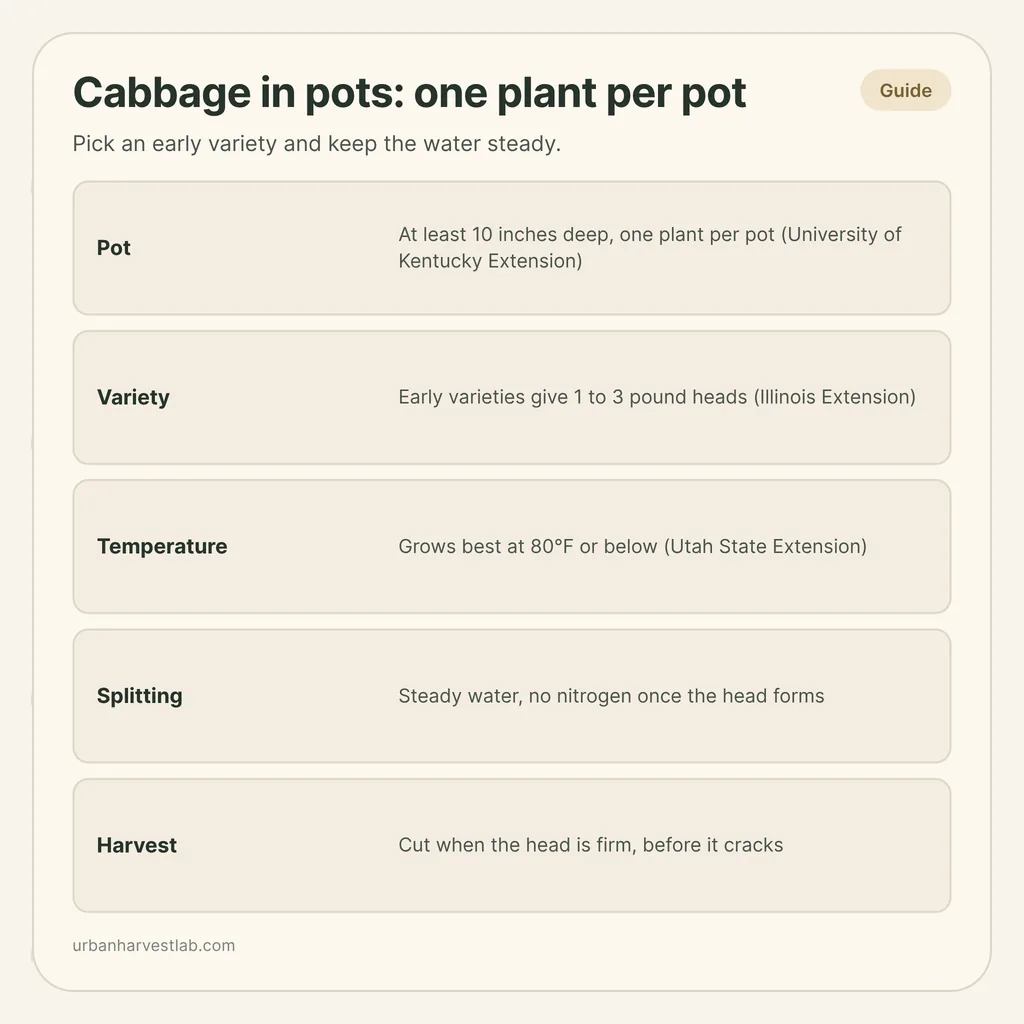
How to grow cabbage in pots: small varieties, split heads and timing
Cabbage works on a balcony if you give each plant its own pot, choose an early variety with a 1 to 3 pound head, and keep the water steady so the head does not split.
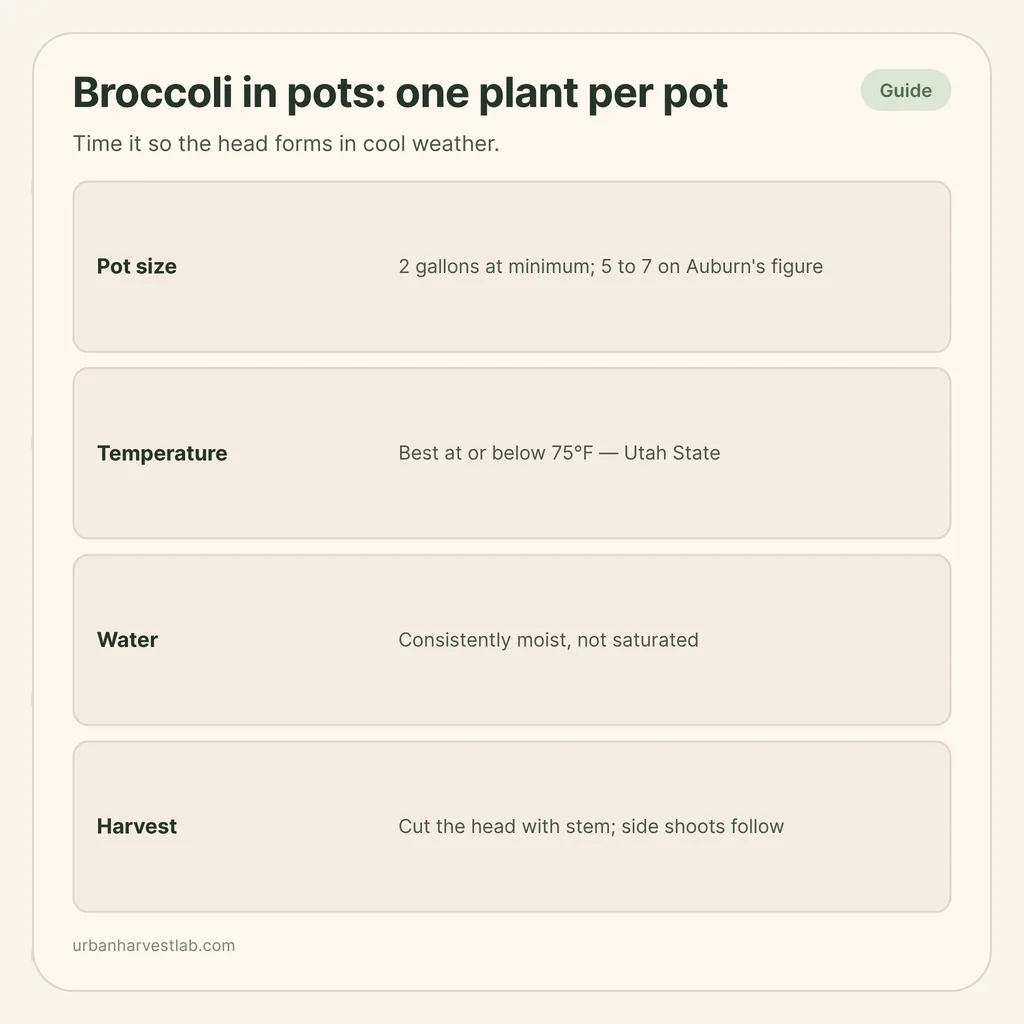
How to grow broccoli in pots: pot size, cool weather and side shoots
Broccoli works on a balcony if you give each plant its own pot, aim for cool weather, and cut the main head so the side shoots can follow.
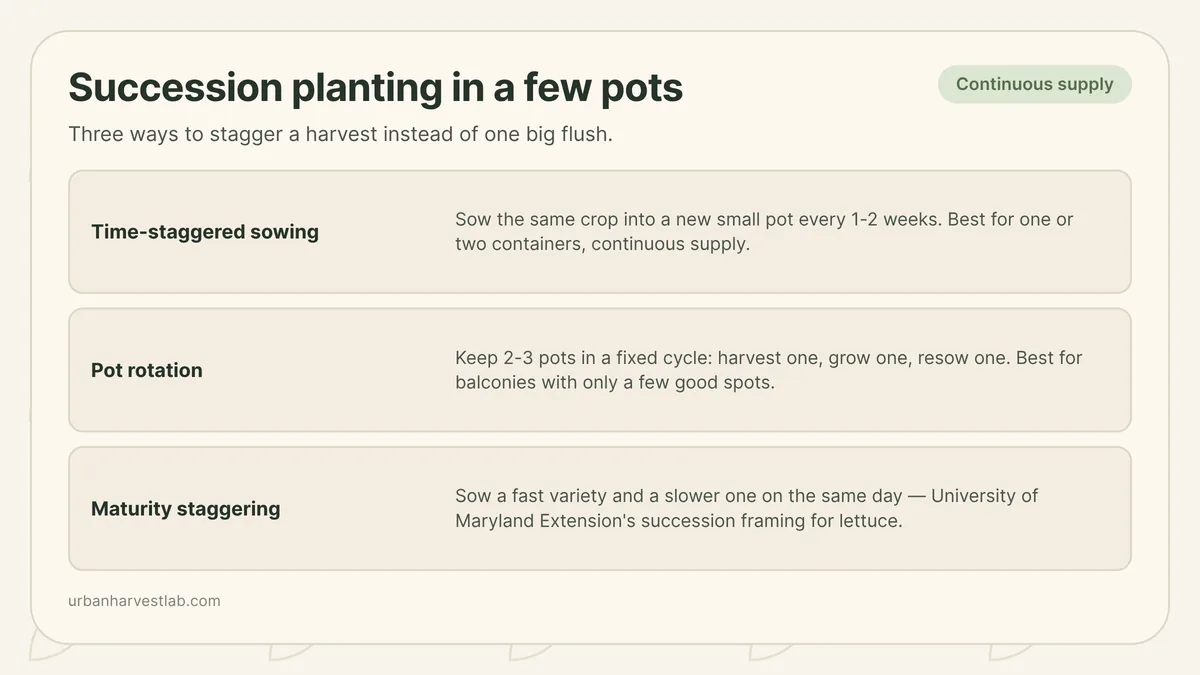
Succession planting in containers: how to stagger a harvest from a few pots
Succession planting in containers is a sowing rhythm: a few pots restarted on a schedule keep producing, where one large planting ripens together and then quits together.